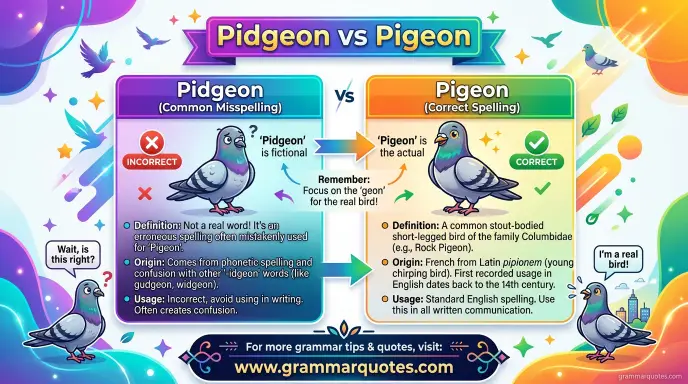
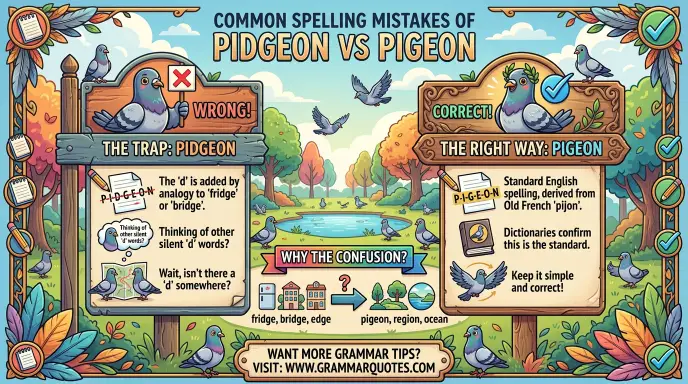
Pigeon is the correct standard English spelling, while pidgeon is a common misspelling of the word for a type of bird. The extra “d” in the incorrect form is easy to add because the word does not sound exactly the way many people expect it to look.
A pigeon is a familiar bird found in cities, parks, gardens, farms, and other places around the world. These birds belong to the dove family and are well known for adapting to urban environments.
The spelling can be confusing because English contains many words with similar letter patterns. When people hear or say the word, they may naturally assume that a “d” belongs between the “i” and “g.” However, standard English does not use that letter.
The correct spelling is:
P I G E O N
The incorrect form is:
P I D G E O N
This guide explains the correct spelling, meaning, pronunciation, origin, common mistakes, British and American usage, everyday examples, and an easy way to remember the word.
Pigeon vs Pidgeon : Quick Answer
Pigeon is the correct spelling.
Pidgeon is generally a misspelling.
Correct examples:
A pigeon was sitting on the roof.
I saw several pigeons in the park.
Incorrect example:
A pidgeon was sitting on the roof.
The main spelling difference is simple:
Pigeon → correct
Pidgeon → incorrect
The word does not contain a “d.”
Definition and Meaning
What is a pigeon?
A pigeon is a bird belonging to the family Columbidae, which also includes doves.
The word can refer to many different birds in this family, although in everyday English it often refers to the familiar birds commonly seen in cities.
Pigeons can have different colors and patterns. Many urban pigeons have gray bodies, darker wings, and iridescent feathers around the neck, but their appearance can vary.
What does pigeon mean in everyday English?
In ordinary conversation, pigeon usually means the bird.
For example:
There is a pigeon on the balcony.
The word can also appear in figurative expressions, literature, and other contexts.
Why Is “Pidgeon” Incorrect?
The main problem is the extra d.
The standard spelling is:
PIGEON
There is no d between the i and g.
A common reason for the mistake is pronunciation. When people say the word quickly, they may imagine a spelling that contains a “d.”
English has many words where pronunciation does not make spelling obvious. This is one of them.
A good way to avoid the mistake is to memorize the word visually:
P I G E O N
How Do You Spell Pigeon?
Break the word into its letters:
P + I + G + E + O + N
That gives:
PIGEON
The incorrect form adds a letter:
P + I + D + G + E + O + N
That creates pidgeon, which is not the standard spelling.
Easy spelling trick
Remember:
Pigeon has “pig” at the beginning.
The first three letters are:
P I G
Then add:
E O N
Together:
PIG + EON = PIGEON
This can make the spelling easier to remember.
The Origin of “Pigeon”
The word has a long history in English and entered the language through Old French forms related to the bird.
Its history is connected with older European words used for pigeons and related birds.
English spelling changed over time, but the modern standard form became pigeon.
This historical development is also one reason the spelling may not seem completely predictable from pronunciation.
Pigeon vs Dove
A common question is if a pigeon is the same as a dove.
Both belong to the same bird family, Columbidae.
In everyday English, however, the words often carry different associations.
Pigeon is frequently used for birds seen in cities and public places.
Dove is often used for smaller or more delicate looking members of the same family and is also common in symbolic or religious contexts.
There is no strict scientific rule saying that every bird called a pigeon must be completely different from every bird called a dove. The common names overlap.
Is Pidgeon a Word?
Pidgeon is not the standard spelling of the bird’s name.
You may encounter it online because people make spelling mistakes, but if you are writing standard English, use:
pigeon
For example:
❌ I saw a pidgeon outside.
✅ I saw a pigeon outside.
Common Spelling Mistakes
1. Adding “d”
❌ Pidgeon
✅ Pigeon
This is the most common error.
2. Writing “pigion”
Another possible mistake is:
❌ Pigion
The correct spelling is:
✅ Pigeon
3. Writing “pigeon” with the wrong vowel order
The letters e o appear after g.
Correct:
pigeon
Not:
pigean
4. Confusing the singular and plural
The singular is:
pigeon
The plural is:
pigeons
Example:
One pigeon is on the wall.
Three pigeons are on the wall.
Pigeon Pronunciation
The word is generally pronounced with two syllables.
Its pronunciation can vary slightly by accent, but the spelling remains the same in standard British and American English.
The main challenge is that the pronunciation does not make every letter obvious. This is why some learners may insert a “d” when spelling it.
When learning the word, focus on both its written form and its spoken form.
British English vs American English
There is no major spelling difference between British and American English.
Both use:
pigeon
Both also use:
pigeons
Examples:
A pigeon landed on the roof.
Several pigeons were in the park.
The misspelling pidgeon is not the standard spelling in either variety.
Pigeon in Everyday Examples
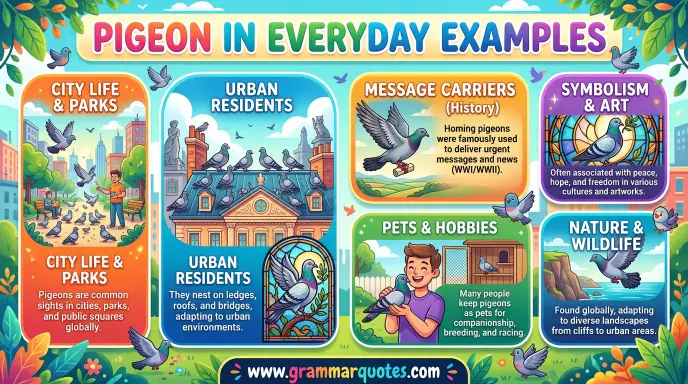
Here are some natural examples:
- A pigeon landed on the balcony.
- I saw a pigeon near the bus stop.
- The children watched the pigeons in the park.
- Several pigeons were sitting on the roof.
- A pigeon flew across the street.
- The bird walked along the sidewalk.
- We saw pigeons near the old building.
- The pigeon quickly flew away.
- A gray pigeon was sitting on the wall.
- The park was full of pigeons.
These examples show how the word is normally used in everyday English.
Pigeon as a Verb
Although the noun is much more common, pigeon can also appear in certain verb related expressions.
For example, pigeonhole is a common verb meaning to classify or place someone or something into a narrow category.
Example:
Don’t pigeonhole people based on one characteristic.
This use is related to the idea of putting something into a small compartment or category.
The standalone noun pigeon is still most commonly associated with the bird.
“Pigeonhole” and the Spelling
The word pigeonhole is worth mentioning because it contains the correct spelling.
It means:
- A small compartment for storing things
- A narrow category or classification
For example:
The letters were placed in a pigeonhole.
The word combines pigeon with hole.
This can provide another useful spelling reminder:
pigeon + hole = pigeonhole
Not pidgeonhole.
Why Do People Write “Pidgeon”?
The spelling mistake usually comes from the relationship between pronunciation and spelling.
English spelling is not always perfectly phonetic. A speaker may hear a sound and mentally add a letter that seems appropriate.
The combination of g, e, and o can also make the spelling less intuitive.
People may therefore write the form they expect rather than the standard dictionary spelling.
This is a spelling problem rather than a difference in meaning.
Pigeon in Formal Writing
Use pigeon in all standard forms of writing when referring to the bird.
This includes:
- School assignments
- Essays
- Articles
- Reports
- Emails
- News writing
- Scientific writing
- Websites
For example:
The researchers observed several pigeons in the urban environment.
Using the standard spelling helps make your writing clear and professional.
How to Remember the Correct Spelling
Try this simple trick:
Remember “PIG”
The word starts with:
PIG
Then continue:
PIG + EON
= PIGEON
There is no D.
Another memory sentence is:
A pigeon has no D in its spelling.
This short reminder can help prevent the most common error.
Pigeon vs Pigeons
The singular and plural forms are straightforward.
| Singular | Plural |
| Pigeon | Pigeons |
Examples:
I saw one pigeon.
I saw five pigeons.
Simply add s to form the plural.
Dove or Pigeon
| Feature | Pigeon | Dove |
| Bird family | Columbidae | Columbidae |
| Everyday use | Often urban birds | Often smaller or symbolic birds |
| Scientific distinction | Common name category | Common name category |
| Spelling | Pigeon | Dove |
| Plural | Pigeons | Doves |
| Same family? | Yes | Yes |
The terms can overlap because common bird names do not always match strict scientific classifications.
Which Spelling Should You Use?
If you mean the bird, use:
pigeon
Do not add a d.
If you are writing a person’s name, business name, place name, or another proper noun that happens to contain a different spelling, follow that specific name.
For the ordinary bird, however, pigeon is the standard choice.
Easy Memory Trick
Use the three step rule:
1. Start with PIG.
2. Add EON.
3. Never add D.
So:
PIG + EON = PIGEON
This is one of the easiest ways to remember the spelling.
Comparison Table
| Feature | Pigeon | Pidgeon |
| Standard spelling | Yes | No |
| Refers to the bird | Yes | Intended meaning, but misspelled |
| Contains D | No | Yes |
| Singular | Pigeon | — |
| Plural | Pigeons | — |
| Used in British English | Yes | No |
| Used in American English | Yes | No |
| Suitable for formal writing | Yes | No |
Google Trends & Usage
Searches for spelling pairs like this often happen when people are unsure about an unusual letter pattern.
The word pigeon is widely used because pigeons are familiar birds in cities, parks, buildings, and other environments. People may also search the spelling when writing school assignments, articles, animal descriptions, or social media posts.
Search interest can vary by country and time. A spelling comparison is therefore more useful for understanding the language question than for judging which form is “more popular.”
For an English learning website, this word is particularly useful because it demonstrates how pronunciation and spelling do not always match perfectly.
People Also Ask Questions
1. What is the correct spelling, pidgeon or pigeon?
Pigeon is the correct standard spelling.
2. Is pidgeon a correct spelling?
No. It is generally a misspelling of pigeon.
3. Why is pigeon spelled without a d?
The standard English spelling developed historically as pigeon, without the extra letter.
4. How do you spell pigeon?
It is spelled P I G E O N.
5. What is the plural of pigeon?
The plural is pigeons.
6. Is pigeon a bird?
Yes. A pigeon is a bird in the family Columbidae.
7. Are pigeons and doves related?
Yes. Both belong to the family Columbidae.
8. Is pigeon spelled differently in British English?
No. British English uses pigeon.
9. Is pigeon spelled differently in American English?
No. American English also uses pigeon.
10. How can I remember the spelling?
Remember PIG + EON and do not add a D.
FAQs
Is pigeon the correct spelling?
Yes. Pigeon is the standard English spelling.
Why do people spell it pidgeon?
The extra d is likely influenced by how people expect the word to look or sound.
What is one pigeon called?
One bird is a pigeon.
What is the plural of pigeon?
The plural is pigeons.
Are pigeon and dove the same?
They are both members of the same bird family, although everyday English often uses the two names differently.
Can pigeon be used in formal writing?
Yes. It is the standard spelling and is appropriate in formal writing.
Does British English use pigeon?
Yes. The spelling is pigeon in both British and American English.
Final Comparison
| Question | Answer |
| Correct spelling | Pigeon |
| Common misspelling | Pidgeon |
| Is it a bird? | Yes |
| Family | Columbidae |
| Singular | Pigeon |
| Plural | Pigeons |
| Has a “d”? | No |
| British spelling | Pigeon |
| American spelling | Pigeon |
| Easy memory trick | PIG + EON |
Conclusion
Pigeon is the correct standard English spelling for the bird, while pidgeon is a common spelling mistake. The main reason for the confusion is that the word’s pronunciation does not make its spelling completely obvious.
The easiest way to remember the correct form is to break it into two parts:
PIG + EON = PIGEON
Most importantly, there is no D in the standard spelling.
The word is used in both British and American English, and its plural form is simple: pigeons. It can refer to the familiar birds commonly seen in cities, parks, buildings, and other environments.
If you are writing an article, school assignment, email, report, or social media post, choose pigeon. Once you remember the “PIG + EON” trick, the spelling becomes much easier to recall.
Discover More Articles!
Target or Walmart: What Is the Difference?(2026)
Keeped or Kept: Common Grammar Mistake Explained(2026)
Dublin or Belfast: Which City Is Better?

Ethan Parker is an English-language writer known for his interest in words, language, and clear communication. His work focuses on making everyday English easier to understand through simple explanations and practical examples.