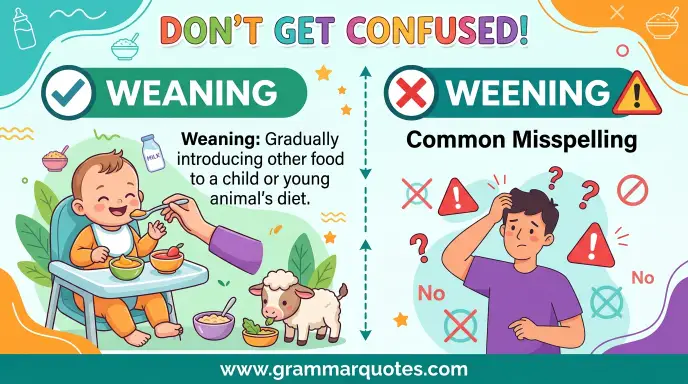
Weaning is the standard modern spelling when you mean gradually moving a baby or young animal away from milk, or slowly reducing dependence on something. Weening is much less common and is generally not the word you want in this context.
The confusion comes from the fact that both forms look almost identical. Only one letter separates them, but they come from different words. Weaning comes from the verb wean, while weening comes from the much rarer verb ween.
The word wean is familiar in modern English. It is commonly used when discussing breastfeeding, baby food, animal care, habits, and dependence on medicines or other things. By contrast, ween is an old fashioned verb meaning to think, believe, or suppose.
Knowing the difference can help you avoid an easy spelling mistake. It is especially useful when writing about babies, parenting, animals, health, or gradual changes in habits.
This guide explains both words, their meanings, origins, British and American usage, common mistakes, examples, and when to use each form.
Weening or Weaning : Quick Answer
Weaning is the correct choice when you mean gradually stopping milk feeding or reducing dependence on something.
Weening is a rare form related to the verb ween, which historically meant to think, believe, or suppose.
| Word | Meaning | Modern usage |
| Weaning | Gradually stopping milk feeding or reducing dependence | Common |
| Weening | A form related to the old verb ween | Very rare |
Simple Rule
If you are talking about:
- Breastfeeding
- Baby food
- Milk
- A young animal
- Reducing dependence
- Gradually stopping something
use weaning.
If you are reading an old literary text where ween means “think” or “believe,” a form such as weening may appear.
Definition and Meaning
What Does Weaning Mean?
Weaning is the process of gradually getting a baby or young animal used to food other than milk.
For humans, it often refers to introducing solid foods while reducing dependence on breast milk or formula.
The term can also be used more broadly.
For example:
He is slowly weaning himself off social media.
Here, it means gradually reducing dependence on something.
What Does Weening Mean?
Weening is connected with the old verb ween.
Ween means to think, believe, or suppose. It is rarely used in everyday modern English.
For example, older writing may use ween where modern English would use think.
Because the word is uncommon today, weening is not normally used when discussing breastfeeding or gradually stopping a habit.
Wean vs Ween
The easiest way to understand the spelling is to look at the base verbs.
Wean
Wean means to gradually reduce dependence on something.
Examples:
- Wean a baby from milk.
- Wean a puppy from its mother.
- Wean someone off a habit.
Its ing form is:
wean → weaning
Ween
Ween is an old or literary verb meaning to think, believe, or suppose.
Its ing form is:
ween → weening
These two verbs are different even though their spellings are very similar.
The Origin of Weaning
The verb wean has Old English roots. Its early meaning was connected with getting a child accustomed to food other than breast milk.
Over time, the meaning became broader.
Modern English can use the word for gradually reducing someone’s dependence on many things, not just milk.
This is why you may see it in phrases involving:
- Food
- Breastfeeding
- Habits
- Medication
- Technology
- Other forms of dependence
The basic idea remains the same: a gradual move away from something.
The Origin of Ween
Ween also has Old English roots, but it developed with a different meaning.
Historically, it meant to think, expect, believe, or suppose.
The word gradually became uncommon as everyday English changed. Modern speakers normally use words such as think, believe, or suppose instead.
Because of this history, the two spellings should not be treated as alternative forms of the same word.
British English vs American English
There is no important British American spelling difference between the standard modern form.
Both varieties use weaning when discussing the process of gradually moving away from milk or reducing dependence.
| Meaning | British English | American English |
| Moving a baby away from milk | weaning | weaning |
| Introducing other foods | weaning | weaning |
| Reducing dependence | weaning | weaning |
| Historical “think/believe” verb | ween | ween |
| Common modern form | weaning | weaning |
So, the choice is not about British versus American spelling. It is about which word you actually mean.
Which Spelling Should You Use?
For almost all modern situations involving babies, animals, habits, or dependence, choose weaning.
Use Weaning When Talking About:
Babies
The parents started the weaning process.
Animals
The puppies are ready for weaning.
Habits
He is gradually weaning himself off social media.
Medication
The doctor discussed a gradual plan for reducing the medicine.
In medical situations, changes to medication should always follow professional advice.
Use Weening Only in a Historical Context
If you are studying old English, historical literature, or a text that uses ween, the related form may appear.
In ordinary modern writing, however, this is not the spelling you normally need.
Common Spelling Mistakes
1. Writing Weening for Baby Feeding
❌ The baby is weening from breast milk.
✅ The baby is weaning from breast milk.
2. Confusing Wean and Ween
These words have different meanings.
Wean = gradually reduce dependence.
Ween = think or believe, mainly in old or literary usage.
3. Assuming They Are Two Spellings of One Word
They are not simply British and American versions.
They come from different verbs.
4. Using the Rare Form in Everyday Writing
If you are writing a parenting article, school assignment, email, or general explanation about breastfeeding, weaning is the natural choice.
Weaning in Everyday Examples
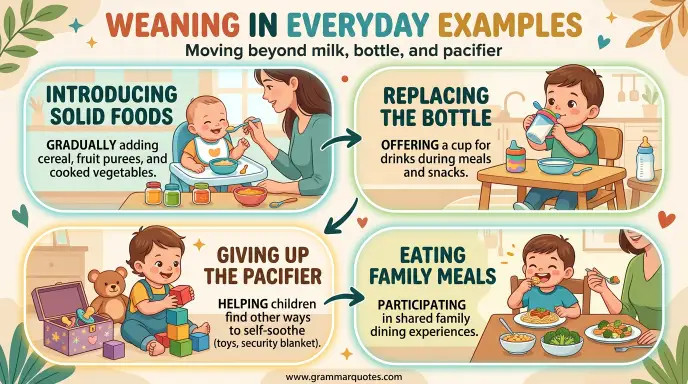
Here are some natural examples:
- The baby is beginning the weaning process.
- Her doctor explained how to introduce new foods.
- The puppies are being weaned from their mother.
- He is slowly weaning himself off the habit.
- The farmer started weaning the young animals.
- The child is moving from milk to solid foods.
- She is gradually reducing her dependence on social media.
These examples all describe a gradual change or reduction.
Ween in Historical Examples
The verb ween is uncommon today, but it can appear in older writing.
A historical sentence might use:
I ween he knows the truth.
In modern English, a writer would usually say:
I think he knows the truth.
This difference explains why the form can sometimes appear in older books even though most modern readers rarely use it.
Weening or Weaning: Comparison Table
| Feature | Weening | Weaning |
| Base verb | Ween | Wean |
| Main meaning | Think or believe | Gradually reduce dependence |
| Common today | No | Yes |
| Used for breastfeeding | No | Yes |
| Used for baby food | No | Yes |
| Used for animals | Not in the modern sense | Yes |
| Historical usage | Yes | Also historically established |
| British spelling | Rare | Standard |
| American spelling | Rare | Standard |
Why Is This Confusion So Common?
The confusion is understandable because the words are almost identical.
There is only one letter difference:
WEENING
WEANING
The meanings, however, are not interchangeable.
Another reason is that English has many words with similar looking spelling patterns. Someone who hears the word without seeing it written may easily choose the wrong vowel.
The best solution is to remember the base word:
WEAN → WEANING
If the sentence is about gradually moving away from milk or dependence, start with wean.
People Also Ask Questions
1. Is it weening or weaning?
For breastfeeding, baby food, animals, or reducing dependence, the correct modern form is weaning.
2. What is the correct spelling for stopping breastfeeding?
The standard spelling is weaning.
3. What does weaning mean?
It means gradually moving away from milk feeding or reducing dependence on something.
4. Is weening a real word?
It can occur as a form related to the old verb ween, but it is extremely uncommon in modern English.
5. What does ween mean?
Ween is an old fashioned verb meaning to think, believe, or suppose.
6. Is weaning only used for babies?
No. It can also refer to young animals and the gradual reduction of dependence on something.
7. What is the difference between wean and ween?
Wean means to gradually reduce dependence, while ween historically means to think or believe.
8. How do you spell weaning?
It is spelled W E A N I N G.
9. Is weaning British or American English?
It is standard in both British and American English.
10. Why do people write weening?
The spelling is easy to confuse with weaning because the two words look and sound very similar.
Conclusion
Weaning is the standard modern spelling when you are talking about gradually moving a baby or young animal away from milk, introducing other foods, or reducing dependence on something. It is used in both British and American English and is common in parenting, animal care, health, and everyday writing.
The less common form weening has a different origin. It comes from the old verb ween, which meant to think, believe, or suppose. Because ween is rarely used today, this form is mostly encountered in historical or literary contexts.
The easiest way to avoid the mistake is to remember the base verb. If the meaning involves gradually reducing dependence, use wean, which gives you weaning. If you are reading an older text and encounter ween, its meaning is related to thinking or believing.
For modern writing, especially when discussing babies or breastfeeding, weaning is almost always the form you need.
Discover More Articles!
Hussle vs Hustle: Which Spelling Is Correct?(2026)
Cancelation or Cancellation: Which Spelling Is Correct?
Pickens vs Sutton: Stats, Matchups, and Value(2026)

Ethan Parker is an English-language writer known for his interest in words, language, and clear communication. His work focuses on making everyday English easier to understand through simple explanations and practical examples.