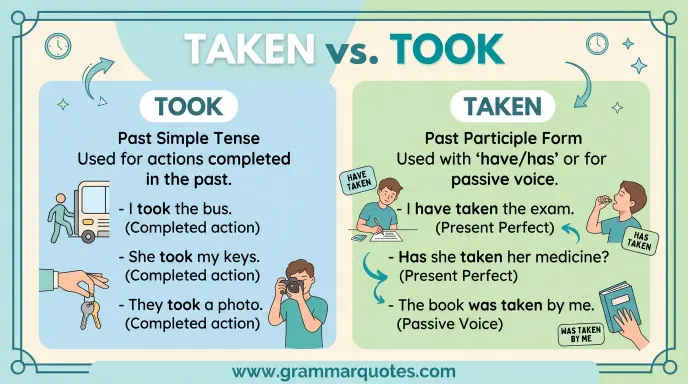
Took and taken are both forms of the verb “take,” but they are used differently: “took” is the simple past tense, while “taken” is the past participle. The correct choice depends on the structure of the sentence.
This difference is important because English uses irregular verbs in ways that do not always follow the usual ed pattern. The verb “take” changes to took in the past and taken as its past participle.
For example, you can say, “I took the bus yesterday,” but you cannot normally replace “took” with “taken” in that sentence. On the other hand, “I have taken the bus before” requires the participle form.
Many learners become confused because both words describe an action that happened in the past. The key is not simply asking if the action happened before now. Instead, look at the grammar around the verb.
This guide explains the meanings, forms, grammar rules, common mistakes, everyday examples, pronunciation, British and American usage, and an easy way to remember which form to use.
Taken or Took : Quick Answer
The basic rule is:
- Took = simple past tense of take
- Taken = past participle of take
Examples with “took”
- I took the train yesterday.
- She took my book.
- They took a taxi last night.
- He took a photo.
Examples with “taken”
- I have taken the train before.
- She has taken my book.
- They had taken a taxi.
- He has taken a photo.
The easiest rule is:
Take → Took → Taken
Definition and Meaning
What Does “Took” Mean?
Took is the simple past form of take. It is used when talking about an action that happened in the past.
Examples:
- I took a break.
- She took the keys.
- We took the wrong road.
- They took the bus.
It can be used with a specific past time:
- I took the test yesterday.
- He took the train last night.
- We took a trip last summer.
What Does “Taken” Mean?
Taken is the past participle of take.
It normally appears with an auxiliary verb such as:
- have
- has
- had
- be
Examples:
- I have taken the test.
- She has taken my phone.
- They had taken the wrong road.
- The book was taken from the table.
The word itself does not normally work as the simple past form.
Take, Took, and Taken
The complete basic verb pattern is:
| Form | Verb |
| Base form | Take |
| Simple past | Took |
| Past participle | Taken |
| Present participle | Taking |
Examples:
- I take the bus every day.
- I took the bus yesterday.
- I have taken the bus many times.
- I am taking the bus now.
Learning all four forms together makes the difference much easier to understand.
When Should You Use “Took”?
Use took when you are describing a completed action in the simple past.
Examples:
- I took a shower this morning.
- She took the money yesterday.
- We took a taxi after dinner.
- He took a picture at the event.
- They took the wrong train.
The simple past often appears with words such as:
- yesterday
- last night
- last week
- two days ago
- in 2025
- this morning
For example:
She took the exam yesterday.
The action happened in the past and is presented as a completed event.
When Should You Use “Taken”?
Use taken when the grammar requires the past participle.
It commonly appears with have, has, or had.
Examples:
- I have taken the exam.
- She has taken the exam.
- We had taken the wrong train.
- They have taken several photos.
It can also appear in passive constructions:
- The book was taken.
- The car was taken to the garage.
- The documents were taken from the office.
So, taken usually needs another grammatical structure around it.
Why Can’t We Say “I Have Took”?
This is one of the most common mistakes.
Incorrect:
- I have took the bus.
Correct:
- I have taken the bus.
Why?
Because have is followed by a past participle, not the simple past form.
The pattern is:
have/has/had + taken
Examples:
- I have taken
- She has taken
- They had taken
Not:
- I have took
- She has took
- They had took
Why Can’t We Say “I Taken the Bus”?
Another common mistake is using the participle without the required auxiliary verb.
Incorrect:
- I taken the bus yesterday.
Correct:
- I took the bus yesterday.
Or:
- I have taken the bus before.
The difference is the sentence structure.
Took can function as the main past tense verb.
Taken normally needs an auxiliary verb in standard constructions.
Common Mistakes
1. Using “Took” After Have
Incorrect:
- I have took the test.
Correct:
- I have taken the test.
2. Using “Taken” Alone for Simple Past
Incorrect:
- I taken the train yesterday.
Correct:
- I took the train yesterday.
3. Using “Took” After Had
Incorrect:
- They had took my bag.
Correct:
- They had taken my bag.
4. Confusing “Take” and “Took”
Incorrect:
- Yesterday, I take the bus.
Correct:
- Yesterday, I took the bus.
5. Confusing “Taken” and “Taking”
These are different forms.
- I am taking the bus now.
- I have taken the bus before.
Took in Questions
The simple past form can be used in questions with did.
Examples:
- Did you take the bus?
- Did she take my book?
- Did they take the test?
- Did he take a photo?
Notice that after did, the verb returns to its base form.
Incorrect:
- Did you took the bus?
Correct:
- Did you take the bus?
This is an important rule for irregular verbs.
Taken in Questions
The participle appears with auxiliary verbs such as have or has.
Examples:
- Have you taken the test?
- Has she taken the bus?
- Have they taken the documents?
- Had he taken the keys?
Compare:
- Did you take the test?
- Have you taken the test?
Both are grammatically correct, but they use different structures and can express different relationships to the present.
Took vs Taken With Time Expressions
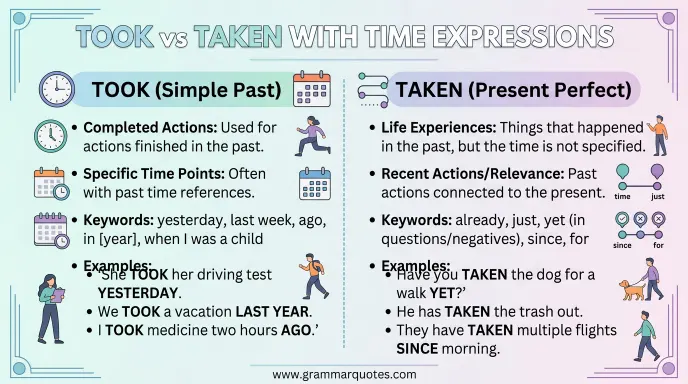
Time expressions can help you choose the correct form, although they are not the only factor.
Simple Past
- I took the exam yesterday.
- She took the train last night.
- They took a trip last year.
Present Perfect
- I have taken the exam before.
- She has taken the train many times.
- They have taken several trips.
A useful clue is that yesterday, last week, and ago often appear with the simple past.
Words such as have, has, and had usually signal the need for the past participle.
Everyday Examples
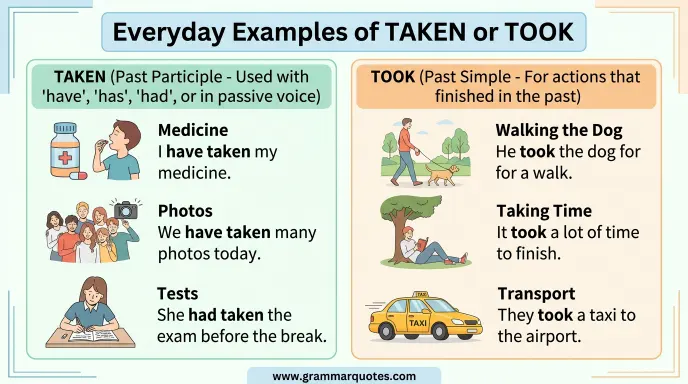
Transportation
- I took the bus yesterday.
- She has taken the train before.
- We took a taxi home.
- They have taken the same route many times.
School
- I took my exam last Monday.
- She has taken three exams this month.
- We took notes during the lecture.
- He had taken the course before.
Work
- I took the documents to the office.
- She has taken responsibility for the project.
- They took a short break.
- He had taken the files home.
Photos
- I took a photo yesterday.
- She has taken hundreds of photos.
- They took pictures at the event.
- He had taken a photo before the ceremony started.
British English vs American English
There is no major difference between British and American English in the basic use of these verb forms.
Both varieties use:
- take as the base form
- took as the simple past
- taken as the past participle
For example:
- I took the train yesterday.
- I have taken the train before.
The grammar is essentially the same in both forms of English.
Which Form Should You Use?
Ask yourself what grammar structure you are using.
Use “took” when:
- The sentence is in the simple past.
- You are describing a completed past action.
- The sentence uses a specific finished time.
Example:
I took the test yesterday.
Use “taken” when:
- It follows have, has, or had.
- It appears in a perfect tense.
- It is used in a passive construction.
Example:
I have taken the test.
This simple check can prevent most mistakes.
A Simple Memory Trick
Remember the three main forms:
Take → Took → Taken
You can connect them with three time ideas:
- Take → present
- Took → simple past
- Taken → past participle
For example:
Haan, readability ke liye isay simple table mein rakhna better rahega:
| Form | Tense | Example |
|---|---|---|
| Take | Present | I take the bus every day. |
| Took | Past | I took the bus yesterday. |
| Taken | Past participle | I have taken the bus many times. |
This pattern is useful because it shows how the same verb changes according to the sentence structure.
Took vs Taken in Passive Sentences
The participle can also be used in passive constructions.
Examples:
- The phone was taken.
- The documents were taken.
- The money was taken from the drawer.
Here, the subject receives the action rather than performing it.
- Someone took the phone.
- The phone was taken.
The first sentence uses the simple past. The second uses the past participle in a passive construction.
Took or Taken With “Have”
A very useful rule is:
Have/has/had + past participle
Since taken is the past participle, it works naturally after these auxiliary verbs.
Examples:
- I have taken
- You have taken
- He has taken
- She has taken
- We have taken
- They have taken
- They had taken
This is why “have took” is not standard English.
Google Trends & Usage Data
Searches for the two forms usually come from English learners trying to understand irregular verb patterns, especially the difference between simple past and past participles.
Common searches include:
- took vs taken
- take took taken
- have taken or have took
- took or taken grammar
- past tense of take
- past participle of take
Search interest can vary by country and time period. Exact Google Trends numbers should therefore be checked for a specific market and date range rather than treated as permanent data.
People Also Ask: Common Search Questions
Is “took” the past tense of take?
Yes. Took is the simple past form of take.
Is “taken” the past participle of take?
Yes. Taken is the past participle.
Should I say “I took” or “I taken”?
For simple past, use I took.
Is “I have took” correct?
No. Standard English uses I have taken.
Is “I have taken” correct?
Yes. It uses the present perfect structure.
Can I say “I taken”?
Not normally by itself. The standard structure requires an auxiliary verb, such as “I have taken.”
What comes after “did”?
Use the base form: Did you take?
What comes after “has”?
Use the past participle: She has taken.
What are the three forms of take?
The main forms are take, took, taken.
Is “taken” past tense?
It is the past participle, not the simple past form. The simple past is took.
Frequently Asked Questions
What is the difference between took and taken?
Took is the simple past form, while taken is the past participle.
Which is correct: “I took it” or “I taken it”?
I took it is correct for a simple past sentence.
Which is correct: “I have took it” or “I have taken it”?
I have taken it is correct because have is followed by the past participle.
Is “taken” used with had?
Yes.
Example:
They had taken the wrong road.
Is “took” used with did?
No. After did, use the base form take.
Correct:
Did you take my phone?
Can “taken” be used in passive voice?
Yes.
Example:
The documents were taken from the office.
Is the pronunciation of took and taken different?
Yes. They have different vowel sounds, so listening practice can help learners distinguish them.
Final Comparison
| Feature | Took | Taken |
| Base verb | Take | Take |
| Grammar form | Simple past | Past participle |
| Common structure | Subject + took | Have/has/had + taken |
| Example | I took the bus. | I have taken the bus. |
| Used after “did”? | No | No |
| Used after “have”? | No | Yes |
| Used in passive voice? | No | Yes |
Conclusion
Took and taken are both forms of the irregular verb take, but they have different grammatical jobs. Took is the simple past form, while taken is the past participle.
Use the first form when describing a completed action in the simple past, such as “I took the bus yesterday.” Use the participle when the sentence contains an auxiliary such as have, has, or had, as in “I have taken the bus before.”
One of the most important rules to remember is that have, has, and had are followed by the past participle. That is why “I have took” is incorrect and “I have taken” is correct.
Also remember that did is followed by the base form: “Did you take?” rather than “Did you took?”
The easiest way to remember the complete pattern is:
Take → Took → Taken
Once you understand this sequence, using the correct form becomes much easier in everyday English, formal writing, questions, and conversations.
Discover More Articles!
BlackRock or Blackstone: What Is the Difference?(2026)
Bearable or Bareable: Which Spelling Is Correct?(2026)
Inate or Innate: Which Spelling Is Correct?(2026)

Ethan Parker is an English-language writer known for his interest in words, language, and clear communication. His work focuses on making everyday English easier to understand through simple explanations and practical examples.