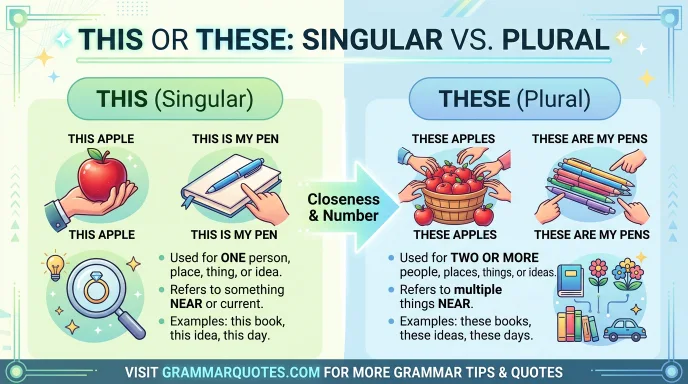
“These” and “this” are both demonstrative words, but this refers to one person, thing, or idea, while these refers to two or more. The main difference is simple: this is singular, and these is plural.
English learners often confuse these two words because they are used for things that are near the speaker or writer.
For example, you can say “this book” when talking about one book, but you should say “these books” when talking about several books.
Knowing the difference helps you write and speak more clearly. It also prevents common grammar mistakes such as saying “these book” or “this shoes.” The word that follows the demonstrative usually gives you a useful clue: a singular noun needs this, while a plural noun needs these.
In this guide, we will explain the meaning, grammar rules, examples, common mistakes, pronunciation, British and American usage, and simple ways to remember the difference.
These or This : Quick Answer
The basic rule is:
- This = one thing or person
- These = two or more things or people
Examples
- This book is interesting.
- These books are interesting.
- This phone belongs to me.
- These phones belong to me.
- This student is working hard.
- These students are working hard.
A quick memory trick is:
This = one
These = more than one
So, if you are talking about a single object, use this. If you are talking about several objects, use these.
Definition and Meaning
What Does “This” Mean?
This is a demonstrative determiner or pronoun used to identify one person, thing, place, or idea that is usually near the speaker or relevant to the current situation.
Examples:
- This car is new.
- This is my brother.
- I like this song.
- This idea could work.
Here, the word points to one thing.
What Does “These” Mean?
These is the plural form of this. It is used for two or more people, things, places, or ideas that are usually near the speaker or relevant to the current situation.
Examples:
- These cars are new.
- These are my brothers.
- I like these songs.
- These ideas could work.
The important point is that these is plural.
Why Do People Confuse These Two Words?
The confusion usually happens because both words point to something near the speaker or something currently being discussed.
The main difference is not distance. It is number.
Compare:
- This apple is fresh. → one apple
- These apples are fresh. → several apples
The same rule works with people:
- This student is ready.
- These students are ready.
And with ideas:
- This idea is useful.
- These ideas are useful.
Is “These” Singular or Plural?
These is plural. It normally refers to more than one person, thing, or idea.
For example:
- These books are mine.
- These children are playing.
- These questions are difficult.
You should not normally use these with a singular noun.
Incorrect:
- These book is expensive.
Correct:
- This book is expensive.
- These books are expensive.
The Grammar Rule Behind the Difference
The easiest grammar rule is to match the demonstrative with the noun’s number.
| Demonstrative | Number | Example |
| This | Singular | This car |
| These | Plural | These cars |
There are two other related words:
| Word | Number | General distance |
| This | Singular | Near |
| These | Plural | Near |
| That | Singular | Farther away |
| Those | Plural | Farther away |
This creates a useful four word system:
This → These
That → Those
For example:
- This chair → These chairs
- That chair → Those chairs
This or These With Nouns
When this comes before a noun, the noun should normally be singular.
Examples:
- this computer
- this house
- this student
- this problem
- this website
When these comes before a noun, the noun should normally be plural.
Examples:
- these computers
- these houses
- these students
- these problems
- these websites
A simple test is to look at the noun.
If it describes one, use this.
If it describes more than one, use these.
This or These Without a Noun
Both words can also work as pronouns. In this case, the noun does not have to appear directly after them.
Examples:
- This is my laptop.
- These are my laptops.
- This is difficult.
- These are difficult.
- I don’t understand this.
- I don’t understand these.
The verb can also help you identify the difference.
Compare:
- This is my book.
- These are my books.
This normally goes with is, while these normally goes with are when used in these structures.
Common Mistakes
1. Using “These” With a Singular Noun
Incorrect:
- These phone is expensive.
Correct:
- This phone is expensive.
Or:
- These phones are expensive.
2. Using “This” With a Plural Noun
Incorrect:
- This books are useful.
Correct:
- These books are useful.
3. Confusing “This” With “That”
“This” generally points to something near the speaker or something currently close in context.
“That” is often used for something farther away.
For example:
- This pen is in my hand.
- That pen is on the other table.
4. Forgetting the Verb
Incorrect:
- These my shoes.
Correct:
- These are my shoes.
Incorrect:
- This my phone.
Correct:
- This is my phone.
These or This in Everyday Examples
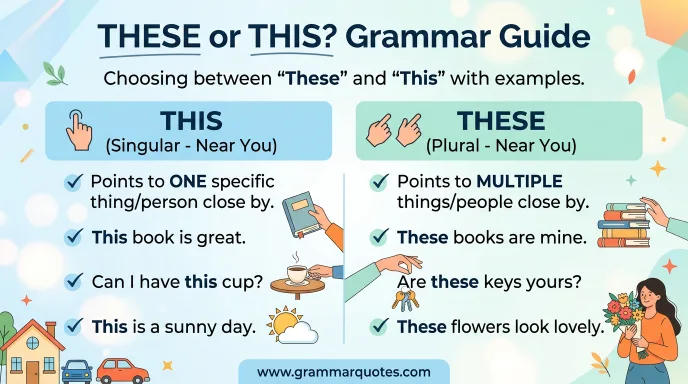
Here are some natural examples:
At Home
- This room is clean.
- These rooms are clean.
- This chair is broken.
- These chairs are broken.
At School
- This lesson is easy.
- These lessons are easy.
- This student is absent.
- These students are absent.
At Work
- This report needs editing.
- These reports need editing.
- This project is important.
- These projects are important.
Online
- This website is useful.
- These websites are useful.
- This comment is interesting.
- These comments are interesting.
In Conversation
Someone may point to a phone and say:
“This is my phone.”
If they are pointing to several phones, they might say:
“These are my phones.”
The number changes the demonstrative.
This vs These: A Simple Comparison
| Feature | This | These |
| Number | Singular | Plural |
| Refers to | One | Two or more |
| Example | This book | These books |
| Common verb | Is | Are |
| Pronoun example | This is mine | These are mine |
| General distance | Near | Near |
The key difference is singular versus plural.
This, These, That, and Those
Understanding all four words makes the rule even easier.
| Word | Number | Example |
| This | Singular | This car |
| These | Plural | These cars |
| That | Singular | That car |
| Those | Plural | Those cars |
Think of them as two pairs:
Near:
- This = one
- These = more than one
Farther away:
- That = one
- Those = more than one
Which Is Correct: “This Shoes” or “These Shoes”?
These shoes is correct because “shoes” is plural.
You would say:
- This shoe is comfortable.
- These shoes are comfortable.
The same pattern works with clothes, books, phones, and other plural nouns.
British English vs American English
There is no major difference between British and American English when it comes to the basic grammar of this and these.
Both varieties use:
- this for singular
- these for plural
For example:
- This car is fast.
- These cars are fast.
The rule remains the same in both forms of English.
Differences between British and American English may appear in vocabulary, spelling, or pronunciation, but the basic use of these demonstratives does not change.
Which Word Should You Use?
Choose the word based on the number of things you are describing.
Use this when:
- You mean one thing.
- You mean one person.
- You are introducing one idea.
- You are pointing to one nearby object.
Use these when:
- You mean several things.
- You mean several people.
- You are introducing multiple ideas.
- You are pointing to multiple nearby objects.
Easy Rule
Ask yourself:
“Am I talking about one or more than one?”
If the answer is one, choose this.
If the answer is more than one, choose these.
Pronunciation of This and These
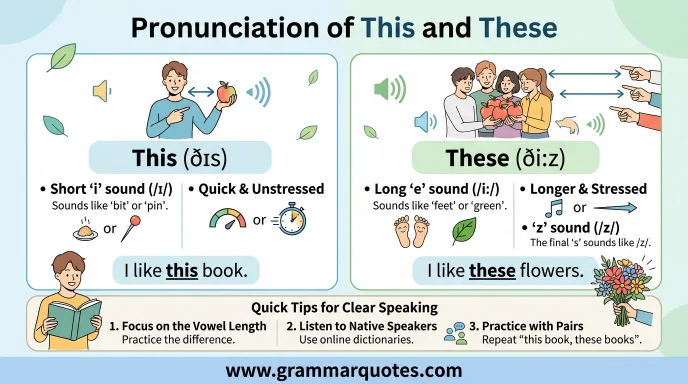
The words sound different.
- This is pronounced approximately like “this.”
- These has a long vowel sound and sounds approximately like “theez.”
The difference can be heard clearly in normal speech.
Example:
- This book
- These books
Listening to native speakers can help you become more comfortable with the difference.
“This” and “These” With Time
Both words can also refer to time rather than physical objects.
Examples:
- This week
- This month
- This year
- These days
Notice that these days is a common expression referring to the present period of time.
For example:
These days, many people study online.
Here, these refers to the current period rather than physical objects.
“This” and “These” With Ideas
The words can also point to ideas or situations.
Examples:
- This is a good idea.
- These are good ideas.
- This problem is serious.
- These problems are serious.
This is common in academic writing, business communication, and everyday conversation.
Google Trends & Usage Data
Search interest for “this” is naturally much broader than for many grammar comparison phrases because “this” is one of the most common words in English. “These” is also extremely common and appears across everyday speech, writing, education, websites, and search queries.
Exact Google Trends numbers can change over time, so they should be checked for a specific country and date range rather than treated as permanent figures.
People often search questions such as:
- Is it this or these?
- Should I use this or these?
- Is these grammatically correct?
- What is the difference between this and these?
These searches show that the main problem is usually understanding singular and plural agreement.
People Also Ask: Common Search Questions
Is “these” plural or singular?
“These” is plural. It normally refers to two or more people, things, or ideas.
What is the difference between this and these?
“This” is singular, while “these” is plural.
Can I say “these is”?
Usually, no. Standard English normally uses these are, not “these is.”
Is “this books” correct?
No. Use this book for one book or these books for multiple books.
Is “these book” correct?
No. The correct plural form is these books.
Is “this” always singular?
When used as a demonstrative determiner or pronoun, this is normally singular.
What is the plural of “this”?
The plural form of this is these.
What is the difference between these and those?
Both are plural, but these generally refers to things nearer to the speaker, while those generally refers to things farther away.
Can “these” be used without a noun?
Yes. For example: “These are mine.”
Should I say “this are” or “these are”?
Use these are for plural things and this is for one thing.
Frequently Asked Questions
Is “this” singular?
Yes. “This” is used for one person, thing, or idea.
Is “these” the plural of “this”?
Yes. These is the plural counterpart of this.
Which is correct: “this people” or “these people”?
These people is correct because “people” is plural.
Which is correct: “this things” or “these things”?
These things is correct because “things” is plural.
Can “this” describe an idea?
Yes. For example, “This is a useful idea.”
Can “these” describe ideas?
Yes. For example, “These are useful ideas.”
What is an easy way to remember the difference?
Remember: this = one, while these = more than one.
Final Comparison
| Question | This | These |
| Singular? | Yes | No |
| Plural? | No | Yes |
| One object? | ✓ | ✗ |
| Multiple objects? | ✗ | ✓ |
| Example | This phone | These phones |
| Example with “is/are” | This is | These are |
Conclusion
The difference between this and these is mainly about number. This is used for one person, thing, or idea, while these is used for two or more.
For example, you can say “This book is useful” when talking about one book. If you are talking about several books, say “These books are useful.”
The same rule works with people, objects, ideas, situations, and many other nouns. Remembering the pair this → these makes the grammar much easier.
You can also connect them with that → those. This gives you a simple four word system: this and these for nearby things, and that and those for things that are farther away.
The easiest rule to remember is simple: this means one, and these means more than one. Once you check if the noun is singular or plural, choosing the correct word becomes much easier.
Discover More Articles!
BlackRock or Blackstone: What Is the Difference?(2026)
Bearable or Bareable: Which Spelling Is Correct?(2026)
Inate or Innate: Which Spelling Is Correct?(2026)

Ethan Parker is an English-language writer known for his interest in words, language, and clear communication. His work focuses on making everyday English easier to understand through simple explanations and practical examples.