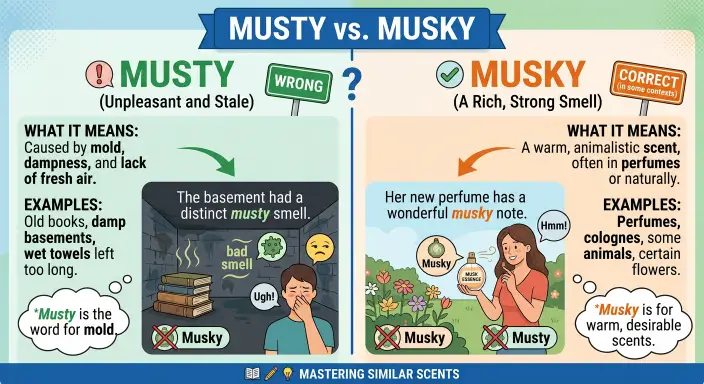
Musty and musky are both correct English words, but they describe different types of smells. Musty usually describes an old, damp, stale, or slightly unpleasant smell, while musky describes a strong, warm, earthy, or animal-like scent that is often associated with perfumes and fragrances.
The two words are easy to confuse because they look and sound similar. However, their meanings are quite different. A room that has been closed for a long time may smell musty, while a perfume can have a musky scent.
Understanding this difference is useful when describing rooms, clothes, books, perfumes, food, and other smells. It can also help writers choose more precise vocabulary when creating descriptions.
In simple terms, think of musty as a smell often connected with age, dampness, or poor ventilation. Think of musky as a deeper, warmer scent that may be natural or intentionally added to perfumes.
Both words are standard English, and neither is simply a misspelling of the other. The correct choice depends on the smell you want to describe.
Musty or Musky: Quick Answer
Musty describes an old, damp, stale, or closed-in smell.
Musky describes a strong, warm, earthy, animal-like, or fragrance-related smell.
Examples:
The basement had a musty smell.
The perfume has a warm, musky scent.
Simple Rule
Musty = old, damp, stale smell
Musky = warm, earthy, strong scent
The easiest way to remember the difference is to connect musty with damp rooms and musky with fragrance.
Definition and Meaning
What Does Musty Mean?
Musty is an adjective used to describe a smell that is old, damp, stale, or associated with a place that has not had much fresh air.
It is often used for:
- Old houses
- Basements
- Closets
- Books
- Clothes
- Damp rooms
- Stored furniture
Examples:
The basement smelled musty.
These old books have a musty smell.
The word often has a negative or unpleasant feeling.
What Does Musky Mean?
Musky is an adjective used to describe a strong, warm, earthy, animal-like, or somewhat sweet scent.
It is especially common when talking about:
- Perfume
- Cologne
- Fragrances
- Natural scents
- Certain animals
- Body scents
Example:
The perfume has a deep musky fragrance.
Unlike musty, the word musky is not always negative. In perfumes, it can be used to describe a rich or attractive scent.
The Origin of Musty and Musky
The two words have different histories.
Musty is related to must, a word associated with something that has become stale, damp, or moldy-smelling. Its meaning developed around the idea of an unpleasant smell caused by age, moisture, or lack of fresh air.
Musky comes from musk, a strongly scented substance historically associated with certain animals and later widely used in perfumery.
Over time, musky came to describe smells that resemble musk or have a warm, deep, earthy quality.
Although the two words look similar, their origins and meanings are different.
British English vs American English
There is no important British-American spelling difference between these words.
Both British and American English use:
- musty
- musky
The meanings are also essentially the same.
| Word | British English | American English |
|---|---|---|
| Musty | Musty | Musty |
| Musky | Musky | Musky |
| Old/damp smell | Musty | Musty |
| Warm/earthy scent | Musky | Musky |
So, this is a meaning and vocabulary difference rather than a regional spelling difference.
Musty Meaning: Old or Damp Smell
A musty smell is usually associated with things that have been stored for a long time or places with limited airflow.
For example:
The unused room smelled musty.
My old jacket had a musty smell after being stored for years.
The word can suggest:
- Dampness
- Staleness
- Age
- Poor ventilation
- Long-term storage
Common Musty Places
You might describe these as musty:
- A basement
- An old attic
- A closed storage room
- An old library
- A rarely opened closet
- An old box of clothes
The word focuses mainly on the condition of the environment or object.
Musky Meaning: Warm or Earthy Scent
A musky smell is often deeper and stronger than an ordinary scent. It can have an earthy, warm, animal-like, or slightly sweet quality.
The word is especially common in fragrance descriptions.
For example:
The perfume has a soft musky base.
In this context, musky can be positive and sophisticated.
It can also be used outside perfumes:
The forest had a warm, musky smell after the rain.
The meaning depends heavily on context.
Musky vs Musty: What’s the Difference?
The easiest distinction is based on the type of smell.
Musty usually suggests something old, damp, stale, or poorly ventilated.
Musky usually suggests a warm, earthy, strong, or animal-like scent.
Compare:
The old basement smelled musty.
This suggests age, dampness, or stale air.
The perfume smelled musky.
This suggests a warm, deep fragrance.
Using one word in place of the other can change the meaning of your sentence.
Common Mistakes
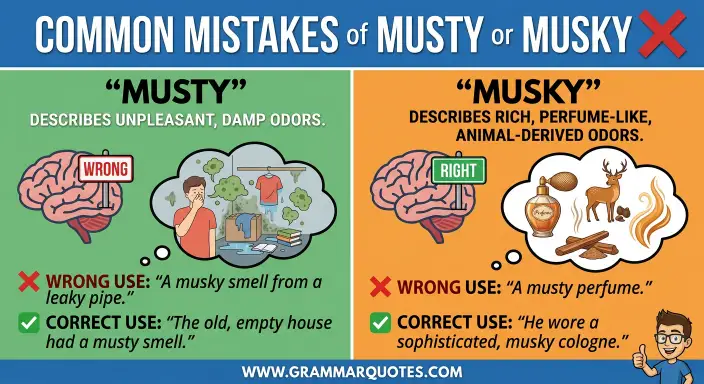
Mistake 1: Using musky for a damp room
Incorrect:
The basement had a musky smell because it had been closed for years.
Better:
The basement had a musty smell because it had been closed for years.
Mistake 2: Using musty for perfume
Incorrect:
She wore a musty perfume with a warm fragrance.
Better:
She wore a musky perfume with a warm fragrance.
Mistake 3: Thinking both words mean unpleasant
Musty is usually associated with an unpleasant or stale smell.
Musky can be pleasant, especially in perfumes, although it can also describe a strong or unpleasant scent depending on context.
Mistake 4: Treating one word as a spelling variation
These are not two spellings of the same word.
Musty and musky are separate words with different meanings.
Musky and Musty in Everyday Examples
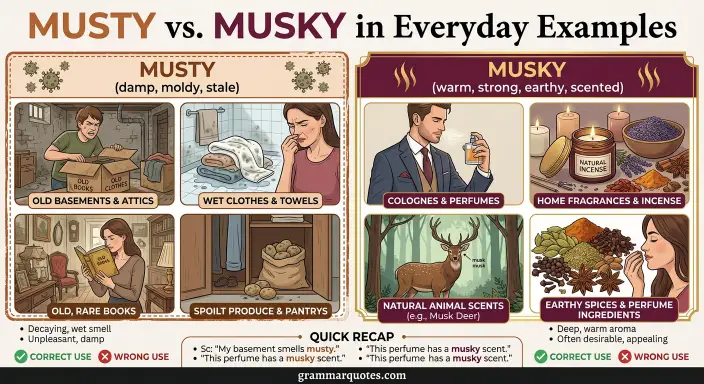
Old House
The abandoned house had a musty smell.
Books
The old library smelled slightly musty.
Clothes
The clothes smelled musty after being stored in the closet.
Perfume
The fragrance has a warm musky base.
Cologne
He chose a deep, musky cologne.
Nature
The forest had a rich, earthy and slightly musky scent.
These examples show how context helps determine which word is appropriate.
Musty vs Musky: Side-by-Side Comparison
| Feature | Musty | Musky |
|---|---|---|
| Main meaning | Old, damp, stale smell | Warm, earthy, strong scent |
| Common with old rooms | Yes | Usually no |
| Common with perfume | Usually no | Yes |
| Can describe books | Yes | Rarely |
| Can be pleasant | Usually less pleasant | Yes, depending on context |
| Related idea | Dampness and age | Musk and fragrance |
| British spelling | Musty | Musky |
| American spelling | Musty | Musky |
Which Word Should You Use?
Ask yourself what kind of smell you are describing.
Use musty if the smell reminds you of:
- An old basement
- Damp clothes
- A closed room
- Old books
- Stale air
- Long-term storage
Use musky if the smell reminds you of:
- Perfume
- Cologne
- Musk
- A warm earthy scent
- A strong natural scent
Quick Test
If the smell makes you think “old and damp,” choose musty.
If it makes you think “warm and earthy,” choose musky.
Musty vs Moldy
These words are related but are not exactly the same.
Musty describes a smell.
Moldy describes something affected by mold and can also describe its smell.
For example:
The basement smelled musty.
The bread was moldy.
A musty smell can sometimes be associated with moisture or mold, but the words are not interchangeable in every situation.
Musky vs Earthy: Quick Answer
Musky and earthy are both used to describe scents, but they create different impressions. Musky usually describes a warm, deep, soft, or slightly animal-like fragrance. Earthy describes a natural scent that reminds you of soil, woods, leaves, or the outdoors.
What Does Musky Mean?
Musky describes a scent that feels warm, rich, deep, and slightly sweet or animal-like. In modern fragrances, musk is often used as a base note to give a perfume a smooth and lasting character.
Examples:
- The perfume has a soft, musky scent.
- This fragrance smells warm and musky.
- Musk adds depth to many perfumes.
What Does Earthy Mean?
Earthy describes a natural smell that reminds you of fresh soil, damp ground, forests, wood, or plants. It is commonly used for fragrances that have a grounded and natural character.
Examples:
- The perfume has a fresh, earthy aroma.
- I love the earthy smell after rain.
- Sandalwood can give a fragrance an earthy character.
Musky vs Earthy: Key Difference
The easiest way to remember the difference is:
Musky = warm, deep, soft, and sometimes animal-like.
Earthy = natural, woody, soil-like, and connected to the outdoors.
| Word | Main Impression | Common Associations |
|---|---|---|
| Musky | Warm and deep | Musk, skin, warmth, softness |
| Earthy | Natural and grounded | Soil, woods, leaves, forests |
A fragrance can be both musky and earthy. For example, a perfume may have an earthy base with a soft musky note, creating a warm and natural scent.
Earthy suggests soil, plants, wood, or natural ground-like smells.
For example:
The perfume has a musky base.
The fragrance has an earthy character.
Both can describe natural or deep scents, but they create different impressions.
Google Trends and Usage
People often search these words together because their spelling is similar and both describe smells.
Search interest can vary depending on the season, fragrance trends, writing needs, and regional vocabulary. Exact Google Trends numbers also change over time and should not be treated as a permanent measure of word popularity.
For practical writing, the distinction is more useful than search volume:
musty is mainly associated with old, damp, or stale smells, while musky is commonly associated with warm, earthy, or fragrance-related scents.
People Also Ask
What is the difference between musty and musky?
Musty usually describes an old, damp, or stale smell, while musky describes a warm, earthy, strong, or fragrance-related scent.
Is a musty smell bad?
A musty smell is usually considered unpleasant because it suggests stale air, dampness, or age.
Can musky smell be good?
Yes. Musky can describe an attractive or sophisticated fragrance, especially in perfumes and colognes.
Is musty the same as moldy?
No. Musty mainly describes a smell, while moldy describes something affected by mold.
What does musky mean in perfume?
In perfume, musky usually describes a warm, deep, earthy, or animal-like fragrance note.
What does musty mean for clothes?
It usually means the clothes have an old, stale, or damp smell, often after being stored without enough airflow.
Can a room smell musky?
Yes, but the intended meaning depends on the context. If the room smells old and damp, musty is usually more precise.
Is musky always a bad smell?
No. It can be pleasant, neutral, or unpleasant depending on the particular scent and context.
Is musty a positive word?
Usually not. It commonly describes a stale or unpleasant smell.
Are musty and musky interchangeable?
No. They are separate words with different meanings and should not normally be used interchangeably.
Frequently Used Phrases
Musty Smell
The room had a musty smell.
This usually suggests stale, damp, or old air.
Musty Room
The storage room was dark and musty.
Musty Books
The old books had a musty odor.
Musky Perfume
She prefers a warm musky perfume.
Musky Fragrance
The fragrance has a deep musky base.
Musky Scent
The flower had a slightly musky scent.
Final Takeaway
Musty and musky are both correct English words, but they describe different kinds of smells.
Use musty when describing an old, damp, stale, or closed-in smell. It is commonly used for basements, old rooms, stored clothes, books, and furniture. The word usually has a negative or unpleasant feeling.
Use musky when describing a warm, earthy, strong, animal-like, or fragrance-related scent. It is especially common in perfume and cologne descriptions. Unlike musty, it can have a positive meaning.
A simple memory trick is to connect musty with old and damp and musky with warm and earthy.
Neither word is a variation of the other. They have different meanings, even though their spellings are similar. Once you understand the type of smell each word describes, choosing between them becomes much easier.
Discover More Articles!
Meak or Meek: Which Spelling Is Correct?(2026)
Choose or Die: Meaning, Usage, and Correct Context
Impostor or Imposter: Which Spelling Is Correct?(2026)

Ethan Parker is an English-language writer known for his interest in words, language, and clear communication. His work focuses on making everyday English easier to understand through simple explanations and practical examples.