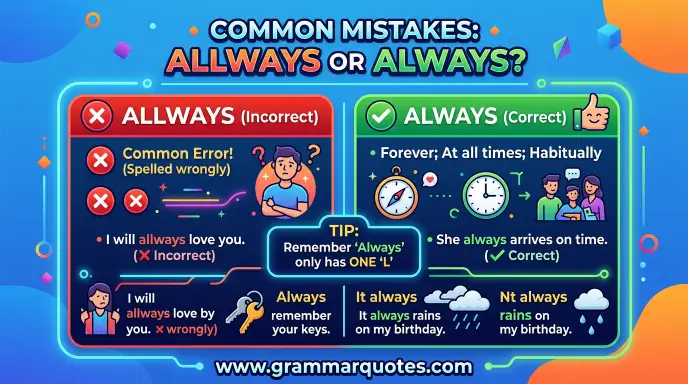
Many English learners get confused about Allways or Always because the two spellings look very similar. But which one is correct, and which one is a spelling mistake? Learn the correct spelling, Always, its meaning and proper usage with simple examples, while understanding why Allways is incorrect.
This confusion often appears among English learners, students, writers, and people typing quickly online. Knowing the difference matters because always is a very common English adverb used in everyday speech, academic writing, emails, and professional communication.
In this guide, you will learn what always means, why allways is incorrect in modern standard English, how the word developed, how British and American English treat it, and how to avoid the spelling mistake. You will also see practical examples, comparison tables, FAQs, and useful writing tips.
Allways or Always: Quick Answer
The correct spelling is always, not allways.
- ✅ Always = correct
- ❌ Allways = incorrect
- Always is an adverb.
- It means “at all times” or “every time.”
Examples
I always drink water in the morning.
He always helps his friends.
We should always check our work before submitting it.
A simple way to remember it is:
A + L + W + A + Y + S = ALWAYS
There is no second l.
What Does Always Mean?
Always is an adverb that describes something that happens at all times, regularly, or on every relevant occasion.
For example:
- She always studies before an exam.
- My father always wakes up early.
- I will always remember this lesson.
- He is always ready to help.
The exact meaning can depend on context. It can describe a regular habit, a repeated action, or something that is considered true without exception.
Common meanings of always
1. At all times
The library is always open during these hours.
2. Every time
She always calls her mother after work.
3. Regularly
He always takes the same route to school.
4. For all time
True friends always support each other.
Always as an adverb
Because always is an adverb, it commonly modifies a verb.
They always arrive early.
I always remember his advice.
With the verb be, it usually comes after the verb:
She is always polite.
The Origin of Allways and Always
The word always has a long history in English. It developed from older expressions connected with the idea of being “all the time” or “at all times.”
Its spelling and form changed over the history of the English language. Modern English eventually settled on always as the standard spelling.
The important point for modern writers is that the historical development of the word does not make allways a correct alternative spelling today. Contemporary standard English uses always.
The extra l in allways is likely easy to imagine because English speakers know the word all. However, modern spelling does not combine all and ways to produce allways.
British English vs American English
There is no spelling difference between British and American English for this word.
| British English | American English | Example |
| always | always | She always works hard. |
| allways | allways | Incorrect in both varieties. |
Both major varieties of English use always.
This is different from words such as colour/color or centre/center, where British and American spelling can differ.
Does UK English use “allways”?
No. Allways is not the standard British spelling.
Does US English use “allways”?
No. Allways is also incorrect in standard American English.
So, if you are writing for readers in the United States, United Kingdom, Canada, Australia, or another English speaking region, use always.
Which Version Should You Use?
The answer is straightforward:
| Writing Context | Recommended Spelling |
| United States | always |
| United Kingdom | always |
| Canada | always |
| Australia | always |
| International English | always |
| Academic writing | always |
| Business writing | always |
| Emails | always |
| Social media | always |
There is no standard English context where allways should replace always.
For formal writing, this is especially important. A spelling checker may identify allways as an error, but it is better to know the correct spelling yourself.
Common Mistakes
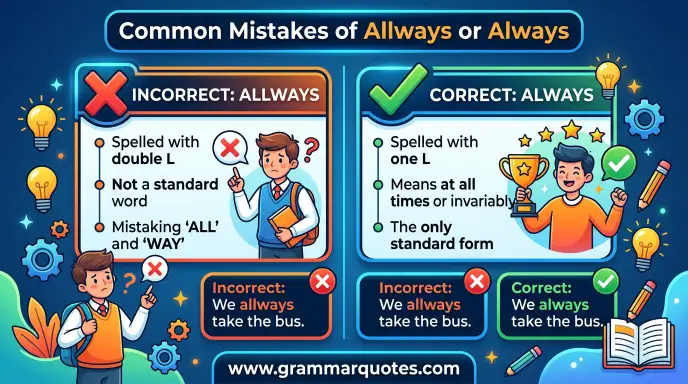
Mistake 1: Adding a second L
❌ I allways try my best.
✅ I always try my best.
Why?
The correct spelling contains only one l.
Memory tip: Think of always as one fixed word rather than all + ways.
Mistake 2: Thinking “allways” means “all ways”
❌ I will allways support you.
✅ I will always support you.
Why?
Always means “at all times.” It is not formed by joining all and ways.
Mistake 3: Using “allways” because it sounds natural
❌ She allways arrives early.
✅ She always arrives early.
Pronunciation does not clearly reveal the spelling. This is why it helps to memorize the written form.
Quick memory trick
Remember:
ALWAYS = one L
You can also write it several times:
always → always → always
This helps build spelling familiarity.
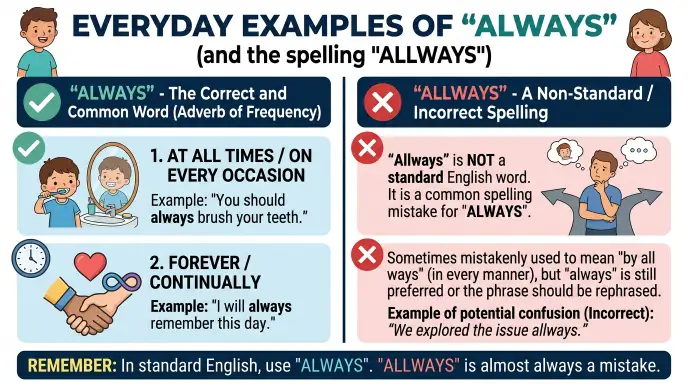
Everyday Examples
Emails
I always appreciate your quick response.
Please always include your contact information.
Business writing
Our team always checks the order before delivery.
Customer satisfaction is always our priority.
News headlines
Experts say consumers always look for better value.
In headlines, writers may shorten language for style, but the spelling remains always.
Blogs
Good writers always consider their readers.
Remember to always proofread your article before publishing.
Social media
Always keep learning! 📚
Good friends always support each other.
Academic writing
Researchers should always evaluate the quality of their sources.
Daily conversation
Do you always wake up this early?
I always forget where I put my keys.
Google Trends & Modern Usage
People search for “allways or always” because the two spellings look very similar. The confusion is understandable, especially for English learners and people who associate always with the word all.
Modern standard English clearly favors always. Allways is generally treated as a spelling error rather than a regional alternative.
Search behavior can also be influenced by autocorrect, spelling check questions, educational searches, and people checking their writing before publishing it.
There is no need to treat allways as an accepted British or American variant. If your goal is correct standard English, choose always.
Quick Comparison Table
| Version | Meaning | Correct? | Region | Example |
| always | At all times; every time | ✅ Yes | All major English varieties | I always study. |
| allways | Intended to mean “always” | ❌ No | None as a standard spelling | I allways study. |
Always vs Allways at a glance
| Feature | Always | Allways |
| Standard English | ✅ Yes | ❌ No |
| Correct spelling | ✅ | ❌ |
| Used in US English | ✅ | ❌ |
| Used in UK English | ✅ | ❌ |
| Used in academic writing | ✅ | ❌ |
| Meaning “at all times” | ✅ | Intended meaning only |
| Recommended | Yes | No |
Key Takeaways
- Always is the correct spelling.
- Allways is a common misspelling.
- Always means “at all times,” “every time,” or “regularly.”
- The word is used in both British and American English.
- There is no standard regional spelling allways.
- The correct word contains only one L.
- Use always in academic, professional, and casual writing.
- Remember: ALWAYS = one L.
FAQs
Is “allways” a correct English word?
No. Allways is not the standard spelling of the word meaning “at all times.” The correct spelling is always. If you are writing an email, essay, article, business document, or social media post, use always.
Is it always or allways?
It is always. The spelling has one l. For example, “She always arrives early” is correct, while “She allways arrives early” contains a spelling mistake.
Why do people spell always as allways?
People may spell always as allways because the word looks as though it could be related directly to all. Fast typing and pronunciation can also contribute to the mistake. However, allways is not the standard spelling in modern English.
Is “allways” British or American English?
Neither. Allways is not the standard British or American spelling. Both British English and American English use always.
What does always mean?
Always usually means “at all times,” “every time,” or “on every occasion.” For example, “He always helps his classmates” means that helping his classmates is something he consistently does.
Is “always” an adverb?
Yes. Always is an adverb, usually used to describe how regularly or consistently an action happens. For example, in “She always studies,” the word always modifies the verb studies.
How can I remember the spelling of always?
Use the simple rule “always has one L.” Think of the spelling as A L W A Y S, not all + ways. Repeating the correct form several times can also make it easier to remember.
Can I use “allways” in formal writing?
No. Avoid allways in formal writing. Use always instead. This applies to school assignments, academic papers, professional emails, business documents, websites, and other edited content.
Is “always” used in American English?
Yes. Always is the standard spelling in American English. It is also the standard spelling in British English, Canadian English, Australian English, and international English.
What is the difference between always and allways?
The difference is spelling and correctness. Always is the correct English word meaning “at all times.” Allways is a misspelling and should normally be corrected to always.
Conclusion
If you are confused about allways or always, the answer is clear: always is the correct spelling. Allways is a common spelling mistake, not a standard British or American variant.
The word always is an adverb that can mean “at all times,” “every time,” or “regularly.” It is used across everyday conversation, academic writing, business communication, blogs, emails, and professional content. The same spelling is used in both British and American English.
The easiest way to remember it is to focus on the spelling: A L W A Y S. There is only one l.
Before publishing or submitting your writing, check for the extra l. If you see allways, change it to always.
Memorable takeaway: Always has one L, and “allways” is always a spelling mistake.
Discover More Articles!
i.e. vs e.g.: Meaning, Difference, and Correct Usage
Else’s or Elses: Common Mistakes and Examples(2026)
Perfume or Parfum: What’s the Difference?(2026)

Ethan Parker is an English-language writer known for his interest in words, language, and clear communication. His work focuses on making everyday English easier to understand through simple explanations and practical examples.