I’m confused about the phrase Portland or homeless and want to understand what these terms mean. Are Portland and homeless related words, or do they have completely different meanings? I’d also like to know the correct way to use each term in a sentence, especially when talking about Portland and homelessness.
This confusion often comes from search queries such as “Portland homeless,” “homelessness in Portland,” or “Portland or homeless.” These phrases may look like a word comparison, but they describe different ideas.
Portland identifies a place. Homeless describes a housing situation. For example, “Portland has services for people experiencing homelessness” uses both terms correctly.
In this guide, you will learn the meaning, grammar, usage, regional differences, common mistakes, and everyday examples of Portland or homeless. You will also learn why homelessness is often the better noun when writing about the wider social issue.
Portland or Homeless : Quick Answer
The short answer is simple:
- Portland = a place name.
- Homeless = an adjective describing a person or group without stable housing.
- Homelessness = the condition or social issue of not having stable housing.
Examples
Portland is a city in Oregon.
Some Portland residents are experiencing homelessness.
The city is working on homelessness and housing services.
So, you should not replace Portland with homeless, or vice versa.
They have completely different grammatical and semantic roles.
What Does Portland or Homeless Mean?
What does Portland mean?
Portland is a proper noun. Several places around the world have this name.
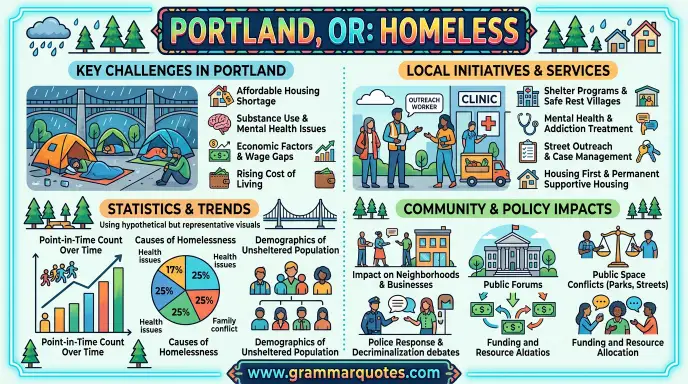
In many US searches, Portland refers to Portland, Oregon. The City of Portland’s official website has dedicated information about its homelessness response, shelters, housing, outreach, and related services.
The word itself does not mean homelessness.
For example:
Portland is in Oregon.
Here, Portland is the name of a place.
What does homeless mean?
Homeless is an adjective.
It describes someone who does not have a stable or permanent home.
Examples include:
The program helps homeless people.
The city provides services for homeless residents.
In modern formal writing, people experiencing homelessness is often preferred because it focuses on the person rather than defining the person by their housing situation.
What does homelessness mean?
Homelessness is a noun.
It refers to the condition or experience of not having stable housing.
For example:
The city is developing programs to address homelessness.
Portland’s official information uses the term homelessness when discussing the broader issue and its response.
The Origin of Portland or Homeless
The two terms have completely different histories.
Origin of Portland
Portland is a place name, not a general English adjective.
The name is used by several geographic locations. Portland, Oregon, is one of the best known places with this name.
Because it is a proper noun, it normally begins with a capital P:
Portland
Not:
portland
when referring to a named city.
Origin of homeless
Homeless is formed from:
home + less
The suffix less generally means “without.”
Examples include:
- homeless = without a home
- careless = without care
- hopeless = without hope
- powerless = without power
The related noun homelessness adds the suffix ness:
homeless + ness = homelessness
This means the condition or state of being homeless.
British English vs American English
There is no British versus American spelling difference between Portland, homeless, and homelessness.
The main differences are more likely to involve wording, style, and preferred terminology.
| Term | British English | American English | Example |
| Portland | Portland | Portland | Portland is a city. |
| homeless | homeless | homeless | The program supports homeless residents. |
| homelessness | homelessness | homelessness | The report discusses homelessness. |
| people experiencing homelessness | Used | Used | The service supports people experiencing homelessness. |
| housing | housing | housing | Affordable housing can help prevent homelessness. |
Regional differences
The spelling stays the same.
However, organizations, governments, journalists, and style guides may choose different wording.
For example, some formal writing may prefer:
people experiencing homelessness
instead of:
homeless people
The goal is often to use respectful, person centered language.
Publishing preferences
If you are writing for a newspaper, university, government agency, or nonprofit organization, check its style guide.
The preferred terminology can vary by organization.
Which Version Should You Use?
There is no single “version” to choose because Portland, homeless, and homelessness have different meanings.
United States
If you mean the city in Oregon, write:
Portland
If you mean the housing issue, write:
homelessness
If you are describing people, choose wording that fits your publication’s style, such as:
people experiencing homelessness
United Kingdom
Use the same spellings:
- Portland
- homeless
- homelessness
British English does not change the spelling of these words.
Canada
The same basic spellings apply.
For formal or public facing writing, person centered language may be preferred depending on the organization.
Australia
Again, the spelling is generally unchanged.
Follow the terminology preferred by the publication or organization you are writing for.
International Writing
For international readers, make the location clear.
Instead of:
Portland has a homelessness problem.
You could write:
Portland, Oregon, has ongoing homelessness and housing challenges.
This removes possible confusion with other places named Portland.
Academic Writing
Academic writing should be precise.
Use homelessness when discussing the wider issue.
Example:
This study examines homelessness in Portland, Oregon.
Business Writing
Business writing should be neutral and clear.
Example:
The organization provides services to people experiencing homelessness in Portland.
Common Mistakes
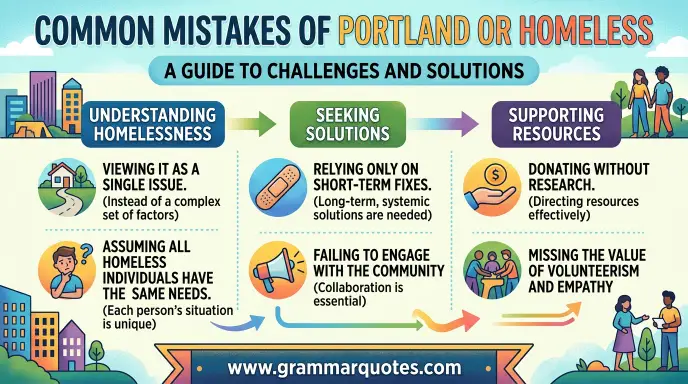
Mistake 1: Treating Portland and homeless as synonyms
❌ Portland means homeless.
✅ Portland is a place name, while homeless describes a housing situation.
Explanation: They have different meanings.
Memory tip: Think place vs condition.
Mistake 2: Using lowercase for Portland
❌ portland, Oregon
✅ Portland, Oregon
Explanation: A city name is a proper noun, so it begins with a capital letter.
Memory tip: Names of specific places normally use capital letters.
Mistake 3: Using homelessness as an adjective
❌ The homelessness people need support.
✅ Homeless people need support.
Or:
✅ People experiencing homelessness need support.
Explanation: Homelessness is a noun. It names a condition, not the people experiencing it.
Mistake 4: Confusing homeless and homelessness
❌ The city is trying to reduce homeless.
✅ The city is trying to reduce homelessness.
Explanation: After “reduce,” you need the noun homelessness when you mean the wider issue.
Mistake 5: Writing an unclear location
❌ Portland has this problem.
✅ Portland, Oregon, has this problem.
Explanation: Several places are called Portland. Adding the state can make the sentence clearer.
Everyday Examples
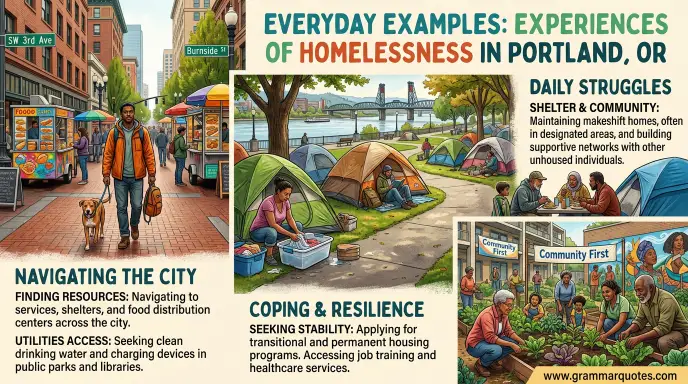
Emails
Our organization provides housing support to people experiencing homelessness in Portland.
Business Writing
The company is working with local groups on housing and homelessness initiatives.
News Headlines
Portland Expands Its Homelessness Response
A news headline may shorten language for space, but accuracy should remain the priority.
Blogs
What Is Portland Doing About Homelessness?
This is clearer than treating “Portland” and “homeless” as competing terms.
Social Media
Portland continues to discuss housing, shelters, and homelessness.
Academic Writing
This paper examines homelessness in Portland, Oregon.
Daily Conversation
Is Portland dealing with homelessness?
Yes. The city has several housing and shelter programs.
Portland’s current official resources include shelter programs, housing information, outreach, data tools, and homelessness services.
Google Trends & Modern Usage
The exact phrase “Portland or homeless” does not represent a standard English comparison such as “affect or effect” or “their or there.”
Search behavior around the phrase is more likely connected with searches about homelessness in Portland.
People may search for related phrases such as:
- Portland homeless
- Portland homelessness
- homeless shelters in Portland
- homelessness in Portland
- Portland housing crisis
- Portland homeless services
- people experiencing homelessness in Portland
The City of Portland currently provides data, maps, shelter information, housing resources, outreach programs, and other information related to homelessness.
The city also publishes information about its current camping ordinance and its homelessness response. Its official page says enforcement of the camping ordinance resumed in November 2025 after being paused earlier that year.
Exact Google search volume numbers should not be invented. Without a current keyword research dataset, it is safer to describe these as related search patterns rather than claim a specific search ranking or percentage.
The main language point remains simple:
Portland is a place. Homeless is a description. Homelessness is the condition.
Quick Comparison Table
| Version | Meaning | Correct? | Region | Example |
| Portland | A proper place name | Yes | Global | Portland, Oregon, is a city. |
| homeless | Describes a person without stable housing | Yes | Global | The program supports homeless residents. |
| homelessness | The condition of lacking stable housing | Yes | Global | The report discusses homelessness. |
| Portland homeless | Informal search phrase | Yes as a search phrase | Mainly English language searches | Portland homeless services |
| Portland homelessness | Topic phrase | Yes | Global | Homelessness in Portland |
| Portland or homeless | Not a standard word comparison | Not as a synonym comparison | Search dependent | The terms have different meanings. |
Key Takeaways
- Portland and homeless are not alternative spellings.
- Portland is a proper noun and commonly refers to a place.
- Homeless is an adjective describing a housing situation.
- Homelessness is the noun for the wider condition or issue.
- Use Portland, Oregon when you need to make the location clear.
- In formal writing, people experiencing homelessness can be a useful person centered phrase.
- Homelessness in Portland is clearer than treating “Portland or homeless” as a word choice question.
- Always choose the term based on what you actually mean.
FAQs
Is Portland another word for homeless?
No. Portland is a place name, while homeless describes a person or group without stable housing. The two words can appear together in phrases such as “homelessness in Portland,” but they are not synonyms. If you are writing about the wider issue, homelessness in Portland is usually much clearer.
What does “Portland homeless” mean?
“Portland homeless” is usually a search style phrase referring to homelessness or people experiencing homelessness in Portland. It is not a special English expression. In a normal sentence, it is often better to write homelessness in Portland or people experiencing homelessness in Portland.
Is Portland a city?
Yes. Portland is the name of several places. In many US contexts, Portland refers to Portland, Oregon. The city has official programs and resources dealing with housing, shelters, outreach, and homelessness.
Is homeless a noun or an adjective?
Homeless is mainly used as an adjective. It describes a person, group, or situation related to having no stable home. Homelessness is the noun. For example, “homeless residents” uses homeless as an adjective, while “homelessness is a serious issue” uses homelessness as a noun.
Should I say “homeless people” or “people experiencing homelessness”?
Both expressions can be understood, but people experiencing homelessness is often preferred in formal, professional, or person centered writing. The best choice depends on the audience and the style guide you are following. When writing for an organization, check its preferred terminology.
Is “homelessness in Portland” grammatically correct?
Yes. Homelessness in Portland is a clear and grammatically correct phrase. “Homelessness” is the noun naming the condition, and “in Portland” identifies the location. It is often clearer than the shorter search phrase “Portland homeless.”
How do I capitalize Portland?
Capitalize Portland because it is a proper noun when it refers to a specific place. Write Portland, Oregon, not portland, Oregon. If the word is part of a specific name, preserve the official capitalization.
What is the difference between homeless and homelessness?
Homeless is an adjective, while homelessness is a noun. “Homeless” describes someone or something, while “homelessness” names the condition. For example, “people experiencing homelessness” and “the problem of homelessness” use the noun correctly.
Is “Portland or homeless” a correct comparison?
Not as a normal word choice comparison. The two terms have different meanings and grammatical functions. Portland identifies a place, while homeless describes a housing situation. If your intended topic is the social issue in the city, homelessness in Portland is a more natural and useful phrase.
What is the best phrase for formal writing about this topic?
A clear formal option is people experiencing homelessness in Portland. If you are discussing the wider issue, use homelessness in Portland. These phrases make both the people or condition and the location clear without treating the words as synonyms.
Conclusion
The phrase Portland or homeless can look like a normal word comparison query, but these terms are not alternatives. Portland is a proper noun used for a place, while homeless is an adjective describing a person or situation involving a lack of stable housing. The related noun homelessness refers to the wider condition or social issue.
If you are writing about the topic, choose the word that matches your meaning. Use Portland when you mean the place. Use homeless when describing people or situations. Use homelessness when discussing the broader issue.
For formal and professional content, phrases such as homelessness in Portland or people experiencing homelessness in Portland can provide more precise context. Portland’s own current public resources use “homelessness” extensively when discussing its housing, shelter, outreach, and response programs.
The easiest way to remember the difference is simple:
Portland is a place. Homeless is a description. Homelessness is a condition.
Use that rule whenever you write about this topic, and your wording will be much clearer.
Discover More Articles!
i.e. vs e.g.: Meaning, Difference, and Correct Usage
Perfume or Parfum: What’s the Difference?(2026)
Else’s or Elses: Common Mistakes and Examples(2026)

Ethan Parker is an English-language writer known for his interest in words, language, and clear communication. His work focuses on making everyday English easier to understand through simple explanations and practical examples.