Perfume and parfum often appear on fragrance bottles, product pages, and beauty websites, which can make shoppers wonder if they are two different products.
The short answer is that perfume and parfum usually refer to the same general type of fragrance, but the exact meaning can depend on how a brand uses the term. “Perfume” is the common English word, while “parfum” is the French word that is widely used in the fragrance industry.
People search for perfume or parfum because labels can be confusing. Some bottles say “Eau de Parfum,” others simply say “Parfum,” and product descriptions may use “perfume” as a broad term. This can make it hard to know if one option is stronger, longer lasting, or more luxurious than another.
This guide explains the difference in simple terms. You will learn what each word means, where the terms come from, how British and American English treat them, how fragrance labels work, and which term you should use in different situations.
Perfume or Parfum: Quick Answer
If you are asking which word is correct, both are correct.
The difference is mainly about language, context, and fragrance terminology.
- Perfume is the normal English word for a scented fragrance product.
- Parfum is the French word for perfume.
- Parfum is also commonly used on fragrance packaging.
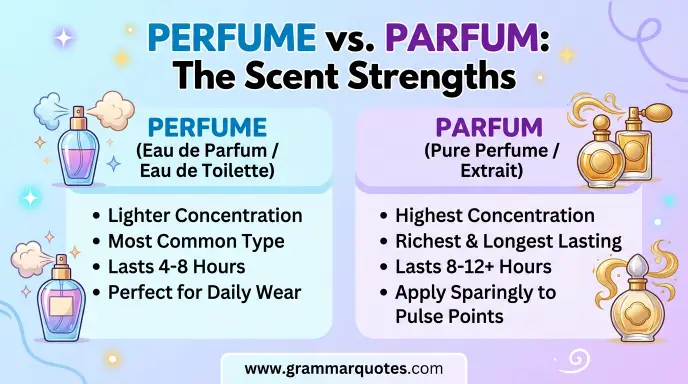
- In fragrance classification, parfum can describe a highly concentrated form of fragrance.
- Eau de Parfum is a different label from simply Parfum.
For example:
“She bought a new perfume.”
This is natural English.
“The bottle is labeled parfum.”
This is also correct when referring to the wording on the product.
“This parfum has a rich floral scent.”
This can work, especially in fragrance related writing, although perfume is usually more natural in everyday English.
The important point is that the words are not always interchangeable in every technical context.
What Does Perfume or Parfum Mean?
Perfume is a scented substance designed to give a pleasant smell. In everyday English, the word can refer to the finished fragrance worn on the body.
The term can also be used more broadly for fragrance products.
Parfum has two main uses.
First, it is the French word for “perfume” or “fragrance.”
Second, fragrance companies often use parfum as a product label. In this context, it may indicate a fragrance with a relatively high amount of aromatic compounds.
This creates an important distinction.
When someone says:
“I love this perfume.”
They are using a normal English noun.
When a bottle says:
“Parfum”
The word may be part of the product’s formal fragrance classification.
Is Parfum Stronger Than Perfume?
This question is slightly misleading because perfume is a broad English term.
A person may use “perfume” to describe almost any fragrance worn on the skin. Parfum, however, can be used as a specific concentration category.
In general fragrance terminology, products are often discussed in a rough concentration range:
- Parfum or extrait
- Eau de Parfum
- Eau de Toilette
- Eau de Cologne
These categories are not governed by one universal worldwide standard. Brands can use terms differently, so the label alone does not guarantee a specific concentration.
The Origin of Perfume or Parfum
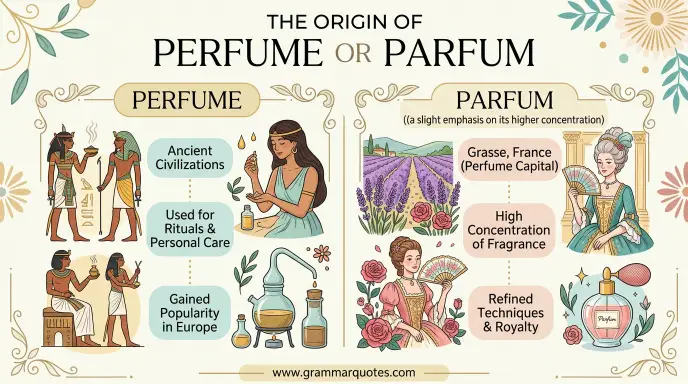
The two words have a shared linguistic connection.
The English word perfume came through French from Latin roots associated with producing fragrance through smoke or burning aromatic substances. This connects to the Latin expression per fumum, meaning “through smoke.”
This makes sense historically because early perfumes often involved aromatic materials that were burned or used in religious and ceremonial settings.
Parfum is the French form of the word.
English borrowed many words from French over centuries. Perfume became the common English form, while parfum remained strongly associated with French and later became common in international fragrance branding.
Today, both terms can appear in English speaking markets.
That is why a shopper may see:
- perfume
- parfum
- eau de parfum
- eau de toilette
- extrait de parfum
These labels have related meanings, but they are not all identical.
British English vs American English
Unlike spelling pairs such as colour and color, there is no major British versus American spelling difference between perfume and parfum.
Both forms can appear in either variety of English.
| Term | British English | American English | Typical Use |
| Perfume | Common | Common | Everyday English |
| Parfum | Used | Used | French term and fragrance labeling |
| Eau de Parfum | Common | Common | Fragrance category |
| Eau de Toilette | Common | Common | Fragrance category |
| Fragrance | Common | Common | General or neutral term |
The main difference is context, not regional spelling.
British and American consumers may both see parfum on international fragrance packaging. Product names are often kept in their original form for branding.
What Do Style Guides Prefer?
For general English writing, perfume is usually the safest and clearest choice.
Use parfum when:
- You are quoting a product label.
- You are discussing French terminology.
- The brand officially calls the product parfum.
- You are explaining fragrance concentration.
- The exact product category matters.
For a general audience, writing “perfume” is usually easier to understand.
Which Version Should You Use?
The best choice depends on your audience and purpose.
United States
Use perfume in normal conversation and general writing.
Example:
“I bought a new perfume yesterday.”
Use parfum when discussing a specific product name or fragrance classification.
United Kingdom
The same general rule applies.
Perfume is the natural everyday term, while parfum is common on fragrance labels and in specialist writing.
Canada
Both terms are understood.
For simple English, perfume is usually the better choice. Keep parfum when it appears as part of the official product name or description.
Australia
Use perfume for ordinary communication.
Use parfum when the context is the fragrance industry or a product label.
International Writing
For a global audience, perfume is usually the clearest term.
If you are explaining fragrance types, you can introduce the other term:
“Parfum, also called perfume extract, is generally a highly concentrated fragrance format.”
Academic Writing
Choose the term based on the subject.
A paper about language may discuss the French word parfum. A paper about cosmetics may use perfume as a general term and parfum as a product category.
Business Writing
Follow the product’s official naming.
If a company sells “Eau de Parfum,” do not casually rename it “perfume” when the exact product category matters.
Common Mistakes
Mistake 1: Thinking Parfum Is Wrong English
Incorrect idea:
“Parfum is not an English word, so it must be wrong.”
Better understanding:
“Parfum is a French word that is also widely used in English fragrance terminology.”
Memory tip:
Think parfum = French fragrance term.
Mistake 2: Assuming Perfume and Parfum Always Mean Exactly the Same Thing
Incorrect:
“Every perfume is technically a parfum.”
Better:
“Perfume is a broad term, while parfum may refer to a specific fragrance format.”
The exact meaning depends on context.
Mistake 3: Confusing Parfum With Eau de Parfum
These terms are related but should not automatically be treated as identical.
Parfum generally refers to a more concentrated fragrance category.
Eau de Parfum is another fragrance concentration category.
Brand terminology can vary, so check the product information.
Mistake 4: Using Parfum in Casual Writing
This is not always grammatically wrong, but it can sound unnatural.
Instead of:
“I need to buy some parfum.”
A more natural everyday sentence is:
“I need to buy some perfume.”
Mistake 5: Assuming Concentration Guarantees Longevity
A higher fragrance concentration can be associated with longer wear, but longevity also depends on the formula, ingredients, skin, climate, and application.
Memory tip:
Concentration affects performance, but it does not tell the whole story.
Everyday Examples
Emails
Natural:
“Could you send me the details of the perfume collection?”
When referring to a product:
“Please confirm if the item is classified as parfum or eau de parfum.”
Business Writing
A fragrance company might write:
“Our new parfum features floral and woody notes.”
Here, parfum works because the company is using it as part of its product terminology.
News Headlines
A headline might say:
Luxury Brand Launches New Perfume Collection
Or:
French House Introduces New Parfum
Both can work depending on the story and product.
Blogs
A beauty blogger might write:
“This perfume has a fresh citrus opening.”
Later, the same article might say:
“The parfum concentration gives the scent a richer feel.”
This is a natural way to distinguish the broad product from its specific category.
Social Media
Common:
“This is my favorite perfume!”
More product focused:
“The new parfum is finally here.”
Academic Writing
A paper about fragrance history might say:
“Perfume has been used in many cultures for centuries.”
A paper about terminology might say:
“The French term parfum is widely used in the international fragrance industry.”
Daily Conversation
Most people would naturally say:
“What perfume are you wearing?”
They are much less likely to say:
“What parfum are you wearing?”
That second sentence is understandable, but it sounds more specialized or brand focused.
Google Trends & Modern Usage
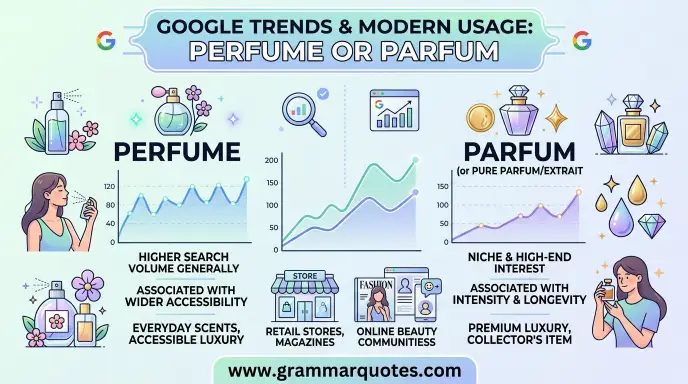
People search for this comparison because fragrance labels often mix everyday English with French terminology.
Search intent commonly includes questions such as:
- Is parfum the same as perfume?
- What does parfum mean?
- Is parfum stronger than perfume?
- Is eau de parfum the same as parfum?
- What is the difference between perfume and parfum?
- Which lasts longer?
- Is parfum better than perfume?
The exact search volume for these phrases can change over time and by country. Without a live dataset, it would be misleading to claim specific numbers.
The general pattern is clear, though. Perfume is the broader everyday English term, while parfum has a stronger connection to product labeling and specialist fragrance language.
Modern fragrance websites also use French terms because they are traditional in the industry and can help define product categories.
For , a useful article should therefore answer both the language question and the shopping question. Simply saying “they mean the same thing” leaves out important information about fragrance concentration.
Quick Comparison Table
| Version | Meaning | Correct? | Region | Example |
| Perfume | General fragrance term | Yes | Global English | “She bought a perfume.” |
| Parfum | French term and fragrance label | Yes | International | “The bottle says parfum.” |
| Eau de Parfum | A fragrance concentration category | Yes | International | “I prefer eau de parfum.” |
| Eau de Toilette | A lighter fragrance category | Yes | International | “He wears eau de toilette.” |
| Fragrance | Broad term for scented products | Yes | Global English | “This fragrance smells fresh.” |
Perfume vs Parfum at a Glance
| Feature | Perfume | Parfum |
| Language origin | English usage via French | French |
| Everyday English | Very common | Less common |
| Used on labels | Common | Very common |
| Can describe fragrance generally? | Yes | Sometimes |
| Can describe a concentration category? | Sometimes, broadly | Yes, commonly |
| Correct word? | Yes | Yes |
| Best for simple writing | Usually | When context requires it |
Key Takeaways
- Perfume is the standard everyday English word.
- Parfum is the French word for perfume and is common on fragrance labels.
- Both terms are correct.
- Parfum can also describe a specific, highly concentrated fragrance category.
- Eau de Parfum and Parfum are related but are not automatically identical.
- British and American English generally use the same spellings.
- Use perfume for simple, general English.
- Use parfum when the product label or technical fragrance context calls for it.
FAQs
Is parfum the same as perfume?
They are closely related, but the terms are not always identical in every context. Parfum is the French word for perfume and is widely used in fragrance labeling. In the industry, it can also refer to a highly concentrated fragrance category. Perfume is broader and is the normal everyday English term.
Is parfum stronger than perfume?
It can be, but this question needs context. Perfume is a broad term and can describe fragrance products at different concentration levels. Parfum is often used for a highly concentrated fragrance format. However, concentration does not always predict how long a scent will last.
Is parfum a French word?
Yes. Parfum is a French word meaning perfume or fragrance. The term has also become common in international fragrance marketing. That is why you may see it on products sold in English speaking countries.
Should I say perfume or parfum?
For normal English conversation and general writing, perfume is usually the best choice. Use parfum when discussing a product that uses that term, quoting a label, or talking about fragrance classifications. This keeps your wording natural and clear.
Is eau de parfum the same as parfum?
No, they are related but generally treated as different fragrance categories. Parfum usually indicates a higher concentration category, while eau de parfum is another established format. Exact concentration ranges can vary by brand, so product specifications are more reliable than the name alone.
Which lasts longer, parfum or eau de parfum?
Parfum often has a higher fragrance concentration than eau de parfum and may last longer, but this is not guaranteed. Ingredients, formula, skin type, weather, and application all affect performance. A well made eau de parfum can sometimes last longer than a particular parfum.
Is parfum better than perfume?
There is no universal winner. Perfume is a broad term, so comparing the two as if they were always separate products can be misleading. If you mean parfum versus another concentration, the best choice depends on your preferred strength, scent, price, and how long you want it to last.
Why do perfume bottles say parfum?
Many fragrance brands use French terminology because of the long association between French culture and the perfume industry. The word can also identify a particular fragrance category. Therefore, seeing parfum on a bottle does not mean the product is mislabeled.
Is parfum used in American English?
Yes. Americans commonly use parfum when reading fragrance labels or discussing fragrance products. However, perfume is much more natural in ordinary conversation. For example, “What perfume are you wearing?” sounds more natural than “What parfum are you wearing?”
Can I use perfume and parfum interchangeably?
Sometimes, but not always. In casual conversation, perfume can often replace parfum when you simply mean a fragrance. In product descriptions and technical discussions, keep the original term because it may identify a specific fragrance category.
Conclusion
The choice between perfume or parfum is easier once you separate everyday English from fragrance terminology. Perfume is the normal English word for a scented product. Parfum is the French equivalent and is also widely used by fragrance brands and the wider beauty industry.
The two words can refer to the same general idea, but parfum may have a more specific meaning when it appears as a fragrance concentration category. It should also not be confused automatically with eau de parfum, which is a separate category.
There is no major British versus American spelling issue. Both forms can appear in English, although perfume is usually the clearer choice for everyday communication. If you are writing about a specific product, use the terminology shown by the manufacturer.
The simplest rule is this: use perfume when you mean fragrance in general, and use parfum when the French or product label context matters.
When in doubt, choose the word your reader understands fastest: perfume.
Discover More Articles!
Portland OR ZIP Code: ZIP Codes, Areas, and Address Information
Tower or Terror: Definitions, Examples, and Common Mistakes
Beijing or Shanghai: Which City Should You Choose?(2026)

Ethan Parker is an English-language writer known for his interest in words, language, and clear communication. His work focuses on making everyday English easier to understand through simple explanations and practical examples.