Youth vs Youths What is the difference between “youth” and “youths”? Learn when to use each word, with simple grammar rules, meanings, and everyday examples.
People often search for youth or youths because they see both forms in books, news reports, school writing, and everyday English.
They may wonder if “youths” is grammatically correct or if “youth” should always be used for a group. The answer depends on meaning and context.
For example, you can say, “He spent his youth in London,” but “Several youths joined the event.” You can also say, “The youth of today face many challenges.”
This guide explains the difference in simple terms. You will learn when to use youth, when to use youths, which form works best in formal writing, and how to avoid common mistakes.
Youth or Youths : Quick Answer
Both youth and youths are correct, but they are not always interchangeable.
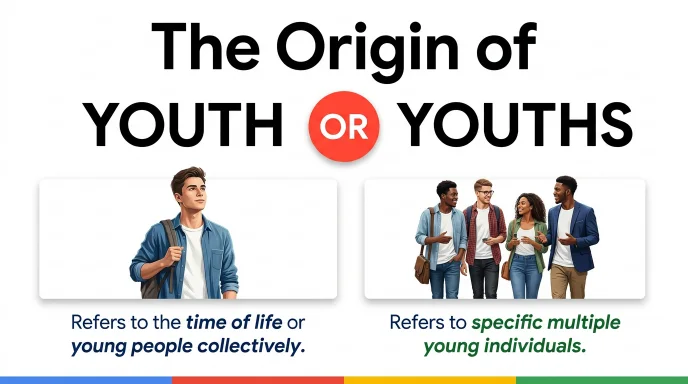
- Youth = the state or period of being young.
- Youth = young people considered as a group.
- Youth = one young person, especially a young man, in some contexts.
- Youths = more than one young person.
Examples
Youth as a life stage:
She spent her youth in the countryside.
Youth as a group:
The youth of the country have many new opportunities.
Youth as one person:
A young youth stood near the gate.
Youths as several people:
Three youths entered the building.
Merriam Webster lists youths as the plural of youth, while Cambridge also gives “youth” as a word for young people generally and “youths” for multiple young people.
The Origin of Youth or Youths
The word youth is very old. Merriam Webster traces it to Middle English youthe, from Old English geoguth, related to the idea of being young. Its recorded use goes back to before the 12th century.
Over time, youth developed several meanings. It came to describe:
- The period when someone is young.
- The quality of being young.
- A young person.
- Young people as a group.
The plural youths developed naturally when youth was used as a countable noun for individual young people.
So, there is no spelling mistake in youths. It is simply the plural form of youth.
The important point is that youth can be both an abstract noun and a countable noun. That is why its plural use depends on the meaning.
British English vs American English Spelling
There is no major British versus American spelling difference between youth and youths. Both varieties use the same spellings.
The main difference is meaning and context, not spelling.
| Meaning | British English | American English |
| Period of being young | youth | youth |
| Young people as a group | youth | youth |
| One young person | youth | youth |
| More than one young person | youths | youths |
| Youth related | youth | youth |
Cambridge gives examples such as “the youth of today” for young people generally and “gangs of youths” for multiple young people.
Simple rule
Do not choose youths because you are writing British English or American English. Choose it because you are talking about separate young people.
Which Spelling Should You Use?
There is no need to choose between British and American spelling here because youth and youths are spelled the same in both forms of English.
Instead, choose the word based on your meaning.
Use “youth” for a general idea
Use youth when talking about the period of being young.
He enjoyed his youth.
Use it for young people as a group:
The youth are important to the future of the country.
It is also common before another noun:
youth culture
youth programs
youth employment
youth sports
Use “youths” for individual young people
Use youths when you mean several young people as separate individuals.
Two youths were waiting outside.
The police spoke to several youths.
For modern professional writing, young people is often clearer and more neutral than youths, especially when referring to a mixed group.
Common Mistakes with Youth or Youths
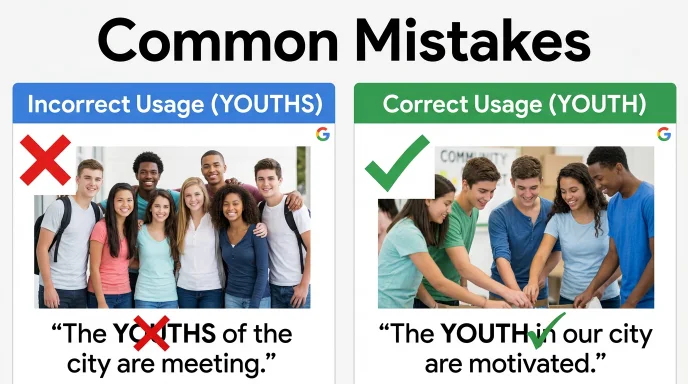
Mistake 1: Thinking “youths” is always wrong
Incorrect idea:
“Youths” is not a real plural.
Correction:
Several youths attended the meeting.
Youths is a valid plural form.
Mistake 2: Using “youths” for the period of life
Incorrect:
He spent his youths in Pakistan.
Correct:
He spent his youth in Pakistan.
Here, youth means the period of being young.
Mistake 3: Using “youth” when individual people are meant
Less precise:
Three youth entered the store.
Better:
Three youths entered the store.
Or, in many modern contexts:
Three young people entered the store.
Mistake 4: Adding an apostrophe
Incorrect:
The youth’s of the city joined the program.
Correct:
The youths of the city joined the program.
The apostrophe is not needed for a simple plural.
Mistake 5: Assuming “youth” always means one person
It does not. Youth can also refer to young people collectively.
The youth of today face new challenges.
Cambridge specifically lists this collective meaning.
Youth or Youths in Everyday Examples
Understanding real examples makes the difference much easier.
In emails
Our program supports youth education.
Here, youth refers to young people generally.
Several youths attended the training session.
Here, youths refers to separate young people.
In news writing
Police questioned two youths after the incident.
This use is grammatically correct, and news sources commonly use youths for multiple young people.
In social media
Investing in youth creates a stronger future.
Here, youth means young people as a group.
In formal writing
The project aims to improve employment opportunities for youth.
This is a common collective use.
In personal writing
I remember my youth with great happiness.
Here, youth means the period of being young.
Youth or Youths : Google Trends & Usage Data
Search interest for youth and youths can change by country, topic, and time. The two words also have different meanings, so search volume alone does not tell the whole story.
Youth is a broad term. It appears in searches about education, employment, sports, culture, politics, development, and the stage of life.
Youths is more specific. It is mainly used when people are looking for information about multiple young individuals or when they encounter the plural form in news and formal reports.
For example, searches related to:
- youth employment
- youth programs
- youth development
- youth culture
- youth sports
usually use youth because it works as a broad collective or descriptive term.
Searches involving several individual young people may use youths.
Google Trends results can vary by selected country, date range, and search category, so there is no single worldwide ranking that permanently proves one form is “better.” For writing purposes, the stronger rule is to choose the form that matches your intended meaning.
Youth vs Youths: Comparison Table
| Word | Main Meaning | Number | Example |
| Youth | Period of being young | Uncountable | She enjoyed her youth. |
| Youth | Young people as a group | Collective | The youth need support. |
| Youth | One young person | Singular | A youth approached him. |
| Youths | Several young people | Plural | Several youths arrived. |
Quick memory trick
Think of it this way:
Youth = young age or a group
Youths = individual young people
This simple rule will solve most youth or youths questions.
FAQs
1. Is “youths” a correct word?
Yes. Youths is the standard plural form of youth when referring to multiple young people.
2. Is “youth” singular or plural?
It can be both, depending on its meaning. It can refer to one young person, a group of young people, or the period of being young.
3. What is the plural of youth?
The plural of youth is youths when you mean multiple individual young people.
4. Can I say “the youths”?
For example:
The youths joined the event.
It means several young people.
5. Should I say “youth” or “young people”?
Both can be correct. Young people is often clearer and more neutral when you mean individual people. Youth is common in formal, social, educational, and policy contexts.
6. Is “youth” countable or uncountable?
It can be either. It is uncountable when it means the state or period of being young, and it can be countable when it means a young person. Cambridge identifies these different uses.
7. Is “youths” used in British and American English?
Yes. Youths is used in both British and American English. The difference is not a spelling rule between the two varieties.
Conclusion
The choice between youth or youths is simple once you understand the meaning. Youth is used for the period of being young, the quality of being young, and young people as a group. It can also describe one young person in certain contexts. Youths is the plural form when you mean several individual young people.
For example, “She spent her youth abroad” talks about a stage of life. “The youth need better opportunities” refers to young people as a group. But “Several youths joined the event” refers to separate young people.
There is no important British versus American spelling difference here. Both varieties use youth and youths. The real choice is based on meaning.
For professional and modern writing, youth is often best for broad topics such as youth education, youth employment, and youth culture. When you mean separate individuals, youths is grammatically correct. When clarity matters most, young people is often an excellent alternative.
Discover More Articles!
Potatoe or Potato: Is “Potatoe” a Correct Word?
Ques or Cues: Meaning, Usage, and Examples
Buying or Renting: Which Is Better for You?

Hi,I am a Adrian walker. I’m passionate about making English grammar simple and easy to understand. I write clear comparisons that explain confusing words, spelling differences, and common grammar mistakes so readers can write with confidence. My goal is to provide accurate, practical, and easy-to-follow language guides for learners and writers worldwide.