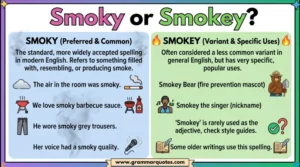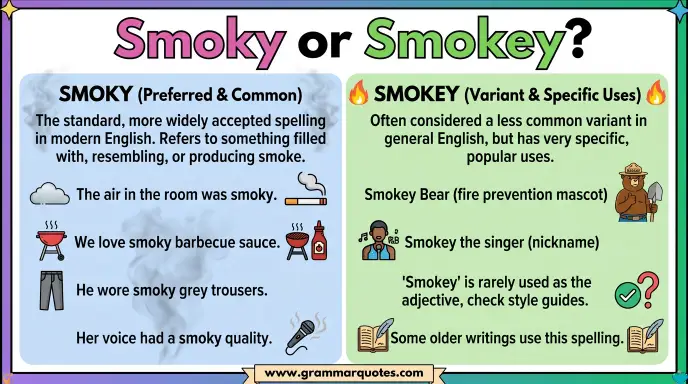
Have you ever wondered if “smoky” or “smokey” is the correct spelling? Both forms exist, but smoky is the standard and preferred spelling when describing something filled with smoke or having a smoky smell, taste, or appearance. Smokey is also recognized as a variant and is commonly seen in proper names, such as Smokey Bear.
The confusion is easy to understand. Both words sound the same, and the extra “e” in smokey may look natural because the word comes from smoke. However, the spelling you choose can depend on the context.
For example, you would normally write “a smoky room” or “a smoky flavor.” If you are writing the established name Smokey Bear, you should keep its original spelling.
In this guide, you will learn the meaning of each form, how to use it in a sentence, if British and American English differ, and which spelling works best in formal writing. You will also find practical examples, common mistakes, and simple tips to help you remember the difference.
Smoky or Smokey: Quick Answer
The main difference is how the words are commonly used.
| Word | Meaning or use | Example |
| Smoky | The standard adjective related to smoke | The kitchen became smoky. |
| Smokey | A variant spelling; also used in names | Smokey Bear is a well known character. |
Quick rule: Use smoky for ordinary descriptions. Use Smokey when it is the established spelling of a name, or retain smokey when a particular source intentionally uses that variant.
Are you writing about food, air, a smell, or a color? In most cases, smoky is the better choice.
What Does Smoky Mean? Definition and Meaning
Smoky is an adjective that describes something containing smoke, producing smoke, or resembling smoke in smell, taste, color, or appearance.
The word can describe both literal smoke and qualities that remind us of smoke.
1. Smoky Means Filled With Smoke
Use smoky when a place or object contains a noticeable amount of smoke.
Example: The kitchen became smoky after the food burned.
This means that smoke filled the kitchen.
Another example:
The fireplace left the room smoky.
Here, smoky describes the condition of the room.
2. Smoky Means Having a Smoke Like Smell or Taste
The word can also describe food, drinks, or other things with a smell or flavor similar to smoke.
Example: The grilled vegetables had a rich, smoky flavor.
This means the vegetables had a taste associated with smoke or grilling.
You may also see phrases such as:
- Smoky cheese
- Smoky barbecue sauce
- A smoky aroma
- A smoky flavor
These expressions are common in food descriptions and restaurant menus.
3. Smoky Means Hazy or Smoke Like in Appearance
Smoky can describe something that looks hazy, gray, or similar to smoke.
Example: A smoky haze covered the distant hills.
The sentence describes a hazy appearance that resembles smoke.
The word can also describe colors:
She chose a smoky gray shade for the walls.
In this example, smoky refers to the appearance of the color.
What Does Smokey Mean?
Smokey is a recognized variant of smoky, although smoky remains the standard choice for most general writing.
You may encounter smokey in informal writing, product names, creative titles, nicknames, and other special uses. It is especially familiar in the proper name Smokey Bear, the well known character associated with wildfire prevention in the United States.
Consider these examples:
- Smoky: The restaurant serves smoky barbecue.
- Smokey: Smokey Bear appears in a wildfire prevention campaign.
The first example uses the standard adjective. The second uses a name whose spelling should remain unchanged.
It is important not to treat every use of smokey as automatically wrong. Some dictionaries recognize it as a variant. However, when you are writing a normal descriptive sentence, smoky is usually the clearest and most conventional choice.
The Origin of Smokey and Smoky
The word smoky comes from the noun smoke combined with the suffix y. This suffix often helps form adjectives that mean “having,” “containing,” or “characterized by” something.
For example:
- Cloud → cloudy
- Dirt → dirty
- Cream → creamy
- Smoke → smoky
The spelling may seem surprising because smoke ends with the letter e. In the standard adjective, that final e is dropped before adding y.
This gives us:
Smoke + y → smoky
The spelling smokey developed and continues to appear as a variant. It is also established in certain names. That is why both forms can appear in dictionaries and everyday writing, even though smoky is generally preferred for ordinary descriptions.
British English vs American English
Is smoky British English while smokey is American English? No. The main distinction is not a British versus American spelling rule.
Smoky is the standard, preferred adjective in both British and American English. Smokey also appears as a variant, including in American usage, and it is used in particular names.
| English variety | Preferred general spelling | Example |
| British English | Smoky | The room was smoky. |
| American English | Smoky | The chicken had a smoky flavor. |
| Canadian English | Smoky is the safe standard choice | The air looked smoky. |
| Australian English | Smoky is the safe standard choice | The sky had a smoky appearance. |
The examples use regional wording where appropriate, such as flavor in American English. The spelling of smoky itself does not change in the same way as color/colour or organize/organise.
If you are writing for a British, American, Canadian, or Australian audience, choose smoky for general descriptive writing. If you are reproducing a person’s name, product name, or official title, follow its established spelling.
Which Spelling Should You Use?
The best choice depends on what you are trying to say.
Use Smoky in Everyday Writing
Choose smoky when describing smoke, smell, taste, appearance, or color.
Correct: The room smelled smoky.
Correct: The artist used a smoky gray background.
These examples use smoky as an ordinary adjective.
Use Smoky in Academic and Business Writing
Formal writing usually benefits from standard, consistent spelling.
For example:
The report describes the effects of smoky air on visibility.
Or:
The product is known for its smoky flavor.
In both cases, smoky is the conventional choice.
Use Smokey for an Established Name
Some names are spelled with an e. Do not change that spelling just to match the standard adjective.
Example: Smokey Bear is associated with wildfire prevention.
If a person, brand, character, or product officially uses Smokey, preserve that spelling when referring to it.
What About Product Names and Marketing?
A business may intentionally choose Smokey as part of a product or brand name. That is a naming choice, not proof that it is the preferred spelling for every use of the adjective.
For example, if a product is officially called “Smokey BBQ,” use that name when referring to the product. In your own general description, you can still write “a smoky barbecue flavor.”
Common Mistakes With Smoky and Smokey
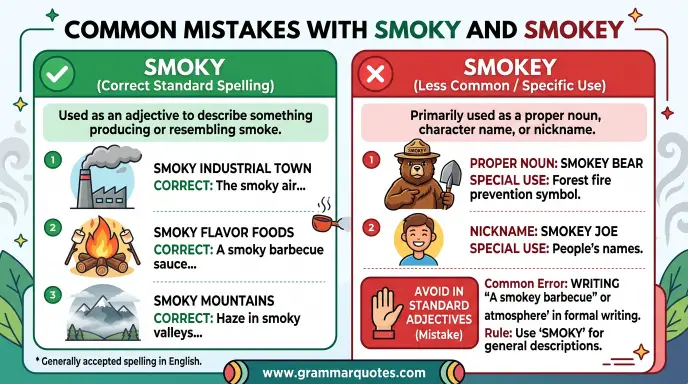
Writers often mix up these forms because they sound identical. Here are common mistakes and how to avoid them.
Mistake 1: Assuming Smokey Is Always Incorrect
Not quite: Smokey is a recognized variant and appears in proper names.
Better rule: Use smoky as the standard adjective, but preserve smokey when it is part of an established name or intentional spelling.
Mistake 2: Treating Smoky and Smokey as Regional Spellings
Incorrect assumption: British writers must use smoky, while American writers must use smokey.
Correct explanation: Smoky is the preferred general spelling in both varieties. The extra e does not mark a simple British American distinction.
Mistake 3: Using Smokey in Formal Descriptions Without a Reason
Less conventional: The room had a smokey smell.
Preferred: The room had a smoky smell.
The second version follows the standard spelling for the adjective.
Mistake 4: Changing a Proper Name
Incorrect: Smoky Bear.
Correct: Smokey Bear.
When referring to this established name, keep its official spelling.
Mistake 5: Confusing Smoky With Smoked
These words are related, but they do not always mean the same thing.
- Smoky: Having a smell, taste, appearance, or quality associated with smoke.
- Smoked: Usually describes something that has been exposed to smoke, often during cooking or preservation.
Example: The cheese has a smoky flavor.
Example: The chef served smoked cheese.
The first sentence describes flavor. The second describes how the cheese was treated or prepared.
Memory tip: For an ordinary description, remember smoke → smoky. For a special name, copy the spelling used by that name.
Everyday Examples of Smokey and Smoky
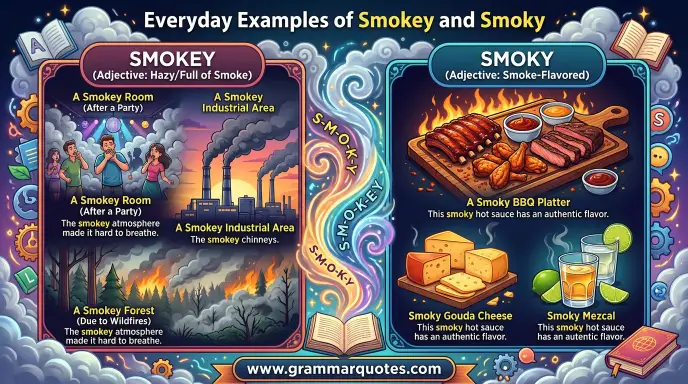
Seeing the words in context makes the difference easier to understand.
1. Daily Conversation
Correct: Why is the room so smoky?
This asks why the room contains so much smoke.
Correct: I love the smoky smell of a campfire.
Here, smoky describes the smell.
2. Food and Restaurant Writing
The restaurant is famous for its smoky barbecue sauce.
The word describes the sauce’s flavor.
The chef added smoked paprika to the recipe.
Here, smoked describes the ingredient, not the flavor directly.
3. Emails and Business Writing
The office became smoky, so the staff moved outside.
This is a straightforward description of a situation.
Our new sauce has a smoky flavor that complements grilled vegetables.
This sentence works in a product description or business email.
4. Blogs and Headlines
A writer might use headlines such as:
- How to Add a Smoky Flavor to Your Cooking
- Why Does My Kitchen Smell Smoky?
- Choosing the Right Smoky Gray Paint
These use smoky as a descriptive adjective.
5. Academic Writing
Smoke from the fire created a smoky haze over the area.
This sentence uses smoky to describe the haze.
The researchers recorded reduced visibility during smoky conditions.
This is another natural use in a formal context.
6. Names and Titles
Smokey Bear is a recognizable character in American wildfire prevention campaigns.
Here, Smokey is correct because it belongs to the name.
The key lesson is that the correct spelling depends on if you are using a general adjective or reproducing a specific name.
Google Trends and Modern Usage
People may search for both “smoky or smokey” and “smokey or smoky” because the words sound alike and the extra e seems reasonable. Some readers also encounter Smokey in names or product titles and then wonder if the same spelling works in ordinary sentences.
These are plausible reasons for the spelling question, not verified search volume findings. Without a specific Google Trends comparison, it would be misleading to claim that one version receives a particular percentage of searches or is growing faster.
For everyday writing, dictionary guidance is more useful than search popularity. Smoky is the standard choice for general descriptions, while smokey remains a recognized variant and a familiar spelling in certain names.
If you are writing an article for search engines, use the phrase “smoky or smokey” naturally in the title or introduction, then explain the distinction clearly. Avoid repeating both spellings in every paragraph just to target the keyword.
Quick Comparison Table: Smoky vs. Smokey
| Version | Meaning or role | Correct? | Typical use | Example |
| Smoky | Standard adjective | Yes | General descriptions | The room was smoky. |
| Smokey | Variant spelling | Recognized | Some informal or special uses | The menu used the spelling “smokey.” |
| Smokey | Proper name | Yes, when spelled that way officially | Names and titles | Smokey Bear is a character. |
| Smoked | Describes something exposed to smoke | Yes, in the right context | Food and preparation | We ordered smoked cheese. |
Remember: Smoky is usually the best choice for an ordinary adjective. Smokey is not universally wrong, but context matters.
Key Takeaways
- Smoky is the standard and preferred spelling for the ordinary adjective.
- Smoky describes something filled with smoke or having a smoke like smell, taste, or appearance.
- Smokey is also recognized as a variant spelling.
- Smokey appears in established names, such as Smokey Bear.
- British and American English both generally use smoky as the preferred adjective.
- Do not confuse smoky with smoked, because the words have different uses.
- In formal writing, choose smoky unless a specific name or style requires another spelling.
Frequently Asked Questions
1. Is smoky or smokey correct?
Smoky is the standard and preferred spelling when you are describing something related to smoke. Smokey is also recognized as a variant and appears in names. For everyday, academic, and professional writing, smoky is generally the safest choice.
2. Is smokey a real word?
Yes. Smokey is recognized as a variant spelling of smoky. It also appears in proper names and special uses. However, if you simply mean something filled with smoke or having a smoke like flavor, smell, or appearance, smoky is the more conventional choice.
3. Is smoky American or British English?
Smoky is used in both American and British English. It is the standard, preferred spelling of the adjective in both varieties. The difference between smoky and smokey is not a straightforward regional distinction like color and colour.
4. How do you spell smoky correctly?
The standard spelling is smoky, without an e before the final y. A simple way to remember it is to start with smoke and remove the final e before adding y: smoke → smoky.
5. Why is Smokey Bear spelled with an e?
Smokey Bear is an established proper name. The spelling of a name should be preserved, even when it differs from the standard spelling of a related adjective. That is why Smokey Bear is correct, while smoky is preferred in a general description.
6. Is “smoky flavor” correct?
Yes. Smoky flavor is a standard expression used to describe food or drinks with a taste associated with smoke, grilling, or smoking. For example, “The grilled vegetables had a smoky flavor” is a natural and correct sentence.
7. What is the difference between smoky and smoked?
Smoky describes a quality, such as a smell, taste, or appearance associated with smoke. Smoked usually describes something exposed to smoke, often during cooking or preservation. For example, smoky flavor describes taste, while smoked fish describes how the fish was prepared.
8. Can I use smokey in a brand name?
Yes. A brand or product can intentionally use Smokey in its official name. If you are referring to that particular brand, preserve its spelling. In your own general description, however, smoky is usually the standard adjective.
9. Is “smoky smell” grammatically correct?
Yes. Smoky smell is correct because smoky is an adjective describing the smell. For example, “There was a smoky smell coming from the kitchen” means that the smell resembled or came from smoke.
10. What is the easiest way to remember smoky vs. smokey?
Remember this simple rule: Use smoky for normal descriptions and preserve Smokey when it is part of a specific name. For example, write “a smoky room,” but write “Smokey Bear” when referring to the character.
Conclusion: Smoky or Smokey?
When choosing between smoky and smokey, smoky is generally the best spelling for ordinary descriptive writing. Use it for a smoky room, a smoky smell, a smoky flavor, or a smoky gray color. It is the standard, preferred adjective in both British and American English.
Smokey is not always incorrect. Dictionaries recognize it as a variant, and it appears in established names such as Smokey Bear. The important point is to consider the context rather than assuming that the extra e is always right or always wrong.
If you are unsure, ask yourself one simple question: Am I describing something, or am I using a specific name? For a normal description, choose smoky. For a name, follow its official spelling.
With this small rule in mind, you can use both forms more confidently and make your writing clearer. If you enjoy learning the differences between commonly confused English words, explore more spelling and grammar guides to strengthen your everyday writing.
Discover More Articles!
Or Bond Meaning: Definition, Examples, and How to Use It
WAV or FLAC: Which Audio Format Is Better for Music Production?
Mare or Mear: Which Spelling Is Correct?(2026)

Ethan Parker is an English-language writer known for his interest in words, language, and clear communication. His work focuses on making everyday English easier to understand through simple explanations and practical examples.