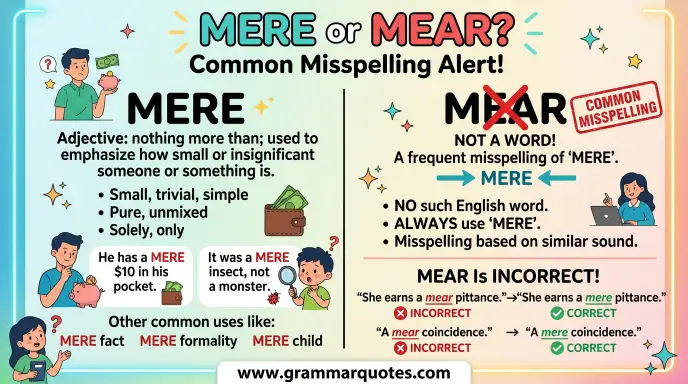
Mare is the correct spelling when referring to an adult female horse, while mear is generally a misspelling of “mare” in this context. However, “mear” can appear in historical, dialectal, or specialized contexts, so its meaning depends on how it is used.
For example, you might write, “The mare grazed peacefully in the field,” when describing a female horse. Writing “The mear grazed peacefully in the field” would be incorrect in standard English if you mean the animal.
These words can cause confusion because they look similar and may be pronounced alike in some accents. However, understanding their meanings and usage makes it easier to choose the right spelling.
if you are writing a school assignment, improving your vocabulary, or checking a word for an article, knowing the difference between “mare” and “mear” can help you avoid spelling mistakes.
In this guide, you will learn the correct spelling, definitions, origins, British and American usage, examples, common mistakes, and frequently asked questions about “mare” and “mear.”
Quick Answer: Mare or Mear?
Mare is the standard spelling for an adult female horse. “Mear” is not the standard spelling of this word in modern everyday English.
| Word | Meaning | Example |
| Mare | An adult female horse | The mare walked across the field. |
| Mear | A rare or historical form in certain contexts; usually a misspelling of “mare” when referring to a horse | Check the intended meaning before using it. |
Easy memory trick: Remember that a mare is a female horse. Associate the word with a stable or a horse grazing in a field.
Related question: Is “mear” ever correct?
“Mear” can occur in historical English, dialectal usage, or specialized names and terms. However, if you are writing about a female horse, the correct modern spelling is “mare.”
1. What Does Mare Mean?
A mare is an adult female horse. The term is commonly used in horse breeding, riding, farming, racing, and other equestrian activities.
Mares can have different breeds, sizes, colors, and temperaments. The word identifies the horse’s sex and adult status rather than its breed or appearance.
Definition and Meaning
According to its standard modern English meaning, “mare” is a noun that refers to an adult female horse.
Examples:
- The mare stood quietly beside the stable.
- The farmer cared for the mare and her young foal.
- A healthy mare can be trained for riding.
- The mare and the other horses grazed in the meadow.
The word is particularly common in conversations about horses, animal care, agriculture, and horse racing.
What Is the Difference Between Mare and Mear?
The main difference is that “mare” is the standard word for an adult female horse, whereas “mear” is not the usual spelling for that meaning.
For example:
- Incorrect: The mear gave birth to a foal.
- Correct: The mare gave birth to a foal.
The correct spelling is important because “mare” is the established term used in dictionaries and standard English writing.
2. What Does Mear Mean?
“Mear” is an uncommon word in modern everyday English. Depending on the historical or specialized context, it may appear as an older form, a dialect word, or part of a proper name.
It should not normally be used as a replacement for “mare” when referring to a female horse.
Definition and Meaning
Unlike “mare,” “mear” does not have one widely used meaning in contemporary standard English. Its interpretation depends on the source and context in which it appears.
If you encounter “mear” in an old book, historical document, regional text, or surname, check the surrounding sentence or a reliable dictionary before deciding what it means.
Examples:
- If you mean a female horse, write: The mare ran across the field.
- If “Mear” appears as a surname, preserve its spelling as a proper name.
- If you find “mear” in an older text, examine the historical context before interpreting it.
Is Mear a Real Word?
“Mear” does occur in some historical and specialized contexts, but it is not the standard modern English word for an adult female horse.
For everyday writing, choose “mare” when describing the animal.
3. Origin of the Words Mare and Mear
Understanding the history of a word can help explain its spelling and meaning.
Origin of Mare
The English word “mare” comes from Old English mære, with related forms found in other Germanic languages. It has long been used to identify a female horse.
The word has remained part of English vocabulary for centuries and is still common in equestrian terminology.
For example, a horse breeder might refer to a mare when discussing breeding, pregnancy, or the care of adult female horses.
Origin of Mear
The form “mear” has appeared in older and regional English usage, but it does not serve as the standard spelling of the horse related word in contemporary English.
Because historical spellings can vary by region and period, its meaning should be established from the particular text in which it appears rather than assumed from its resemblance to “mare.”
4. Mare vs Mear in British and American English
A common question is if British and American English use different spellings for this word.
The answer is no. Mare is the standard spelling in both British and American English.
| Feature | British English | American English |
| Adult female horse | Mare | Mare |
| Common misspelling for this meaning | Mear | Mear |
| Plural form | Mares | Mares |
| Pronunciation | Generally /meə/ | Generally /mer/ |
| Standard spelling difference | None | None |
Pronunciation varies by accent. In many British accents, “mare” has a vowel similar to the word “air,” while in many American accents it sounds like “mair.”
Is Mare Spelled Differently in the UK and US?
No. Both varieties use “mare” for an adult female horse.
Examples:
- British English: The mare was grazing near the farm.
- American English: The mare was grazing near the farm.
The spelling remains the same.
5. How to Remember the Correct Spelling of Mare
If you often confuse “mare” with “mear,” these simple techniques can help.
Method 1: Associate Mare With a Horse
Picture an adult female horse standing in a stable.
Remember the sentence:
A mare is a female horse.
Repeating this association can help you recall the correct spelling.
Method 2: Memorize the Letters
The correct spelling is:
M A R E
The letter “A” comes immediately after “M,” followed by “R” and “E.”
Method 3: Practice With a Sentence
Write this sentence a few times:
The mare walked beside her foal.
Using the word in context is often more effective than memorizing the spelling alone.
6. Everyday Examples of Mare
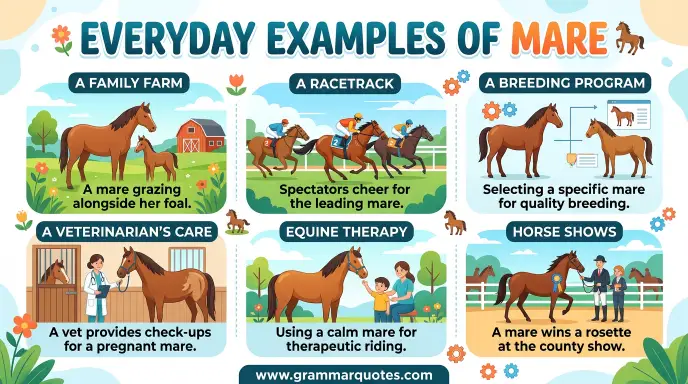
Here are ten examples showing how to use “mare” correctly in everyday English.
- The mare grazed quietly in the green pasture.
- The farmer brought the mare into the stable.
- A young foal followed its mare across the field.
- The mare received veterinary care after the journey.
- The rider prepared the mare for a competition.
- The brown mare stood near the wooden fence.
- The mare rested after a long day of riding.
- The trainer worked patiently with the nervous mare.
- The mare and her foal stayed close to each other.
- The horse breeder selected a healthy mare for breeding.
These examples demonstrate that “mare” is appropriate in conversations about horse care, farming, riding, and animal behavior.
7. Common Mistakes When Using Mare and Mear
Similar looking words can easily be confused, particularly when their pronunciation is close.
Mistake 1: Writing Mear Instead of Mare
Incorrect: The mear was running across the field.
Correct: The mare was running across the field.
If the sentence refers to a female horse, always use “mare.”
Mistake 2: Assuming Mear Is the British Spelling
Incorrect: “Mear” is British English, while “mare” is American English.
Correct: “Mare” is standard in both British and American English.
There is no standard regional spelling difference for this meaning.
Mistake 3: Confusing Mare With Mayor
“Mare” and “mayor” are different words.
- Mare: An adult female horse.
- Mayor: The elected or appointed head of a town or city government.
Example: The mayor visited the farm where the mare was kept.
Mistake 4: Forgetting the Plural Form
The plural of “mare” is mares.
Incorrect: Three mare were standing near the stable.
Correct: Three mares were standing near the stable.
Adding “ s” makes the word plural.
8. Mare vs. Mear: Which Word Should You Use?
Use “mare” when discussing an adult female horse. If you encounter “mear” in a historical document or as part of a name, examine its context before deciding how to interpret it.
| Situation | Correct choice |
| Describing an adult female horse | Mare |
| Writing about horse breeding | Mare |
| Describing a horse with a foal | Mare |
| Referring to multiple adult female horses | Mares |
| Quoting an older text containing “mear” | Preserve the original spelling when appropriate |
| Writing about a person whose surname is Mear | Mear, if that is the person’s correct name |
Which Word Is More Common?
“Mare” is the common, standard word used in modern English to describe an adult female horse.
“Mear” is uncommon in general writing and should not be used as a substitute for “mare” in this context.
9. Frequently Asked Questions
1. Is it mare or mear?
“Mare” is correct when referring to an adult female horse. “Mear” is not the standard spelling for this meaning.
2. Is mear a misspelling of mare?
In a sentence about a female horse, yes. However, “mear” may appear in historical or specialized contexts, so its status depends on the intended meaning.
3. What does mare mean?
A mare is an adult female horse.
4. What is the plural of mare?
The plural is “mares.”
Example: The mares grazed together in the pasture.
5. Is mare the same in British and American English?
Yes. Both British and American English use “mare” to describe an adult female horse.
6. How do you pronounce mare?
Pronunciation varies by accent. It is generally pronounced like “air” with an “m” at the beginning in many British accents, and like “mair” in many American accents.
7. What is the opposite of a mare?
The usual corresponding term for an adult male horse is “stallion” if the horse is an intact adult male. “Gelding” refers to a castrated male horse.
8. Can mare refer to something other than a horse?
Yes. In astronomy, mare is a Latin word used for a large, dark plain on the Moon, such as Mare Imbrium. The plural in lunar terminology is often “maria.”
9. Is mear used in old English texts?
The spelling may appear in historical or regional material. Its precise meaning depends on the text, period, and context.
10. How can I remember mare vs. mear?
Remember the sentence “A mare is a female horse.” The standard spelling is M A R E.
Conclusion
The correct spelling for an adult female horse is mare, not “mear.” Although “mear” may appear in historical, dialectal, or specialized contexts, it is not the standard modern English spelling for the animal.
Use “mare” when writing about horses, horse breeding, riding, or animal care. The same spelling is used in both British and American English, and its plural form is “mares.”
Remember the simple rule: Mare means a female horse. By learning the definition and practicing a few examples, you can avoid this common spelling confusion and make your English writing more accurate.
Discover More Articles!
Sleave vs Sleeve: Meaning, Difference, and Examples
Southpaw or Orthodox: What Is the Difference?(2026)
Aldi or Lidl: What Is the Difference?

Ethan Parker is an English-language writer known for his interest in words, language, and clear communication. His work focuses on making everyday English easier to understand through simple explanations and practical examples.