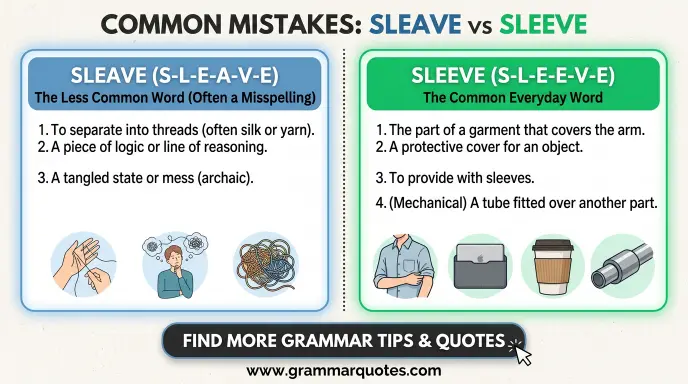
Sleeve is the correct and common English word for the part of a garment that covers the arm. Sleave is a rare word with specialized or historical meanings, including a loose or untwisted strand of silk. These words look similar, but they are not interchangeable in everyday English.
For example, you might say, “The shirt has a long sleeve,” when describing a piece of clothing. However, using “sleave” in this sentence would be incorrect for the intended meaning.
Understanding the difference between these words can help you avoid spelling mistakes in school assignments, emails, product descriptions, and everyday writing. It is especially useful when discussing clothing, sewing, fabrics, and older texts.
In this guide, you will learn what sleave and sleeve mean, how to use them in sentences, and why people sometimes confuse them. You will also discover common mistakes, practical examples, and answers to frequently asked questions.
Quick Answer: Sleave vs Sleeve
- Sleeve: The part of a shirt, jacket, dress, or other garment that covers the arm.
- Sleave: A rare, specialized, or historical word, often associated with loose or untwisted silk thread.
Examples:
- My shirt has a long sleeve.
- In historical textile terminology, sleave can refer to loose or untwisted silk.
Easy rule: When talking about clothing, use sleeve.
What Does Sleeve Mean?
Sleeve is a noun that usually refers to the part of a garment that covers all or part of the arm. Sleeves can be long, short, tight, loose, or designed in many different styles.
The word also has other meanings in everyday English. For example, a record sleeve protects a vinyl record, while a protective sleeve can hold or cover an object.
Definition and Meaning of Sleeve
- Part of speech: Noun; it can also be used as a verb in some contexts.
- Pronunciation: sleev
- Plural: Sleeves
Examples:
- The jacket has long sleeves.
- She rolled up her sleeves before painting the wall.
- He put the document in a protective sleeve.
- The dress has beautiful lace sleeves.
- The record came in a colorful paper sleeve.
Common Uses of Sleeve
1. Clothing
A sleeve is the part of a garment that covers the arm.
Example: “The sleeves of this sweater are too long.”
2. Protective covering
A sleeve can be a cover for an item such as a document, laptop, or record.
Example: “Keep the photograph in a protective sleeve.”
3. Idiomatic expression
The phrase have something up your sleeve means to have a secret plan, idea, or advantage.
Example: “The team may have another strategy up its sleeve.”
What Does Sleave Mean?
Sleave is a rare English word that is mainly encountered in historical or specialized contexts. It has been used to describe loose, untwisted, or separated silk thread.
Unlike sleeve, it is not the normal word for the part of a shirt or jacket that covers the arm.
Definition and Meaning of Sleave
- Part of speech: Noun in its specialized textile sense.
- Pronunciation: Commonly pronounced like sleeve.
- Usage: Rare, historical, or technical.
Examples:
- The old textile glossary used sleave for loose silk thread.
- The historical description referred to sleave before the silk was twisted.
- The researcher explained the rare word sleave in a discussion of traditional textiles.
These examples illustrate the specialized meaning; most modern readers will be much more familiar with sleeve.
Is Sleave a Misspelling of Sleeve?
Not always. Sleave is a real word, but it is uncommon. If you are describing clothing, however, it is almost certainly a spelling mistake.
For example:
- Incorrect for clothing: “My shirt has a short sleave.”
- Correct: “My shirt has a short sleeve.”
The intended meaning determines if the word is appropriate.
Sleave vs Sleeve: Key Differences
| Feature | Sleave | Sleeve |
| Meaning | A rare term associated with loose or untwisted silk | A garment part or protective covering |
| Common usage | Rare and specialized | Very common |
| Typical context | Historical textile terminology | Clothing and protective covers |
| Example | The glossary defines sleave as loose silk thread. | The shirt has a short sleeve. |
| Best everyday choice | Only when the specialized meaning is intended | When discussing clothing |
The main difference is usage. Sleeve is the standard word for clothing, while sleave has a narrow and uncommon meaning.
When Should You Use Sleave or Sleeve?
Choosing the correct word becomes easier when you consider what you are describing.
Use Sleeve for Clothing
Use sleeve when referring to the part of a shirt, coat, dress, or other garment that covers the arm.
Examples:
- The shirt has a blue sleeve.
- His jacket sleeves are too short.
- She repaired the torn sleeve.
- This dress has a loose sleeve design.
If your sentence is about fashion, tailoring, or clothing, sleeve is usually the correct word.
Use Sleave in Specialized Contexts
Use sleave only when the intended meaning relates to its rare historical or textile use.
Example:
- The textile historian explained the meaning of sleave in an old document.
If you are unsure if this rare word is appropriate, check a reliable dictionary or the specific historical source you are reading.
Common Mistakes with Sleave and Sleeve
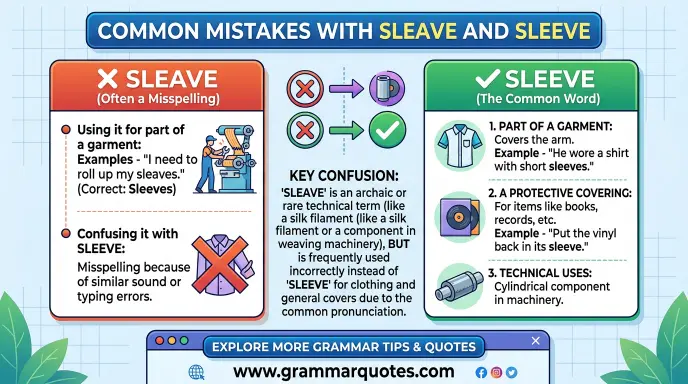
Mistake 1: Writing Sleave Instead of Sleeve
Incorrect: My shirt has a long sleave.
Correct: My shirt has a long sleeve.
Why? The sentence refers to clothing, so sleeve is the correct word.
Mistake 2: Using Sleave in a Clothing Advertisement
Incorrect:
Stylish shirts with full sleaves.
Correct:
Stylish shirts with full sleeves.
Why? Clothing descriptions use sleeve and its plural form sleeves.
Mistake 3: Assuming Sleave Is Never a Word
Incorrect assumption: “Sleave” is always a spelling error.
Correction: Sleave is a genuine but rare word with specialized or historical meanings. It is simply not the usual word for a garment part.
Mistake 4: Confusing Sleeve with Sleeves
Use sleeve for one garment part and sleeves for more than one.
Examples:
- The shirt has one short sleeve.
- The jacket has two long sleeves.
Sleeve or Sleave: Everyday Examples
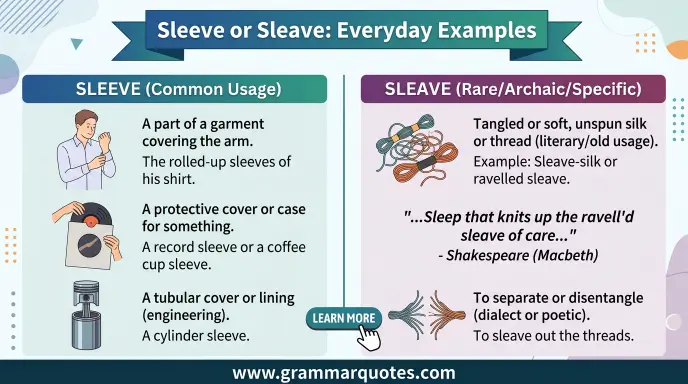
| Context | Correct Example |
| Clothing | The shirt has a short sleeve. |
| Fashion | She likes dresses with long sleeves. |
| Sewing | I need to repair the torn sleeve. |
| Laundry | Roll up your sleeves before washing the clothes. |
| Protection | Place the document inside a plastic sleeve. |
| Music | The vinyl record has a paper sleeve. |
| Idiom | He has a clever plan up his sleeve. |
| Historical textiles | The glossary explains the rare term sleave. |
These examples show that sleeve appears in many modern contexts, while sleave is mainly relevant to specialized vocabulary.
Sleeves vs Sleeve: What Is the Difference?
Sleeve is singular, while sleeves is plural.
Examples:
- This shirt has one short sleeve.
- These shirts have short sleeves.
- The left sleeve is damaged.
- Both sleeves need to be repaired.
Remember to use the singular form for one sleeve and the plural form for two or more.
Origin and History of Sleave and Sleeve
Origin of Sleeve
The word sleeve has a long history in English and comes from Old English slīefe. It has been used for the part of clothing that covers the arm for many centuries.
Over time, its use expanded to include protective coverings for other objects, such as records and documents.
Origin of Sleave
Sleave has historical associations with textile terminology, particularly loose or untwisted silk thread. It is mainly encountered in older writing, specialist glossaries, and discussions of traditional textile production.
Although the two words resemble each other, their meanings and uses are different.
British English vs American English
The spelling distinction between sleave and sleeve is not a standard British versus American spelling difference.
Both British and American English use sleeve for the part of clothing that covers the arm.
Examples:
- British English: “The coat has long sleeves.”
- American English: “The coat has long sleeves.”
In either variety, sleave is not the normal spelling for a clothing sleeve.
Google Trends and Search Usage
People may search for “sleave vs sleeve” when checking a spelling mistake or trying to understand an unfamiliar word.
The word sleeve is common in everyday English and appears in searches about clothing, fashion, sewing, and protective covers. Sleave is much rarer and is more likely to appear in historical or specialist vocabulary discussions.
Google Trends can help compare relative search interest for the two terms over a selected time and region. However, relative interest is not the same as exact monthly search volume, so specific figures should not be assumed without checking the data.
For clear writing and content, use sleeve in clothing related articles and product descriptions. Explain sleave only when the rare word is relevant to the reader’s question.
People Also Ask: Sleave vs Sleeve
1. Is it sleave or sleeve?
Sleeve is correct when referring to the part of a garment that covers the arm. Sleave is a rare word with a specialized historical meaning.
2. What does sleave mean?
Sleave is a rare term associated with loose or untwisted silk thread in historical textile terminology.
3. Is sleave a real English word?
Yes. It is a real but uncommon word. It should not be used as a substitute for sleeve when talking about clothing.
4. What does sleeve mean?
A sleeve is the part of a shirt, jacket, or other garment that covers all or part of the arm.
5. Why do people spell sleeve as sleave?
People may confuse the words because they look similar and have similar pronunciations. In clothing related writing, sleave is usually a spelling mistake.
6. What is the plural of sleeve?
The plural is sleeves. For example, “The jacket has long sleeves.”
7. Is sleeve the same in British and American English?
Yes. Both British and American English use sleeve for the part of a garment that covers the arm.
8. Can sleeve mean something other than clothing?
Yes. A sleeve can also be a protective covering for a record, document, or other item. It also appears in idioms such as “have something up your sleeve.”
9. What is the opposite of a sleeve?
There is no single standard opposite of sleeve. In clothing, a sleeveless garment has no sleeves.
10. How do you remember the correct spelling?
Remember that sleeve contains the word pattern used in sleeveless and sleeves. If you are talking about a shirt or jacket, write sleeve.
Frequently Asked Questions
Is sleave ever correct in a sentence?
Yes. It can be correct in a specialized or historical context involving loose or untwisted silk thread. It is not the normal spelling for a garment part.
What is the difference between sleave and sleeve?
Sleave is a rare historical or technical term, while sleeve is the common word for the part of clothing that covers the arm and for certain protective covers.
Is “short sleave shirt” correct?
No. The correct phrase is “short sleeve shirt” or “short sleeved shirt.” Both are common ways to describe a shirt with short sleeves.
What does sleeveless mean?
Sleeveless describes clothing that has no sleeves, such as a sleeveless shirt or dress.
How can I avoid this spelling mistake?
Use sleeve whenever you are writing about clothing, sewing, or protective covers. Reserve sleave for contexts where its rare historical meaning is intended.
Conclusion
The difference between sleave and sleeve is mainly a matter of meaning and everyday usage. Sleeve is the standard English word for the part of a shirt, jacket, or dress that covers the arm. It can also refer to a protective covering for objects such as records or documents.
Sleave, by contrast, is a rare word associated with historical textile terminology, including loose or untwisted silk thread. Although it is a genuine English word, it is not interchangeable with sleeve in clothing descriptions.
For example, write “The shirt has long sleeves,” not “The shirt has long sleaves.” If you encounter sleave in an old text, consider its historical context before deciding what it means.
The easiest rule to remember is simple: use sleeve for clothing and use sleave only when its specialized meaning is intended. This distinction will help you write accurately in schoolwork, fashion descriptions, product listings, and everyday communication.
Discover More Articles!
Setup vs Set Up: Meaning, Difference, and Examples
Bike or Treadmill: Which Is Better for Exercise?
Bought or Brought: What Is the Difference?(2026)

Ethan Parker is an English-language writer known for his interest in words, language, and clear communication. His work focuses on making everyday English easier to understand through simple explanations and practical examples.