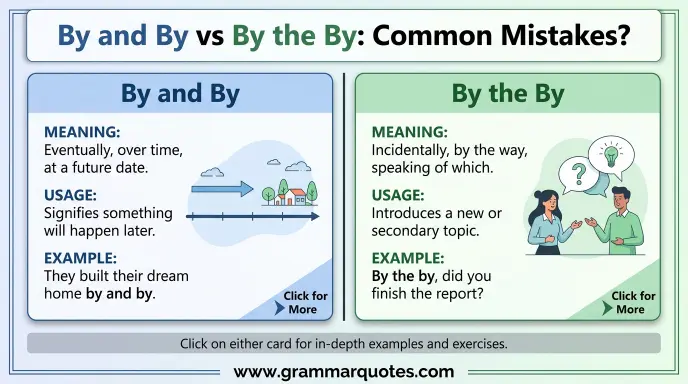
“By and by” means “soon” or “after some time,” while “by the by” is an old fashioned expression meaning “incidentally” or “by the way.” These expressions look similar, but they have different meanings and uses.
For example, “We will leave by and by” means that we will leave after some time. In contrast, “By the by, have you spoken to Ali?” introduces an additional point or question.
You may also come across the phrase “by the bye,” which has the same meaning as “by the by.” Although these expressions are less common in everyday conversation today, understanding them can help you read older books, recognize literary expressions, and improve your vocabulary.
In this guide, you will learn the meaning of each phrase, how to use it correctly, and how to avoid common mistakes. You will also discover practical examples, related expressions, and answers to frequently asked questions.
Quick Answer: By and By vs By the By
- By and by: Means soon, eventually, or after some time.
- By the by: Means incidentally or by the way; it introduces an additional point.
- By the bye: An alternative spelling of “by the by,” with the same meaning.
Examples:
- We will meet by and by. (After some time.)
- By the by, did you finish your homework? (By the way.)
Easy rule: Use “by and by” when talking about time. Use “by the by” when introducing an additional thought.
What Does By and By Mean?
By and by is an English expression that means “soon,” “after a while,” or “eventually.” It is used to describe something that will happen after some time.
The exact meaning depends on the context. Sometimes it refers to the near future, while in other situations it suggests that something will happen gradually or eventually.
Examples of By and By in Sentences
- We will discuss the matter by and by.
- The guests will arrive by and by.
- She became more confident by and by.
- Do not worry; everything will become clear by and by.
- The rain stopped, and the sun appeared by and by.
In these examples, the phrase refers to something happening after a period of time.
When Should You Use By and By?
Use by and by when you want to express the idea of something happening later or eventually.
For example:
- “I will explain everything by and by.” This means the explanation will come later.
- “By and by, the child learned to read.” This means the child learned gradually over time.
The expression often sounds literary, traditional, or slightly old fashioned. In everyday English, people are more likely to say “soon,” “later,” or “eventually.”
What Does By the By Mean?
By the by is an idiom that means “incidentally” or “by the way.” It is used to introduce an additional fact, question, or thought that may be related to the current conversation.
The phrase does not usually describe when something will happen. Instead, it helps a speaker introduce another point.
Examples of By the By in Sentences
- By the by, have you seen my notebook?
- By the by, I met your cousin yesterday.
- By the by, did you remember to call the teacher?
- By the by, your presentation was excellent.
- By the by, we need to discuss tomorrow’s meeting.
Each example introduces an additional thought or piece of information.
Is By the By Still Used Today?
The expression by the by is grammatically correct, but it is uncommon in modern everyday English. It can sound old fashioned or literary.
In most conversations, people use “by the way” instead.
For example:
- Old fashioned: “By the by, where are you going?”
- Modern: “By the way, where are you going?”
Both expressions introduce an additional point, but “by the way” is much more natural in contemporary conversation.
By and By vs By the By: Key Differences
The main difference is that “by and by” refers to time, whereas “by the by” introduces an additional thought.
| Feature | By and By | By the By |
| Meaning | Soon, later, or eventually | Incidentally or by the way |
| Main purpose | Expresses time | Introduces another point |
| Common context | Future events or gradual changes | Conversations and additional information |
| Modern usage | Uncommon; often literary | Uncommon; often old fashioned |
| Modern alternative | Soon, later, eventually | By the way, incidentally |
| Example | We will talk by and by. | By the by, where is Sara? |
Although the phrases look and sound similar, they are not interchangeable. Choosing the correct one depends on the meaning you want to express.
By the By vs By the Bye
You may also see “by the bye.” This is an alternative form of “by the by,” and both expressions mean “incidentally” or “by the way.”
Examples:
- By the by, did you read the message?
- By the bye, did you read the message?
Both sentences introduce an additional question. However, both expressions are uncommon in modern everyday English, so “by the way” is usually the better choice.
Do not confuse “by the bye” with “by and by.” The first introduces an additional point; the second refers to something happening after some time.
Common Mistakes with By and By and By the By
Because these expressions have similar wording, learners sometimes confuse their meanings.
Mistake 1: Using By and By to Introduce a Question
Incorrect: By and by, have you finished your work?
Better: By the by, have you finished your work?
More natural today: By the way, have you finished your work?
The question introduces an additional point rather than describing something happening later.
Mistake 2: Using By the By to Describe Time
Incorrect: We will arrive by the by.
Correct: We will arrive by and by.
More natural today: We will arrive soon.
The sentence refers to a future event, so “by and by” fits the intended meaning.
Mistake 3: Thinking By the Bye Has a Different Meaning
Incorrect assumption: “By the bye” means something different from “by the by.”
Correct: Both expressions have the same meaning: “incidentally” or “by the way.”
However, “by the way” is the more common modern expression.
Mistake 4: Using Old Fashioned Expressions in Every Conversation
The expressions are valid, but they may sound unnatural in casual modern English.
Less natural: “I shall see you by and by.”
More natural: “I will see you later.”
Less natural: “By the by, how was your day?”
More natural: “By the way, how was your day?”
Choose expressions that suit your audience and writing style.
By and By vs By the By: Everyday Examples
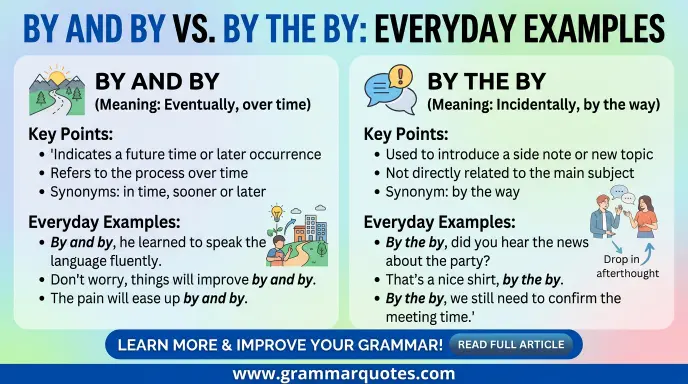
The following examples show how these phrases work in different contexts.
| Context | By and By | By the By |
| School | You will understand the lesson by and by. | By the by, did you complete your homework? |
| Work | The manager will return by and by. | By the by, the meeting starts at ten. |
| Family | Things will get better by and by. | By the by, Aunt Sara called you. |
| Reading | The truth became clear by and by. | By the by, I enjoyed that book. |
| Planning | We will make a decision by and by. | By the by, have you booked the tickets? |
Remember that these examples demonstrate the expressions’ meanings, but more common alternatives may sound more natural in everyday conversation.
Modern Alternatives to By and By and By the By
Knowing modern alternatives will help you communicate more naturally.
Alternatives to By and By
Use these expressions when talking about something happening later or eventually.
- Soon: Something will happen in the near future.
- Later: Something will happen after the present time.
- Eventually: Something will happen after some time or effort.
- After a while: Something will happen after a period of time.
- In time: Something will happen when the appropriate time comes.
Examples:
- We will meet soon.
- I will call you later.
- Eventually, she found the answer.
- The guests arrived after a while.
Alternatives to By the By
Use these expressions to introduce an additional thought or piece of information.
- By the way: Introduces an additional point.
- Incidentally: Adds a related or interesting detail.
- On another note: Introduces a different topic.
- Speaking of which: Connects a new point to something just mentioned.
Examples:
- By the way, where is your brother?
- Incidentally, I know the owner.
- On another note, we need to discuss the budget.
- Speaking of which, did you finish the project?
The best alternative depends on the relationship between your new point and the ongoing conversation.
Origin and History of By and By and By the By
Both expressions belong to the history of English idiomatic language. Their repeated wording developed conventional meanings that cannot always be understood by looking at each individual word.
Origin of By and By
The expression by and by has been used in English for centuries to refer to a future time or something that happens eventually. Its meaning developed into the familiar sense of “after a while” or “in due course.”
It appears in older literary and religious writing, which has helped preserve the phrase in traditional English.
Origin of By the By
By the by developed as an expression for introducing an incidental point. Here, “by” is part of a conventional phrase rather than a literal reference to physical location.
The alternative spelling “by the bye” has also appeared historically. Today, “by the way” has largely replaced both forms in ordinary conversation.
By and By vs By the By in Literature and Writing
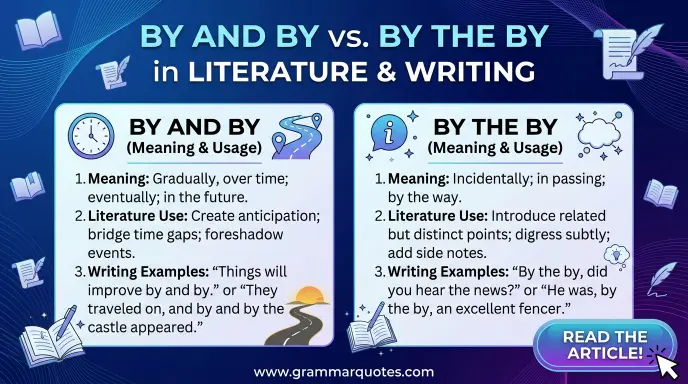
These expressions may appear in novels, older texts, historical writing, or dialogue designed to reflect a traditional style.
Using By and By in Writing
Writers may use by and by to suggest the passage of time or a gradual change.
Example:
“By and by, the village returned to its peaceful routine.”
The sentence suggests that the change happened after some time.
Using By the By in Writing
Writers may use by the by to introduce an incidental observation or question.
Example:
“By the by, I forgot to tell you about the letter.”
The speaker adds a detail that was not previously mentioned.
For modern articles, emails, and everyday writing, “eventually,” “later,” and “by the way” are often clearer choices.
Google Trends and Search Usage
People searching for “by and by vs by the by” may be trying to understand two similar looking English expressions. The difference can be confusing because both contain repeated words, yet their meanings are distinct.
The phrases are relatively uncommon in modern everyday English compared with alternatives such as “soon,” “eventually,” and “by the way.” Their use may vary across literary texts, historical documents, and regional contexts.
Google Trends can help compare relative search interest over a selected period and location. However, it does not automatically provide exact monthly search volumes, and no specific popularity figures should be assumed without checking the data.
For an educational article, explain the meanings clearly and include natural examples. Related terms such as by the way, eventually, incidentally, and after a while can help readers understand the expressions in context.
People Also Ask: By and By vs By the By
1. What is the difference between by and by and by the by?
“By and by” means “soon,” “later,” or “eventually.” “By the by” means “incidentally” or “by the way.”
2. What does by and by mean in simple English?
It means that something will happen after some time. For example, “We will leave by and by” means “We will leave later.”
3. What does by the by mean?
It means “incidentally” or “by the way.” It introduces an additional point or question.
4. Is by the by the same as by the way?
Yes. Both expressions can introduce an additional thought, but “by the way” is much more common in modern English.
5. Is by the bye correct English?
Yes. “By the bye” is an alternative form of “by the by,” and both mean “incidentally” or “by the way.”
6. Is by and by formal or informal?
It is generally considered literary, traditional, or old fashioned. In everyday English, “soon,” “later,” or “eventually” is often more natural.
7. Can by and by mean eventually?
Yes. Depending on the context, “by and by” can mean “eventually” or “after some time.”
8. How do you use by the by in a sentence?
Example: “By the by, did you remember to send the email?” The phrase introduces an additional question.
9. Are by and by and by the by interchangeable?
No. “By and by” refers to time, while “by the by” introduces an additional point. They have different grammatical uses and meanings.
10. What is a modern alternative to by the by?
“By the way” is the most common modern alternative. “Incidentally” may also work in suitable contexts.
Frequently Asked Questions
What does by and by mean in the Bible?
In some older Bible translations, “by and by” refers to a future time or something that happens after a period of time. The precise meaning depends on the passage and the translation.
Is by the by still used today?
Yes, but it is uncommon in everyday conversation. Most modern speakers prefer “by the way.”
What is the difference between by the by and by the bye?
There is no meaningful difference in their conventional meanings. Both are older forms of an expression meaning “incidentally.”
Which phrase should English learners use?
Use “soon,” “later,” or “eventually” instead of “by and by” in most everyday situations. Use “by the way” instead of “by the by” when introducing an additional thought.
Can these phrases be used in academic writing?
They can appear when appropriate, especially when discussing historical texts or literary language. In most academic writing, clearer alternatives such as “eventually” and “incidentally” are preferable.
Conclusion
The difference between by and by and by the by comes down to meaning and context. “By and by” refers to something happening after some time, soon, or eventually. “By the by,” on the other hand, introduces an additional thought and means “incidentally” or “by the way.”
For example, “We will speak by and by” refers to a future conversation. “By the by, have you spoken to the teacher?” introduces an extra question. These expressions are not interchangeable because they serve different purposes.
You may also encounter “by the bye,” which has the same meaning as “by the by.” Both forms are relatively old fashioned, so “by the way” is usually more natural in modern conversation.
The easiest way to remember the distinction is to connect by and by with time and by the by with an extra point. Once you understand this simple rule, you can recognize both expressions in books and use them correctly when the context calls for them.
Discover More Articles!
Axises or Axes: Which Plural Form Is Correct?
DMV or BMV: What’s the Difference?(2026)
Unshakable or Unshakeable: Which Is Correct?

Ethan Parker is an English-language writer known for his interest in words, language, and clear communication. His work focuses on making everyday English easier to understand through simple explanations and practical examples.