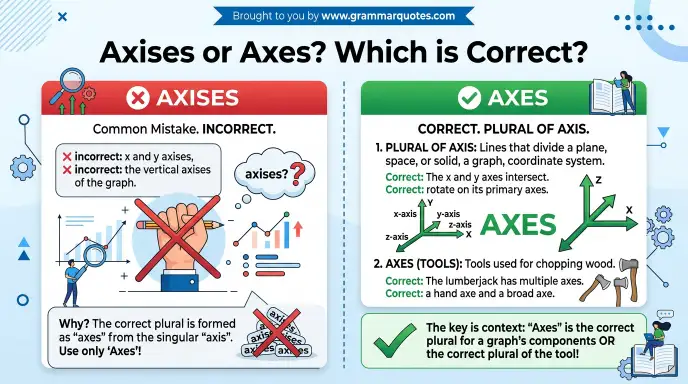
Axes is the standard plural form of axis, while axises is generally not used in standard English when talking about more than one axis. The word axis has a special plural form because it comes from Greek and Latin linguistic traditions.
The confusion usually happens because many English nouns simply add s or es to become plural. For example, box becomes boxes and class becomes classes. Because of this pattern, some learners naturally assume that axis should become axises. However, the standard plural is axes.
There is one important point to remember: axes can also be the plural of ax, the tool used for cutting wood. So the same spelling can have two different meanings depending on context.
In this article, you will learn the difference between the two forms, how to use axes correctly, why axises is usually avoided, and how to remember the correct plural easily.
Axises or Axes : Quick Answer
Axes is the standard plural of axis.
- Singular: axis
- Plural: axes
Example:
The graph has two axes.
However, axes can also be the plural of ax:
The workers carried several axes.
So context tells you which meaning is intended.
Definition and Meaning
An axis is an imaginary or real line around which something rotates or is arranged.
Examples include:
- The Earth’s axis
- The x axis
- The y axis
- The horizontal axis
- The vertical axis
- The axis of rotation
When talking about more than one, use axes.
The graph has two axes.
An ax, on the other hand, is a tool used for cutting or chopping wood. Its plural can also be axes.
The forest workers used several axes.
Why Is Axes the Correct Plural?
The plural axes comes from the older plural form of axis. English has many words borrowed from Greek and Latin that keep unusual plural forms.
Instead of adding s to make axises, standard English uses axes.
This is similar to other words with traditional plural forms:
- Analysis → analyses
- Basis → bases
- Crisis → crises
- Diagnosis → diagnoses
- Thesis → theses
- Axis → axes
These words may look unusual at first, but their plural forms follow established patterns.
What Does Axis Mean?
An axis is a line used as a reference or around which something turns.
In Mathematics
An axis is a reference line on a graph.
For example:
- x axis
- y axis
A two dimensional graph normally has two axes.
The point is located between the two axes.
In Science
The word can describe a line around which an object rotates.
Earth rotates around its axis.
In Anatomy
An axis can describe a central or imaginary line related to the body or movement.
In Geography
An axis can describe a central line or direction used for measurement or organization.
What Does Axes Mean?
Axes has two common meanings.
Axes as the Plural of Axis
When axes means more than one axis, it is usually pronounced like AK seez.
Example:
The coordinate system contains several axes.
Axes as the Plural of Ax
When axes means more than one ax, it is usually pronounced like AK siz.
Example:
The workers sharpened their axes.
This pronunciation difference is useful because the spelling is identical but the meanings are different.
Axes vs Axes: Why Context Matters
The spelling axes can represent two different plural nouns:
Axis → axes
The graph contains three axes.
Ax → axes
The men carried three axes.
The pronunciation can help distinguish them in speech, but in writing, context is usually what tells the reader which meaning is intended.
Is Axises Ever Correct?
Axises is generally not the standard plural form of axis.
In normal academic, scientific, mathematical, and formal writing, use axes.
For example:
Correct:
The graph contains three axes.
Usually incorrect in standard English:
The graph contains three axises.
If you are writing an essay, report, textbook, article, or academic paper, axes is the form you should choose.
Common Uses of Axes
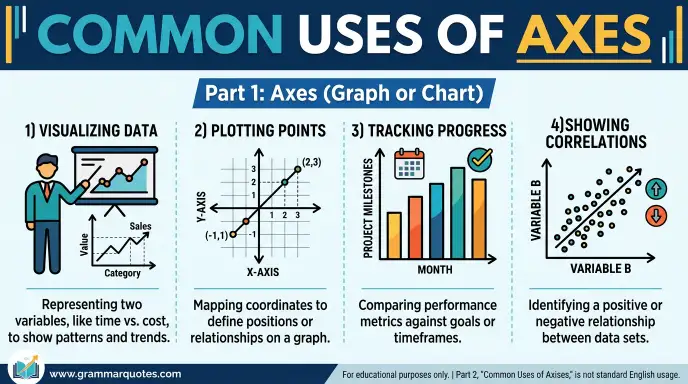
The plural appears in many fields.
Mathematics
The graph has two axes.
Physics
The forces act along different axes.
Engineering
The machine can rotate around several axes.
Geography
The map shows several reference axes.
Anatomy
Movement occurs around different axes.
3D Design
The object can be moved along three axes.
In all these examples, axes is the plural of axis.
Common Mistakes
One common mistake is simply adding es to axis.
Incorrect:
The coordinate system has two axises.
Correct:
The coordinate system has two axes.
Another mistake is assuming that every word ending in is follows the same plural pattern.
English has many irregular or borrowed plural forms, so it is better to learn common words individually.
Axes vs Axis
The basic difference is simple:
| Singular | Plural | Example |
| Axis | Axes | The graph has two axes. |
Remember:
One axis → two axes
Not:
One axis → two axises
Axis and Other Is Words
Several common English words ending in is change their ending when they become plural.
| Singular | Plural |
| Axis | Axes |
| Analysis | Analyses |
| Basis | Bases |
| Crisis | Crises |
| Diagnosis | Diagnoses |
| Thesis | Theses |
| Hypothesis | Hypotheses |
Learning this pattern can make other vocabulary easier too.
British English vs American English
There is no major British American spelling difference for this plural.
Both British and American English normally use:
Axis → axes
For example:
British English:
The graph has three axes.
American English:
The graph has three axes.
The same spelling is standard in both varieties.
Pronunciation of Axis or Axes
The singular axis is usually pronounced:
AX is /ˈæk.sɪs/
When axes is the plural of axis, it is usually pronounced:
AK seez /ˈæk.siːz/
But when axes is the plural of ax, it is pronounced:
AK siz /ˈæk.sɪz/
This makes the word interesting because the same spelling can have different pronunciations.
How to Remember the Correct Form
Use this simple memory trick:
Axis → Axes
Think of the pattern:
- Analysis → analyses
- Crisis → crises
- Thesis → theses
- Axis → axes
Another easy sentence is:
One axis, many axes.
If you remember this sentence, you will rarely need to use axises.
Axes in Everyday Examples
Here are some natural examples:
- The graph has two axes.
- The machine rotates around several axes.
- The Earth rotates around its axis.
- The coordinate system contains three axes.
- The diagram shows the horizontal and vertical axes.
- The robot can move along multiple axes.
- Scientists studied rotation around different axes.
- The chart uses separate axes for comparison.
- The workers carried several axes.
- The tools included three sharp axes.
The context tells us if the word means mathematical or physical axes.
Formal Writing and Academic Usage
Axes is the correct choice in formal writing whenever you mean more than one axis.
You may see it frequently in:
- Mathematics
- Physics
- Engineering
- Statistics
- Geography
- Anatomy
- Computer graphics
- Data visualization
- Scientific research
For example:
The data were plotted along two axes.
Using axises in this type of writing can make the sentence look incorrect or nonstandard.
Axes in Mathematics
In mathematics, axes is especially common.
A basic coordinate plane has:
- x axis
- y axis
Together, they are called the coordinate axes.
In three dimensional space, there are usually three:
- x axis
- y axis
- z axis
So you might write:
The point is plotted using the three coordinate axes.
This is one of the most common contexts where learners encounter the plural.
Axes in Science
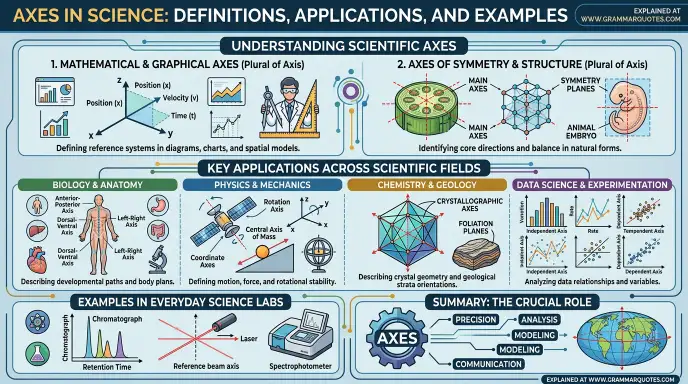
Scientists often use the plural when describing rotation, movement, or measurement.
For example:
The object rotates around multiple axes.
The word can also describe different directions or reference lines used in scientific models.
Common Questions About the Plural
Is “axises” a word?
It may occasionally appear in nonstandard or specialized usage, but axes is the standard plural form of axis in general English.
Is axes the plural of axis?
Yes. Axes is the standard plural of axis.
Is axes also the plural of ax?
Yes. Axes can also be the plural of ax, meaning cutting tools.
Why isn’t the plural “axises”?
Because axis follows an established plural pattern inherited from its Greek and Latin history. The standard plural is axes.
How do you pronounce axes?
When it is the plural of axis, it is usually pronounced AK seez. When it is the plural of ax, it is usually pronounced AK siz.
People Also Ask
1. Is axises or axes correct?
Axes is the standard plural form of axis.
2. What is the plural of axis?
The plural of axis is axes.
3. Is axises grammatically correct?
In standard English, axises is generally not the preferred plural. Use axes.
4. What is the plural of x axis?
The plural is x axes when referring to more than one x axis.
5. What is the plural of y axis?
The plural is y axes.
6. Is axes the plural of ax?
Yes. Axes is also the plural of ax.
7. Why does axis become axes?
It follows the traditional plural pattern of the word, which comes from Greek.
8. What is the difference between axis and axes?
Axis is singular, while axes is plural.
9. Are axis and axes pronounced differently?
Yes. Axis is usually pronounced “AK is,” while the plural meaning more than one axis is usually pronounced “AK seez.”
10. Can I use axises in academic writing?
It is best to avoid it. Use axes in standard academic and professional writing.
Frequently Asked Questions
Is “axes” always pronounced the same way?
No. When it means multiple axes as lines of reference, it is usually pronounced “AK seez.” When it means multiple axes as cutting tools, it is usually pronounced “AK siz.”
What is one axis and two axes?
One axis is singular. Two or more are axes.
Is “coordinate axes” correct?
Yes. Coordinate axes is the standard plural phrase used in mathematics.
Can axes be used for graphs?
Yes. Graphs commonly have two or more axes depending on the type of graph.
Is “axises” a spelling mistake?
In most standard contexts, yes. If you mean more than one axis, axes is the correct form.
Final Comparison
| Word | Meaning | Correct Usage |
| Axis | One reference or rotation line | One axis |
| Axes | More than one axis | Two axes |
| Axises | Nonstandard plural in general English | Avoid |
| Ax | A cutting tool | One ax |
| Axes | More than one cutting tool | Several axes |
Conclusion
The correct standard plural of axis is axes, not axises. Although adding es may seem natural, axis follows a traditional plural pattern that changes the ending of the word.
The word axes can also mean more than one ax, so context is important. In mathematics, science, engineering, and other academic fields, it normally refers to multiple reference or rotation lines. When discussing tools, it can mean multiple cutting axes.
A simple rule is enough to remember the main point: one axis, many axes. This form is used in both British and American English.
If you are writing an academic paper, school assignment, scientific report, or technical article, choose axes whenever you mean more than one axis. Avoid axises in standard English unless you are dealing with a very specific specialized usage that requires it.
Discover More Articles!
Knives or Knifes: Which Spelling Is Correct?(2026)
Sinus or Allergies: What’s the Difference?(2026)
Fourty or Forty: Which Spelling Is Correct?(2026)

Ethan Parker is an English-language writer known for his interest in words, language, and clear communication. His work focuses on making everyday English easier to understand through simple explanations and practical examples.