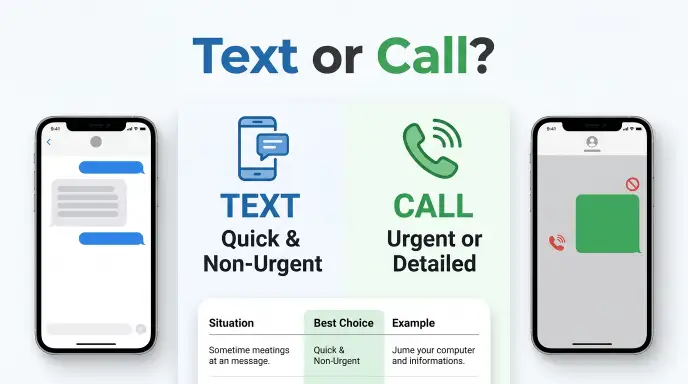
When deciding if to text or call someone, the choice often depends on the situation, urgency, and relationship.
Both forms are correct, but they communicate in different ways. Text is usually better for quick, non urgent messages, while a call is often better when a conversation needs more detail or a fast response.
People often search for “text or call” because they are unsure which communication method sounds more natural in English.
The confusion can also come from phrases such as “Should I text or call?” and “Text me or call me,” especially for ESL learners and writers who want their English to sound natural.
This guide explains the meaning and usage of text or call, shows how the phrase works in American and British English, and gives practical examples for everyday conversations, work, emails, social media, and academic writing.
You will also learn when texting is more suitable than calling and how to avoid common mistakes.
Text or Call: The Quick Answer for Google & AI Overviews
“Text or call” is a correct and natural English phrase. It means choosing between sending someone a text message and speaking with them by telephone. Use text for short, convenient messages and call when the matter is urgent, detailed, personal, or easier to discuss aloud.
Text or Call : Quick Answer
The phrase text or call is grammatically correct and very common in modern English.
It presents two communication options:
- Text = send a written message by phone or messaging service.
- Call = contact someone by telephone and speak with them.
- Text or call = choose between sending a message and making a phone call.
Examples
- Should I text or call you when I arrive?
- You can text or call me if you need help.
- I wasn’t sure if to text or call.
The phrase can work as a question, instruction, or general choice.
For example:
Text me if it is not urgent, or call me if you need an immediate answer.
In everyday English, text or call sounds natural and does not need to be changed to a more formal expression.
What Does Text or Call Mean?
Text or call refers to two common ways of communicating with another person.
The word text can function as both a noun and a verb.
- Noun: “I sent her a text.”
- Verb: “I texted her this morning.”
The word call can also function as both a noun and a verb.
- Noun: “I received a call.”
- Verb: “I called him yesterday.”
When combined as text or call, the phrase asks someone to choose between written and spoken communication.
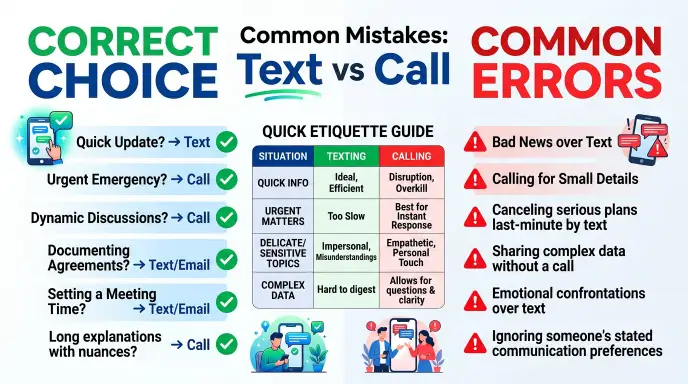
When Should You Text?
Texting is usually useful when:
- The message is short.
- The matter is not urgent.
- You need to send information that the person can read later.
- You want to avoid interrupting someone.
- You need a written record of the conversation.
For example:
“Text me the address when you get a chance.”
When Should You Call?
Calling is usually better when:
- The issue is urgent.
- The subject is complicated.
- You need an immediate response.
- A written conversation could cause confusion.
- The conversation is personal or sensitive.
For example:
“Call me when you have a few minutes. I need to discuss something important.”
The Origin of Text or Call
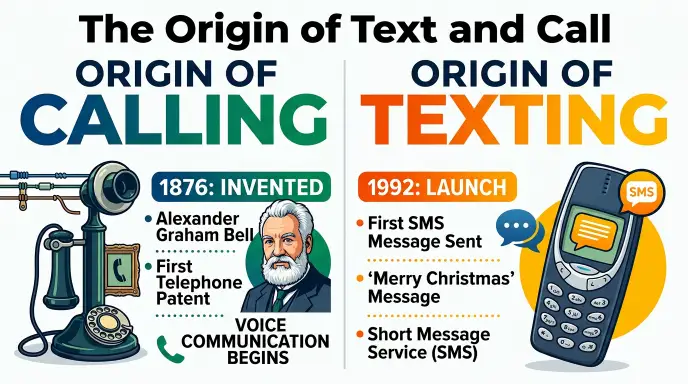
The two words have much older histories than the modern phrase text or call.
Text comes from the Latin textus, related to the idea of something woven or constructed. Over time, English used text to describe written material. The modern verb to text, meaning to send a text message, developed with the rise of mobile phones and SMS messaging.
Call has Old English roots. It has long been used for the act of calling out to someone or communicating by voice. Its telephone meaning became common after the development and spread of telephone communication.
The phrase text or call is therefore a modern combination of two established English words. Its popularity reflects the way people now communicate through both messaging and voice calls.
British English vs American English
There is no major spelling difference between British and American English for text or call. Both varieties use the same phrase.
| British English | American English | Example |
| text | text | “Text me when you arrive.” |
| call | call | “Call me after work.” |
| text or call | text or call | “You can text or call me.” |
| text message | text message | “I sent a text message.” |
| mobile phone | cell phone | “Text me on my mobile/cell phone.” |
The main differences are often vocabulary and communication preferences rather than the phrase itself.
For example, British English commonly uses mobile phone, while American English commonly uses cell phone.
Style Guides and Formal Writing
In professional writing, the choice between text and call depends on the context.
A casual message might say:
Text or call me when you arrive.
A formal business instruction might say:
Please contact our office by telephone or email.
So, text or call is perfectly acceptable in conversational English, but formal documents may use more specific communication terms.
Which Version Should You Use?
You do not need to choose a different spelling for British or American English. Text or call works in both.
United States
Use text or call freely in everyday speech, messages, and informal writing.
Example:
“Text or call me when you get home.”
United Kingdom
The same phrase is natural in British English.
Example:
“Text or call me if you need anything.”
Canada
Canadian English also uses text and call in the same way.
Australia
The phrase is also natural in Australian English.
International Writing
For international audiences, text or call is easy to understand. If the audience may not be familiar with texting terminology, send me a message or call me can be even clearer.
Academic Writing
Academic writing usually avoids conversational instructions such as:
“Text or call me.”
Instead, use formal wording such as:
“Please contact the researcher by telephone or email.”
Business Writing
The right choice depends on the relationship and workplace.
For a colleague:
“Feel free to text or call me.”
For a formal customer message:
“Please contact our support team if you require assistance.”
Common Mistakes With Text or Call
Mistake 1: Using “Texted” Incorrectly
Incorrect:
“I text him yesterday.”
Correct:
“I texted him yesterday.”
Explanation:
When text is used as a regular verb, its simple past form is normally texted.
Memory tip:
Yesterday → texted.
Mistake 2: Confusing “Call” and “Called”
Incorrect:
“I call her yesterday.”
Correct:
“I called her yesterday.”
Explanation:
Use called for a completed action in the past.
Mistake 3: Saying “Text or Calling”
Less natural:
“Should I text or calling him?”
Correct:
“Should I text or call him?”
Explanation:
After should I, use the base forms of both verbs: text and call.
Mistake 4: Using “Text Me or Call Me” as One Word
Incorrect:
“Textme or callme.”
Correct:
“Text me or call me.”
Explanation:
The verb and pronoun are separate words.
Mistake 5: Assuming a Call Is Always Better
There is no universal rule that calling is more polite or professional.
A quick question may be easier by text. A complex problem may be much easier by phone.
The best choice depends on urgency, complexity, privacy, and the other person’s preference.
Text or Call in Everyday Examples
Emails
In a casual workplace email:
“If you have any questions, feel free to text or call me.”
In a formal email:
“If you have any questions, please contact me by telephone or email.”
Business Writing
“Customers can text or call our office during business hours.”
This works well when the audience already understands the communication options.
News Headlines
A headline might use text or call when discussing communication advice:
Should You Text or Call After a Job Interview?
The short structure makes the question easy to scan.
Blogs
“If you need a quick answer, text. If the issue is complicated, call.”
This conversational style is common in online writing.
Social Media
“Need help? Text or call us today.”
The phrase is short and direct, which makes it useful for social media posts.
Academic Writing
Academic writing generally favors more formal language:
“Participants were instructed to contact the research team by telephone or electronic message.”
Daily Conversation
“Should I text or call Sarah?”
“Just text me when you’re free.”
“Call me if it becomes urgent.”
These are all natural examples of everyday English.
Google Trends & Modern Usage
The phrase text or call reflects a common communication choice in modern life. People may search for it when deciding how to contact someone, writing a message, checking if a phrase sounds natural, or comparing texting with calling.
Exact search volume or Google Trends figures should not be assumed without checking current Google Trends data. However, the underlying language is widely used because text and call are both established communication verbs in contemporary English.
Search intent also varies.
Someone searching “text or call” may want to know:
- Which option is more appropriate?
- Is “text or call” grammatically correct?
- Should I text or call someone?
- Is texting more casual than calling?
- What does “text or call me” mean?
- How do I use “text or call” in a sentence?
The phrase is especially useful for ESL learners because text has developed a modern verb meaning that may not be obvious from older English vocabulary.
Quick Comparison Table
| Version | Meaning | Correct? | Region | Example |
| Text | Send a written message | Yes | International | “Text me later.” |
| Call | Speak by telephone | Yes | International | “Call me tonight.” |
| Text or call | Choose either method | Yes | International | “Text or call me.” |
| Texted | Past form of text | Yes | International | “I texted him yesterday.” |
| Called | Past form of call | Yes | International | “She called me earlier.” |
| Text or calling | Incorrect after “should I” | No | All regions | “Should I text or call?” is correct. |
Key Takeaways
- Text or call is a correct and natural English phrase.
- Text usually means sending a written message.
- Call means communicating by telephone, usually by voice.
- Use text for quick or non urgent communication.
- Use call when a conversation is urgent, complex, or personal.
- British and American English use the same spelling: text or call.
- In formal writing, contact by telephone or email may sound more appropriate.
- After “Should I,” use text or call, not “text or calling.”
FAQs About Text or Call
Is “text or call” grammatically correct?
Yes. Text or call is grammatically correct and natural in English. It joins two verbs, text and call, with the conjunction or. For example, “Text or call me when you arrive” gives someone two communication options.
Should I say “text or call” or “text and call”?
Use text or call when either option is acceptable. Use text and call when you want someone to do both actions. For example, “Text or call me” means one method is enough, while “Text and call me” asks for both.
Is it better to text or call someone?
It depends on the situation. Texting is useful for short, non urgent messages, while calling is often better for urgent or complicated matters. Consider the person’s preferences too. If you are unsure, texting first can be a less disruptive way to ask if they are available to talk.
Is “text or call me” correct?
Yes. “Text or call me” is a common and natural sentence. It means the person can either send you a text message or telephone you. For example, “If you have any questions, text or call me” clearly gives two options.
What is the difference between texting and calling?
Texting involves written messages that the recipient can read when convenient. Calling usually involves real time spoken communication. Texting can be easier for quick information, while calling can be more effective when you need immediate feedback or a detailed conversation.
Is “texted” the correct past tense of “text”?
Yes. Texted is the standard past tense form of the verb text. For example, “I texted her yesterday.” Although text began as a noun referring to written material, modern English commonly uses it as a verb for sending a message.
Is “called or texted” correct English?
Yes. Called or texted is grammatically correct when describing two possible completed actions. For example, “She may have called or texted while I was away.” The exact choice depends on if you are talking about a phone call, a text message, or either possibility.
Should I use “text or call” in formal writing?
You can use it when the context is professional but conversational. In highly formal or academic writing, a phrase such as “contact by telephone or electronic message” may be more suitable. Match the wording to your audience and the level of formality required.
Is “text or call” used in British English?
Yes. British English commonly uses text as a verb and call for telephone communication. The phrase “text or call me” is natural in the UK, just as it is in American English. Vocabulary such as mobile phone and cell phone may differ by region.
Which is more polite, texting or calling?
Neither is automatically more polite. A short text can respect someone’s time, while a call may be more considerate when an issue requires a real conversation. The best choice depends on the person’s expectations, the urgency of the matter, and the nature of your relationship.
Conclusion
Text or call is a correct, natural, and widely understood English phrase. It gives someone a choice between sending a written message and communicating by telephone. The two words are simple, but the better option depends on the situation.
Choose text when you have a short question, need to share simple information, or do not want to interrupt someone. Choose call when the matter is urgent, complicated, personal, or easier to explain through conversation. In both British and American English, the spelling remains the same.
For casual conversations, “Text or call me” is perfectly natural. In formal or academic writing, however, a phrase such as “contact by telephone or electronic message” may fit better.
The most important point is simple: text when a message is enough, and call when a conversation is better. When in doubt, consider the urgency and the other person’s communication preference before choosing.
Discover More Articles!
Calm vs Headspace: Which App Should You Choose?(2026)
Intercom vs. Zendesk: Full Features, Pricing, and AI Comparison
Graduate or Undergraduate: What’s the Difference?

Ethan Parker is an English-language writer known for his interest in words, language, and clear communication. His work focuses on making everyday English easier to understand through simple explanations and practical examples.