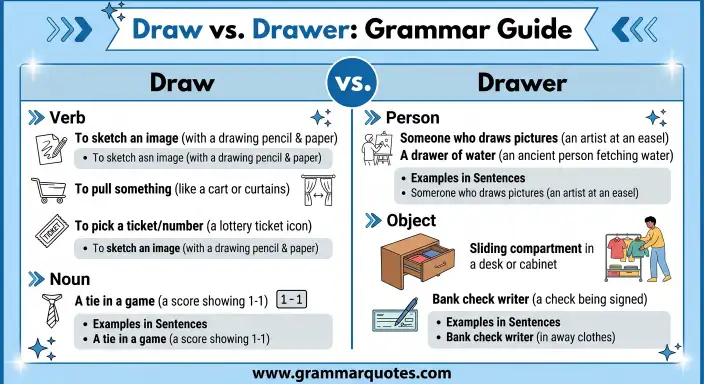
Draw or drawer can be confusing because the two words look similar but have different meanings and uses. Draw is usually a verb that means to make a picture, pull something, or attract attention. Drawer is a noun that often means a sliding storage compartment in a desk, cabinet, or dresser. The words are related in spelling, but you cannot use them interchangeably.
Imagine asking someone to draw a picture of a table. You would use the word “draw” because you want them to create an image. Now imagine asking where you put your pencils. You might say, “They are in the top drawer.” In this sentence, “drawer” means a storage compartment.
These words are useful in daily conversations, schoolwork, emails, and professional writing. Learning the difference helps you avoid spelling mistakes and choose the correct word for your sentence. In this guide, you will learn their meanings, pronunciation, origins, grammar rules, common mistakes, and everyday examples.
Draw or Drawer: Quick Answer
Draw and drawer are both correct English words, but they have different meanings.
- Draw (verb): To make a picture, pull something, or attract something.
- Draw (noun): A tie in a game or competition, or an attraction.
- Drawer (noun): A sliding compartment used to store things.
Examples:
- I like to draw animals.
- Please open the top drawer.
- The football match ended in a draw.
An Easy Way to Remember
Remember this simple rule:
- Draw = make a picture, pull, or attract.
- Drawer = a compartment where you store things.
If you are talking about a desk, cabinet, or dresser, you probably need drawer. If you are talking about making a picture, you need draw.
Definition and Meaning
What Does “Draw” Mean?
Draw (verb): To create a picture using lines, pull something toward you, or attract attention or interest.
Examples:
- She can draw beautiful flowers.
- Please draw the curtains.
- The speaker’s story will draw attention to the problem.
The word has several meanings, so the correct meaning depends on the sentence.
Other Meanings of “Draw”
Draw can also be a noun.
Examples:
- The match ended in a draw. (A tie, with no winner.)
- The main draw of the event was the live music. (The main attraction.)
What Does “Drawer” Mean?
Drawer (noun): A sliding compartment in a piece of furniture that is used to store items.
Examples:
- My keys are in the kitchen drawer.
- She put her notebooks in the desk drawer.
A drawer usually slides in and out of a desk, cabinet, or dresser.
Does “Drawer” Have Other Meanings?
Yes. In finance and legal contexts, a drawer can be a person who writes or issues a cheque or certain other financial instruments.
Example:
- The drawer signed the cheque.
This meaning is less common in everyday conversation than the furniture related meaning.
The Origin of Draw and Drawer
Origin of “Draw”
The word draw comes from Old English dragan, meaning to pull, drag, or draw along. Over time, the word developed several meanings, including pulling something, making a picture, and attracting attention.
Origin of “Drawer”
The word drawer comes from the verb draw and the suffix er, which often identifies a person or thing associated with an action.
A furniture drawer is named for the way it is drawn, or pulled, out of a piece of furniture.
Historical Development
Old English (450–1100)
The ancestor of draw was used with the meaning of pulling or dragging something.
Middle English (1100–1500)
The spelling and meanings of draw continued to develop. The word became associated with more actions, including making lines or pictures.
Modern English (1500–Present)
Draw gained many familiar uses, including drawing pictures, drawing conclusions, and drawing attention. Drawer became a common word for a sliding storage compartment and retained other specialized meanings.
British English vs American English
Are Draw and Drawer Different in British and American English?
The words have the same spelling and basic meanings in British and American English. However, the pronunciation of drawer can vary by accent.
| Feature | British English | American English |
| Draw | Same spelling | Same spelling |
| Drawer | Same spelling | Same spelling |
| Picture making meaning | Draw | Draw |
| Storage compartment | Drawer | Drawer |
| Pronunciation of “draw” | Accent dependent details | Accent dependent details |
| Pronunciation of “drawer” | May sound like “draw uh” | May sound like “draw er” or similar to “draw” in some accents |
Pronunciation varies among speakers in both countries, so these patterns are general rather than strict rules.
When Should You Use Draw or Drawer?
Use “Draw” for Making Pictures
Use draw when someone creates an image with a pencil, pen, or another tool.
Examples:
- My brother likes to draw cartoons.
- The student drew a map of Pakistan.
- Can you draw a simple house?
Remember that draw is the base form, while drew is its simple past tense and drawn is its past participle.
Use “Draw” for Pulling Something
Examples:
- Draw the curtains before you leave.
- She drew the chair closer to the table.
- The horse drew the cart along the road.
Use “Draw” for Attraction or Attention
Examples:
- The advertisement will draw more customers.
- The festival draws visitors every year.
- His speech drew everyone’s attention.
Use “Drawer” for Storage
Examples:
- Keep your pens in the drawer.
- The bottom drawer is full of clothes.
- I found my old photographs in a desk drawer.
Use “Draw” for a Tie in Sports
In sports, a draw means that a match or competition ends without a winner.
Examples:
- The cricket match ended in a draw.
- Both teams played well and earned a draw.
Common Mistakes with Drawer and Draw
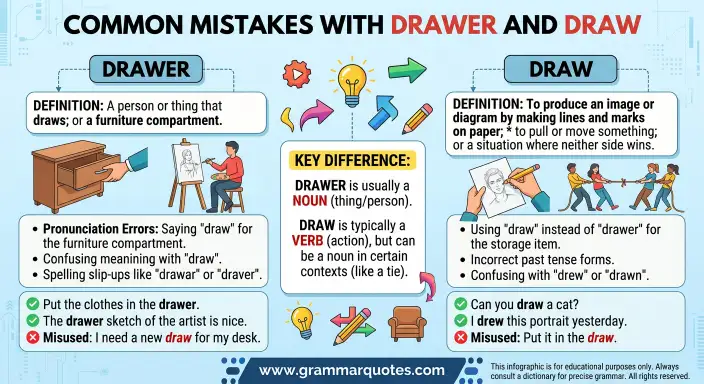
Mistake 1: Using “Draw” for a Storage Compartment
Incorrect: Put the socks in the top draw.
Correct: Put the socks in the top drawer.
Why? A storage compartment is called a drawer, not a draw.
Mistake 2: Using “Drawer” for Making a Picture
Incorrect: I want to drawer a cat.
Correct: I want to draw a cat.
Why? The verb for creating a picture is draw.
Mistake 3: Confusing Draw, Drew, and Drawn
These are three forms of the same verb.
- Draw: I draw pictures every day.
- Drew: I drew a picture yesterday.
- Drawn: I have drawn this picture before.
Mistake 4: Assuming “Drawer” Always Means Furniture
Incorrect claim: “Drawer only means a compartment in a desk.”
Correct: “Drawer” usually means a storage compartment, but it can also refer to a person who issues a cheque or similar financial instrument.
Why? English words can have more than one meaning depending on the context.
Mistake 5: Confusing Spelling with Pronunciation
Some English speakers pronounce drawer very similarly to draw. This can make the words hard to distinguish when listening.
When writing, focus on the meaning of the sentence rather than pronunciation alone.
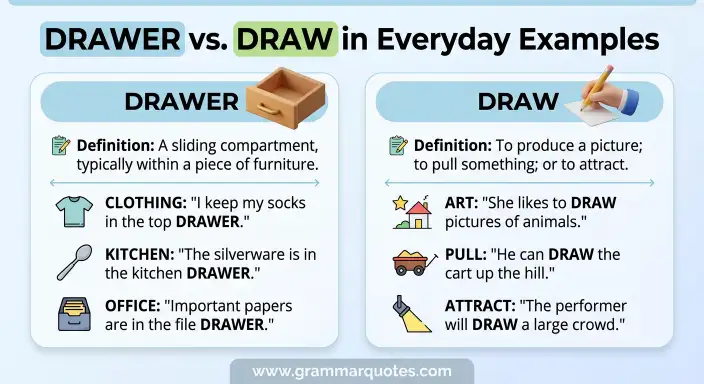
Draw and Drawer in Everyday Examples
In Daily Conversation
- Draw: Can you draw a picture of my dog?
- Drawer: The batteries are in the kitchen drawer.
Use in Schoolwork
- Draw: Draw a diagram of the water cycle.
- Drawer: I keep my school supplies in a drawer.
In Art and Design
- Draw: She learned to draw portraits.
- Drawer: The artist stored pencils in a wooden drawer.
In Business and Advertising
- Draw: The offer may draw new customers.
- Drawer: Please place the documents in the desk drawer.
For Sports
- Draw: The final match ended in a draw.
- Drawer: The word is not normally used for a tied match.
Draw vs Drawer: Comparison Table
| Feature | Draw | Drawer |
| Main word type | Verb; also a noun | Noun |
| Main meaning | Make a picture or pull something | Sliding storage compartment |
| Related to furniture storage? | No, not by itself | Yes |
| Used in art | Draw a picture | Store drawing tools in a drawer |
| Sports meaning | A tied result | Not normally used this way |
| Other meanings | Pull, attract, select, or tie | Person who issues a cheque in financial contexts |
| Example | I draw every weekend. | The pencils are in the drawer. |
| Past tense | Drew | Not applicable as a noun |
| Past participle | Drawn | Not applicable as a noun |
| British spelling | Draw | Drawer |
| American spelling | Draw | Drawer |
A Simple Trick to Remember the Difference
Think about what you want to say:
- Draw: You do an action, such as drawing a picture.
- Drawer: You name a thing, such as the compartment where you keep your pencils.
Try this quick test:
- “Please _____ a flower.”
Correct answer: draw - “Put the paper in the _____.”
Correct answer: drawer - “The match ended in a _____.”
Correct answer: draw
These examples show why the words cannot be used interchangeably.
Frequently Asked Questions
1. What is the main difference between draw and drawer?
Draw usually means to make a picture, pull something, or attract attention. Drawer usually means a sliding storage compartment.
2. Is draw or drawer correct?
Both are correct English words. The right choice depends on the meaning you want to express.
3. Is a drawer part of a desk?
Yes. A drawer is a sliding compartment commonly found in desks, cabinets, and dressers.
4. What is the past tense of draw?
The simple past tense is drew. For example, “She drew a picture yesterday.”
5. What is the past participle of draw?
The past participle is drawn. For example, “I have drawn a picture.”
6. Can draw be used as a noun?
Yes. It can mean a tied result in a game or competition, or something that attracts people.
7. Why do some people pronounce drawer like draw?
In some accents, the pronunciation of drawer is very similar to draw. Pronunciation varies by region and speaker.
8. Is drawer used in British and American English?
Yes. Both British and American English use drawer for a sliding storage compartment.
9. Can drawer mean a person?
Yes. In financial contexts, a drawer can be the person who issues a cheque or similar financial instrument.
10. How can I remember draw vs drawer?
Remember that you draw a picture, but you put things in a drawer.
Conclusion
Understanding draw or drawer is easy once you know their meanings. Draw is commonly a verb that means to make a picture, pull something, or attract attention. It can also be a noun, such as when a sports match ends in a draw. Drawer is usually a noun for a sliding storage compartment in furniture.
The simplest way to remember the difference is to connect each word with a familiar example. You draw a picture, but you put your pencils in a drawer. You can also use draw when describing a tied match or something that attracts visitors.
Both words are used in British and American English, although their pronunciation can vary. By learning their meanings and practicing them in sentences, you can avoid common spelling mistakes and write more clearly in everyday, academic, and professional situations.
Discover More Articles!
Offered vs Offerred: Which Spelling Is Correct and Why It Matters
Boat or Ship: What’s the Difference?(2026)
YAML vs YML: What’s the Difference?(2026)

Ethan Parker is an English-language writer known for his interest in words, language, and clear communication. His work focuses on making everyday English easier to understand through simple explanations and practical examples.