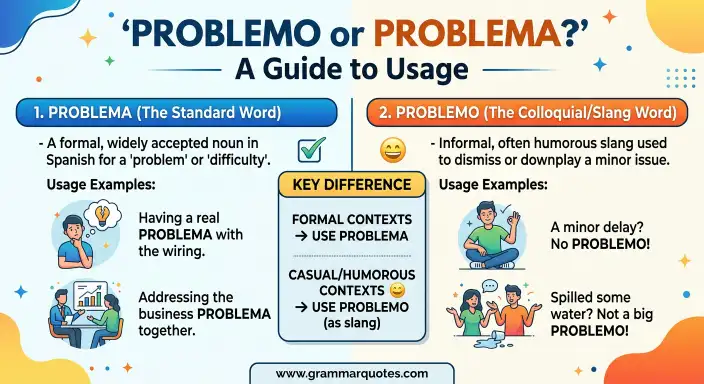
Problema is the standard Spanish word for “problem,” while problemo is not a standard Spanish spelling. In English, people sometimes use “problemo” informally or humorously, but it is not the usual word for a problem.
The words problemo and problema look almost the same, so it is easy to mix them up. You may see both online, in jokes, or in conversations. However, their meanings and correct uses are different.
The main difference is that problema is a real word in Spanish and several other languages, while problemo is often used as a playful or made up form. English speakers may use it jokingly to make a sentence sound funny or dramatic.
In this guide, you will learn what each word means, where it comes from, and how to use it correctly. You will also see simple examples, common mistakes, and answers to frequently asked questions.
Problemo or Problema: Quick Answer
Problema is the correct spelling when you mean “problem” in Spanish. Problemo is generally a nonstandard form that may appear in jokes, slang, or playful English.
Examples:
- Correct Spanish: Tengo un problema. (I have a problem.)
- Standard English: I have a problem.
- Playful English: We have a problemo!
Use problem in normal English writing. Use problema when writing in Spanish or another language where it is the correct form.
Definition and Meaning
What Does Problema Mean?
Problema means “problem” in Spanish. It can refer to a difficult situation, a question that needs solving, or something that causes trouble.
Examples:
- Tengo un problema. — I have a problem.
- Este problema es difícil. — This problem is difficult.
- Necesitamos resolver el problema. — We need to solve the problem.
Although problema ends in a, it is a masculine noun in Spanish. You say el problema, not la problema.
The word is also used in other languages, including Italian, Portuguese, and Greek, although grammar and pronunciation may differ.
What Does Problemo Mean?
Problemo is not the standard Spanish word for “problem.” It is sometimes used in English as a humorous or playful variation of problem.
For example:
- No problemo!
- We have a little problemo.
- Looks like there’s a problemo here!
These expressions are informal. They may be used in jokes, casual conversations, captions, or entertainment. However, problemo is not suitable for most formal writing.
In ordinary English, the standard phrase is “No problem!”
The Origin of Problemo and Problema
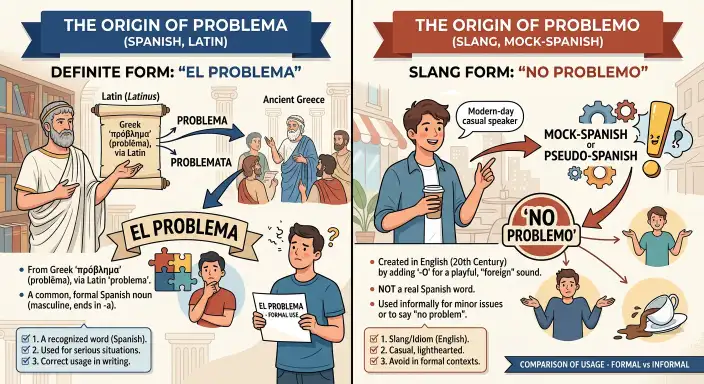
Origin of Problema
The word problema comes from Latin problema, which came from Greek problēma. The Greek word referred to something put forward, such as a question or an issue that needed attention.
Over time, the word developed into the modern term used for a difficulty, challenge, or question requiring a solution.
Spanish retained the form problema, which is still widely used today.
Origin of Problemo
Problemo is often formed by changing the ending of the English word problem from em to emo. This gives it a playful sound.
It is sometimes associated with the informal expression “no problemo,” which means “no problem.” The expression is widely understood in casual English, but it is not standard Spanish.
Unlike problema, problemo does not serve as the normal Spanish noun for a difficulty.
British English vs American English
British and American English both use problem as the standard English word. Neither variety normally uses problemo in formal writing.
| Feature | British English | American English |
| Standard English word | Problem | Problem |
| Spanish word | Problema | Problema |
| Informal playful form | Problemo | Problemo |
| Formal use of “problemo” | Not standard | Not standard |
| “No problem” | Standard phrase | Standard phrase |
The main difference is not between British and American spelling. It is between the standard word problem and the informal expression problemo.
When Should You Use Each Word?
When to Use Problema
Use problema when writing or speaking Spanish, or when using it in another language where it is the correct word.
Examples:
- Tengo un problema con mi teléfono.
- El problema tiene una solución.
- ¿Cuál es el problema?
In English, you might also use problema when discussing Spanish vocabulary or quoting a Spanish sentence.
When to Use Problemo
Use problemo only when you want a casual, humorous, or playful tone.
Examples:
- No problemo, I can help!
- We have a tiny problemo.
- Houston, we have a problemo!
These examples are informal and may sound humorous. Avoid this form in school essays, business emails, academic writing, or professional documents.
When to Use Problem
Use problem in everyday English and in almost all standard writing.
Examples:
- I have a problem with my computer.
- We need to solve this problem.
- There is no problem with your application.
If you are unsure which word to choose in English, problem is the safest and most natural option.
Common Mistakes With Problemo and Problema
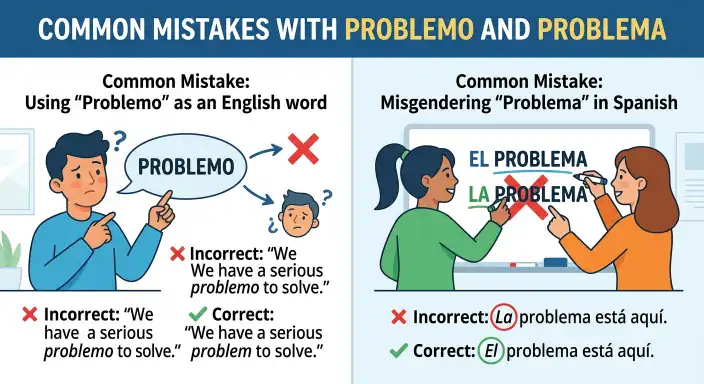
Mistake 1: Using Problemo in Formal Writing
Incorrect: We found a problemo with the report.
Better: We found a problem with the report.
Problemo may be understood, but it sounds informal or humorous.
Mistake 2: Treating Problema as a Spanish Feminine Noun
Incorrect: La problema es difícil.
Correct: El problema es difícil.
In Spanish, problema is masculine, even though it ends in a.
Mistake 3: Thinking Problemo Is Correct Spanish
Incorrect: Tengo un problemo.
Correct: Tengo un problema.
The standard Spanish form is problema.
Mistake 4: Using “No Problemo” in a Professional Email
Informal: No problemo! I’ll send it today.
Professional: No problem. I’ll send it today.
Both can communicate a friendly response, but the second is more suitable for professional settings.
Everyday Examples of Problemo and Problema
In Daily Conversation
- Standard English: Don’t worry; it’s not a problem.
- Informal English: No problemo!
- Spanish: No hay problema. (There is no problem.)
At School
- Standard English: I need help with this math problem.
- Spanish: Tengo un problema de matemáticas. (I have a math problem.)
- Avoid in formal work: I have a math problemo.
At Work
- Standard English: We need to fix the problem before Friday.
- Informal joke: We have a little problemo!
- Spanish: Tenemos un problema. (We have a problem.)
On Social Media
People may use problemo in memes, jokes, or funny captions because it sounds playful.
Example: “When you forget your homework and the teacher starts collecting it… big problemo!”
This style works in casual posts, but it is not standard formal English.
Problemo vs Problema: Comparison Table
| Feature | Problemo | Problema |
| Standard Spanish word | No | Yes |
| Meaning | Usually a playful form of “problem” | Problem or difficulty |
| Common in English | Informal or humorous use | Mostly in Spanish and other languages |
| Formal English writing | Avoid | Use only when appropriate to the language or context |
| Correct Spanish example | Tengo un problemo — nonstandard | Tengo un problema — correct |
| Example | No problemo! | El problema es difícil. |
Remember that problema is not the standard English word either. In ordinary English sentences, use problem.
A Simple Trick to Remember the Difference
Use this easy rule:
- Problem = standard English.
- Problema = standard Spanish.
- Problemo = playful or humorous English.
For example, if you are writing an English essay, choose problem. If you are speaking Spanish, choose problema. If you are making a joke with friends, problemo may fit the tone.
This simple rule will help you choose the right word for most situations.
FAQs About Problemo or Problema
1. Is it problemo or problema?
Problema is the standard Spanish word for “problem.” Problemo is usually a playful or nonstandard form used informally in English.
2. Is problemo a real word?
Problemo appears in informal English and is widely understood in expressions such as “no problemo.” However, it is not the standard Spanish word for “problem.”
3. What does no problemo mean?
“No problemo” is an informal, humorous way to say “no problem.” In standard English, “no problem” is the more natural choice.
4. Is problema a Spanish word?
Yes. Problema is the Spanish word for “problem.” For example, Tengo un problema means “I have a problem.”
5. Is problema masculine or feminine in Spanish?
Problema is masculine in Spanish. The correct form is el problema, even though the word ends in the letter a.
6. Can I use problemo in an essay?
It is best to avoid problemo in formal essays. Use problem in English or problema when writing a Spanish sentence.
7. Is problemo correct in English?
It can be used informally as a humorous expression, but it is not the standard English spelling. The normal word is problem.
8. What is the plural of problema in Spanish?
The plural is problemas. For example, Tengo dos problemas means “I have two problems.”
9. What is the difference between problem and problema?
Problem is the standard English word. Problema is the standard Spanish word and is also used in several other languages.
10. Is “no problemo” formal or informal?
“No problemo” is informal and playful. In formal or professional situations, use “no problem” or a more suitable response, such as “You’re welcome.”
Conclusion
The difference between problemo and problema is mainly about language and context. Problema is the standard Spanish word for “problem,” while problemo is usually a playful expression used in informal English. Although people may say “no problemo” in jokes or casual conversations, it is not the standard Spanish form.
For everyday English, use problem. For Spanish, use problema and remember that it is a masculine noun: el problema. Save problemo for humorous situations where an informal tone is appropriate.
Choosing the right form will help you write more clearly and avoid mistakes in schoolwork, professional messages, and language learning. When in doubt, remember the simple rule: problem in English, problema in Spanish, and problemo for fun.
Discover More Articles!
Lose vs Loose: Meaning, Difference, and Examples(2026)
Poison Tree Tattoo Meaning: What It Symbolizes
Latter or Later: Which One Is Correct?(2026)

Ethan Parker is an English-language writer known for his interest in words, language, and clear communication. His work focuses on making everyday English easier to understand through simple explanations and practical examples.