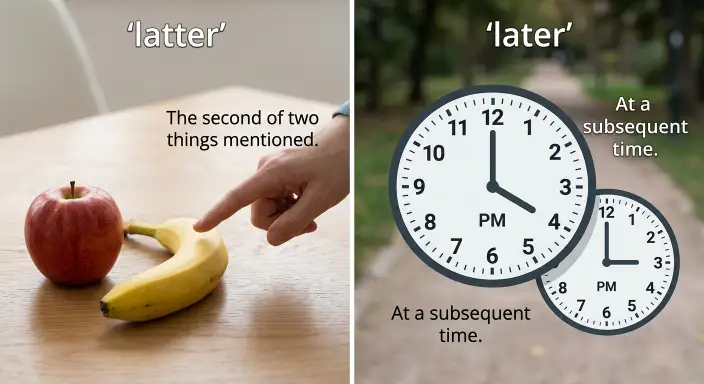
Latter and later are both correct English words, but they have different meanings and are used in different situations. The main difference is that latter usually refers to the second of two things, while later relates to time.
For example, if someone says, “I can study English or computer science. I prefer the latter,” latter means the second option, computer science. On the other hand, “I will call you later” means at a time after now.
These two words look and sound similar, so they are easy to confuse. However, remembering their connection to two choices and time makes the difference simple.
Latter is mainly used when comparing two previously mentioned people, things, or choices. Later is used when talking about a future time, a time after another event, or something happening afterward.
Learning this distinction can help you avoid common mistakes in essays, emails, articles, conversations, and professional writing.
Latter or Later: Quick Answer
Latter means the second of two people or things that have already been mentioned.
Later means at a time afterward or at a future time.
Examples:
I like both tea and coffee, but I prefer the latter.
Here, latter means coffee because it was mentioned second.
I will finish my work later.
Here, later refers to a future time.
Simple Rule
Latter = second of two
Later = afterward or at a future time
This simple rule can help you remember the difference.
Definition and Meaning
What Does Latter Mean?
Latter refers to the second of two people, things, choices, or ideas mentioned earlier.
Example:
Sara and Emma applied for the position. The latter was selected.
The latter refers to Emma because Emma was mentioned second.
It is commonly used when comparing two options.
What Does Later Mean?
Later is related to time.
It can mean:
- At a future time
- After something else
- At a time closer to the end of a period
Examples:
I will call you later.
We arrived later than expected.
She became successful later in life.
The Origin of Latter and Later
Although the two words look similar, they developed from different historical forms and developed different meanings over time.
Latter is related to the old comparative form connected with late and came to be used specifically for the second of two things.
Later developed as the comparative form of late, meaning more advanced in time or afterward.
Their similar spelling comes from their historical relationship with the idea of being later in sequence or time, but modern English uses them differently.
Today, the distinction is quite clear:
- latter → second of two
- later → time
British English vs American English
There is no major spelling difference between British and American English for these words.
Both varieties use:
- Later
- Latter
The meanings are also the same.
| Word | British English | American English |
| Latter | Same spelling and meaning | Same spelling and meaning |
| Later | Same spelling and meaning | Same spelling and meaning |
| Second of two | latter | latter |
| Future/afterward | later | later |
So this is not a British versus American spelling issue. It is mainly a difference in meaning and usage.
Latter Meaning: The Second of Two
One of the most important rules is that latter normally refers to the second of two things.
For example:
We can travel by train or bus. I prefer the latter.
The two options are:
- Train
- Bus
The second option is bus, so latter means bus.
Another example:
Ali and Hamza attended the meeting. The latter arrived early.
Here, latter refers to Hamza.
Important Tip
Use latter when there are two specific choices or subjects being compared.
For more than two items, it is usually clearer to say last, the final one, or name the item directly.
Later Meaning: Time
Later is used when talking about time.
Examples:
I will see you later.
She called me later that evening.
We can discuss this later.
He arrived later than expected.
In each sentence, the word refers to a time after another point.
Later Can Also Mean “Afterward”
For example:
He finished his homework and later went outside.
This means he went outside after finishing his homework.
Latter vs Former
A common phrase is former and latter.
When two things are mentioned, former refers to the first one, while latter refers to the second.
Example:
I enjoy reading books and watching movies. The former is more relaxing, while the latter is more entertaining.
Here:
- former = books
- latter = movies
This pair is useful when comparing two previously mentioned things.
Easy Memory Trick
Think:
Former = first
Latter = last of two
This makes the distinction much easier.
Common Mistakes
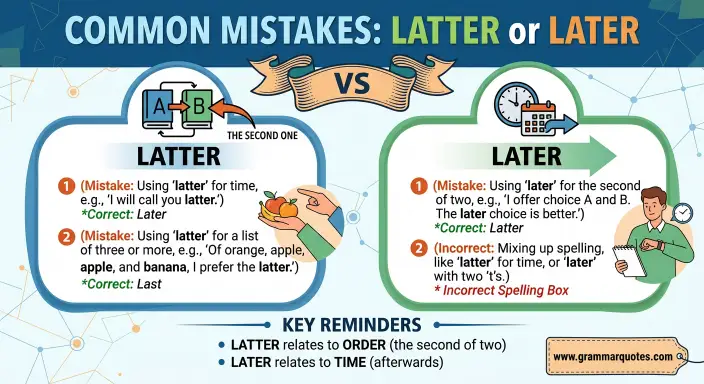
Mistake 1: Using “later” for the second choice
Incorrect:
I prefer the later of the two options.
Better:
I prefer the latter of the two options.
When you mean the second choice, use latter.
Mistake 2: Using “latter” for time
Incorrect:
I will call you latter.
Correct:
I will call you later.
When you mean “afterward,” use later.
Mistake 3: Confusing former and latter
Incorrect understanding:
Former means the second option.
Correct:
Former = first of two
Latter = second of two
Mistake 4: Using latter for three or more choices
The word is traditionally used for the second of two things.
If you have several choices, naming the specific item is usually clearer.
Latter or Later in Everyday Examples
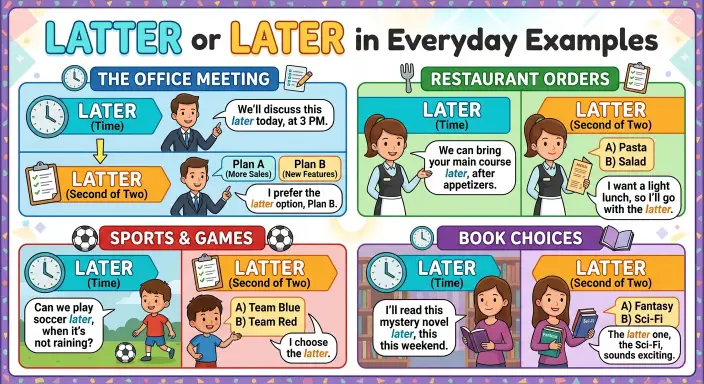
Talking About Two Choices
I can choose tea or coffee. I prefer the latter.
Talking About Time
I will drink coffee later.
In an Essay
Both methods have advantages, but the latter is more practical.
In an Email
I am busy right now, but I can discuss this later.
In Business
The company considered two plans and selected the latter.
In Conversation
I’ll tell you about it later.
These examples show the key difference between choice and time.
Side by Side Comparison
| Feature | Latter | Later |
| Main meaning | Second of two | Afterward or future time |
| Related to choices | Yes | No |
| Related to time | No | Yes |
| Refers to two items | Usually | No |
| Example | I chose the latter. | I’ll call later. |
| Opposite/paired word | Former | Earlier |
Later vs Former vs Latter
These three words can be confusing, so this comparison can help.
| Word | Meaning | Example |
| Former | First of two | I prefer the former. |
| Latter | Second of two | I prefer the latter. |
| Later | At a later time | I will call later. |
Example
John and David applied for the job. The former had more experience, while the latter had better qualifications.
Here:
- Former = John
- Latter = David
But:
David called me later.
Here, later refers to time.
Which Word Should You Use?
Ask yourself one simple question:
Am I talking about two choices or time?
If you are talking about the second of two things, use latter.
I prefer the latter.
If you are talking about a future or later time, use later.
I will do it later.
If you are talking about the first of two things, use former.
I prefer the former.
This quick test can help you choose the correct word almost every time.
Google Trends and Usage
Searches for these words often come from English learners who notice their similar spelling and pronunciation.
The confusion is especially common in writing because both words contain the letters late. However, their modern uses are different.
Search interest can vary by country and over time, so exact Google Trends numbers should not be treated as a permanent measure of usage.
For practical writing, remembering the meaning is more useful than memorizing search statistics:
latter = second of two
later = time
People Also Ask
What is the difference between latter and later?
Latter means the second of two things, while later refers to a future or subsequent time.
Does latter mean second?
Yes. Latter normally means the second of two people or things previously mentioned.
Does later mean afterward?
Yes. Later can mean at a time afterward or at a future time.
Is latter the opposite of former?
Yes. When referring to two things, former means the first and latter means the second.
Can latter be used for three things?
Traditionally, latter is used for the second of two things. With three or more, it is usually clearer to name the specific item.
Is later a time word?
Yes. Later is commonly used to describe a time after now or after another event.
Is latter related to time?
Historically the word is related to late, but in modern usage it mainly identifies the second of two things.
Which is correct: “see you latter” or “see you later”?
See you later is correct because the phrase refers to a future time.
Which is correct: “the latter” or “the later”?
When referring to the second of two choices, the latter is correct.
How can I remember latter and later?
Remember: latter = second of two, while later = time.
Frequently Used Expressions
The Latter
Of the two options, I prefer the latter.
This means the second option.
Later On
We can discuss the problem later on.
This means at some time afterward.
Sooner or Later
You will understand it sooner or later.
This means eventually.
Former and Latter
The former is cheaper, while the latter is more reliable.
This compares two previously mentioned options.
Final Takeaway
Latter and later are both correct words, but they should not be used interchangeably. The easiest distinction is based on meaning.
Use latter when referring to the second of two people, things, choices, or ideas. For example, if you mention tea and coffee and then say you prefer the latter, you mean coffee.
Use later when talking about time. If you say, “I will call you later,” you mean you will call at a time afterward.
You can also remember the useful pair former and later. Former refers to the first of two things, while latter refers to the second. Later, meanwhile, is connected with time.
Once you remember Latter= second and later = time, the difference becomes much easier to understand and use correctly in everyday and formal English.
Discover More Articles!
Paster or Pastor: Which Spelling Is Correct?
Broche or Brooch: Which Spelling Is Correct?(2026)
Trouper or Trooper: What Is the Difference?(2026)

Ethan Parker is an English-language writer known for his interest in words, language, and clear communication. His work focuses on making everyday English easier to understand through simple explanations and practical examples.