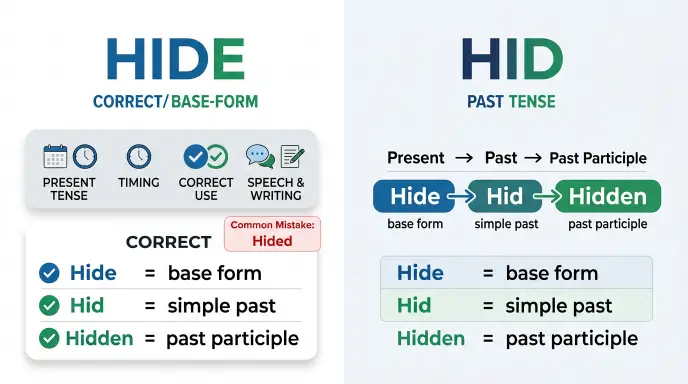
Choosing between hid and hide often confuses learners since both come from the same root verb but serve different purposes. Hide is the base form, used for present actions, commands, and infinitives like “I hide my diary here.”
Hid is the simple past form, used for completed past actions like “I hid my diary yesterday.” The key is timing: use hide for now or general truths, and hid for something that already happened and is finished.
The confusion often comes from the fact that hide has an unusual verb pattern. Its three main forms are hide, hid, hidden. Many English learners expect the past tense to end in ed, but hide is an irregular verb.
Hid or Hide: Quick Answer
The easiest way to remember the difference is:
- Hide = present or base form
- Hid = simple past
- Hidden = past participle
Examples
- I hide my wallet in a safe place.
- Please hide the gift before she arrives.
- They usually hide behind the tree.
Examples
- I hid my wallet yesterday.
- She hid the gift before the party.
- They hid behind the tree when the dog arrived.
Examples
- I have hidden the documents.
- She had hidden the present.
- The keys were hidden under the sofa.
According to Cambridge Dictionary, hide has hid as its past tense and hidden as its past participle.
What Does Hid or Hide Mean?
Hide means to put someone or something somewhere it cannot easily be seen or found. It can also mean keeping information, feelings, or facts from someone.
For example:
Please hide the present.
Here, hide refers to an action that someone should perform.
The word hid describes the same action when it happened in the past:
She hid the present yesterday.
The meaning has not changed. The verb form changes because the time of the action has changed.
Hide as a present or base form
Use hide when discussing:
- A current action
- A regular habit
- A general fact
- An instruction
- An infinitive
- An action after a modal verb
Examples:
- I often hide my important papers.
- Hide the keys before the children find them.
- You should hide the password.
- They want to hide the surprise.
Hid as a past tense form
Use hid when the action was completed in the past.
Examples:
- He hid the letter yesterday.
- She hid behind the door.
- We hid the presents last night.
- The child hid under the bed.
Hidden is different from both
A common mistake is using hid where hidden is required.
Correct:
- I have hidden the keys.
- She had hidden the evidence.
- The money was hidden under the floor.
Incorrect:
- I have hid the keys.
- She had hid the evidence.
In standard modern English, the usual three forms are hide, hid, hidden.
The Origin of Hid or Hide
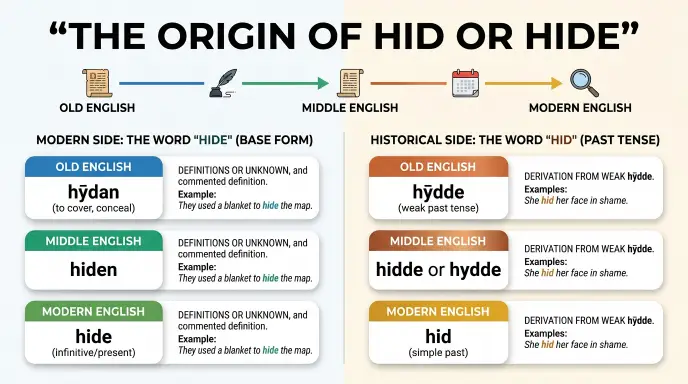
The verb hide is an old English word. Merriam Webster traces the verb through Middle English hiden to Old English hȳdan, with the meaning of getting something out of sight. Oxford also identifies the verb as coming from Old English and describes it as West Germanic in origin.
Over time, English developed many irregular verbs whose past forms do not follow the regular ed pattern. Hide → hid is one example.
This is why you should not write hided when you mean the normal past tense of hide.
The basic pattern is:
hide → hid → hidden
This pattern has remained standard in modern English.
It is also useful to separate the verb hide from the noun hide, which can mean an animal’s skin. That noun has a different history and meaning.
British English vs American English
There is essentially no British American spelling difference between hide and hid. Both varieties use the same standard forms.
| British English | American English | Example |
| hide | hide | I hide the keys here. |
| hid | hid | I hid the keys yesterday. |
| hidden | hidden | I have hidden the keys. |
| hiding | hiding | She is hiding behind the door. |
The difference is therefore not regional. It is mainly a matter of verb tense and grammatical function.
Cambridge gives the same forms in both its UK and US dictionary entries: hide, hid, and hidden.
Do style guides change the rule?
No. Standard English style guides do not normally treat hid and hide as regional alternatives.
If you are writing for:
- A US audience
- A UK audience
- Canadian readers
- Australian readers
- An international audience
the basic verb pattern remains the same.
The important question is when the action happens, not where your readers live.
Which Version Should You Use?
Use the form that matches the grammatical role and time of the action.
United States
American English uses:
- hide for the base and present form
- hid for simple past
- hidden for the past participle
Example:
I hid the documents yesterday.
United Kingdom
British English follows the same standard pattern:
She hid her phone under the pillow.
Canada
Canadian English also uses:
hide → hid → hidden
The same rule applies in everyday and formal writing.
Australia
Australian English follows the same standard conjugation:
He hid the keys before leaving.
International writing
For international readers, simply use the standard forms. There is no need to choose between a British and American version.
Academic writing
Academic writing often uses hide and hid according to normal tense rules.
Examples:
- The researcher hid the participant’s identity.
- The system can hide sensitive information.
- The data had been hidden from the public.
Business writing
Business communication also follows the same pattern:
- Please hide confidential information.
- The employee hid the document.
- The information was hidden from unauthorized users.
The safest rule is simple: choose the verb form based on grammar, not region.
Common Mistakes with Hid or Hide
Mistake 1: Using “hide” for a completed past action
Incorrect:
Yesterday, I hide the documents.
Correct:
Yesterday, I hid the documents.
Why?
“Yesterday” clearly places the action in the past, so the simple past form hid is required.
Memory tip: If you can add yesterday, last night, or last week, hid may be the correct form.
Mistake 2: Using “hided” as the past tense
Incorrect:
She hided the letter.
Correct:
She hid the letter.
Why?
Hide is an irregular verb. Its standard simple past form is hid, not hided. Merriam Webster lists hid as the past form of the standard verb hide.
Memory tip:
Hide → Hid → Hidden
Mistake 3: Using “hid” after “have”
Incorrect:
I have hid the keys.
Correct:
I have hidden the keys.
Why?
After have, has, or had, you normally need the past participle.
- have hidden
- has hidden
- had hidden
Mistake 4: Using “hid” after “to”
Incorrect:
I want to hid the present.
Correct:
I want to hide the present.
Why?
After to, use the base form of the verb.
- to hide
- to write
- to go
- to eat
Mistake 5: Confusing “hid” and “hidden”
Remember:
I hid it yesterday.
But:
I have hidden it.
The first sentence uses simple past. The second uses the past participle.
Hid or Hide in Everyday Examples
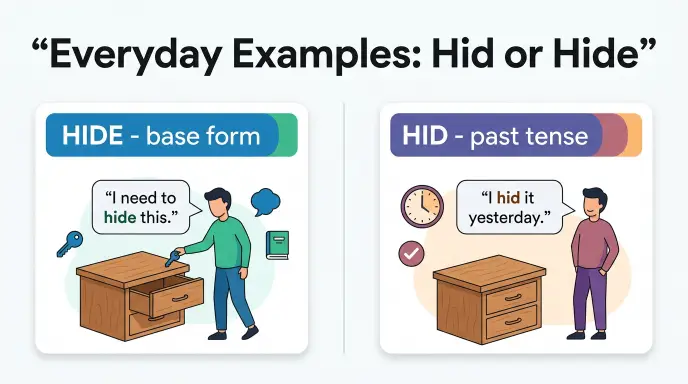
Understanding these forms becomes much easier when you see them in real situations.
Emails
I hid the attachment in the previous folder because it contained confidential information.
Please hide the private details before forwarding the email.
Business writing
The report hid several important details.
The software can hide sensitive information from unauthorized users.
News headlines
News headlines often use short, direct verb forms. For example:
Suspect Hid Evidence Before Police Arrived
In normal article text, the same event could be written:
The suspect hid the evidence before police arrived.
Blogs
I usually hide my spare keys in a secure place.
Last weekend, I hid the keys somewhere I could remember.
Social media
I hid the surprise until the last minute.
Don’t hide your best ideas.
Academic writing
The participant’s identity was hidden to protect privacy.
The researcher hid certain details from the participants during the experiment.
Daily conversation
Where did you hide my phone?
I didn’t hide it.
You hid it under the cushion!
Notice how the verb changes according to the structure and time.
Google Trends & Modern Usage
People searching for “hid or hide” are usually trying to solve a grammar problem. They may be unsure If hid is the correct past tense of hide, or they may confuse hid with hidden.
The confusion is understandable because English uses three different forms:
hide → hid → hidden
Modern dictionaries continue to list this as the standard conjugation. Cambridge identifies hid as the past tense and hidden as the past participle.
Search interest around grammar pairs like this can also come from students, ESL learners, writers, editors, and people checking a sentence before publishing it. Exact regional search volume figures should not be assumed without current Google Trends data.
The key modern usage rule remains stable:
- Hide = base/present form
- Hid = simple past
- Hidden = past participle
There is no major British American difference to worry about.
Quick Comparison Table
| Version | Meaning | Correct? | Region | Example |
| hide | Base/present verb | Yes | All standard English | I hide my keys here. |
| hid | Simple past | Yes | All standard English | I hid my keys yesterday. |
| hidden | Past participle | Yes | All standard English | I have hidden my keys. |
| hided | Incorrect standard past form | No | Standard English | I hided the keys. |
| hiding | Present participle/gerund | Yes | All standard English | She is hiding now. |
Verb Form at a Glance
| Grammar Form | Verb | Example |
| Base form | hide | I want to hide. |
| Present simple | hide/hides | They hide the truth. |
| Simple past | hid | They hid the truth. |
| Past participle | hidden | They have hidden the truth. |
| Present participle | hiding | They are hiding the truth. |
| Infinitive | to hide | They decided to hide. |
Key Takeaways
- Hide is the base form of the verb.
- Hid is the simple past form of hide.
- Hidden is the standard past participle.
- Use hide for present, general, or base form constructions.
- Use hid for a completed action in the past.
- Use hidden after have, has, or had.
- Hided is not the standard simple past form of the verb hide.
- British and American English use the same standard forms.
FAQs
- What is the past participle of “hide”? “Hidden” is the past participle, used with have/has/had. Example: “They have hidden the treasure.”
- Is “hide” a regular or irregular verb? “Hide” is an irregular verb because it doesn’t follow the ed pattern (hide, hid, hidden).
- What is the past tense of “hid”? “Hid” is already the past tense of “hide” it doesn’t have a separate past form of its own.
- Can “hid” be used as a past participle? No, “hid” is only the simple past. Use “hidden” as the past participle instead.
- What is the -ing form of “hide”? The present participle is “hiding,” as in “She is hiding the gift.”
- Is “hide” transitive or intransitive? “Hide” can be both transitive (“hide the key”) and intransitive (“he likes to hide”).
- What is the third person singular of “hide”? It’s “hides,” as in “He hides his feelings well.”
- What is the noun form of “hide”? “Hide” itself can be a noun meaning an animal’s skin, but there’s no separate action-noun form commonly used.
- Is “unhide” a real word? Yes, “unhide” is used informally, especially in tech contexts, to mean revealing something previously hidden.
- What is a synonym for “hid”? Common synonyms include “concealed,” “covered,” and “stashed.”
Conclusion
The choice between hid or hide becomes simple once you understand the role of each form. Hide is the base form of the verb and is used for present actions, general statements, instructions, infinitives, and constructions after modal verbs. Hid is the simple past form and describes an action that happened in the past.
There is also a third form that should not be forgotten: hidden. It is the standard past participle and commonly appears after have, has, and had, as well as in passive constructions.
The standard pattern is:
Hide → Hid → Hidden
This rule applies across standard British, American, Canadian, and Australian English. The main issue is grammar and tense, not regional spelling.
When writing, first ask yourself when the action happened. If it is a simple past action, use hid. If you need the base form, use hide. If you are using a perfect or passive construction, hidden is usually the right choice.
Remember: Hide now, hid before, hidden with have.
Discover More Articles!
Workiversary vs Workaversary: Meaning, Usage & Correct Spelling
Daddy’s vs Daddies: Meaning, Plural, and Usage
Camry or Accord: A Complete Comparison to Find the Better Sedan(2026)

Ethan Parker is an English-language writer known for his interest in words, language, and clear communication. His work focuses on making everyday English easier to understand through simple explanations and practical examples.