Workiversary or Workaversary: Which One Is Correct? Find out which spelling is preferred, what both terms mean, and the best choice for professional or casual writing.
So, which spelling should you use? Workiversary is the better choice if you want the more widely recognized and commonly used form. Workaversary is also used, but it is less common and remains an informal variation. If you are writing something formal, work anniversary is the safest and clearest option.
This guide explains the difference between workiversary or workaversary, where these terms come from, how they work in American and British English, and which version fits emails, social media, business writing, and everyday conversation.
Workiversary or Workaversary: The Quick Answer
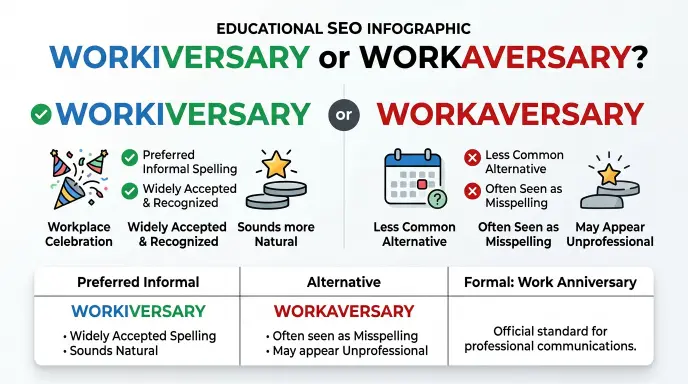
Workiversary is generally the preferred spelling of the informal term for the anniversary of starting a job. Workaversary has the same basic meaning, but it is a less common variant.
If you need a simple rule:
- Workiversary = preferred informal form
- Workaversary = informal alternative
- Work anniversary = clearest formal expression
For example:
- “Today is my fifth workiversary.”
- “Happy workiversary! Thanks for five great years.”
- “We are celebrating Maria’s fifth work anniversary.”
For formal documents, HR policies, reports, and professional announcements, work anniversary is usually the safest wording.
What Does Workiversary Mean?
Workiversary is an informal noun formed from work and anniversary. It means the anniversary of the date a person began working for a company or organization.
It is especially common in friendly workplace communication. Employees may use it when posting on LinkedIn, sending a message to a coworker, or celebrating their years of service.
The word can describe different milestones:
- “It’s my first workiversary.”
- “She celebrated her tenth workiversary.”
- “Our team is planning a celebration for his fifth workiversary.”
The word is informal. It is not normally the best choice for highly formal writing.
For example, an HR report would usually say:
“The employee has reached five years of service.”
Or:
“We are recognizing employees on their five year work anniversaries.”
A casual workplace message could simply say:
“Happy workiversary!”
That difference in tone is important. Workiversary is playful and conversational, while work anniversary is neutral and professional.
The Origin of Workiversary or Workaversary
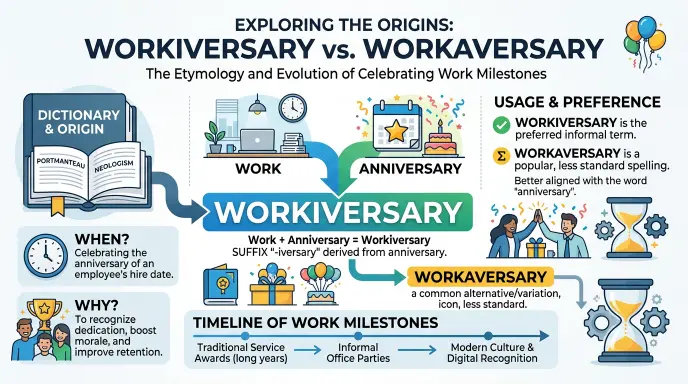
Both workiversary and workaversary are blends, sometimes called portmanteaus. They combine work with part of anniversary.
Workiversary follows the structure:
work + iversary = workiversary
The spelling keeps the i sound and spelling found in the middle of anniversary. This is one reason the form is often preferred.
Workaversary, on the other hand, uses:
work + aversary = workaversary
Both forms developed as playful workplace language rather than as formal replacements for work anniversary.
There is also evidence that workaversary has been used for years. For example, the Star Tribune discussed the term in 2017 and defined it as the anniversary of the day someone started a job.
Because these are informal blends, usage can vary. Unlike a standard word with a long established spelling rule, these terms depend heavily on workplace culture and common usage.
British English vs American English
There is no major British versus American spelling rule that requires workiversary in one country and workaversary in another.
Both are informal workplace blends. The bigger difference is formality and familiarity, not national spelling.
| British English | American English | Example |
| workiversary | workiversary | “Happy workiversary!” |
| workaversary | workaversary | “Today is my workaversary.” |
| work anniversary | work anniversary | “She reached her fifth work anniversary.” |
The standard phrase work anniversary works naturally in both British and American English.
In professional writing, style guides and editorial preferences generally favor familiar, transparent language. That makes work anniversary a strong choice when your audience may not know the informal blend.
For casual workplace communication, workiversary is easy to understand and widely used online. Current workplace resources commonly present it as the more popular spelling, although workaversary remains in use.
Which Version Should You Use?
The best choice depends on your audience and the purpose of your writing.
United States
Use workiversary for casual workplace messages, social posts, employee recognition, and friendly conversations.
For formal HR documents, use work anniversary.
United Kingdom
The same basic advice applies. Workiversary can work in informal communication, but work anniversary is clearer in formal or traditional business writing.
Canada
Both forms may be understood, but work anniversary is the safest neutral choice. Use workiversary when the workplace has a relaxed communication style.
Australia
Workiversary can be used informally, especially in employee recognition or social communication. For formal documents, work anniversary is more straightforward.
International Writing
If your audience includes people who speak English as a second language, choose work anniversary.
It requires no explanation and avoids confusion about if workiversary is a standard dictionary word.
Academic Writing
Avoid both playful blends unless you are specifically discussing workplace language.
Prefer:
- “employment anniversary”
- “work anniversary”
- “anniversary of employment”
- “years of service”
Business Writing
For a formal email, report, policy, or announcement, work anniversary is usually the best option.
For an internal Slack message or employee celebration, workiversary can make the message warmer and more relaxed.
Common Mistakes with Workiversary or Workaversary
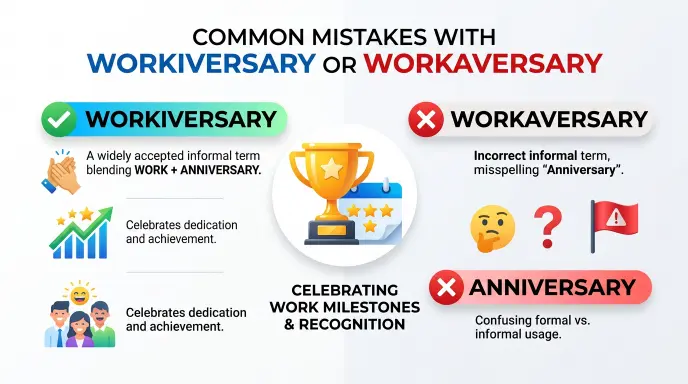
Mistake 1: Treating Workiversary as a Formal Term
Incorrect for formal writing:
“The employee’s workiversary was recorded in the official report.”
Better:
“The employee’s work anniversary was recorded in the official report.”
Why?
“Workiversary” is informal workplace language. A formal phrase is clearer.
Memory tip:
Formal = work anniversary. Casual = workiversary.
Mistake 2: Assuming Workaversary Has a Different Meaning
Incorrect assumption:
“A workaversary means something different from a workiversary.”
Better understanding:
The two terms generally refer to the same workplace milestone.
Mistake 3: Using “Workiversary” for Every Employment Milestone
A workiversary normally refers to the anniversary of starting or joining a workplace.
For broader professional milestones, a clearer phrase may be:
“five years of service”
or
“five years with the company.”
Mistake 4: Mixing Spellings
Avoid switching between forms in the same document.
For example:
“Happy workiversary! We hope you enjoy your workaversary celebration.”
Pick one form and use it consistently.
If you need the safest option, use work anniversary.
Workiversary or Workaversary in Everyday Examples
Emails
Informal:
“Happy workiversary, Sarah! We are lucky to have you on the team.”
Formal:
“Congratulations on your fifth work anniversary.”
Business Writing
“The company recognizes employees who reach significant work anniversaries.”
This is more appropriate than using a playful blend in a formal report.
News Headlines
A casual headline might use:
“Employee Celebrates 20th Workiversary”
A more neutral headline could say:
“Employee Celebrates 20 Years With Company”
Blogs
“Planning a workiversary celebration? Start with a personal message and a small team gathering.”
Here, the informal term fits the friendly tone.
Social Media
“Five years, countless lessons, and an amazing team. Happy workiversary to me!”
This is a natural setting for workiversary.
Academic Writing
“Employee recognition programs may acknowledge employees on their work anniversaries.”
Use work anniversary rather than relying on informal workplace slang.
Daily Conversation
“Tomorrow is my workiversary!”
This sounds casual and natural in a workplace conversation.
Google Trends & Modern Usage
People searching workiversary or workaversary are usually trying to solve one of two problems: they want to know which spelling is correct, or they want a suitable term for celebrating an employee’s time at a company.
Current online usage strongly favors workiversary in many workplace and social contexts. Several recent workplace resources describe it as the more common spelling, while still acknowledging workaversary as a variant.
However, exact search volume numbers can change over time and should not be treated as permanent facts without checking current Google Trends data.
There is also an important distinction between popular usage and formal correctness. A word can be widely understood without being the best choice for every situation.
That is exactly what happens here:
- Workiversary is recognizable and informal.
- Workaversary is understandable but less commonly preferred.
- Work anniversary is clear, neutral, and professional.
So, if someone asks, “Is it workiversary or workaversary?” the practical answer is workiversary, but if the context is formal, write work anniversary instead.
Quick Comparison Table
| Version | Meaning | Correct? | Region | Example |
| Workiversary | Anniversary of starting a job | Yes, informal | International | “Happy workiversary!” |
| Workaversary | Anniversary of starting a job | Yes, informal variant | International | “It’s my workaversary.” |
| Work anniversary | Anniversary of employment | Yes | International | “Today is my work anniversary.” |
| Employment anniversary | Anniversary of employment | Yes, formal | International | “Her employment anniversary is in June.” |
Which One Is Best?
| Situation | Best Choice | Why |
| Casual conversation | Workiversary | Friendly and playful |
| Social media | Workiversary | Short and engaging |
| Team chat | Workiversary | Informal workplace tone |
| HR announcement | Work anniversary | Clear and professional |
| Business report | Work anniversary | Neutral and precise |
| Academic paper | Work anniversary | More formal |
| Formal company policy | Work anniversary | Avoids slang |
| Personal celebration | Workiversary | Warm and casual |
Key Takeaways
- Workiversary and workaversary generally mean the same thing.
- Workiversary is the more widely recognized informal spelling.
- Workaversary is an alternative informal form.
- Neither term should be confused with a completely different workplace milestone.
- Work anniversary is the safest choice for formal writing.
- Use workiversary freely in casual messages, social posts, and team chats.
- Choose one spelling and keep it consistent.
- When writing for an international audience, work anniversary is especially clear.
FAQs
Is workiversary or workaversary correct?
Workiversary is generally the preferred informal spelling. Workaversary is also used and has the same basic meaning, but it is less commonly preferred in many current workplace contexts. If you are writing formally, neither is necessary. Use work anniversary instead.
What does workiversary mean?
A workiversary is the anniversary of the date someone started working for a company or organization. It is an informal blend of “work” and “anniversary.” People commonly use it when celebrating one, five, ten, or more years with an employer.
Is workiversary a real word?
Workiversary is an established informal workplace term, although it is a blend rather than a traditional formal word. It appears in English language dictionaries and workplace resources. Because it remains informal, work anniversary is still a better choice for formal documents.
Is workaversary spelled correctly?
Yes, workaversary is a recognized informal variant used to mean a work anniversary. However, it is not generally the preferred spelling when choosing between the two. Workiversary is more commonly recommended, while work anniversary remains the clearest formal expression.
Can I say “Happy workiversary”?
Yes. “Happy workiversary!” is a natural, friendly expression for celebrating someone’s employment milestone. It works particularly well in team chats, cards, social media posts, and informal emails. For a formal company announcement, “Happy work anniversary!” sounds more professional.
Should I use workiversary in a formal email?
Usually, work anniversary is the better choice. “Workiversary” has a playful tone, so it may sound too casual in a formal email. If you know the workplace culture is relaxed, however, “workiversary” can be perfectly appropriate for an internal message.
Is workiversary used in British English?
Yes, English speakers in the UK can understand and use workiversary, especially in informal workplace communication. There is no major British English rule that makes workaversary the British form and workiversary the American form. The main issue is formality, not nationality.
What is another word for workiversary?
The clearest alternative is work anniversary. Other options include employment anniversary, service anniversary, or years of service milestone, depending on the context. “Work anniversary” is usually the most natural replacement because it is simple and widely understood.
Should I write workiversary or work anniversary on LinkedIn?
Either can work, but workiversary gives a more casual and celebratory tone. Work anniversary sounds more polished and professional. If you are posting a personal milestone, “workiversary” can feel friendly. If you are writing an official company announcement, “work anniversary” is usually safer.
Is workiversary hyphenated?
Usually, workiversary is written as one word. It is a blend of “work” and “anniversary,” rather than a phrase that normally needs a hyphen. If you want to avoid any uncertainty, simply write work anniversary, which is also the clearest formal form.
Conclusion
When choosing between workiversary or workaversary, the simplest answer is workiversary. It is the more commonly preferred informal form for describing the anniversary of someone’s start date at a company. Workaversary is also used, but it is better viewed as an alternative spelling rather than a different word with a different meaning.
The most important point, however, is context. If you are writing a LinkedIn post, team message, card, or casual email, workiversary is friendly and easy to understand. If you are preparing an HR policy, academic paper, formal report, or official business announcement, work anniversary is clearer and more professional.
You do not need to worry about treating workiversary and workaversary as two completely different concepts. They describe essentially the same milestone.
Remember: Workiversary is the fun choice, while work anniversary is the formal choice.
Discover More Articles!
Buying or Renting: Which Is Better for You?
Bit or Byte: What’s the Difference and Which One Should You Use?
Iceland vs Greenland: Which One Should You Choose?

Hi,I am a Adrian walker. I’m passionate about making English grammar simple and easy to understand. I write clear comparisons that explain confusing words, spelling differences, and common grammar mistakes so readers can write with confidence. My goal is to provide accurate, practical, and easy-to-follow language guides for learners and writers worldwide.