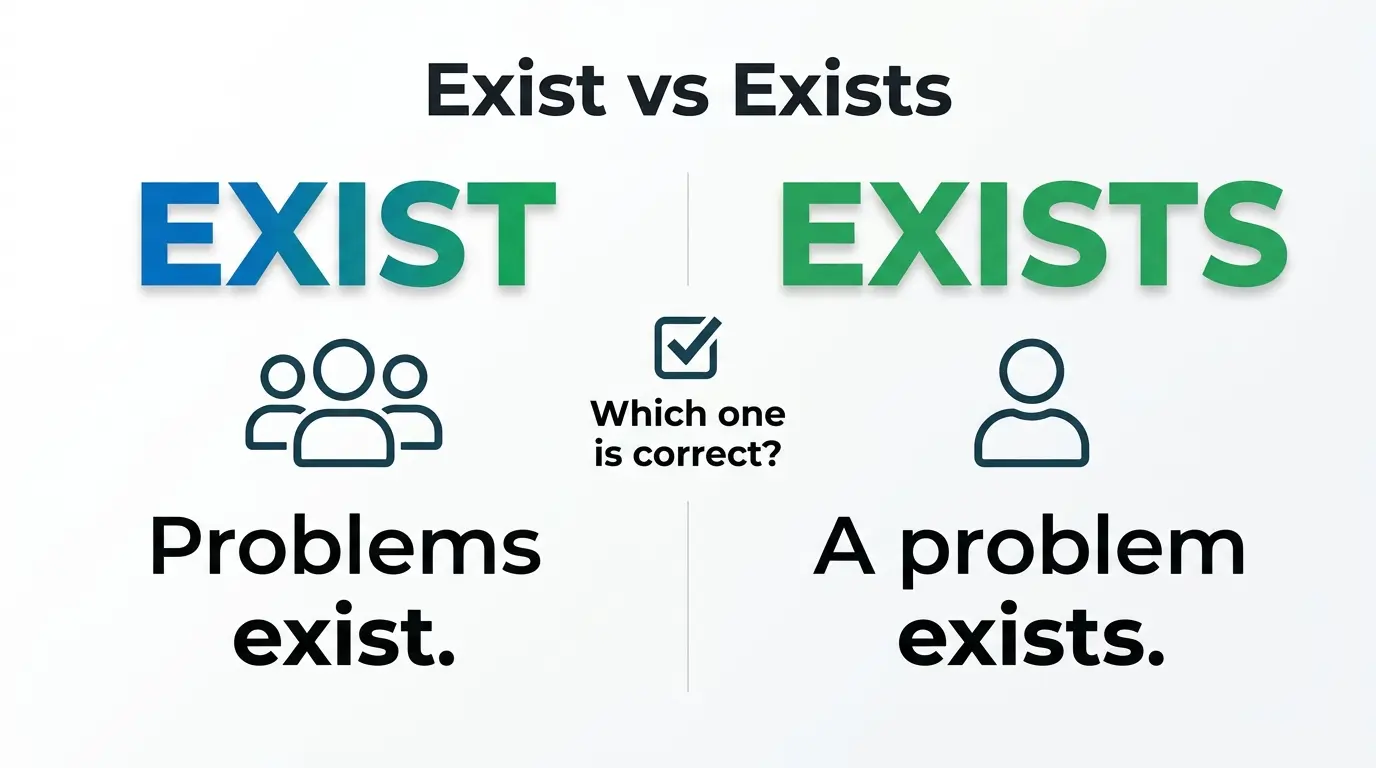
Exist and exists have the same basic meaning, but they are used differently in a sentence. Exist is used with plural subjects or after helping verbs, while exists is used with singular third-person subjects.
For example, “Many problems exist” is correct, while “A problem exists” is correct. After does, always use exist: “Does it exist?” Understanding the subject and the verb structure is the easiest way to choose the correct form.
For example, we say, “Problems exist” because problems is plural, but “A problem exists” because problem is singular. We also say, “Does it exist?”, not “Does it exists?” because the helping verb does already carries the third person singular form.
People often search for exist or exists because the two forms look almost identical. The difference becomes especially confusing in questions, sentences with does, and sentences with words such as everyone, something, and there.
This guide explains when to use exist and exists, their meaning and origin, British and American usage, common mistakes, everyday examples, and simple rules that make the choice easy.
Exist or Exists: Quick Answer
Exist and exists are both correct forms of the verb exist. The choice depends mainly on the subject and the structure of the sentence.
- Use exist with plural subjects: Problems exist.
- Use exists with a singular third person subject: A problem exists.
- Use exist after do, does, did, can, will, may, might, must, and other modal or auxiliary structures where the base verb is required.
- Use exists in a simple present sentence with he, she, it, or another singular noun.
Examples:
Many solutions exist.
One solution exists.
Does a solution exist?
The easiest rule is: singular subject = exists; plural subject = exist, except when another verb requires the base form exist.
What Does Exist Mean?
Exist is a verb that means to be real, to be present, or to have being. It can also mean to continue living, especially under difficult conditions. Cambridge Dictionary gives meanings related to being real or present and to living in difficult conditions.
For example:
- “Do aliens exist?”
- “Many problems exist in the system.”
- “A serious problem exists.”
- “Some animals exist only in this region.”
The form exists has the same basic meaning. It is simply the third person singular present tense form of exist. Merriam Webster lists exists as a present tense form of exist.
Compare:
| Subject | Correct form | Example |
| I | exist | I exist to help. |
| You | exist | You exist in this system. |
| We | exist | We exist as a team. |
| They | exist | They exist today. |
| He | exists | He exists in the story. |
| She | exists | She exists in the database. |
| It | exists | It exists for a reason. |
The important point is that exist is the base form, while exists is the singular third person present form.
The Origin of Exist
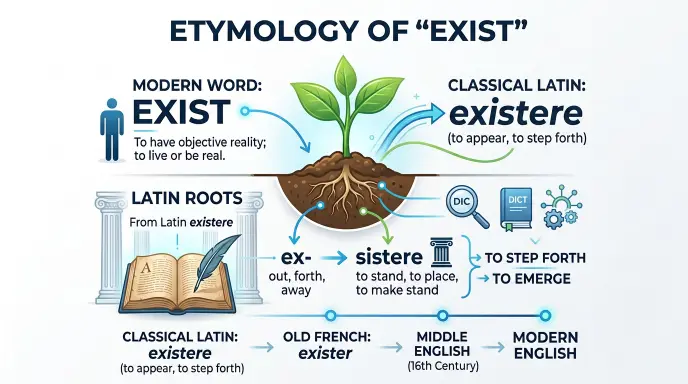
The word exist has a long history. Merriam Webster traces it through Middle French exister to Latin existere or exsistere, with meanings connected to coming into view, coming into being, or having real being. Merriam Webster dates its first known English use to the 16th century.
The word is related to the broader idea of being or having reality.
Over time, English developed the regular verb forms we use today:
- exist = base form
- exists = third person singular present
- existed = past tense
- existing = present participle
The spelling difference between exist and exists is therefore not a difference in meaning. It is mainly a matter of grammar and subject verb agreement.
For example:
The problem exists.
But:
The problems exist.
The extra s in exists signals the third person singular present tense.
British English vs American English Spelling
There is no meaningful British versus American spelling difference between exist and exists. Both forms are standard in British and American English.
The grammar rule remains the same in both varieties.
| British English | American English | Example |
| exist | exist | Problems exist. |
| exists | exists | A problem exists. |
| existed | existed | The problem existed before. |
| existing | existing | Existing problems remain. |
Cambridge provides both UK and US pronunciations for exist, while the grammatical forms remain the same.
What Changes?
The main differences between British and American English usually involve vocabulary, pronunciation, or certain spelling patterns. Exist/exists is not one of those differences.
So if you write for:
- a British audience
- an American audience
- a Canadian audience
- an Australian audience
- an international audience
the basic rule stays the same.
Which Spelling Should You Use?
You do not need to choose between British exist and American exists. Both varieties use both words.
Instead, choose the form based on the grammar of your sentence.
Use “exist” with plural subjects
Many challenges exist.
Several explanations exist.
Use “exists” with singular subjects
One explanation exists.
A serious challenge exists.
Use “exist” after “does”
Does this problem exist?
Not:
Does this problem exists?
Use “exist” after modal verbs
Such risks may exist.
These problems can exist.
The condition might exist.
In Academic Writing
Both forms are common in academic writing.
Several theories exist.
One theory exists to explain the result.
Always follow subject verb agreement.
In Business Writing
The same rule applies:
Several options exist.
A better option exists.
The important thing is not the style of writing. It is the grammatical structure.
Common Mistakes with Exist or Exists
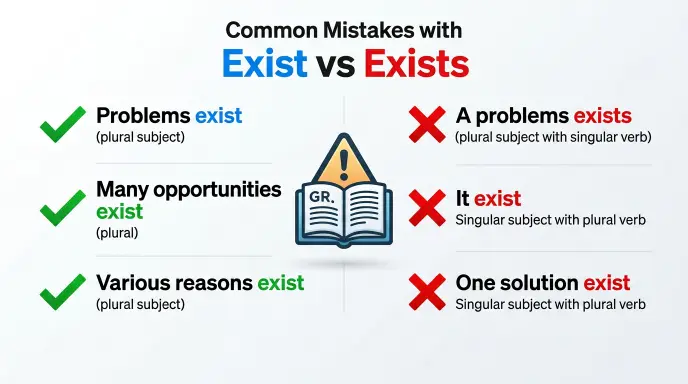
Mistake 1: Using “exists” with a plural subject
Incorrect:
Many problems exists in the system.
Correct:
Many problems exist in the system.
Why?
Problems is plural, so use the plural/base form exist.
Memory tip:
Many = exist.
Mistake 2: Using “exist” with a singular subject
Incorrect:
A serious problem exist.
Correct:
A serious problem exists.
Why?
A serious problem is singular and third person, so the verb takes s.
Memory tip:
One = exists.
Mistake 3: Adding “ s” after “does”
Incorrect:
Does this problem exists?
Correct:
Does this problem exist?
Why?
The auxiliary does already marks the third person singular form. The main verb returns to its base form.
Compare:
The problem exists.
Does the problem exist?
Mistake 4: Using “exists” after a modal verb
Incorrect:
Such a possibility may exists.
Correct:
Such a possibility may exist.
After may, use the base verb exist.
Mistake 5: Confusing “exist” with “existence”
Incorrect:
The exist of the problem is clear.
Correct:
The existence of the problem is clear.
Why?
Exist is a verb. Existence is a noun. Merriam Webster defines existence as the state or fact of having being.
Exist or Exists in Everyday Examples
Emails
“Several options exist, so please choose the one that works best.”
“A simpler solution exists.”
Business Writing
“Several opportunities exist in the current market.”
“A potential risk exists in this process.”
News Headlines
“New Evidence Suggests Similar Problems Exist”
“Scientists Confirm That the Species Exists”
Blogs
“Many myths exist about this topic.”
“One simple explanation exists.”
Social Media
“Problems exist, but solutions do too.”
“Yes, this feature exists!”
Formal Writing
“Several factors exist that may affect the outcome.”
“A significant difference exists between the two groups.”
Daily Conversation
“Do ghosts exist?”
“That option exists, but it is expensive.”
“Many other choices exist.”
Exist or Exists: Google Trends & Usage Data
People commonly search exist or exists because English learners often know that both forms are related but are unsure when to use the final s.
The confusion is especially common in questions such as:
“Does it exist?”
and statements such as:
“It exists.”
The difference is grammatical rather than regional. Both exist and exists are standard English forms, and major dictionaries list them as forms of the same verb.
Search interest can also come from specific phrases such as:
- “does it exist or exists”
- “should I use exist or exists”
- “people exist or exists”
- “does this exist”
- “a problem exist or exists”
- “there exist or there exists”
Exact Google Trends numbers can change over time, so it is better not to assign fixed popularity statistics without checking a current Trends dataset.
For learners, the safest approach is to focus on subject verb agreement rather than trying to memorize individual phrases.
Quick Comparison Table
| Version | Grammar Role | Correct? | When to Use | Example |
| exist | Base/plural form | Yes | Plural subjects | Problems exist. |
| exists | Third person singular present | Yes | Singular subjects | A problem exists. |
| exist | After do/does | Yes | Questions/negatives | Does it exist? |
| exist | After modal verbs | Yes | Can, may, will, etc. | It may exist. |
| existed | Past tense | Yes | Past situations | It existed before. |
| existing | ing form | Yes | Continuous/participial use | Existing problems remain. |
The Simple Grammar Formula
Singular subject + exists
The answer exists.
Plural subject + exist
The answers exist.
Does + subject + exist
Does the answer exist?
Modal + exist
The answer may exist.
This formula solves most exist or exists questions.
Key Takeaways
- Exist and exists are both correct.
- Exist is the base form of the verb.
- Exists is the third person singular present form.
- Use exist with plural subjects.
- Use exists with singular third person subjects.
- After does, always use exist, not exists.
- After modal verbs such as can, may, might, and will, use exist.
- British and American English follow the same basic rule.
FAQs
Is it “exist” or “exists”?
Both are correct, but they are used differently. Use exist with plural subjects, such as “problems exist.” Use exists with a singular third person subject, such as “a problem exists.” After does, use exist, as in “Does the problem exist?”
Is “does it exist” or “does it exists” correct?
“Does it exist?” is correct. After the auxiliary verb does, the main verb must use its base form. Therefore, we say “Does it exist?” rather than “Does it exists?” The statement form is different: “It exists.” The word does carries the grammatical marking in the question.
Is it “people exist” or “people exists”?
“People exist” is correct because people is a plural noun. We use the base form exist with plural subjects. For example, “Many people exist in this community” is grammatically possible, although “Many people live in this community” may sound more natural depending on the meaning.
Is “a problem exist” or “a problem exists” correct?
“A problem exists” is correct. The subject a problem is singular, so the present tense verb needs the third person singular form exists. Compare it with “Problems exist,” where the plural subject takes the base form exist.
Can I say “there exist” and “there exists”?
Yes. Both can be correct. Use there exists with a singular noun phrase, such as “There exists a solution.” Use there exist with a plural noun phrase, such as “There exist several solutions.” In everyday English, “There is a solution” and “There are several solutions” are often more natural.
What is the difference between exist and exists?
The main difference is grammatical form. Exist is the base form and is also used with plural subjects and after auxiliary or modal verbs. Exists is the present tense third person singular form. The meaning remains essentially the same.
Is “does not exist” correct?
Yes. “Does not exist” is correct because does is followed by the base form exist. For example: “This option does not exist.” Do not write “This option does not exists.” The same pattern applies to questions: “Does this option exist?”
Conclusion
The choice between exist or exists becomes simple once you focus on the subject and the verb structure. Both words are correct forms of the verb exist, which means to be real, present, or to have being.
Use exists when a singular third person subject comes directly before the verb. For example, “A solution exists” and “The problem exists.” Use exist with plural subjects, as in “Solutions exist” and “Problems exist.”
There is one rule that causes many mistakes: after does, use exist, not exists. So write “Does it exist?” rather than “Does it exists?” The same base form rule applies after modal verbs such as can, may, might, and will.
There is no major British American spelling difference here. Both varieties use exist and exists according to the same grammar rules.
Remember: one thing exists, many things exist, but after “does,” always use exist.
Discover More Articles!
Iceland vs Greenland: Which One Should You Choose?
Bit or Byte: What’s the Difference and Which One Should You Use?
Workiversary vs Workaversary: Meaning, Usage & Correct Spelling

Ethan Parker is an English-language writer known for his interest in words, language, and clear communication. His work focuses on making everyday English easier to understand through simple explanations and practical examples.