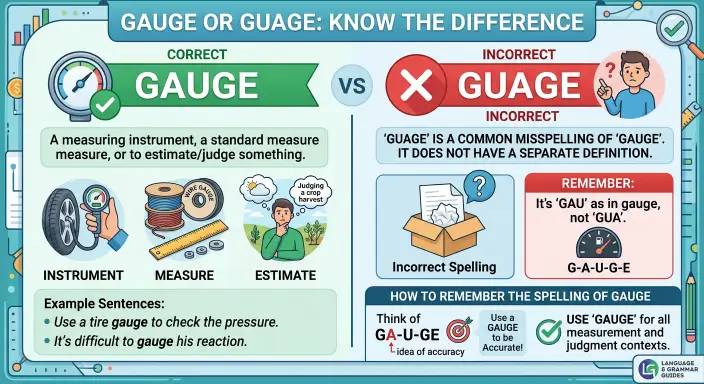
Gauge is the correct spelling in standard English, while guage is a common misspelling. The word “gauge” can mean a device used to measure something, a standard of measurement, or the act of estimating or evaluating something.
For example, you might use a pressure gauge to measure pressure or gauge someone’s reaction to a suggestion.
Many people accidentally write “guage” because the letters in “gauge” appear in an unusual order. Although the incorrect spelling may look reasonable, standard English dictionaries recognize “gauge” as the correct form.
if you are writing an email, completing schoolwork, preparing a report, or improving your vocabulary, knowing the difference can help you avoid a common spelling mistake.
In this guide, you will learn the correct spelling, definition, origin, pronunciation, British and American usage, everyday examples, common mistakes, and frequently asked questions about “guage” and “gauge.”
Quick Answer: Guage or Gauge?
Gauge is correct. Guage is incorrect in standard English.
| Word | Status | Example |
| Gauge | Correct | Check the pressure gauge. |
| Guage | Misspelling | Check the pressure guage. |
Easy memory trick: Remember that “gauge” contains the letter sequence G A U G E. Think of the “A U” appearing before the second “G.”
Related question: Is “guage” ever correct?
In ordinary English writing, “guage” is a misspelling of “gauge.” A particular brand name, username, or specialized proper name could use that spelling, but it is not the standard spelling of the English word.
1. What Does Gauge Mean?
The word “gauge” has several meanings. It can be a noun or a verb, depending on how it is used in a sentence.
Definition and Meaning
As a noun, a gauge is an instrument or standard used to measure, assess, or compare something.
Examples:
- A fuel gauge shows how much fuel remains in a vehicle.
- A temperature gauge indicates the temperature of a system.
- A performance gauge helps evaluate progress.
As a verb, “gauge” means to measure, estimate, judge, or assess something.
Examples:
- We need to gauge the project’s progress.
- She tried to gauge his reaction.
- The teacher used a short quiz to gauge the students’ understanding.
What Is the Difference Between Gauge and Guage?
“Gauge” is the accepted English spelling. “Guage” is generally a spelling error caused by confusion about the order of the letters.
For example:
- Incorrect: The mechanic checked the tire guage.
- Correct: The mechanic checked the tire gauge.
Remember that “gauge” is used for both measuring instruments and the act of estimating or evaluating something.
2. Origin of the Word Gauge
The word “gauge” has a long history in English and is associated with measurement and standards. It developed from older forms of the word, including Middle English gauge and related Anglo French forms.
Historically, the word was used in contexts involving measurements, quantities, and standards. Over time, its meaning expanded to include assessing a situation or estimating someone’s feelings and reactions.
For example, a person might gauge the depth of water by measuring it. In modern everyday English, someone might also gauge public opinion by observing responses to a question.
Understanding the word’s history can help explain why “gauge” is the established spelling rather than “guage.”
3. Gauge in British vs American English
One common question is if British and American English use different spellings of “gauge.”
The answer is no. Gauge is the standard spelling in both British and American English.
| Feature | British English | American English |
| Correct spelling | Gauge | Gauge |
| Incorrect spelling | Guage | Guage |
| Pronunciation | Generally /ɡeɪdʒ/ | Generally /ɡeɪdʒ/ |
| Noun usage | A measuring instrument | A measuring instrument |
| Verb usage | To estimate or assess | To estimate or assess |
Unlike words such as “colour” and “color,” the spelling of “gauge” does not change between these varieties of English.
Is Gauge Spelled Differently in the UK and US?
No. Both British and American dictionaries use “gauge.”
For example:
- British English: The engineer checked the pressure gauge.
- American English: The engineer checked the pressure gauge.
The spelling stays the same regardless of location.
4. How to Remember the Correct Spelling of Gauge
Because “gauge” contains an unusual combination of letters, it can be easy to misspell.
Here are three simple ways to remember it.
Method 1: Memorize the Letter Order
Write the word as:
G A U G E
The first “G” comes before “A” and “U,” while the second “G” comes afterward.
Method 2: Connect It With Measurement
Think of a familiar measuring device, such as a fuel gauge or pressure gauge.
The association between “gauge” and measurement can help you remember the correct spelling.
Method 3: Practice With a Sentence
Write and repeat this sentence:
I used a gauge to measure the pressure.
Practicing the word in context can make its spelling easier to recall.
5. Everyday Examples of Gauge
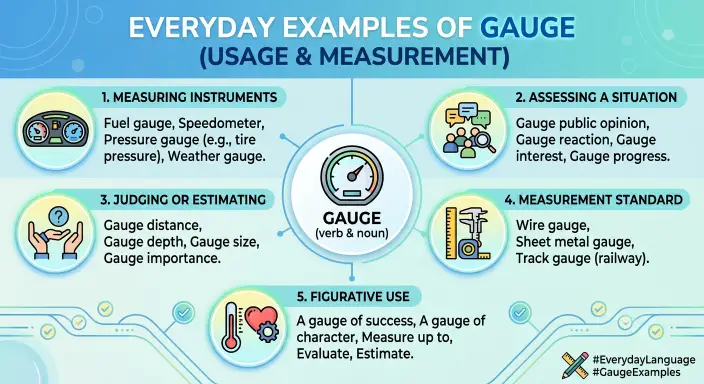
The word “gauge” appears in technical writing, conversations, education, business, and daily life.
Here are ten examples showing how to use it correctly.
- Pressure: The technician inspected the pressure gauge before starting the machine.
- Fuel: I checked the fuel gauge before driving to the next town.
- Reaction: He watched her expression to gauge her reaction.
- Interest: The company conducted a survey to gauge customer interest.
- Progress: Weekly tests help teachers gauge students’ progress.
- Mood: She asked a few questions to gauge the team’s mood.
- Temperature: The temperature gauge showed that the engine was getting hot.
- Public opinion: Researchers collected responses to gauge public opinion.
- Difficulty: The coach asked questions to gauge the difficulty of the task.
- Business performance: The manager reviewed the figures to gauge the business’s performance.
These examples show that “gauge” can refer to physical measurement as well as judgment or estimation.
6. Common Spelling Mistakes With Gauge
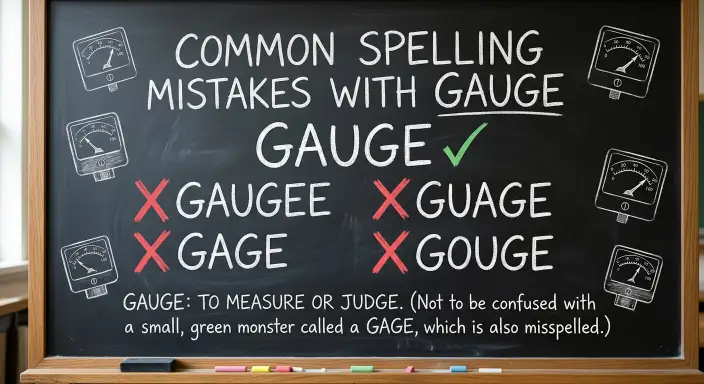
Even experienced English writers sometimes make spelling mistakes with words containing unusual letter combinations.
Mistake 1: Writing Guage Instead of Gauge
Incorrect: The fuel guage is almost empty.
Correct: The fuel gauge is almost empty.
The mistake occurs when the letters “A” and “U” are placed after the second “G” rather than before it.
Mistake 2: Assuming Gauge Has a Different British Spelling
Incorrect: “Guage” is the British spelling, while “gauge” is American.
Correct: “Gauge” is standard in both varieties.
There is no standard British American spelling difference for this word.
Mistake 3: Using Gauge When You Mean Gage Without Considering Context
“Gage” is a recognized spelling variant in some contexts, particularly in American English and specialized terminology. However, “gauge” is the usual spelling in general writing.
For example:
- General usage: The pressure gauge needs replacing.
- General usage: We need to gauge the audience’s response.
For most everyday writing, choose “gauge.”
Mistake 4: Confusing Gauge With Similar Measurement Words
“Gauge,” “measure,” “assess,” and “estimate” can have related meanings, but they are not always interchangeable.
- Measure: Determine the size, amount, or degree of something.
- Assess: Evaluate a situation or quality.
- Estimate: Make an approximate calculation or judgment.
- Gauge: Measure or estimate something, often to understand its level, extent, or likely response.
Choosing the most precise word makes your writing clearer.
7. Gauge vs. Gage: Are Both Correct?
Both “gauge” and “gage” are recognized English spellings, but their usage differs.
“Gauge” is the usual spelling in modern general English. “Gage” appears as a variant in some American and technical contexts, as well as in proper names.
| Word | Typical use | Example |
| Gauge | Standard general English | Check the pressure gauge. |
| Gage | Recognized spelling variant or specialized usage | Consult the relevant technical specification. |
| Guage | Common misspelling | Avoid this spelling in standard writing. |
If you are writing an essay, an email, or a general article, “gauge” is the safest choice.
8. Google Trends and Common Search Confusion
People often search for “guage or gauge” because the word’s spelling is not immediately obvious from its pronunciation.
Searches comparing the two spellings usually reflect a desire to confirm which version is correct.
However, search interest alone does not establish if a word is grammatically or orthographically correct. For spelling questions, established dictionaries and reputable language references are more reliable.
If you are writing for a website, use “gauge” in your content, headings, and examples when it is the intended word.
9. Frequently Asked Questions
1. Is it guage or gauge?
“Gauge” is correct in standard English. “Guage” is a common misspelling.
2. Why do people spell gauge as guage?
People often reverse the order of the letters because the spelling does not closely match what they expect from the pronunciation.
3. Is gauge correct in British English?
Yes. “Gauge” is the standard spelling in British English and American English.
4. What does gauge mean?
As a noun, it can mean a measuring instrument or standard. As a verb, it means to measure, estimate, or assess something.
5. How do you pronounce gauge?
It is generally pronounced /ɡeɪdʒ/, which sounds like “gayj.”
6. Is gage a real word?
Yes. “Gage” is a recognized spelling variant, although “gauge” is more common in general English.
7. What is the plural of gauge?
The plural noun is “gauges.”
Example: The mechanic checked all the pressure gauges.
8. What is the past tense of gauge?
The past tense is “gauged.”
Example: The researcher gauged public opinion through a survey.
9. What are some synonyms for gauge?
Depending on the context, synonyms include measure, assess, estimate, evaluate, judge, and determine.
10. How can I avoid misspelling gauge?
Remember the letter sequence G A U G E and practice using the word in sentences involving measurement or assessment.
Conclusion
The correct spelling is gauge, not “guage.” Although the two forms may look similar, only “gauge” is the standard spelling for the ordinary English word.
Use “gauge” when referring to a measuring instrument, such as a fuel gauge, or when describing the act of assessing a reaction, estimating progress, or evaluating a situation. The spelling remains the same in British and American English.
You may also encounter “gage” as a recognized variant, particularly in some American or technical contexts. However, “gauge” remains the best choice for most everyday and formal writing.
To remember the correct form, focus on the letter order: G A U G E. A little practice will help you avoid this common mistake and write with greater confidence.
Discover More Articles!
Aldi or Lidl: What Is the Difference?
Southpaw or Orthodox: What Is the Difference?(2026)
Sleave vs Sleeve: Meaning, Difference, and Examples

Ethan Parker is an English-language writer known for his interest in words, language, and clear communication. His work focuses on making everyday English easier to understand through simple explanations and practical examples.