Have you ever wondered if trick or treators is the correct spelling? The phrase is often used when talking about Halloween, but the more common and widely accepted term for people who go door to door asking for candy is trick or treaters.
Trick or treaters are usually children who dress up in costumes and visit homes on Halloween. They say “Trick or treat!” when someone answers the door and hope to receive sweets or other small treats.
The spelling can be confusing because the phrase combines several words, and people may write it in different ways. However, knowing the standard spelling helps you use it correctly in school assignments, blog posts, social media captions, and everyday conversations.
In this guide, you will learn the meaning of trick or treaters, understand why trick or treators is not the standard spelling, and explore useful examples. You will also discover the difference between trick, treat, and treaters, along with common spelling mistakes and answers to frequently asked questions.
Trick or Treators: Quick Answer
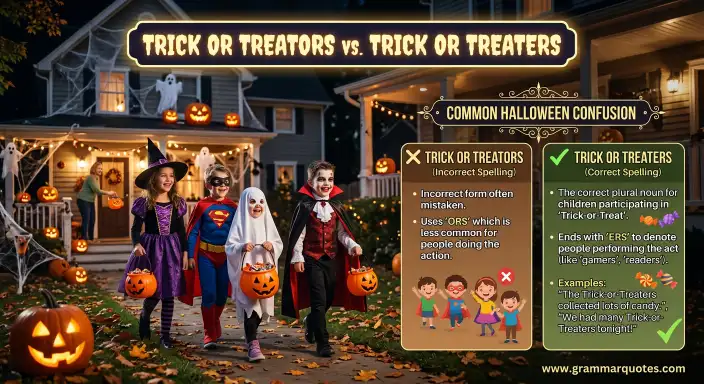
The standard spelling is trick or treaters, not trick or treators, when referring to people who visit houses to ask for candy on Halloween.
- Trick or treaters: People who participate in the Halloween tradition of going door to door for treats.
- Trick or treators: A nonstandard spelling sometimes used by mistake.
Examples of Trick or Treaters
- The trick or treaters visited our house on Halloween night.
- We bought candy for the trick or treaters in our neighborhood.
- The children dressed up as witches and superheroes to become trick or treaters.
Easy rule: When referring to people who go door to door on Halloween, write trick or treaters.
Definition and Meaning
What Does Trick or Treaters Mean?
Trick or treaters is the plural form of trick or treater. It describes people, usually children, who visit homes on Halloween and ask for candy or other treats.
The term comes from the Halloween expression “trick or treat.” Traditionally, the phrase gives a playful choice between a trick and a treat, although modern trick or treating usually focuses on receiving candy.
Examples:
- The trick or treaters wore colorful costumes.
- Several trick or treaters knocked on our door.
- My neighbors prepared small gift bags for the trick or treaters.
What Does Trick or Treators Mean?
Trick or treators is not the standard spelling for Halloween visitors. People may write it this way because treators looks like it could be a word formed from treat.
However, English uses treater for a person who gives or receives a treat, depending on the context. In the Halloween expression, the established compound spelling is trick or treater.
For example:
Incorrect: We gave candy to the trick or treators.
Correct: We gave candy to the trick or treaters.
The second sentence uses the conventional spelling and hyphenation.
The Origin of Trick or Treaters
The word trick has roots in older French and Latin related forms that came into English through French. It can refer to a clever action, a prank, or something intended to deceive.
In Halloween traditions, a trick is associated with the playful idea of a prank.
Examples:
- The magician performed a clever trick.
- The children played a harmless trick on their friend.
The word treat comes through Old French from Latin roots associated with handling or dealing with something. In modern English, it can mean something enjoyable, such as candy, or the act of giving someone special attention.
Examples:
- The children received a sweet treat.
- My parents bought ice cream as a special treat.
The Origin of Trick or Treating
The modern Halloween custom developed from older seasonal traditions, including practices in which people visited homes and received food. The phrase trick or treat became strongly associated with Halloween in North America during the twentieth century.
Today, trick or treating usually involves children wearing costumes and visiting homes that welcome them to collect candy.
British English vs. American English
The term trick or treater is especially common in American English because trick or treating is a well known Halloween tradition in the United States. The term is also understood in Britain and other English speaking countries.
| Feature | British English | American English |
| Standard spelling | Trick or treater | Trick or treater |
| Plural spelling | Trick or treaters | Trick or treaters |
| Halloween use | Understood and used | Very common |
| Common activity | Visiting homes for treats | Visiting homes for candy |
| Nonstandard spelling | Trick or treators | Trick or treators |
Which Spelling Is More Common?
Trick or treaters is the standard spelling in both varieties of English. The activity is particularly associated with American Halloween celebrations, but the term is widely understood elsewhere.
Remember that American English often uses the word candy, while British English commonly uses sweets.
Examples:
- American English: The trick or treaters collected candy.
- British English: The trick or treaters collected sweets.
Both sentences are correct.
When to Use Trick or Treaters
Use trick or treaters when talking about people who take part in the Halloween tradition.
1. In Halloween Stories
The word is useful when describing children or groups visiting houses for treats.
Examples:
- The trick or treaters arrived just after sunset.
- A group of trick or treaters walked down the street.
- The house was decorated for the trick or treaters.
2. In Blog Posts and Articles
If you are writing about Halloween activities, costumes, decorations, or candy, trick or treaters is the standard term.
Examples:
- How to welcome trick or treaters safely.
- The best treats to prepare for trick or treaters.
- Halloween decorations that trick or treaters will love.
3. In Social Media Captions
The term can also be used in Halloween posts and captions.
Examples:
- Ready for the trick or treaters!
- Our little trick or treaters are ready for Halloween.
- Candy is waiting for all the trick or treaters tonight.
4. In School Assignments
Use the standard spelling in essays, stories, and classroom activities.
Example:
“Our neighborhood welcomed many trick or treaters on Halloween night.”
This spelling is suitable for both formal and informal writing about the tradition.
Common Mistakes with Treaters or Trick
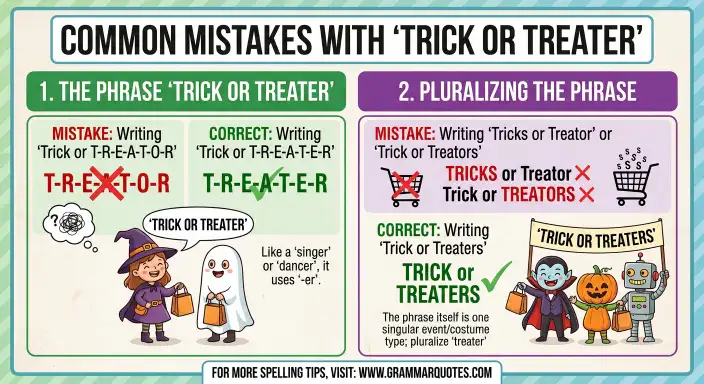
Mistake 1: Writing Trick or Treators
Incorrect: We prepared candy for the trick or treators.
Correct: We prepared candy for the trick or treaters.
Why? Trick or treaters is the established spelling for people who participate in the Halloween activity.
Mistake 2: Forgetting the Hyphens
Incorrect: The trick or treaters came to our door.
Preferred: The trick or treaters came to our door.
Why? The hyphens connect the words into a compound term. This is the standard written form.
Mistake 3: Using Trick or Treater for More Than One Person
Incorrect: Many trick or treater visited our house.
Correct: Many trick or treaters visited our house.
Why? Add s to make the singular noun trick or treater plural.
Mistake 4: Confusing Trick or Treaters with Treats
Trick or treaters refers to people, while treats refers to the candy or other goodies they receive.
Examples:
- The trick or treaters knocked on the door.
- We gave the trick or treaters some treats.
The people and the items they receive are different things.
Everyday Examples of Trick or Treaters
In Daily Conversation
- Are we expecting many trick or treaters tonight?
- The trick or treaters are walking around the neighborhood.
- We have enough candy for the trick or treaters.
School and Academic Writing
- The story describes a group of trick or treaters on Halloween.
- Students wrote short stories about trick or treaters.
- The class discussed Halloween traditions and trick or treaters.
In Work and Professional Writing
- The community center is organizing an event for young trick or treaters.
- The store is offering Halloween treats for trick or treaters.
- Volunteers will help direct trick or treaters during the event.
For Social Media Posts
- Happy Halloween to all the little trick or treaters!
- Our front porch is ready for trick or treaters.
- We loved seeing all the creative costumes worn by the trick or treaters.
Trick or Treater vs. Trick or Treaters: Comparison
| Feature | Trick or Treater | Trick or Treaters |
| Form | Singular | Plural |
| Meaning | One person participating in trick or treating | Two or more people participating |
| Example | A trick or treater rang the bell. | The trick or treaters rang the bell. |
| Spelling | Hyphenated | Hyphenated |
| Correct usage | One person | Multiple people |
Trick vs. Treat vs. Treater
| Word | Meaning | Example |
| Trick | A prank or clever action | The magician performed a trick. |
| Treat | Something enjoyable, such as candy | Each child received a treat. |
| Treater | A person who gives or receives a treat | The host greeted each treater. |
| Trick or treater | A person participating in the Halloween tradition | A trick or treater asked for candy. |
The established Halloween term is trick or treater. Using the full compound makes the intended meaning clear.
Easy Tricks to Remember the Spelling
Trick 1: Remember the Word “Treat”
The correct term ends with treaters, not treators.
Correct: trick or treaters.
Trick 2: Think About the People
The word refers to people who go from house to house on Halloween. If you are talking about those people, use trick or treaters.
Trick 3: Use the Hyphens
Remember the standard pattern:
Trick + or + treaters = trick or treaters
The hyphens join the words into one compound noun.
Trick 4: Check Singular and Plural
- One person: trick or treater.
- More than one person: trick or treaters.
This simple rule will help you avoid common spelling and grammar mistakes.
Frequently Asked Questions
1. Is It Trick or Treators or Trick or Treaters?
Trick or treaters is the standard spelling for people who visit homes on Halloween to ask for treats. Trick or treators is a nonstandard spelling in this context.
2. What Does Trick or Treaters Mean?
It refers to people, often children, who dress up in costumes and visit homes on Halloween to collect candy or other treats.
3. Is Trick or Treater One Word?
No. The standard spelling uses three parts connected by hyphens: trick or treater.
4. What Is the Plural of Trick or Treater?
The plural is trick or treaters. For example, “The trick or treaters visited several houses.”
5. Why Is Trick or Treaters Hyphenated?
The hyphens connect the words into a compound noun that names people who participate in the Halloween tradition.
6. Is Trick or Treators Ever Correct?
It is not the standard spelling for Halloween visitors. In ordinary writing, use trick or treaters.
7. What Do Trick or Treaters Say?
They traditionally say, “Trick or treat!” when someone answers the door. The phrase is part of the Halloween custom of asking for candy or other treats.
8. Is Trick or Treaters American or British English?
The term is especially associated with American Halloween traditions, but it is also understood and used in British English and other English speaking regions.
9. What Is the Difference Between Trick or Treaters and Treats?
Trick or treaters are the people who visit homes. Treats are the candy, sweets, or other goodies they receive.
10. How Can I Remember the Correct Spelling?
Remember that the standard word ends in treaters. Write trick or treaters with hyphens when referring to people who participate in Halloween activities.
Conclusion
The correct and standard spelling is trick or treaters when referring to people who visit homes on Halloween to collect candy or other treats. Although trick or treators may appear in informal writing, it is not the accepted spelling for this meaning.
The term combines the familiar Halloween phrase trick or treat with er, which identifies a person who performs an activity. Its plural form is trick or treaters, while the singular form is trick or treater.
Use the word in Halloween stories, blog posts, school assignments, event announcements, and social media captions. Remember to keep the hyphens and spell the ending as treaters, not treators.
With this simple rule, you can avoid a common spelling mistake and make your writing clearer. Whenever you write about children collecting candy or people visiting homes during Halloween, trick or treaters is the spelling to choose.
Discover More Articles!
Bollard or Ballard: Which Spelling Is Correct?(2026)
Boat or Ship: What’s the Difference?(2026)
YAML vs YML: What’s the Difference?(2026)

Ethan Parker is an English-language writer known for his interest in words, language, and clear communication. His work focuses on making everyday English easier to understand through simple explanations and practical examples.