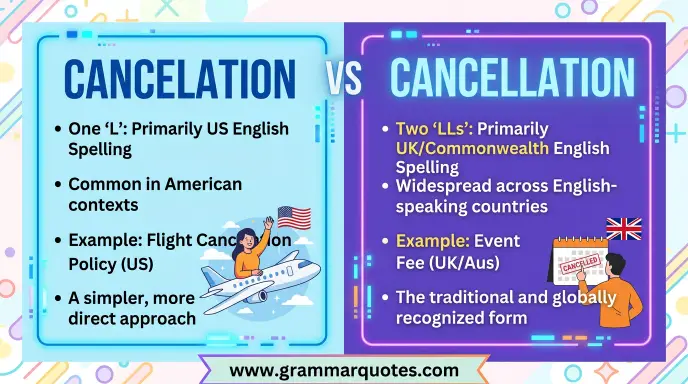
Cancellation is the standard spelling in modern English, while cancelation is a less common variant that you may still see in some dictionaries and writing.
If you are unsure if to write cancelation or cancellation, you are not alone. The confusion comes from the way the verb cancel changes when the ending ation is added.
This spelling question often appears in emails, business notices, travel updates, event announcements, and everyday writing. Both forms can be found in English, but they do not have the same level of common use. Cancellation is widely preferred, especially in American English, while cancelation is accepted as a variant by some dictionaries.
The good news is that the choice is simple for most writers. If you want the spelling that readers are most likely to expect, cancellation is the safer choice.
This guide explains the difference between cancelation and cancellation, their origins, British and American usage, common mistakes, examples, and when to use each spelling.
Cancelation or Cancellation : Quick Answer
Cancellation is the preferred and more common spelling.
Cancelation is also found as a spelling variant, but it is much less common.
Examples
- Correct and preferred: The flight cancellation was announced this morning.
- Less common variant: The flight cancelation was announced this morning.
Both forms refer to the act of canceling something.
| Spelling | Status | Commonness |
| Cancellation | Standard and preferred | Very common |
| Cancelation | Accepted variant | Less common |
If you are writing an email, article, school assignment, business notice, or formal document, cancellation is usually the best choice.
Definition and Meaning
Cancellation means the act of stopping, calling off, or ending something that was planned or arranged.
For example:
The company announced the cancellation of the event.
Here, cancellation means that the event will no longer happen.
Cancelation has the same basic meaning when it is used as a spelling variant.
The Origin of Cancelation and Cancellation
Both cancelation and cancellation come from the verb cancel.
The English word cancel came through Old French from Latin cancellare, meaning to cross out or mark something with lines. The Latin word is related to cancellus, meaning a lattice or grating.
Over time, cancel developed its modern meaning of removing, stopping, or calling something off.
The noun forms cancelation and cancellation developed from the verb cancel with the suffix ation.
The spelling difference comes from how English handles the final l before certain suffixes.
In one form:
cancel + ation → cancelation
In the other:
cancel + lation → cancellation
The double l spelling became especially established in American English.
Why Are There Two Spellings?
English spelling is not always perfectly consistent. Some words have different accepted forms because spelling conventions developed differently over time.
The same pattern can be seen in words related to cancel:
- cancel
- canceled / cancelled
- canceling / cancelling
- cancellation / cancelation
Different English varieties can prefer different spellings.
British English vs American English Spelling
The most important difference appears in related forms of the word.
British English commonly uses cancelled and cancelling, with a double l. American English commonly uses canceled and canceling, with one l.
However, the noun cancellation is widely used in both British and American English.
| Word | British English | American English |
| Verb | cancel | cancel |
| Past tense | cancelled | canceled |
| ing form | cancelling | canceling |
| Noun | cancellation | cancellation |
| Variant noun | cancelation | cancelation |
This creates an interesting spelling pattern. American English often removes the extra l in canceled and canceling, but cancellation commonly retains the double l.
British English Examples
The airline confirmed the cancellation of the flight.
We received notice of the cancellation yesterday.
American English Examples
The airline confirmed the cancellation of the flight.
We received notice of the cancellation yesterday.
The noun spelling is therefore easy to remember: cancellation works naturally in both major varieties of English.
Which Spelling Should You Use?
For most readers, use cancellation.
For American English
Use cancellation in standard American English writing.
Examples:
- cancellation policy
- cancellation fee
- order cancellation
- flight cancellation
For British English
Use cancellation as well.
It fits naturally with British spelling conventions.
For International English
Cancellation is the safest choice because it is widely recognized and commonly used across English speaking countries.
For Professional Writing
Use cancellation in:
- Business emails
- Company policies
- Travel notices
- Customer service messages
- News articles
- School assignments
- Formal documents
Although cancelation can be found as a dictionary variant, cancellation is more familiar to most readers.
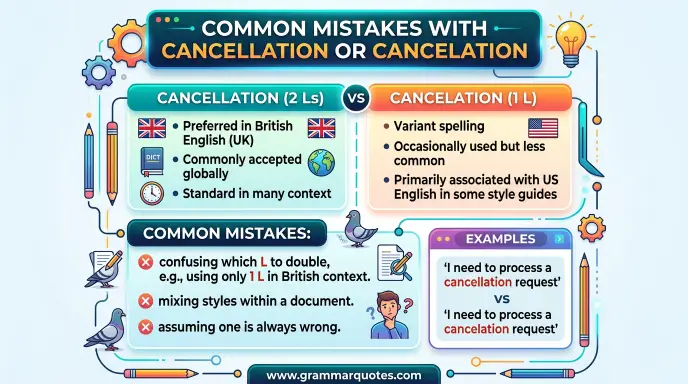
Common Mistakes with Cancellation or Cancelation
1. Writing “Cancelation” When You Want the Common Form
Cancelation is not necessarily an error, but it is much less common.
Preferred:
The cancellation was unexpected.
2. Writing “Cancelletion”
This spelling is incorrect.
❌ Cancelletion
✅ Cancellation
The ending is ation, not e tion.
3. Confusing Cancellation With Cancelled
The two words are related but have different functions.
Cancelled is a verb form or adjective.
The meeting was cancelled.
Cancellation is a noun.
The cancellation of the meeting was unexpected.
4. Mixing British and American Forms
A writer may use:
The event was canceled.
and later:
The event was cancelling.
The second form may conflict with the spelling style being used.
For consistent American English:
- canceled
- canceling
For consistent British English:
- cancelled
- cancelling
5. Assuming One L Always Means American English
This is a common misunderstanding.
American English usually uses canceled and canceling, but the noun cancellation is commonly spelled with two ls.
Cancelation or Cancellation in Everyday Examples
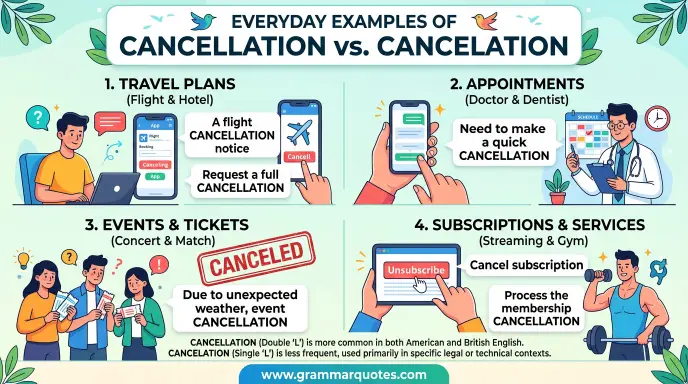
In Emails
Please accept my apologies for the cancellation of today’s meeting.
This is the natural choice for professional communication.
In News
The airline announced the cancellation of several flights.
The word clearly tells readers that the flights will not operate as planned.
On Social Media
Due to bad weather, the event’s cancellation has been announced.
Social media posts can use either variant, but cancellation is more familiar.
In Business Writing
Our cancellation policy requires 24 hours’ notice.
This is a common business phrase.
In Formal Writing
The cancellation of the contract resulted in additional costs.
Cancellation works well in formal and academic contexts.
In Everyday Conversation
I called the hotel about my cancellation.
The word is also common in normal speech.
Cancelation vs Cancellation Comparison
The two forms have the same basic meaning, but their usage differs.
| Feature | Cancellation | Cancelation |
| Meaning | Act of canceling something | Act of canceling something |
| Spelling | Double l | Single l |
| Commonness | Very common | Less common |
| British English | Common | Variant |
| American English | Common | Variant |
| Professional writing | Recommended | Usually avoid |
| Academic writing | Recommended | Usually avoid |
| Everyday writing | Recommended | Less common |
The main difference is usage frequency and preference, not meaning.
Why Is Cancellation Spelled With Two Ls?
The spelling cancellation developed with the double l form of the base word.
English spelling can preserve letters when suffixes are added, even when related forms use a different spelling rule.
This is why you can see:
- cancel
- canceled
- canceling
- cancellation
The spelling system may look inconsistent, but each form follows established usage patterns.
A useful memory trick is:
Cancel → cancellation
Think of the noun as keeping the double l:
c a n c e l l a t i o n
Is Cancelation Wrong?
Not always.
Cancelation is recognized as a spelling variant in some dictionaries and references. However, it is much less common than cancellation.
For practical writing, choosing the more familiar spelling reduces the chance that readers will think it is a typo.
So:
Cancellation = preferred
Cancelation = less common variant
This distinction is more useful than simply calling cancelation “wrong.”
Cancellation in Common Phrases
The word cancellation appears in many common expressions.
Cancellation Policy
Please read our cancellation policy before booking.
Cancellation Fee
The hotel charges a cancellation fee.
Flight Cancellation
Passengers were notified about the flight cancellation.
Order Cancellation
Your order cancellation has been processed.
Subscription Cancellation
The subscription cancellation was completed successfully.
Event Cancellation
The event cancellation was announced on Friday.
These phrases are widely understood and normally use cancellation.
Cancelation or Cancellation : Google Trends & Usage Data
Search interest for spelling questions often comes from people who encounter both forms and want to know which one to use.
The search phrase “cancelation or cancellation” reflects a common spelling intent query. Users are usually looking for a quick answer, followed by an explanation of why both forms appear online.
Exact Google Trends numbers can change based on the selected country, time period, and search settings. Therefore, current numerical search volume claims should be verified directly through Google Trends before publication rather than invented.
For purposes, related searches include:
- cancelation or cancellation
- cancellation or cancelation
- cancelation vs cancellation
- is cancelation correct
- is cancellation correct
- cancellation spelling
- how to spell cancellation
- canceled or cancelled
These related searches show that users often want to understand both the noun and the related verb forms.
Cancelation or Cancellation: Which One Is More Common?
Cancellation is considerably more common in general English.
Readers are more likely to recognize:
Cancellation
than:
Cancelation
That does not automatically make cancelation meaningless or invalid. It is a less common spelling variant.
If your goal is clear, professional, and widely accepted English, cancellation is the better default.
FAQs About Cancelation or Cancellation
Is cancellation or cancelation correct?
Cancellation is the preferred and much more common spelling. Cancelation is also found as a variant.
Is cancelation a misspelling?
Not necessarily. Some dictionaries recognize cancelation as a variant, but it is far less common than cancellation.
Why does cancellation have two Ls?
The spelling developed from cancel with the noun forming ending ation, and the double l form became established in English usage.
Do British people spell it cancellation?
Yes. Cancellation is the normal and widely used spelling in British English.
Do Americans spell it cancellation?
Yes. Cancellation is also widely used in American English, even though American English commonly uses canceled and canceling with one l.
Which is better for formal writing, cancelation or cancellation?
Cancellation is the safer choice for formal writing because it is much more common and familiar to readers.
What is the difference between cancellation and canceled?
Cancellation is a noun that means the act of canceling something. Canceled is a past tense or past participle form of the verb cancel.
For example:
The cancellation was announced.
The meeting was canceled.
Conclusion
When choosing between cancelation or cancellation, cancellation is the preferred spelling for most English writing. It is widely used in British English, American English, and international English. Cancelation can also be found as a spelling variant, but it is much less common.
The confusion often comes from related words such as canceled and cancelled. American English usually uses canceled and canceling, while British English commonly uses cancelled and cancelling. Despite this difference, cancellation remains the familiar noun spelling in both varieties.
If you are writing a business email, school assignment, article, notice, travel update, or formal document, choose cancellation. It is clear, recognizable, and widely accepted.
The simplest rule is easy to remember: when you need the noun, use cancellation. While cancelation may appear in dictionaries or online sources, choosing the more common form helps your writing look natural and professional.
Discover More Articles!
Dublin or Belfast: Which City Is Better?
Roll or Role: What’s the Difference(2026)
These or This: What Is the Difference?(2026)

Ethan Parker is an English-language writer known for his interest in words, language, and clear communication. His work focuses on making everyday English easier to understand through simple explanations and practical examples.