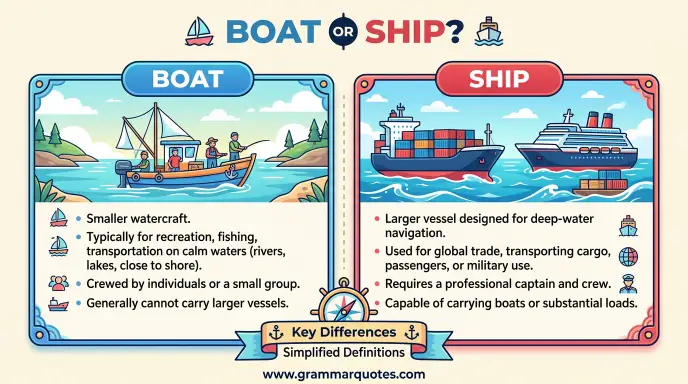
Choosing between boat or ship can be confusing because both words describe vessels that travel on water. The key difference is usually size and purpose. A boat is generally smaller, while a ship is a larger vessel designed for longer journeys, especially at sea.
But the distinction is not always absolute. In everyday English, people sometimes use boat as a general word for a watercraft, even when talking about a large vessel.
For example, someone may say, “We traveled by boat,” when they actually traveled on a ferry or ship. Cambridge Dictionary defines a boat as a vehicle for traveling on water, especially one that is not very large, while a ship is a large boat used especially for traveling across the sea.
This guide explains boat vs. ship, including their meanings, origins, regional usage, common mistakes, practical examples, and the best word to choose in different situations.
Boat or Ship: The Simple Answer
A boat is generally a smaller watercraft, while a ship is generally a larger vessel designed to carry people or goods, often across the sea.
In simple terms:
- Boat: Usually smaller and used on rivers, lakes, coasts, or for shorter trips.
- Ship: Usually larger and built for ocean travel, cargo, passengers, or military purposes.
- Boat can sometimes be used informally as a general term for a ship.
- Ship is more specific when referring to a large ocean going vessel.
For example:
- “We rented a boat on the lake.”
- “The cargo ship crossed the Atlantic.”
- “The cruise ship arrived at the port.”
- “They went fishing in a small boat.”
So, if you are talking about a large ocean going vessel, ship is usually the better choice.
Boat or Ship : Quick Answer
The most useful rule is:
A boat is generally smaller; a ship is generally larger and designed for major sea travel.
However, size is not the only factor. The vessel’s design, function, operating area, and maritime terminology can also matter.
Use boat for:
- Rowboats
- Fishing boats
- Speedboats
- Sailboats
- Small recreational vessels
- Small workboats
- Lifeboats
Use ship for:
- Cruise ships
- Cargo ships
- Container ships
- Passenger ships
- Naval ships
- Large ocean going vessels
- Many large commercial vessels
There is also some overlap. Cambridge notes that boat can be used informally to mean a ship, especially in expressions such as traveling “by boat.”
What Does Boat Mean?
A boat is a vehicle or vessel designed to travel on water. In standard dictionary usage, it generally refers to a vessel that is not very large.
Boats can operate on different types of water. They may be used on:
- Rivers
- Lakes
- Canals
- Coastal waters
- Seas
Examples include:
- fishing boat
- rowing boat
- sailboat
- motorboat
- lifeboat
- houseboat
- speedboat
The word is also common in everyday expressions.
For example:
“We rented a boat for the afternoon.”
This normally suggests a relatively small recreational vessel.
Another example is:
“The fisherman returned to shore in his boat.”
Here, boat is natural because the vessel is understood to be relatively small.
What Does Ship Mean?
A ship is generally a large vessel used to travel on water, particularly across the sea. Cambridge defines a ship as a large boat for traveling on water, especially across the sea.
Common types include:
- cargo ship
- container ship
- cruise ship
- passenger ship
- merchant ship
- naval ship
- research ship
- tanker ship
For example:
“The cargo ship arrived at the port.”
The word ship immediately suggests a large commercial vessel.
Likewise:
“Thousands of passengers boarded the cruise ship.”
Using boat here would sound less precise because a cruise ship is a large ocean going vessel.
The Origin of Ship and Boat
The distinction between boat and ship has a long history.
The word boat comes from Old English bāt, through Middle English bot, and is related to similar Germanic words. Its historical meaning was associated with a relatively small vessel used on water.
The word ship comes from Old English scip, through Middle English ship, and originally referred to a vessel used for navigation. Interestingly, the historical meaning of ship was not always restricted to the large vessels we associate with the word today.
Over time, the meanings became more specialized.
Historical usage also shows why there is no perfect mathematical rule separating the two words. The distinction has changed depending on period, vessel type, and maritime practice.
This is why it is safer to think of boat vs. ship as a practical distinction rather than an absolute rule.
British English vs American English
There is no major spelling difference between boat and ship in British and American English. Both varieties use the same words.
The main difference is how broadly boat may be used in everyday speech.
| Usage | British English | American English | Example |
| Small watercraft | Boat | Boat | “We rented a boat.” |
| Large ocean vessel | Ship | Ship | “The ship entered the port.” |
| General water travel | Boat can be used broadly | Boat can be used broadly | “We traveled by boat.” |
| Cargo vessel | Ship | Ship | “The cargo ship arrived.” |
| Cruise vessel | Ship | Ship | “The cruise ship departed.” |
In both varieties, ship is the normal word for a large ocean going vessel.
Cambridge also lists boat as a general or informal term that can refer to a ship in certain contexts.
So this is not really a British versus American spelling issue. It is primarily a matter of meaning, context, and level of precision.
Which Version Should You Use?
The answer depends more on the vessel than on the country where you are writing.
United States
Use boat for smaller vessels and ship for large ocean going vessels.
- “We bought a fishing boat.”
- “The ship carries thousands of containers.”
United Kingdom
The same basic distinction applies.
- “They went out in a small boat.”
- “The ship sailed from Southampton.”
Canada
Canadian English generally follows the same practical distinction.
Use boat for smaller craft and ship for larger vessels.
Australia
Australian English also uses both terms according to the type and size of vessel.
For example:
- “We took the boat out fishing.”
- “The passenger ship docked at the harbor.”
International English
For international readers, choose the more specific term when possible.
If the vessel is clearly large and ocean going, use ship.
If it is small or used for recreation, fishing, rowing, or local transport, use boat.
Academic Writing
Academic and technical writing should favor precision.
Instead of writing:
“The boat transported 5,000 containers.”
write:
“The container ship transported 5,000 containers.”
The second sentence gives the reader a clearer picture of the vessel.
Business Writing
Use the established industry term.
For example:
- cargo ship
- container ship
- fishing boat
- patrol boat
- passenger ship
The correct compound noun often makes the choice obvious.
Common Mistakes With Boat and Ship
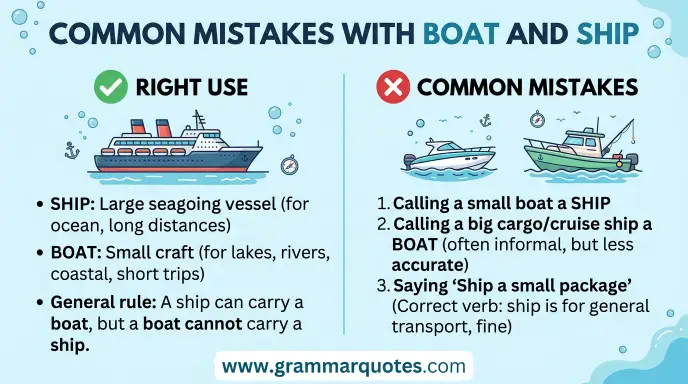
Mistake 1: Treating the words as exact synonyms
Incorrect or imprecise:
“The small ship was used for fishing on the lake.”
Better:
“The small boat was used for fishing on the lake.”
A small recreational or fishing vessel is normally called a boat.
Mistake 2: Calling a large cargo vessel a boat
Less precise:
“The cargo boat arrived from China.”
Better:
“The cargo ship arrived from China.”
Cargo ship is the standard term for a large vessel transporting goods.
Mistake 3: Assuming every vessel has one universal name
Some vessel names depend on function, size, and design.
For example:
- tugboat
- lifeboat
- sailboat
- ferry
- yacht
- submarine
- cruise ship
- container ship
Do not rely on size alone. The established name of the vessel type matters too.
Memory Tip
Think:
Boat = generally smaller
Ship = generally larger
If you imagine a small fishing vessel on a lake, think boat.
If you imagine a huge container vessel crossing an ocean, think ship.
Ship or Boat in Everyday Examples
Emails
“The boat will leave the marina at 8 a.m.”
“The ship is scheduled to arrive at the port tomorrow.”
Business Writing
“The company operates a fleet of fishing boats.”
“The company recently purchased two cargo ships.”
News Headlines
“Fishing Boat Rescued After Engine Failure”
“Cargo Ship Arrives at Port”
News writing normally uses the most specific vessel term available.
Blogs
“We spent the weekend exploring the lake by boat.”
“The cruise ship offered restaurants, theaters, and swimming pools.”
Social Media
“Beautiful day out on the boat!”
This sounds natural when someone is sharing a recreational boating experience.
Academic Writing
“The research vessel collected samples from the ocean.”
In academic writing, vessel can be useful when the exact distinction between boat and ship is not the focus.
Daily Conversation
“Are you taking the boat across the lake?”
“Have you ever been on a cruise ship?”
Both sound natural because the context makes the size and function clear.
Google Trends & Modern Usage
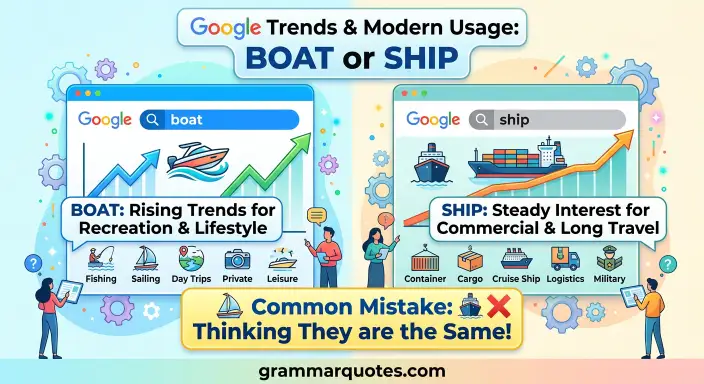
People often search “boat or ship” because the two words overlap in everyday English. Learners may know that both refer to watercraft but may not know when one is more appropriate.
A major source of confusion is that boat can be used broadly. Cambridge, for example, includes an informal sense of boat meaning a ship.
At the same time, ship has a more specific meaning when referring to large vessels, especially those used for sea travel.
This creates sentences such as:
“We traveled by boat.”
That sentence does not necessarily mean the vessel was small. It can simply mean that the person traveled by water rather than by air or another form of transport.
Therefore, modern usage is best understood through context rather than a strict size cutoff.
There is no universal rule saying that a vessel becomes a ship at a particular number of feet, passengers, or tons. Maritime terminology can depend on vessel type and industry practice.
Quick Comparison Table
| Version | Meaning | Correct? | Region | Example |
| Boat | Generally a smaller watercraft | Yes | International | “The fishing boat returned.” |
| Ship | Generally a large sea going vessel | Yes | International | “The ship crossed the ocean.” |
| Fishing boat | Boat used for fishing | Yes | International | “The fishing boat left early.” |
| Cargo ship | Large vessel carrying goods | Yes | International | “The cargo ship reached port.” |
| Cruise ship | Large passenger vessel | Yes | International | “The cruise ship departed.” |
| Sailboat | Boat powered or assisted by sails | Yes | International | “They bought a sailboat.” |
| Boat for general water travel | Broad everyday term | Yes | International | “We traveled by boat.” |
Boat vs Ship: What Should You Remember?
- Boat generally refers to a smaller watercraft.
- Ship generally refers to a larger vessel.
- Ships are especially associated with ocean and sea travel.
- Boats can operate on lakes, rivers, coastal waters, and seas.
- Boat can sometimes be used informally as a broad term for a ship.
- There is no universal size measurement that perfectly separates boats from ships.
- Use established terms such as cruise ship, cargo ship, fishing boat, and lifeboat.
- In formal writing, choose the most precise term available.
FAQs About Boat or Ship
Is a ship bigger than a boat?
Generally, yes. A ship is usually larger than a boat and is often designed for longer distance travel, particularly at sea. However, there is no single universal size limit that separates the two. Maritime terminology can depend on the vessel’s design, function, and traditional classification.
Can a ship be called a boat?
Yes, in some contexts. Boat can be used as a broad or informal term for a vessel, including a ship. For example, people may say they are traveling “by boat” even when the actual vessel is a large ferry or ship. For precise writing, ship is usually better for large vessels.
Is a cruise boat correct or cruise ship?
Cruise ship is the standard and more natural term. Cruise vessels are large passenger ships designed for extended trips. Saying “cruise boat” may be understood, but it is much less precise in standard English.
Is a fishing boat a ship?
Usually, a fishing boat is called a boat, especially when it is relatively small. However, very large commercial fishing vessels may be described using more specific terms such as fishing vessel. The appropriate term depends on the vessel’s type and scale.
Is a ferry a boat or a ship?
A ferry can be a boat or a ship, depending on its size, design, route, and local terminology. Small ferries may be called ferry boats, while large passenger ferries are often treated as ships. Ferry itself is the most useful general term.
Which is correct: “on a boat” or “on a ship”?
Both are correct. Use on a boat when referring to a boat and on a ship when referring to a ship. For example, “We went fishing on a boat” and “They traveled on a ship” are both grammatically correct.
Do British people call ships boats?
Sometimes. In British English, boat can be used broadly in everyday contexts, especially when discussing travel by water. However, large vessels are still commonly called ships. The distinction is therefore more about context and precision than British versus American English.
Is a yacht a boat or a ship?
A yacht is usually called a yacht, which is the most precise term. Smaller yachts are commonly treated as boats, while very large luxury yachts may sometimes be described as superyachts. The word yacht is generally better than choosing simply between boat and ship.
What is the easiest way to remember boat vs ship?
Remember this simple guideline: boat usually means smaller, while ship usually means larger and more suited to major sea travel. Then consider the vessel’s established type. A fishing boat, lifeboat, and sailboat are normally called boats, while a cargo ship and cruise ship are normally called ships.
Is “travel by boat” correct for a cruise?
Yes. Travel by boat can be used as a broad expression for traveling on water. However, if you specifically mean a cruise ship, saying “travel by ship” or “take a cruise ship” is more precise. Context determines which expression sounds most natural.
Conclusion
The difference between boat or ship is mainly a matter of size, function, and context. A boat is generally a smaller watercraft used for activities such as fishing, recreation, rowing, sailing, or local transportation. A ship is generally a larger vessel designed for major journeys, especially across seas and oceans.
The distinction is useful, but it is not an absolute rule. Historical English shows that the meanings of both words have changed over time, and modern dictionaries recognize some overlap.
For everyday writing, the easiest approach is to use the established name of the vessel. Say fishing boat, lifeboat, and sailboat, but cruise ship, cargo ship, and container ship.
If you are unsure, ask yourself what the vessel is like and what it is designed to do. When precision matters, choose the specific vessel term rather than relying on “boat” or “ship” alone.
Discover More Articles!
Navy or Army: What’s the Difference(2026)
Portland OR ZIP Code: ZIP Codes, Areas, and Address Information
Beijing or Shanghai: Which City Should You Choose?(2026)

Ethan Parker is an English-language writer known for his interest in words, language, and clear communication. His work focuses on making everyday English easier to understand through simple explanations and practical examples.