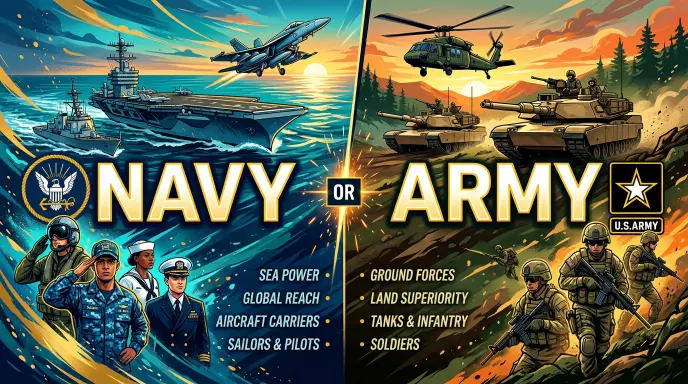
Choosing between the Navy or Army can be confusing. Both are major branches of the military, both protect a country, and both offer careers in combat, technology, logistics, medicine, engineering, and leadership. But their main missions are very different.
People often search for “navy or army” because they want to understand which branch is better, what each one does, and which service may fit their skills or lifestyle. The answer depends on what you want from a military career.
If you prefer ships, oceans, maritime operations, and life at sea, the Navy may be a better fit. If you prefer ground operations, vehicles, land missions, and working with soldiers on land, the Army may be more suitable.
This guide explains Navy vs. Army in simple terms. You will learn the key differences in missions, jobs, training, lifestyle, equipment, and career options. You will also see practical examples to help you understand when to use each term.
Navy or Army : Quick Answer
The simple answer is:
- Navy: Primarily focuses on military operations at sea and uses ships, submarines, aircraft, and other naval forces.
- Army: Primarily focuses on military operations on land and uses soldiers, vehicles, artillery, aircraft, and ground based systems.
For example:
The Navy protects the country at sea.
The Army protects and fights on land.
The U.S. Navy describes its role as protecting America at sea and keeping the seas open and free. The U.S. Army, meanwhile, provides combat ready units and soldiers for the Army and joint force across different types of conflict.
However, the difference is not simply water vs. land. Modern military operations are closely connected. Navy forces can support land operations, while Army forces can work with naval and air forces during joint missions.
The Origin of Navy or Army
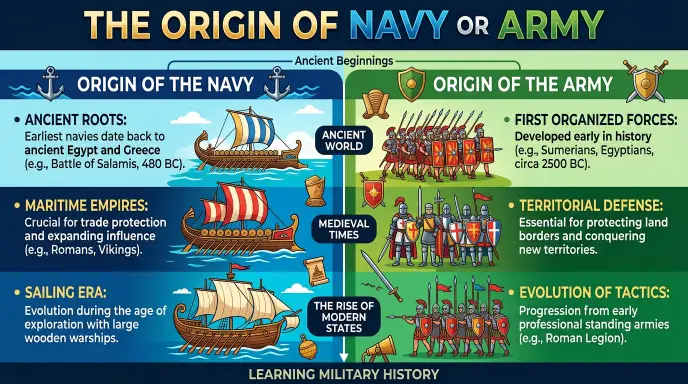
The words navy and army have different histories and originally described different types of military forces.
Navy
The word navy is connected to older words relating to ships and naval forces. A navy is a country’s organized military force designed mainly for operations at sea.
Over time, naval forces developed from groups of fighting ships into highly advanced organizations that can operate with ships, submarines, aircraft, missiles, communications systems, and other technology.
Today, a modern navy can perform many roles, including:
- Protecting sea routes
- Defending coastal areas
- Operating aircraft carriers
- Operating submarines
- Transporting military forces
- Supporting ground forces
- Conducting maritime security operations
The U.S. Navy describes its mission around maritime defense, sea power, and maintaining access to the world’s oceans.
Army
The word army has roots in words associated with armed forces and military organization. An army traditionally refers to a country’s organized land based military force.
Armies have historically been responsible for controlling territory, defending borders, and conducting ground combat.
Modern armies do much more than traditional infantry combat. They can include:
- Infantry
- Armored units
- Artillery
- Engineers
- Aviation
- Medical units
- Intelligence
- Cyber specialists
- Logistics teams
So, while the words have old origins, their modern meanings describe large and highly specialized military organizations.
British English vs American English Spelling
There is no major British vs. American spelling difference between navy and army.
Both American and British English normally use:
- navy
- army
The main difference is usually capitalization, not spelling.
When referring to a specific official military organization, the name may be capitalized:
- the U.S. Navy
- the U.S. Army
- the British Army
- the Royal Navy
When using the words in a general sense, lowercase is often appropriate:
- The country has a large navy.
- He joined the army.
- Many countries have an army and navy.
Navy vs. Army: Spelling and Usage Table
| Term | Correct Spelling | Meaning | Example |
| Navy | Navy | Maritime military force | She joined the Navy. |
| Army | Army | Land military force | He joined the Army. |
| navvy | Incorrect for this meaning | Not the military term | ❌ Don’t use it for navy |
| armee | Incorrect English spelling | Not standard English | ❌ Avoid it |
So, if your question is about spelling, navy and army are both correct. The real question is usually about which military branch or role you mean.
Which Spelling Should You Use?
If you mean the military branch, use navy or army based on the organization you are describing.
Use “Navy” When:
Use Navy when talking about a country’s naval military service or a specific naval organization.
Examples:
- He joined the U.S. Navy.
- The Navy operates aircraft carriers.
- She wants a career in the Navy.
- The Navy protects maritime interests.
The U.S. Navy says its mission includes protecting America at sea and supporting freedom of the seas.
Use “Army” When:
Use Army when talking about a country’s land based military service.
Examples:
- He joined the U.S. Army.
- She wants to become an Army officer.
- The Army trains soldiers for ground operations.
- The Army operates armored and artillery units.
For Global Readers
Different countries organize their armed forces in different ways. Some have a separate army and navy, while others use different names or structures.
Therefore, always consider the country and military organization you are discussing.
Navy vs. Army: Main Differences
The easiest way to understand the difference is to compare their primary missions.
| Feature | Navy | Army |
| Main environment | Sea and maritime areas | Land |
| Main personnel | Sailors | Soldiers |
| Common equipment | Ships, submarines, naval aircraft | Tanks, armored vehicles, artillery |
| Main operations | Maritime operations | Ground operations |
| Common bases | Naval bases and ports | Army bases and installations |
| Common career areas | Naval engineering, aviation, maritime operations | Infantry, armor, artillery, engineering |
| Typical environment | Ships, ports, oceans, coastal areas | Bases, training areas, cities, fields |
| Main focus | Sea power and maritime security | Land power and ground operations |
This does not mean the two branches always work separately. Modern armed forces frequently conduct joint operations.
Common Mistakes with Navy or Army
People make several common mistakes when using navy or army.
1. Thinking They Are the Same
Incorrect idea:
“The Navy and Army are basically the same.”
Better understanding:
They are different military branches with different primary missions.
2. Using “Navy” for All Military Forces
The Navy is only one branch of a country’s armed forces.
Incorrect:
The navy sent soldiers to fight on land.
This may be misleading because the people involved could belong to another military branch.
3. Assuming the Navy Only Uses Ships
Modern naval forces may operate:
- Aircraft
- Submarines
- Drones
- Missiles
- Intelligence systems
- Cyber capabilities
- Shore based facilities
The U.S. Navy describes operations that extend from the seabed to space and across information and cyber environments.
4. Assuming the Army Only Uses Soldiers With Rifles
Modern armies contain many specialized roles.
An army can include:
- Engineers
- Doctors
- Pilots
- Mechanics
- Intelligence specialists
- Communications specialists
- Cyber professionals
- Logistics personnel
So, both branches offer far more careers than their traditional images suggest.
Army or Navy in Everyday Examples
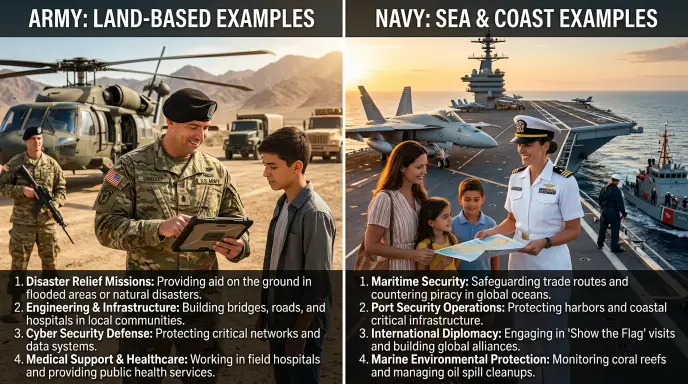
Knowing how to use these terms correctly helps in emails, articles, conversations, and formal writing.
In an Email
Correct:
My brother recently joined the Navy.
Correct:
My cousin is considering a career in the Army.
In News Writing
Navy example:
The Navy conducted a maritime exercise with allied forces.
Army example:
The Army conducted a large scale ground exercise.
In Social Media
You might write:
Proud of my brother for beginning his Navy career.
Or:
Congratulations to my friend on joining the Army!
In Formal Writing
For formal writing, be specific when possible:
The U.S. Navy is responsible for major maritime defense operations.
The U.S. Army provides ground forces for a wide range of military missions.
The U.S. Army describes its mission as providing combat ready units and soldiers to the Army and joint force across the full spectrum of conflict.
Navy or Army : Which Is Better for a Career?
There is no universal winner. The better choice depends on your interests, skills, and preferred lifestyle.
Choose the Navy If You Prefer:
- Ships and maritime environments
- Ocean operations
- Naval aviation
- Submarines
- Engineering
- Technology
- Life around ports and ships
- Maritime missions
The Navy has many technical and operational careers beyond traditional shipboard roles.
Choose the Army If You Prefer:
- Ground operations
- Land vehicles
- Infantry
- Engineering
- Artillery
- Logistics
- Field training
- Land based missions
The Army also offers many technical and professional career paths.
A Simple Career Comparison
| If You Prefer… | Consider |
| Ships | Navy |
| Submarines | Navy |
| Ocean operations | Navy |
| Maritime aviation | Navy |
| Ground combat | Army |
| Tanks and armored vehicles | Army |
| Field operations | Army |
| Land based military careers | Army |
Navy or Army : Lifestyle Differences
Lifestyle is another important difference.
Navy Lifestyle
Navy personnel may spend significant time:
- On ships
- At naval bases
- In ports
- At sea
- Supporting maritime operations
Depending on the job, deployments can mean spending extended periods away from home.
Army Lifestyle
Army personnel may spend more time:
- At Army installations
- In training areas
- In field exercises
- With ground units
- Operating land vehicles
- Supporting land based missions
However, Army life varies greatly by job and unit.
A person working in military medicine may have a very different daily routine from an infantry soldier. The same is true for a Navy engineer compared with a sailor serving aboard a ship.
Army or Navy : Google Trends & Usage Data
People search for “navy or army” for several reasons. Some want a career comparison, while others want to understand military branches, uniforms, jobs, training, salary, or lifestyle.
Google Trends measures search interest, rather than giving a simple count of all searches. It lets users compare search terms by location and time.
Search interest can also change because of:
- Military news
- International conflicts
- Recruitment campaigns
- Movies and television
- Major military exercises
- Political events
- New military technology
- National celebrations
For example, someone researching military careers may search “Navy vs Army,” “Army vs Navy,” “Navy jobs,” or “Army jobs.” Someone following a military event may search the branch name alone.
Country and Context Matter
Search behavior can vary by country.
In the United States, searches may commonly relate to the U.S. Navy and U.S. Army. In the United Kingdom, people may search for the Royal Navy and British Army.
Therefore, comparing the two terms globally without selecting a country can produce a broad picture rather than a precise local result.
For the most current comparison, Google Trends allows users to select a country, time period, and search category.
Army vs Navy: Side by Side Comparison
| Category | Navy | Army |
| Primary domain | Sea | Land |
| Service member | Sailor | Soldier |
| Main platforms | Ships and submarines | Ground vehicles and artillery |
| Aircraft | Naval aircraft | Army aviation |
| Typical bases | Naval bases | Army installations |
| Main mission | Maritime operations | Ground operations |
| Common jobs | Sailor, naval engineer, naval aviator | Soldier, engineer, pilot, medic |
| Training | Military + naval skills | Military + ground skills |
| Deployment | May include long periods at sea | May include field or overseas deployments |
| Best fit | People interested in maritime service | People interested in land operations |
FAQs About Navy or Army
Is the Navy better than the Army?
Neither is automatically better. The Navy may be better for someone interested in ships and maritime operations, while the Army may suit someone interested in ground operations.
Is the Navy harder than the Army?
There is no simple answer. Both have demanding physical and mental requirements. Difficulty depends on the job, training, unit, and mission.
Does the Navy fight on land?
Yes. Naval forces can support land operations, and some Navy personnel and units have roles that involve operating ashore.
Does the Army have aircraft?
Yes. Modern armies can operate aviation units and aircraft for transportation, reconnaissance, support, and other missions.
Are Navy and Army the same thing?
No. They are different military branches with different primary missions.
Should I join the Navy or Army?
Consider your preferred work environment, career goals, technical interests, physical demands, and lifestyle. Choose the branch whose roles match your goals.
Which is better for technology jobs, Navy or Army?
Both can offer technology focused careers. The best choice depends on the specific occupation rather than the branch name alone.
Conclusion: Navy or Army
The choice between Navy or Army becomes much easier once you understand their main roles. The Navy is primarily a maritime military force.
It operates at sea and uses ships, submarines, aircraft, and other systems to protect national interests and maintain maritime security. The Army is primarily a land based military force. It provides soldiers and ground capabilities for a wide range of operations.
Neither branch is automatically better. Your best choice depends on your interests and career goals. If you enjoy ships, oceans, naval technology, and maritime operations, the Navy may be a strong fit. If you prefer ground operations, vehicles, field exercises, engineering, or land based missions, the Army may be more suitable.
Remember that modern military operations are joint. Navy and Army forces can work together as part of a larger military mission. The most important difference is therefore not simply which branch is “stronger,” but what each branch is designed to do and which type of career fits you best.
Discover More Articles!
Or vs Er: Which Suffix Is Correct?(2026)
LP or LLC: Which Business Structure Is Better?
Alpha or Beta: Meaning, Differences, and Usage(2026)

Ethan Parker is an English-language writer known for his interest in words, language, and clear communication. His work focuses on making everyday English easier to understand through simple explanations and practical examples.