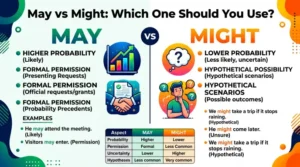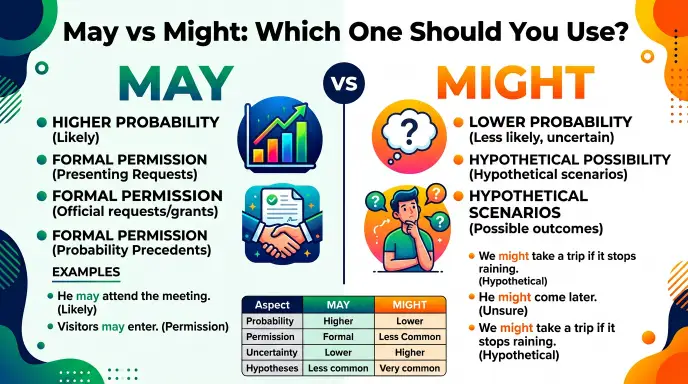
The difference is usually small. In many cases, may suggests a possibility that feels a little more likely or more direct, while might often suggests a weaker, less certain, or more tentative possibility. However, this is not a strict rule. Context, tone, and time can all affect the meaning.
People also search for may vs might because these words are common in school writing, emails, conversations, reports, and formal English. Knowing how they work can help you sound more natural and avoid grammar mistakes.
This guide explains the difference between may and might, shows when to use each word, and gives simple examples. You will also learn how British and American English use these modal verbs and which choice is best for different situations.
May vs Might : Quick Answer
May and might are both modal verbs used to talk about possibility.
- May usually expresses a possible event or situation.
- Might also expresses possibility, but it can sound more uncertain or tentative.
- May is often used for permission in formal or polite English.
- Might is commonly used for weaker possibilities and hypothetical situations.
Simple examples
I may go to the party tonight.
This means going to the party is possible.
I might go to the party tonight.
This also means going is possible, but the speaker may sound less certain.
Another example:
It may rain this afternoon.
It might rain this afternoon.
Both sentences are correct. The first can suggest a stronger possibility, while the second can sound more uncertain.
Quick rule
If you are talking about possibility, both may and might can often work.
If you are asking for or giving permission, may is usually the better choice:
May I leave early?
If you want to sound tentative or uncertain, might is often a natural choice:
We might need more time.
The difference is not always about a fixed grammar rule. In everyday English, the two words can overlap.
The Origin of May vs Might
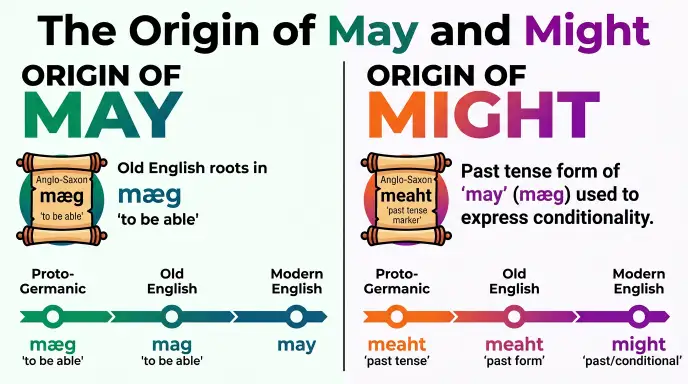
The words may and might have a long history in English. Both developed from older forms of the same Germanic verb related to the idea of having power, ability, or possibility.
May comes from Old English mæg, which was related to the idea of being able to do something. Over time, its meaning expanded from ability toward permission and possibility.
Might developed as the past form of may. In modern English, however, it does not simply mean “past may.” It has developed several uses of its own.
For example:
She may come later.
This describes a possible future event.
She said she might come later.
Here, might can appear in reported speech because the original statement may have been:
“I may come later.”
This is sometimes called backshifting. The modal changes from may to might when a statement is reported in a past context.
Over time, might also became useful for expressing weaker possibility, suggestions, and hypothetical situations.
For example:
You might want to check your email.
This does not mean that checking the email is merely a remote possibility. It can be a polite suggestion.
So, although may and might have a shared historical origin, modern English gives them slightly different functions.
British English vs American English Spelling and Usage
There is no major spelling difference between British and American English for may and might. Both varieties spell the words the same way.
The main differences are related to usage, tone, and preference.
Both British and American speakers use:
It may rain tomorrow.
and:
It might rain tomorrow.
Both varieties also use may when asking for permission:
May I come in?
However, everyday American English often uses can for informal permission:
Can I come in?
In formal English, may remains a standard choice.
Comparison table
| Use | May | Might |
| Present possibility | Yes | Yes |
| Future possibility | Yes | Yes |
| Weaker possibility | Sometimes | Common |
| Formal permission | Yes | Rare |
| Polite suggestion | Sometimes | Common |
| Hypothetical situation | Sometimes | Common |
| Reported speech | Sometimes | Common |
| Past possibility | Yes, in some structures | Yes |
Examples in both varieties
British English:
I may visit London next month.
American English:
I may visit New York next month.
The grammar is the same. The location changes, but the use of may does not.
Likewise:
I might call you later.
This sentence works naturally in both British and American English.
The key point is that may vs might is not mainly a British versus American spelling issue. It is mostly a question of meaning, certainty, permission, and tone.
Which Spelling Should You Use?
There is no different spelling to choose. The correct words are may and might in both British and American English.
Instead, choose the word based on what you want to say.
Use “may” for possibility
Use may when something is possible:
We may go out tonight.
The price may increase next year.
She may arrive late.
Use “might” for less certain possibility
Use might when you want to show more uncertainty:
We might go out tonight.
The price might increase next year.
She might arrive late.
The difference can be very small.
Use “may” for formal permission
When asking for permission, may is a traditional and formal choice:
May I join the meeting?
May I borrow your pen?
May we start the class now?
Use “might” for a tentative suggestion
Might can make a suggestion sound gentle:
You might try restarting your computer.
You might want to speak with your teacher.
This does not necessarily mean that the speaker thinks the action is unlikely. It often simply makes the suggestion less direct.
For international English
If you write for a global audience, both words are safe. Focus on the meaning rather than trying to follow a British or American spelling rule.
Common Mistakes with May vs Might
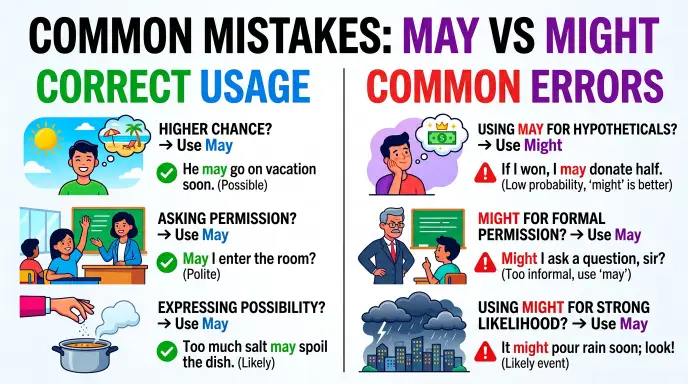
Because may and might have similar meanings, learners often use them incorrectly.
Mistake 1: Treating “might” as only the past of “may”
It is true that might has a historical connection with the past form of may. But modern English uses might in many situations that are not simply past.
Incorrect idea:
“Might” must always describe the past.
Correct:
I might go tomorrow.
Here, might refers to a possible future event.
Mistake 2: Using “may” after “to”
Modal verbs are followed by the base form of the verb.
Correct:
She may go home.
Incorrect:
She may to go home.
The same rule applies to might:
He might come later.
Not:
He might to come later.
Mistake 3: Adding “ s” after may or might
Modal verbs do not take s with third person singular subjects.
Correct:
She may arrive soon.
Incorrect:
She mays arrive soon.
Correct:
He might leave early.
Incorrect:
He mights leave early.
Mistake 4: Using “may” and “might” together unnecessarily
Do not normally use both modal verbs together.
Incorrect:
It may might rain.
Correct:
It may rain.
or:
It might rain.
Mistake 5: Confusing possibility with permission
May can mean permission:
May I open the window?
But when may describes possibility, its meaning is different:
The train may arrive late.
The first sentence asks if something is allowed. The second says something is possible.
Mistake 6: Assuming “may” is always more likely
A common grammar shortcut says:
may = more likely
might = less likely
This can help beginners, but it is not an absolute rule.
Native speakers often use the two words interchangeably:
It may rain.
It might rain.
Both can simply mean that rain is possible.
Tone and context often matter more than a precise percentage of probability.
May vs Might in Everyday Examples
Understanding may vs might becomes easier when you see the words in real situations.
In emails
May can sound professional:
We may need additional information before processing your request.
Might can sound more tentative:
We might need additional information before processing your request.
Both are correct. The second can make the statement sound less definite.
In conversations
I may go shopping later.
I might go shopping later.
Both mean that shopping is possible.
The speaker may choose might when they have not made up their mind.
In news writing
News reports often use may when discussing possible developments:
The company may announce a new product next week.
Might can also be used:
The company might announce a new product next week.
The choice depends on the writer’s intended level of certainty and the surrounding context.
In formal writing
May is common when describing possible outcomes:
This change may affect future results.
Might is also useful when discussing hypothetical or uncertain outcomes:
This change might affect future results.
In social media
Casual posts often use might:
I might post another update tonight.
We might go somewhere new this weekend.
The word fits naturally because the speaker is often talking about plans that are not fixed.
In suggestions
Might is especially useful:
You might want to read the instructions first.
You might try a different approach.
This sounds softer than a direct command.
May vs Might : Google Trends & Usage Data
Search interest for may vs might usually comes from people trying to understand the difference between two very common English words. This makes the topic especially useful for students, ESL learners, writers, and people checking grammar before publishing text.
Google Trends can help show how interest in grammar questions changes by country, time period, and search phrase. However, Google Trends does not provide an absolute number of searches. It uses a relative scale, where a value of 100 represents the highest search interest for the selected term and period.
For this reason, it is better to use Google Trends to identify relative patterns rather than claim that one word has a specific global search volume.
Interest can also vary by context. Searches involving:
- “may vs might”
- “difference between may and might”
- “may or might”
- “when to use may and might”
- “may vs might examples”
are likely to come from different types of learners and writers.
The important point is that may and might are both standard English words, and neither is an incorrect version of the other.
Search popularity also does not determine grammatical correctness. A word can be searched more often and still have a different function from its alternative.
May vs Might Comparison Table
| Feature | May | Might |
| Part of speech | Modal verb | Modal verb |
| Shows possibility | Yes | Yes |
| Shows uncertainty | Yes | Yes |
| Often sounds more tentative | Less often | Often |
| Formal permission | Common | Uncommon |
| Future possibility | Yes | Yes |
| Hypothetical situations | Possible | Very common |
| Polite suggestions | Possible | Very common |
| Used in reported speech | Sometimes | Common |
| Followed by base verb | Yes | Yes |
| Takes “to” after it | No | No |
| Takes “ s” | No | No |
| British English | Used | Used |
| American English | Used | Used |
More examples
| Meaning | Example |
| Possibility | She may be at home. |
| Possibility | She might be at home. |
| Future possibility | We may travel next month. |
| Uncertain plan | We might travel next month. |
| Permission | May I leave? |
| Tentative suggestion | You might try again. |
| Hypothetical result | It might work. |
| Reported speech | He said he might come. |
May vs Might: Easy Rules to Remember
If you need a quick way to remember the difference, use these rules:
1. Use “may” for possibility.
The package may arrive today.
2. Use “might” for possibility that sounds more uncertain.
The package might arrive today.
3. Use “may” for formal permission.
May I come in?
4. Use “might” for gentle suggestions.
You might want to check your answer.
5. Remember that the difference is not always strict.
In many everyday sentences, either word can be correct.
FAQs About May vs Might
Is “may” or “might” more correct?
Neither is always more correct. Both are standard modal verbs. The correct choice depends on meaning and context.
Is “might” the past tense of “may”?
Historically, might developed as the past form of may, and it is still used in some past or reported contexts. However, modern English also uses might for present and future possibility.
Which is more likely, may or might?
Traditionally, may can suggest a greater possibility than might. However, native speakers often use them interchangeably, so the difference is not always exact.
Can I use “might” for future events?
Yes. Might is commonly used for possible future events.
I might visit you tomorrow.
Can “may” mean permission?
Yes. May is commonly used to ask for or give formal permission.
May I use your computer?
Is “may might” grammatically correct?
No. In standard English, you normally choose one modal verb:
It may rain.
or:
It might rain.
Should I use “may” or “might” in formal writing?
Both can be used in formal writing. Use may for possibility or formal permission, and might when you want to express uncertainty, a hypothetical idea, or a gentle suggestion.
Conclusion: May vs Might Made Simple
The difference between may vs might is useful, but it does not need to be difficult. Both words are modal verbs that can express possibility.
May often sounds more direct or slightly more likely, while might often sounds more uncertain or tentative. Still, these meanings can overlap, especially in everyday English.
Use may when you want to talk about a possible event or ask for formal permission. For example, “She may arrive soon” describes possibility, while “May I leave?” asks for permission.
Use might when you want to show uncertainty, discuss a hypothetical situation, or make a soft suggestion. For example, “She might arrive soon” sounds less certain, while “You might want to check again” is a polite suggestion.
Most importantly, do not treat may and might as completely separate words with fixed probability levels. Context matters. Both are correct in many of the same sentences.
For everyday writing, choose the word that best matches your intended meaning and tone. If the sentence is about possibility, either may or might may work. If you are asking formal permission, may is usually the safest choice.
Discover More Articles!
31th or 31st: Which Is Correct?
Telluride or Palisade: Which SUV Is Better?
Everybody’s vs Everybodies: Correct Spelling and Usage(2026)

Ethan Parker is an English-language writer known for his interest in words, language, and clear communication. His work focuses on making everyday English easier to understand through simple explanations and practical examples.