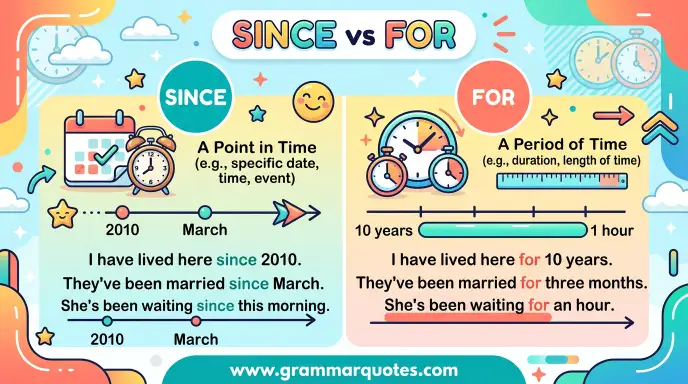
Since and for are both used to talk about time, but “since” shows when a period started, while “for” shows how long the period lasts.
These two small words often cause big problems for English learners. People commonly search since vs for because both words can appear with the present perfect and present perfect continuous tenses.
For example, you may hear “I have lived here since 2020” and “I have lived here for six years.” Both sentences are correct, but the words do not have the same meaning.
The easiest way to understand the difference is to focus on the type of time expression that follows each word.
Since is used with a specific starting point, such as Monday, 2020, last summer, or 8 a.m. For is used with a period of time, such as two hours, three years, or a long time.
This difference becomes especially important when talking about actions that started in the past and continue into the present.
In this guide, we will explain since vs for, their meanings, grammar rules, common mistakes, everyday examples, and useful questions. By the end, you will know exactly when to use since and when to use for.
Since vs For: Quick Answer
The basic rule is simple:
- Since = starting point
- For = length of time
Examples with Since
- I have lived here since 2020.
- She has worked here since Monday.
- We have known him since childhood.
- He has been studying since 8 a.m.
Examples with For
- I have lived here for six years.
- She has worked here for three months.
- We have known him for a long time.
- He has been studying for two hours.
Definition and Meaning of Since
Since is used to identify the point in time when something began.
It answers the question:
“When did it start?”
Examples:
I have been here since Monday.
They have lived in Lahore since 2022.
Here, Monday and 2022 are starting points.
Definition and Meaning of For
For is used to show the length or duration of an action or situation.
It answers the question:
“How long?”
Examples:
I have been here for three days.
They have lived in Lahore for four years.
Here, three days and four years are periods of time.
The Origin of Since vs For
Since has a long history in English. It developed from older expressions connected with the idea of “from then until now” or “from a particular time.”
For is also an old English word. It has been used for many centuries to express purpose, reason, duration, and other relationships.
Today, both words have many uses, but their use with time is especially important for English learners.
The key distinction is:
Since → starting point
For → duration
This simple rule makes many sentences easier to understand.
Since vs For in English Grammar
Although both words can talk about time, they work differently.
| Word | What it shows | Example |
| Since | Starting point | since 2020 |
| For | Duration | for five years |
| Since | Starting time | since Monday |
| For | Length of time | for three days |
| Since | Specific moment | since 9 a.m. |
| For | Time period | for two hours |
Starting Points with Since
Use since before:
- Monday
- January
- 2020
- yesterday
- last summer
- 8 a.m.
- childhood
- my birthday
Example:
She has worked here since January.
Time Periods with For
Use for before:
- two hours
- three days
- six months
- five years
- a long time
- several weeks
- a few minutes
Example:
She has worked here for six months.
Which One Should You Use?
Ask yourself one simple question.
Is it a Starting Point?
Use since.
I have studied English since 2021.
2021 tells us when the study started.
Is it a Duration?
Use for.
I have studied English for five years.
Five years tells us how long the study has continued.
Easy Memory Trick
Think:
Since = Start
For = Duration
This is one of the easiest ways to remember the difference.
Common Mistakes with Since vs For
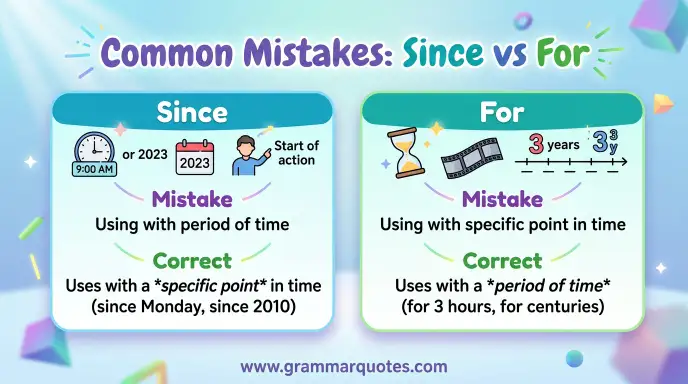
Mistake 1: Using “for” with a year
❌ I have lived here for 2020.
✅ I have lived here since 2020.
A year is a starting point.
Mistake 2: Using “since” with a duration
❌ I have lived here since five years.
✅ I have lived here for five years.
“Five years” is a duration.
Mistake 3: Saying “since two hours”
❌ I have been waiting since two hours.
✅ I have been waiting for two hours.
Mistake 4: Confusing “since” with “ago”
❌ I moved here since three years ago.
A natural sentence is:
✅ I moved here three years ago.
Or:
✅ I have lived here for three years.
Mistake 5: Using the wrong question
For since, ask:
When did it start?
For for, ask:
How long?
Since vs For in Everyday Examples
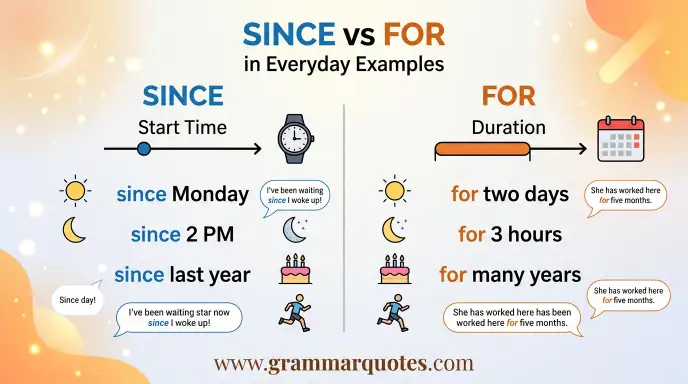
In Emails
I have been working on this project since Monday.
I have been working on this project for three days.
In Conversations
How long have you lived here?
I have lived here for five years.
In Formal Writing
The company has operated in this region since 2018.
On Social Media
I have been using this phone for two years.
At School
She has studied English since childhood.
These examples show that the same situation can often be expressed using either word, as long as the time expression changes correctly.
Since and For with Present Perfect
Since and for are very common with the present perfect tense.
Since
I have known him since 2019.
For
I have known him for seven years.
Both sentences describe a situation that began in the past and continues to the present.
They simply give time in different ways.
Since vs For with Present Perfect Continuous
Both words can also be used with the present perfect continuous.
Since
She has been studying since morning.
For
She has been studying for three hours.
Again:
since = when the activity began
for = how long it has continued
Since vs For Comparison Table
| Feature | Since | For |
| Main use | Starting point | Duration |
| Answers | When did it start? | How long? |
| Followed by | A specific time | A period of time |
| Example | since 2020 | for five years |
| Example | since Monday | for three days |
| Example | since 8 a.m. | for two hours |
| Common with | Perfect tenses | Perfect tenses |
Since or For Google Trends & Usage Data
Since vs for is a common grammar search because learners often know that both words relate to time but are unsure which one belongs in a sentence.
Searches may also include related phrases such as since or for, since vs for grammar, how to use since and for, and since and for examples.
Google Trends can show relative interest in these search terms by country and over time. However, Google Trends measures search interest, not exact monthly search volume.
For content, covering both the direct grammar rule and related questions is useful because searchers may use different wording while looking for the same answer.
People Also Ask: Since vs For
1. What is the difference between since and for?
Since gives a starting point, while for gives the length of time.
2. When should I use since?
Use since when you mention the time when something started.
Example:
I have lived here since 2020.
3. When should I use for?
Use for when you mention how long something has continued.
Example:
I have lived here for six years.
4. Is it since two years or for two years?
The correct phrase is for two years because two years is a duration.
5. Is it since 2020 or for 2020?
The correct phrase is since 2020 because 2020 is a starting point.
6. Can since and for be used with present perfect?
Yes. Both are commonly used with the present perfect.
Example:
I have worked here since 2020.
I have worked here for six years.
7. Can since and for be used with present perfect continuous?
Yes. Both can be used with the present perfect continuous.
Example:
She has been studying since morning.
She has been studying for three hours.
8. What comes after since?
A specific starting point usually comes after since, such as a year, date, day, or exact time.
9. What comes after for?
A period or duration usually comes after for, such as two hours, three years, or several months.
10. How can I remember since and for?
Remember this simple rule: Since = starting point; For = duration.
FAQs About Since vs For
Is “since” a preposition?
Yes. Since can work as a preposition when it introduces a starting point, such as “since Monday.” It can also function as a conjunction or adverb in other contexts.
Is “for” always used for time?
No. For has many uses. It can show purpose, benefit, reason, and other relationships.
Example:
This gift is for you.
Can I use “since” with a period of time?
Normally, no when expressing duration.
❌ I have lived here since five years.
✅ I have lived here for five years.
Can I use “for” with a specific date?
When talking about duration, for is not normally followed by a starting date.
❌ I have lived here for 2020.
✅ I have lived here since 2020.
What is the easiest way to remember since and for?
Use since for a starting point and for for a length of time.
Can “since” mean “because”?
Yes. In some sentences, since can introduce a reason.
Example:
Since it was raining, we stayed home.
Here, since does not refer to time.
Does “for” work with present perfect?
Yes.
I have worked here for five years.
This is a standard use of for with the present perfect.
Conclusion
The difference between since vs for becomes easy when you focus on the type of time expression that follows each word. Since is used for a starting point, while for is used for a period or duration.
Use since with expressions such as 2020, Monday, January, 8 a.m., or childhood. These tell the reader when something began. Use for with expressions such as two hours, three days, five years, or a long time. These tell the reader how long something has continued.
Both words are especially common with the present perfect and present perfect continuous tenses. For example, “I have lived here since 2020” and “I have lived here for six years” are both correct.
The easiest rule to remember is Since = when it started and For = how long. Once you learn this simple difference, you can avoid many common grammar mistakes. When unsure, ask yourself: “Is this a starting point or a duration?” If it is a starting point, use since. If it is a duration, use for.
Discover More Articles!
Dig or Die: Meaning, Usage & Examples(2026)
Absents or Absence: Meaning, Difference & Examples(2026)
Unbalanced or Imbalanced: Meaning, Differences & Examples

Ethan Parker is an English-language writer known for his interest in words, language, and clear communication. His work focuses on making everyday English easier to understand through simple explanations and practical examples.