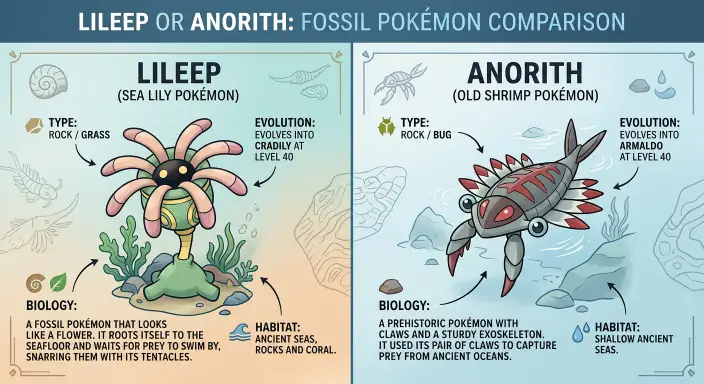
Lileep or Anorith is a common Pokémon comparison for players choosing between the two Hoenn fossil Pokémon.
Both were introduced in Generation III and are revived from different fossils, but they have different types, stats, abilities, evolutions, and battle styles.
Lileep is a Rock/Grass type Pokémon revived from the Root Fossil, while Anorith is a Rock/Bug type Pokémon revived from the Claw Fossil. Both have a base stat total of 355 and evolve at level 40, but their stats are distributed very differently.
Lileep focuses more on defensive and special defense qualities. It has high Defense and Special Defense but very low Speed.
Anorith is much more offensive and faster, with significantly higher Attack and Speed. Their evolutions continue these differences: Lileep becomes Cradily, while Anorith becomes Armaldo.
The choice between them can therefore depend on what kind of Pokémon you want to use. This guide compares Lileep vs Anorith by type, fossil, stats, abilities, evolution, strengths, weaknesses, and battle style.
Lileep or Anorith : Quick Answer
Anorith and Lileep are both Hoenn fossil Pokémon, but they play very differently.
Lileep is a Rock/Grass type Pokémon with stronger defensive stats and a very low Speed stat. Anorith is a Rock/Bug type Pokémon with much higher Attack and Speed.
| Feature | Lileep | Anorith |
| Generation | III | III |
| Type | Rock/Grass | Rock/Bug |
| Fossil | Root Fossil | Claw Fossil |
| Evolution | Cradily | Armaldo |
| Evolution Level | 40 | 40 |
| Base Stat Total | 355 | 355 |
| HP | 66 | 45 |
| Attack | 41 | 95 |
| Defense | 77 | 50 |
| Sp. Attack | 61 | 40 |
| Sp. Defense | 87 | 50 |
| Speed | 23 | 75 |
The biggest difference is simple: Lileep is more defensive, while Anorith is more offensive and faster.
Definition and Meaning: Lileep and Anorith
What Is Lileep?
Lileep is a Rock/Grass Fossil Pokémon from Generation III. It is based on an ancient marine organism and has a plant like appearance with tentacles.
Lileep was restored from a Root Fossil and evolves into Cradily at level 40.
What Is Anorith?
Anorith is a Rock/Bug Fossil Pokémon from Generation III. Its design is based largely on the ancient marine arthropod Anomalocaris.
Anorith is restored from a Claw Fossil and evolves into Armaldo at level 40.
The Origin of Lileep and Anorith
Both Pokémon come from Generation III, where Hoenn introduced several fossil Pokémon.
Lileep is inspired by crinoids, sometimes called sea lilies. Its design reflects an ancient sea creature that resembles a plant. It lived in warm seas and used its tentacles to catch prey.
Anorith is based on Anomalocaris, an ancient marine arthropod. Its large claws and swimming appendages reflect its prehistoric inspiration.
The two Pokémon were designed to represent different forms of prehistoric marine life.
Root Fossil and Claw Fossil
The fossil choice is one of the main reasons players compare Lileep and Anorith.
Root Fossil
The Root Fossil produces Lileep.
Lileep later evolves into Cradily, another Rock/Grass Pokémon.
Claw Fossil
The Claw Fossil produces Anorith.
Anorith later evolves into Armaldo, another Rock/Bug Pokémon.
In the original Pokémon Ruby and Sapphire games, the player chooses between the Root Fossil and Claw Fossil. This makes Lileep and Anorith mutually exclusive choices in those games.
Lileep vs Anorith: Type Comparison
The Pokémon have Rock as their first type, but their second types are different.
| Pokémon | Type |
| Lileep | Rock/Grass |
| Anorith | Rock/Bug |
This difference has a major effect on their weaknesses, resistances, and available moves.
Lileep’s Type
Lileep combines Rock and Grass.
Its Grass typing gives it access to useful Grass type moves while its Rock typing provides another offensive option.
Anorith’s Type
Anorith combines Rock and Bug.
Its Bug typing gives it access to Bug type attacks, while Rock provides additional offensive options.
Lileep or Anorith: Base Stats
Both Pokémon have a total of 355 base stat points, but those points are distributed very differently.
| Stat | Lileep | Anorith |
| HP | 66 | 45 |
| Attack | 41 | 95 |
| Defense | 77 | 50 |
| Sp. Attack | 61 | 40 |
| Sp. Defense | 87 | 50 |
| Speed | 23 | 75 |
| Total | 355 | 355 |
This table explains much of their different battle styles.
Lileep has higher HP, Defense, and Special Defense.
Anorith has much higher Attack and Speed.
So, although their total stats are equal, they are built very differently.
Lileep or Anorith: Which Has Better Attack?
Anorith has the higher Attack stat.
Anorith has a base Attack of 95, while Lileep has only 41. This gives Anorith a major advantage when using physical attacks.
Lileep instead has better defensive stats.
If you prefer a Pokémon that can deal physical damage more effectively, Anorith’s stat distribution is more suited to that role.
Lileep or Anorith: Which Is Faster?
Anorith is much faster.
Lileep has a base Speed of only 23, while Anorith has a base Speed of 75.
That is one of the biggest differences between the two Pokémon.
Lileep is designed around staying power rather than speed. Anorith can act much sooner in many battles.
Lileep or Anorith: Which Is More Defensive?
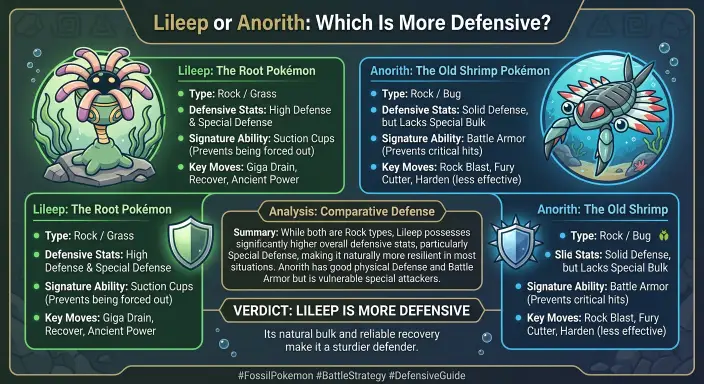
Lileep has the stronger defensive stat profile.
Its base Defense is 77, compared with Anorith’s 50. Its Special Defense is also much higher at 87, compared with Anorith’s 50.
Lileep also has higher base HP.
This makes Lileep more naturally suited to a defensive or slower battle style.
Anorith or Lileep: Abilities
Their abilities also reflect their different designs.
Lileep
Lileep’s standard ability is Suction Cups. This ability helps it stay in battle by preventing effects that would force it to switch out.
Anorith
Anorith’s standard ability is Battle Armor, while Swift Swim is available as a Hidden Ability in relevant games.
These abilities give the two Pokémon different utility during battles.
Lileep Evolution
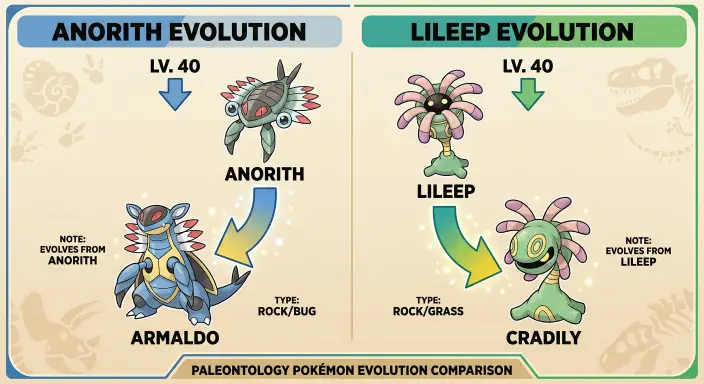
Lileep evolves into Cradily at level 40.
The evolution line is:
Lileep → Cradily
Both Pokémon remain Rock/Grass type.
Cradily keeps the defensive identity of Lileep while becoming considerably stronger.
Anorith Evolution
Anorith evolves into Armaldo at level 40.
The evolution line is:
Anorith → Armaldo
Both Pokémon remain Rock/Bug type.
Armaldo greatly improves on Anorith’s offensive capabilities.
Anorith vs Lileep Evolution Comparison
| Feature | Lileep | Anorith |
| Fossil | Root Fossil | Claw Fossil |
| Type | Rock/Grass | Rock/Bug |
| Evolves into | Cradily | Armaldo |
| Evolution level | 40 | 40 |
| Main stat focus | Defense and Sp. Defense | Attack and Speed |
| Battle style | Defensive | Offensive |
Lileep or Anorith: Weaknesses
Their different secondary types give them different weaknesses.
Lileep
Lileep is vulnerable to:
- Bug
- Ice
- Fighting
- Steel
Anorith
Anorith has weaknesses including:
- Water
- Rock
- Steel
Its Rock/Bug typing gives it a different defensive profile from Lileep.
This means team composition matters when deciding between the two.
Lileep or Anorith for a Team?
The better choice depends on what your team needs.
Choose Lileep if you want:
- Higher defensive stats
- Higher Special Defense
- A Grass type option
- A slower defensive Pokémon
- The Cradily evolution line
Choose Anorith if you want:
- Higher Attack
- Higher Speed
- A Bug type option
- A more offensive playstyle
- The Armaldo evolution line
Neither Pokémon is simply identical to the other. Their stat distributions and typings make them useful in different situations.
Lileep or Anorith in Pokémon Ruby and Sapphire
The comparison is especially important in Pokémon Ruby and Sapphire because the player chooses between the Root Fossil and Claw Fossil.
The Root Fossil gives you Lileep.
The Claw Fossil gives you Anorith.
Because the two fossils are mutually exclusive in those games, your selection determines which Pokémon you can revive from that choice during the playthrough.
Lileep vs Anorith: Everyday Comparison
Here is the simplest way to remember their differences:
Lileep = Rock + Grass + Defense
Anorith = Rock + Bug + Attack + Speed
Lileep has more defensive stats and much lower Speed.
Anorith has much higher Attack and Speed but lower defensive stats.
Their final evolutions follow the same general pattern:
Lileep → Cradily
Anorith → Armaldo
People Also Ask Questions About Lileep or Anorith
1. Is Lileep or Anorith better?
Lileep and Anorith serve different roles. Lileep has stronger defensive stats, while Anorith has higher Attack and Speed.
2. What fossil gives Lileep?
Lileep is revived from the Root Fossil.
3. What fossil gives Anorith?
Anorith is revived from the Claw Fossil.
4. What does Lileep evolve into?
Lileep evolves into Cradily at level 40.
5. What does Anorith evolve into?
Anorith evolves into Armaldo at level 40.
6. Is Lileep a Grass type Pokémon?
Yes. Lileep is a Rock/Grass type Pokémon.
7. Is Anorith a Bug type Pokémon?
Yes. Anorith is a Rock/Bug type Pokémon.
8. Which is faster, Lileep or Anorith?
Anorith is much faster, with a base Speed of 75 compared with Lileep’s 23.
9. Which has more Attack, Lileep or Anorith?
Anorith has much more Attack. Its base Attack is 95, while Lileep’s is 41.
10. Can you get both Lileep and Anorith?
It depends on the Pokémon game. In the original Ruby and Sapphire, the Root Fossil and Claw Fossil are mutually exclusive choices. Other games can handle the fossils differently.
Conclusion
The choice between Lileep or Anorith comes down to two very different Pokémon styles. Lileep is a Rock/Grass Fossil Pokémon with stronger defensive stats, higher Special Defense, and very low Speed. Anorith is a Rock/Bug Fossil Pokémon with much higher Attack and Speed.
Both have the same base stat total of 355, but their stats are distributed in completely different ways. Lileep evolves into Cradily at level 40, while Anorith evolves into Armaldo at level 40. Lileep comes from the Root Fossil, whereas Anorith comes from the Claw Fossil.
For players who enjoy a slower and more defensive Pokémon, Lileep offers that kind of stat profile. Players who prefer stronger physical Attack and greater Speed may find Anorith’s design more suited to that style.
In the original Pokémon Ruby and Sapphire, the choice is especially important because the Root Fossil and Claw Fossil are mutually exclusive. Understanding their types, stats, abilities, and evolutions makes the decision much easier.
Discover More Articles!
Allways or Always: Which Spelling Is Correct?(2026)
Roll or Role: What’s the Difference(2026)
Taken or Took: What Is the Difference?(2026)

Ethan Parker is an English-language writer known for his interest in words, language, and clear communication. His work focuses on making everyday English easier to understand through simple explanations and practical examples.