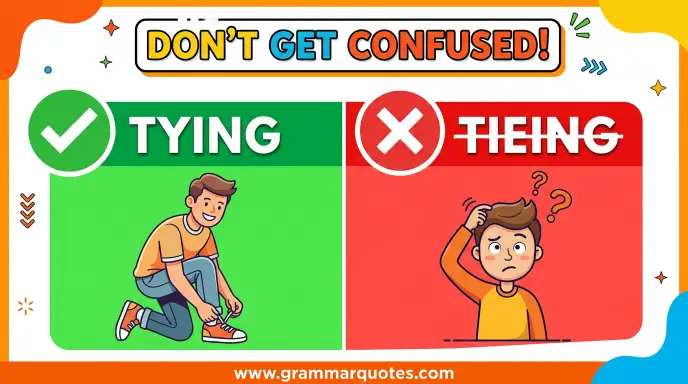
If you are unsure if to write tieing or tying, the correct spelling is tying. The form “tieing” is generally considered incorrect in modern English.
This confusion happens because the base verb tie ends in ie. When adding the ing ending, English changes ie to y, giving us tying. This follows a spelling rule that appears in several other words as well.
The word is common in everyday English. You might use it when talking about tying your shoes, tying a package, tying a knot, or connecting something with a rope or string.
Understanding this small spelling rule can help you avoid an easy mistake in school assignments, emails, articles, and other forms of writing. In this guide, we will look at the correct form, its meaning, the spelling rule behind it, common mistakes, examples, British and American usage, and related questions.
Tying or Tieing : Quick Answer
Tying is the correct spelling.
Tieing is not the standard modern spelling when the verb tie takes the ing ending.
Examples
- I am tying my shoes.
- She is tying the ribbon.
- He was tying the package.
- They are tying the boat to the dock.
The spelling changes because tie + ing does not become tieing. Instead, the final ie changes to y before adding ing.
Tie → tying
This same pattern can be seen in other verbs:
- lie → lying
- die → dying
- tie → tying
Definition and Meaning
What does “tying” mean?
Tying is the present participle or gerund form of the verb tie.
The verb tie can mean to fasten, connect, secure, or attach something using a knot, string, rope, ribbon, or another method.
For example:
She is tying her shoelaces.
Here, the person is fastening the laces.
The word can also have broader meanings.
Different uses
Fastening something:
- He is tying his shoes.
Securing something:
- We are tying the boxes together.
Connecting people or things:
- The agreement is tying the two companies together.
Making a knot:
- She is tying a knot in the rope.
So, the meaning depends on the sentence, but the spelling remains tying.
Why Does Tie Become Tying?
The spelling comes from a common English rule.
When a verb ends in ie and we add ing, the ie changes to y.
The pattern is:
ie → y + ing
Examples:
| Base Verb | + ing | Correct Form |
| tie | tie + ing | tying |
| lie | lie + ing | lying |
| die | die + ing | dying |
This makes the spelling easier to read and pronounce.
Therefore:
❌ tieing
✅ tying
The Origin of the Word “Tie”
The verb tie has a very old history. It is related to words in older Germanic languages that carried the idea of fastening, binding, or connecting.
Over time, the word developed several related meanings. Today, it can refer to physically fastening something, forming a connection, or even creating a relationship between ideas or people.
The spelling has also changed over the history of English. Modern English eventually settled on tie as the common form, while its ing form follows the special ie → y spelling pattern.
British English vs American English
There is no spelling difference between British and American English in this case.
Both varieties use tying as the standard form.
| English Type | Standard Spelling | Example |
| British English | tying | She is tying her shoes. |
| American English | tying | She is tying her shoes. |
| Canadian English | tying | He is tying the rope. |
| Australian English | tying | They are tying the boat. |
So, you do not need to choose between a British and American spelling here.
Tying works in both.
Which Spelling Should You Use?
Use tying whenever you need the ing form of tie.
This applies to:
- School assignments
- University work
- Emails
- Blog posts
- Articles
- Business writing
- Social media
- Formal documents
Correct
I am tying my shoes.
Incorrect
I am tieing my shoes.
The second version may look logical because the base word is tie, but English spelling rules do not normally keep the ie before ing.
Common Mistakes
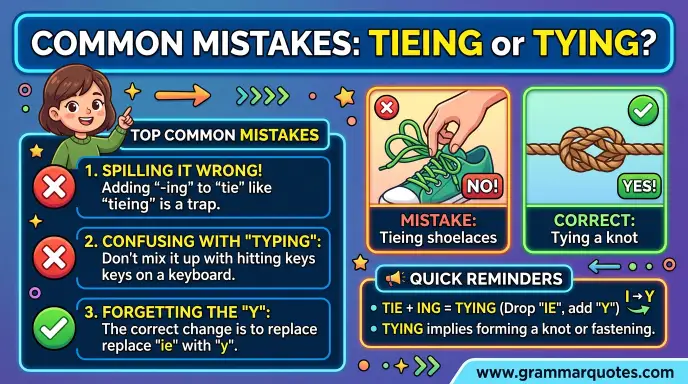
1. Writing “tieing”
This is the most common spelling mistake.
❌ She is tieing her hair.
✅ She is tying her hair.
2. Forgetting the spelling change
Some learners simply add ing to the original word.
tie + ing = tieing ❌
The correct pattern is:
tie → tying ✅
3. Confusing it with “tying” pronunciation
The spelling may look unusual, but tying is pronounced naturally as the ing form of tie.
4. Confusing “tying” with “trying”
These words look somewhat similar but have different meanings.
- Tying = fastening or connecting
- Trying = attempting to do something
Example:
I am tying the rope.
I am trying to open the door.
Tying in Everyday Examples
The word appears in many normal situations.
At home
Mom is tying the curtains.
With clothing
He is tying his shoelaces.
With gifts
She is tying a ribbon around the box.
With sports
The teams are tying the score.
Here, tying can also mean bringing two scores to the same level.
With ropes
They are tying the boat to the dock.
In relationships
The contract is tying the two businesses together.
These examples show that the word can have both literal and figurative meanings.
Tying vs Similar Words
Several words can appear similar but have different meanings.
| Word | Meaning |
| Tying | Fastening or connecting |
| Trying | Attempting something |
| Lying | Resting flat or telling something untrue, depending on context |
| Dying | Coming to the end of life |
Knowing the spelling pattern helps separate these words.
Tying or Tieing: Comparison Table
| Feature | Tying | Tieing |
| Standard modern English | Yes | No |
| Based on “tie” | Yes | Yes |
| Correct ing form | Yes | No |
| British English | Used | Not standard |
| American English | Used | Not standard |
| Suitable for formal writing | Yes | No |
| Example | She is tying the rope. | She is tieing the rope. |
The important point is simple: tying is the form you should use in normal modern English.
Why Is This Spelling So Confusing?
The confusion comes from the unusual ending of the base word.
Many English verbs simply add ing:
- walk → walking
- play → playing
- read → reading
But words ending in ie behave differently.
For example:
- tie → tying
- lie → lying
- die → dying
This means learners who apply the basic “just add ing” rule may naturally write the wrong form.
The best way to remember it is:
IE changes to Y before ING.
Google Trends & Usage Data
Search interest for spelling questions can change over time, especially when learners search for quick answers to common writing problems.
The important usage pattern here is clear: tying is the standard spelling used in modern English, while tieing is generally treated as a misspelling.
If you are researching search volume for an article, exact Google Trends numbers should be checked for the target country and date range because search interest changes over time.
For content writing, the useful related searches include questions such as:
- how to spell tying
- tying meaning
- tie past tense
- tie present participle
- why is tying spelled with y
- tie + ing spelling rule
These related phrases can help cover the topic naturally without repeating the same keyword too often.
People Also Ask Questions
1. Is “tieing” a correct spelling?
No. Tying is the standard modern English spelling.
2. Why is “tieing” wrong?
Because verbs ending in ie normally change ie to y before ing.
3. Is it “tying” or “tieing”?
The correct form is tying.
4. What is the ing form of tie?
The ing form of tie is tying.
5. Is “tying” used in British English?
Yes. British English uses tying.
6. Is “tying” used in American English?
Yes. American English also uses tying.
7. What is the spelling rule for tie + ing?
Change ie to y and then add ing: tie → tying.
8. What is the difference between tying and trying?
Tying means fastening or connecting something, while trying means attempting something.
9. What are other words like tying?
Lying and dying follow a similar ie → y spelling pattern.
10. How do you remember the correct spelling?
Remember this simple rule: words ending in ie change to y before ing.
Conclusion
The correct modern spelling is tying, not tieing. The difference comes from a useful English spelling rule: when a verb ends in ie and takes the ing ending, the ie changes to y.
This gives us tie → tying, just as we get lie → lying and die → dying. The same spelling is used in both British and American English, so there is no regional variation to worry about.
Once you remember the ie → y pattern, this spelling becomes much easier to recognize. if you are writing about tying shoes, securing a package, making a knot, or connecting two things, tying is the form to use.
For school, professional writing, websites, emails, and everyday communication, stick with the standard spelling. If you see tieing, treat it as a common spelling error rather than an alternative form.
Discover More Articles!
Weening or Weaning: One Letter Changes the Entire Meaning
Pidgeon vs Pigeon: Which Spelling Is Correct?
Fruits or Vegetables: What Is the Difference?

Ethan Parker is an English-language writer known for his interest in words, language, and clear communication. His work focuses on making everyday English easier to understand through simple explanations and practical examples.