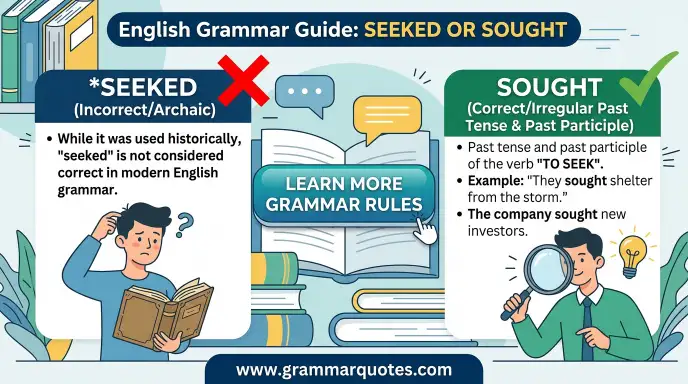
Have you ever wondered if to use “seeked” or “sought” when talking about searching for something? Sought is the correct past tense and past participle of the verb “seek.” Although some people use “seeked” by mistake, it is not the standard form in modern English.
The confusion happens because many English verbs form their past tense by adding ed, such as “walked,” “played,” and “helped.” However, “seek” is an irregular verb, so its past forms do not follow this usual pattern.
You should say, “I sought help,” rather than “I seeked help.” Similarly, the correct sentence is “She has sought advice,” not “She has seeked advice.”
In this guide, you will learn the difference between seeked and sought, understand the meaning of “sought,” and discover how to use it correctly in everyday English. You will also find simple examples, common mistakes, a comparison table, and answers to frequently asked questions.
Quick Answer: Seeked or Sought?
Sought is correct. It is both the simple past tense and the past participle of “seek.”
- Present tense: I seek help.
- Past tense: I sought help.
- Present perfect: I have sought help.
- Incorrect standard form: I seeked help.
Remember this simple rule: Seek → Sought → Sought.
Definition and Meaning of Seek and Sought
What Does Seek Mean?
The verb “seek” means to look for something, try to find something, or make an effort to obtain something.
It can refer to searching for a physical object, looking for information, or trying to achieve something important.
Examples:
- I seek answers to my questions.
- Many students seek better educational opportunities.
- They seek a peaceful solution to the problem.
- You should seek advice when you need help.
What Does Sought Mean?
“Sought” is the past tense and past participle of “seek.” It describes an action of looking for, requesting, or trying to obtain something in the past or in a perfect tense construction.
Examples:
- She sought help from her teacher.
- We sought information about the course.
- He has sought a better job.
- They had sought permission before entering.
Is Seeked a Real Word?
“Seeked” may appear in nonstandard writing or as a learner’s mistake, but it is not the accepted past tense form of “seek” in standard modern English.
For schoolwork, professional writing, emails, and formal documents, use “sought.”
Incorrect: He seeked permission from his parents.
Correct: He sought permission from his parents.
Origin of Seeked and Sought
The verb “seek” has a long history in English and belongs to a group of verbs that developed irregular past tense forms.
Instead of following the regular pattern of adding ed, “seek” uses “sought” for both its past tense and past participle.
This pattern is similar to other irregular verbs:
- Think → Thought
- Buy → Bought
- Bring → Brought
- Seek → Sought
These forms developed through the history of the English language. Although “seeked” may seem logical because it follows the regular ed pattern, standard English retains “sought.”
Seeked vs Sought: Main Differences
The main difference is grammatical correctness. “Sought” is the standard form, while “seeked” is generally considered incorrect in modern standard English.
| Feature | Seeked | Sought |
| Standard English | Nonstandard | Correct |
| Past tense | Incorrect in standard usage | Correct |
| Past participle | Incorrect in standard usage | Correct |
| Formal writing | Avoid | Use |
| Example | She seeked help. | She sought help. |
When Should You Use Sought?
Use “sought” when describing a past search, request, or effort to obtain something.
Examples:
- The student sought guidance from the counselor.
- The company sought new customers.
- They sought shelter during the storm.
- I sought an answer to my question.
- She has sought advice from several experts.
When Should You Avoid Seeked?
Avoid “seeked” when you need the standard past tense or past participle of “seek.”
Incorrect: I seeked a solution to the problem.
Correct: I sought a solution to the problem.
Incorrect: They have seeked permission.
Correct: They have sought permission.
How to Use Sought in Different Tenses
Understanding verb tenses can help you avoid this common mistake.
Present Tense
Use “seek” when talking about the present or a general habit.
Examples:
- I seek knowledge every day.
- She seeks advice from her parents.
- They seek new opportunities.
Simple Past Tense
Use “sought” for an action completed in the past.
Examples:
- I sought help yesterday.
- She sought a new job last month.
- We sought directions from a local resident.
Present Perfect Tense
Use “sought” after “has” or “have” to describe an experience or action connected to the present.
Examples:
- I have sought professional advice.
- He has sought a better opportunity.
- They have sought assistance several times.
Past Perfect Tense
Use “sought” after “had” when one past action happened before another past action.
Examples:
- She had sought help before the situation became worse.
- We had sought permission before starting the project.
- He had sought advice before making his decision.
Everyday Examples of Sought
Here are simple sentences showing how “sought” works in everyday English.
- I sought help with my homework.
- She sought advice from her mother.
- He sought a job after graduation.
- We sought information online.
- They sought shelter from the rain.
- The teacher sought an explanation.
- The company sought skilled workers.
- I sought an answer to this question.
- The family sought a safer place to live.
- The student has sought guidance from a mentor.
Notice that “sought” can be followed by words such as help, advice, information, permission, and opportunities.
Common Mistakes with Seeked and Sought
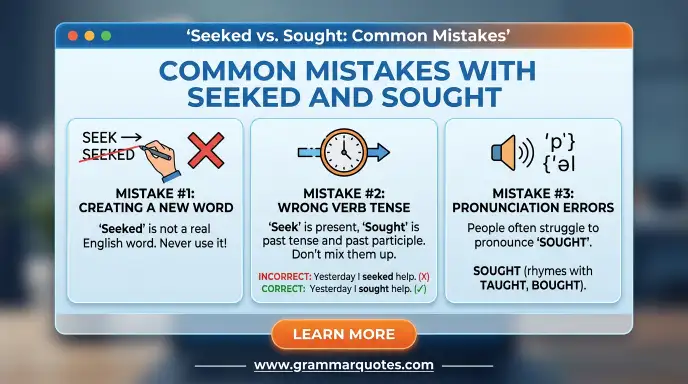
Mistake 1: Adding ed to Seek
Incorrect: She seeked help from her friend.
Correct: She sought help from her friend.
Why? “Seek” is irregular, so its past tense is “sought.”
Mistake 2: Using Seeked After Have or Has
Incorrect: He has seeked a solution.
Correct: He has sought a solution.
Why? The past participle of “seek” is also “sought.”
Mistake 3: Using Sought for the Present Tense
Incorrect: I sought help every time I have a question.
Correct: I seek help whenever I have a question.
Why? Use “seek” for a present habit and “sought” for a completed past action.
Mistake 4: Confusing Seek and Search
“Seek” and “search” have similar meanings, but they are not always used in exactly the same way.
- I seek advice.
- I search for my missing keys.
Both verbs can describe looking for something, but their natural sentence patterns can differ. Remember that the past tense of “seek” is “sought,” while the past tense of “search” is “searched.”
Seek vs Sought vs Searched
These words are related, but their grammatical uses differ.
| Word | Meaning or Function | Example |
| Seek | Present form | I seek knowledge. |
| Sought | Past form of seek | I sought knowledge. |
| Searched | Past form of search | I searched the room. |
Use “sought” when the main verb is “seek.” Use “searched” when the main verb is “search.”
A Simple Trick to Remember Sought
The easiest way to remember the correct form is to learn the three forms together:
Seek → Sought → Sought
You can also remember the pattern by comparing “seek” with “think”:
- Think → Thought
- Seek → Sought
Both verbs have irregular past forms, so you should not automatically add ed.
Try saying this sentence aloud: “I seek help today, and I sought help yesterday.”
Repeating this pattern can make the correct form easier to remember.
Frequently Asked Questions
1. Is seeked or sought correct?
“Sought” is correct in standard English. It is the past tense and past participle of “seek.”
2. Is seeked a real English word?
“Seeked” can appear as a nonstandard form, but it is not accepted as the standard past tense of “seek.” Use “sought” instead.
3. What is the past tense of seek?
The past tense of “seek” is “sought.”
Example: “She sought help from her teacher.”
4. What is the past participle of seek?
The past participle is also “sought.”
Example: “They have sought advice.”
5. Should I say “I seeked help” or “I sought help”?
Say “I sought help.” This is the grammatically correct form in standard English.
6. Is “has seeked” grammatically correct?
No, not in standard English. The correct phrase is “has sought.”
Example: “He has sought professional guidance.”
7. What are the three forms of seek?
The three forms are seek, sought, and sought.
- Base form: Seek
- Past tense: Sought
- Past participle: Sought
8. What is the difference between seek and sought?
“Seek” is the base form used in the present tense, while “sought” is its past tense and past participle.
Example: “I seek advice” and “I sought advice.”
9. Is sought formal or informal?
“Sought” is correct in both formal and informal English. It is especially common in writing about help, advice, information, employment, and opportunities.
10. How can I remember the difference between seeked and sought?
Memorize the pattern “seek, sought, sought.” Remember that “seek” is irregular and does not use the standard ed ending.
Conclusion
When choosing between seeked and sought, always use sought in standard English. It is the correct past tense and past participle of “seek.” Although adding ed may seem logical, “seek” is an irregular verb and follows a different pattern.
Use “seek” when talking about the present, as in “I seek advice.” Use “sought” when describing a completed past action, as in “I sought advice.” You should also use “sought” after “has,” “have,” or “had,” as in “She has sought help.”
Remember the simple verb pattern: Seek → Sought → Sought. Learning this pattern will help you avoid common grammar mistakes in school assignments, emails, exams, and everyday conversations.
With regular practice and a few example sentences, you can confidently use “sought” whenever you need the past form of “seek.”
Discover More Articles!
Draw or Drawer: Meaning, Differences, and Examples(2026)
Texting vs Calling: Which Communication Method Wins?(2026)
Unshakable or Unshakeable: Which Is Correct?

Ethan Parker is an English-language writer known for his interest in words, language, and clear communication. His work focuses on making everyday English easier to understand through simple explanations and practical examples.