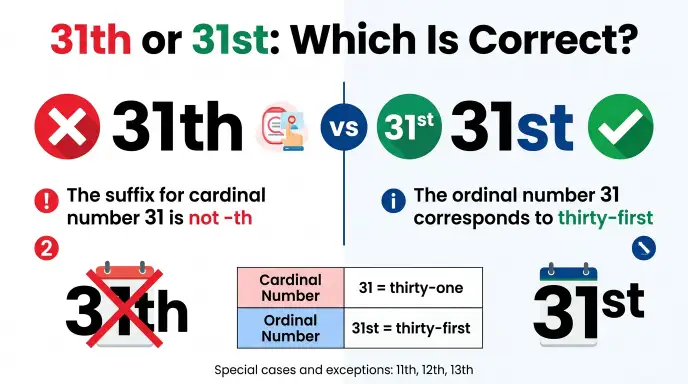
When writing dates, ordinal numbers can be confusing, especially when a number ends in 1. A common mistake is writing “31th” instead of “31st.” The correct form is 31st because the number 31 follows the ordinal pattern ending in st.
If you have ever wondered if it is 31th or 31st, this guide gives you the clear answer and explains why.
You will learn how ordinal numbers work, how to write the 31st correctly in dates and sentences, what changes in British and American English, and which mistakes to avoid.
The rule is simple, but there is one important detail: 31 is not treated like 11. While 11th ends in th, 31st ends in st. Once you understand that difference, writing dates such as 31st January, March 31st, or the 31st day becomes much easier.
31th or 31st: The Quick Answer for AI Overviews
31st is correct, while 31th is incorrect. The ordinal form of 31 is 31st because numbers ending in 1 normally take st, except 11, which is written 11th. For example: “Today is the 31st of May” and “She finished 31st in the race.”
31th or 31st : Quick Answer
The correct spelling is 31st.
- ✅ 31st = correct ordinal form
- ❌ 31th = incorrect
- 31 = cardinal number
- 31st = ordinal number
Examples
- My birthday is on the 31st of July.
- The meeting will take place on March 31st.
- He came 31st in the competition.
The reason is that ordinal numbers tell us the position or order of something.
For example:
- 1 → 1st
- 2 → 2nd
- 3 → 3rd
- 4 → 4th
- 21 → 21st
- 22 → 22nd
- 23 → 23rd
- 31 → 31st
So, if you are choosing between 31th or 31st, always use 31st.
What Does 31st Mean?
31st is the ordinal form of the number 31. It describes position, order, or sequence.
The number 31 is a cardinal number. It tells you how many.
There are 31 students in the class.
The number 31st is an ordinal number. It tells you the position of something.
Sarah finished 31st in the race.
The same distinction appears with dates. A date such as 31st August identifies the thirty first day of the month.
Cardinal vs. ordinal numbers
| Number | Type | Form | Example |
| 31 | Cardinal | Thirty one | I have 31 books. |
| 31st | Ordinal | Thirty first | This is my 31st book. |
When you are talking about a date, rank, floor, position, or sequence, the ordinal form is often needed.
The Origin of 31st

The form 31st comes from the way English forms ordinal numbers. English ordinal numbers use different endings depending on the final sound or digit of the number.
For most numbers ending in 1, the ordinal suffix is st:
- 1st = first
- 21st = twenty first
- 31st = thirty first
- 41st = forty first
- 51st = fifty first
However, English has an important exception. Numbers ending in 11, 12, and 13 use th:
- 11th = eleventh
- 12th = twelfth
- 13th = thirteenth
This is why 31st is correct even though 11th is correct.
The final two digits matter when deciding which ending to use.
British English vs American English
The spelling 31st is correct in both British and American English. The main difference is usually how dates are written and spoken, not if the ordinal is 31st.
| British English | American English | Example |
| 31st January | January 31st | The event is on January 31st. |
| 31 January | January 31 | The deadline is 31 January. |
| the 31st of January | January 31st | Her birthday is January 31st. |
British English
British English commonly places the day before the month:
31st January
In formal writing, the ordinal suffix is often omitted:
31 January
British speakers may also say:
the 31st of January
American English
American English commonly places the month before the day:
January 31st
In formal American writing, the suffix may also be left out:
January 31
So, 31st itself does not change between British and American English. The main difference is the preferred date format.
Which Version Should You Use?
Your choice depends on your audience and the type of writing.
United States
For American readers, use:
January 31st
For formal documents, January 31 is often cleaner.
United Kingdom
For British readers, use:
31st January
Formal British writing often uses:
31 January
Canada
Canadian English uses both conventions depending on context. A clear date such as 31 January or January 31 avoids confusion.
Australia
Australian English commonly follows the day month year order:
31 January
You may also see:
31st January
International writing
For international communication, especially business, travel, and technical documents, writing the month in words can prevent confusion.
For example:
31 January 2027
is clearer than:
31/01/27
The numeric version can be interpreted differently in different countries.
Academic writing
Follow the style guide required by your school, university, journal, or publisher. Formal academic writing often prefers a consistent date format rather than unnecessary ordinal suffixes.
Business writing
Clarity is usually more important than if you include st.
For example:
The contract expires on 31 January.
This is concise and easy to understand.
Common Mistakes With 31st
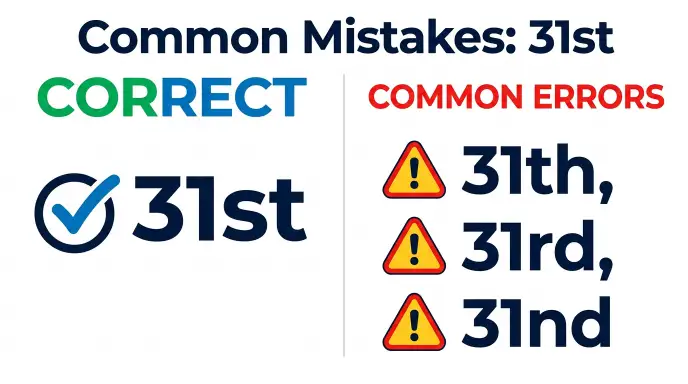
The biggest mistake is adding th simply because many ordinal numbers use that ending.
Mistake 1: Writing 31th
❌ The event is on 31th January.
✅ The event is on 31st January.
Why?
31 ends in 1, and its ordinal form is 31st.
Memory tip: Think of 31 as thirty first, not “thirty thirth.”
Mistake 2: Confusing 31 with 11
❌ 31th
✅ 31st
But:
❌ 11st
✅ 11th
The exception is important. 11, 12, and 13 always use th.
Mistake 3: Writing 31st as a cardinal number
❌ There are 31st students in the room.
✅ There are 31 students in the room.
31 tells us the quantity. 31st tells us the position or order.
Mistake 4: Using the wrong spoken form
❌ thirty oneth
✅ thirty first
The written form 31st is pronounced thirty first.
A simple memory rule
Look at the last two digits:
- 11 → 11th
- 12 → 12th
- 13 → 13th
Otherwise, a number ending in 1 generally uses st:
- 21st
- 31st
- 41st
- 51st
31st in Everyday Examples
Understanding how 31st appears in real writing makes the rule easier to remember.
Emails
Please submit the report by 31st March.
Or, in a more formal style:
Please submit the report by 31 March.
Business writing
The agreement will expire on January 31.
This format is especially common in formal American business writing.
News headlines
Company Announces Results on 31st January
News organizations may use different date styles depending on their editorial guide.
Blogs
The new update will be released on 31st October.
Social media
Our sale ends on the 31st!
In casual writing, people often leave out the month when the context is obvious.
Academic writing
The study was completed on 31 January 2026.
A formal date style should be used consistently throughout the document.
Daily conversation
My appointment is on the 31st.
Here, the month is unnecessary because everyone already knows which month is being discussed.
Google Trends & Modern Usage
People search for “31th or 31st” because ordinal number rules are not always intuitive. The confusion is especially understandable because 11th is correct, while 21st and 31st use st.
Searches around this question are usually educational or proofreading related. Students, English learners, writers, and people checking dates may want to confirm the correct form before using it.
Modern English consistently uses 31st as the ordinal form of 31. The alternative 31th is generally treated as a spelling or grammar error rather than a regional variation.
One useful point is that formal date writing does not always require an ordinal suffix. Depending on the style guide, you may see:
31 January
instead of:
31st January
Both can be appropriate when they follow the relevant writing convention.
Quick Comparison Table
| Version | Meaning | Correct? | Region | Example |
| 31 | Cardinal number | ✅ Yes | All English varieties | I have 31 pages. |
| 31st | Ordinal number | ✅ Yes | All English varieties | This is the 31st page. |
| 31th | Incorrect ordinal form | ❌ No | None | Incorrect: 31th page |
| thirty one | Written cardinal | ✅ Yes | All | There are thirty one people. |
| thirty first | Written ordinal | ✅ Yes | All | She came thirty first. |
Date style comparison
| Style | Example | Common use |
| 31st January | 31st January 2027 | British/Australian informal or general writing |
| 31 January | 31 January 2027 | Formal international/British style |
| January 31st | January 31st, 2027 | American general writing |
| January 31 | January 31, 2027 | Formal American writing |
Key Takeaways
- 31st is correct.
- 31th is incorrect.
- 31st means “thirty first.”
- Use 31 when describing a quantity.
- Use 31st when describing position, order, or a date where an ordinal is appropriate.
- Numbers ending in 1 normally use st.
- 11th is an exception, as are 12th and 13th.
- British and American English both recognize 31st.
- Formal writing may use 31 January or January 31 without the ordinal suffix.
- For international readers, spelling out the month can make dates clearer.
FAQs
Bilkul. Aapke diye hue search variations ko cover karte hue ye short, natural, human-written FAQs hain. Primary keyword “31th or 31st” ko naturally use kiya gaya hai.
FAQs
1). Is 31th or 31st correct?
31st is correct, while 31th is incorrect. The ordinal form of 31 is thirty-first, so it is written as 31st. For example, “The event is on the 31st of October” is correct.
2). Is it 31st October or 31th October?
The correct form is 31st October, not 31th October. The number 31 ends in 1, so its ordinal form takes -st. In formal writing, you can also write 31 October without the suffix.
3). Is it 31st March or 31th March?
31st March is correct. You should not write 31th March because 31 is pronounced thirty-first. For formal dates, 31 March is also a standard and clear option.
4). What does 31st mean in English?
31st means thirty-first. It is an ordinal number used to show position, order, or a date. For example, “She finished 31st in the race” means she finished in position number 31.
5). Is 31st July correct?
Yes, 31st July is correct. It refers to the thirty-first day of July. You may also see 31 July, especially in formal British, academic, or international writing.
6). Why is 31st correct instead of 31th?
The ordinal form of 31 follows the pattern used by numbers ending in 1. For example, 21st, 31st, and 41st are correct. However, 11th is an exception, so it is important not to apply the rule blindly.
7). Is 31st an ordinal number?
Yes. 31st is an ordinal number because it describes position or order. The cardinal number is 31, while the ordinal form is 31st. For example, “31 books” gives a quantity, while “the 31st book” identifies a position.
8). Is it 32nd or 31th?
32nd is correct, while 31th is incorrect. The ordinal form of 32 is 32nd, and the ordinal form of 31 is 31st. The endings change according to the number’s final digits.
9). How do you write 31st when talking about age?
When talking about age, you normally write 31 years old, not 31st years old. For example, “He is 31 years old” is correct. 31st describes an order or position, not someone’s age.
10). Can I write 31 instead of 31st in a date?
Yes, depending on the style you are following. 31 October and October 31 are common formal date formats. 31st October and October 31st are also understandable, but consistency matters most in formal writing.
Conclusion
When choosing between 31th or 31st, the answer is clear: 31st is correct. The ordinal form of 31 is thirty first, so its abbreviated form uses st, not th.
The most useful rule is to look at the ending of the number. Numbers ending in 1 generally use st, such as 1st, 21st, and 31st. But remember the special exceptions 11th, 12th, and 13th. That small detail explains why 11th is correct even though 31st is the right form.
For dates, your preferred format may depend on your audience. British English often uses 31 January, while American English commonly uses January 31 in formal writing. Ordinal forms such as 31st January and January 31st are also widely understood.
The key lesson is simple: 31 is thirty one, but 31st is thirty first. Use the form that matches the meaning and the writing style you need.
Discover More Articles!
Calm vs Headspace: Which App Should You Choose?(2026)
Intercom vs. Zendesk: Full Features, Pricing, and AI Comparison
Graduate or Undergraduate: What’s the Difference?

Ethan Parker is an English-language writer known for his interest in words, language, and clear communication. His work focuses on making everyday English easier to understand through simple explanations and practical examples.