If you’re comparing Intercom or Zendesk, the right choice depends on your support needs, team size, and workflow. Both platforms offer powerful customer service and AI tools, but they take different approaches. This guide explains the key differences so you can choose the option that best fits your business.
Intercom is generally a strong choice for businesses that want conversational, proactive, and AI first customer support.
Zendesk is often a better fit for teams that need a structured help desk, mature ticketing workflows, and detailed service operations.
The right choice depends on how your support team works. A SaaS startup that wants live chat, proactive messaging, and an AI agent may prefer Intercom. A larger support organization managing large volumes of structured tickets may find Zendesk more suitable.
In this guide, we will compare Intercom vs Zendesk across customer support, ticketing, AI, live chat, automation, integrations, usability, and common business needs. We will also explain which platform makes more sense for startups, growing companies, enterprise teams, and businesses with complex support workflows.
Intercom or Zendesk: The Quick Answer for Searchers
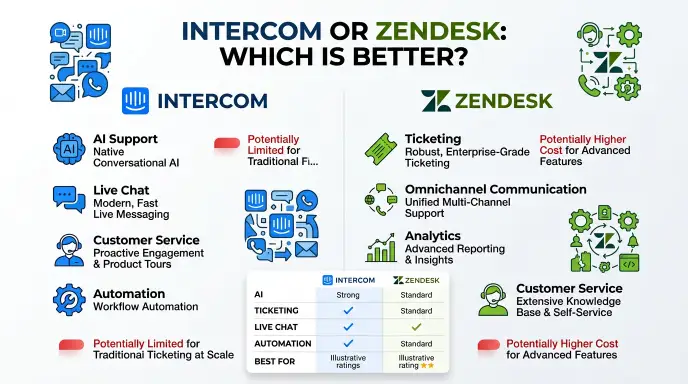
Intercom is usually better for conversational and proactive customer support, while Zendesk is usually better for structured ticket management and traditional help desk operations. Intercom emphasizes its shared Inbox, conversational support, proactive messaging, and Fin AI Agent. Zendesk focuses heavily on its service platform, ticketing, AI agents, agent tools, and structured support workflows.
Intercom or Zendesk: Quick Answer
There is no universal winner between Intercom or Zendesk.
Choose Intercom if you want:
- Conversational customer support
- Live chat and proactive messaging
- A modern shared Inbox
- Strong AI first support
- Customer engagement beyond traditional tickets
- Support closely connected to sales and customer journeys
Choose Zendesk if you want:
- A mature help desk and ticketing system
- Structured support workflows
- Detailed ticket management
- Extensive service management capabilities
- AI tools for agents and administrators
- A platform suited to complex support operations
Intercom describes its platform as a help desk built around Inbox, omnichannel support, ticketing, proactive messaging, workflows, and its Fin AI Agent.
Zendesk describes Zendesk AI as an intelligence layer across its service platform, including AI agents, generative search, ticket summaries, suggested macros, intelligent triage, and agent assistance.
Example 1: SaaS Startup
A software startup wants customers to chat with support inside the product, receive proactive messages, and get quick AI answers.
Intercom may be the better fit.
Example 2: Large Support Department
A company receives thousands of support requests and needs structured ticket routing, detailed workflows, reporting, and agent tools.
Zendesk may be the better fit.
Example 3: AI First Support Team
A company wants AI to resolve customer questions before a human agent becomes involved.
Both platforms can do this. Intercom uses Fin AI Agent, while Zendesk offers AI agents that can automate customer interactions across supported channels.
What Does Intercom or Zendesk Mean?
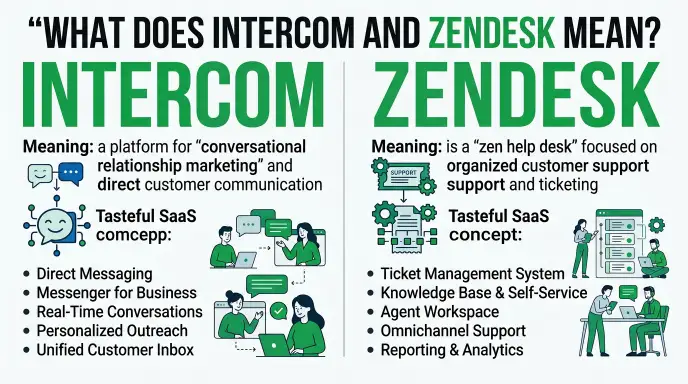
Intercom and Zendesk are customer service and support platforms. Businesses use them to communicate with customers, manage support requests, automate repetitive tasks, create help content, and improve customer service.
They overlap in many areas, but their product philosophies differ.
Intercom
Intercom centers its support experience around conversations. Its Inbox brings customer conversations into one workspace, while its platform also supports tickets, help content, workflows, outbound messaging, integrations, and AI.
Its Fin AI Agent can answer customer questions, work across channels, and escalate conversations to human agents when necessary.
Zendesk
Zendesk is strongly associated with structured customer service and help desk operations. Its platform includes ticketing, messaging, knowledge tools, reporting, AI capabilities, agent assistance, and automation.
Zendesk AI can help with tasks such as ticket summaries, intelligent triage, translations, suggested macros, generative search, and AI powered customer interactions.
In simple terms:
Intercom leans toward conversations and proactive engagement.
Zendesk leans toward structured service operations and ticket management.
The Origin of Intercom and Zendesk
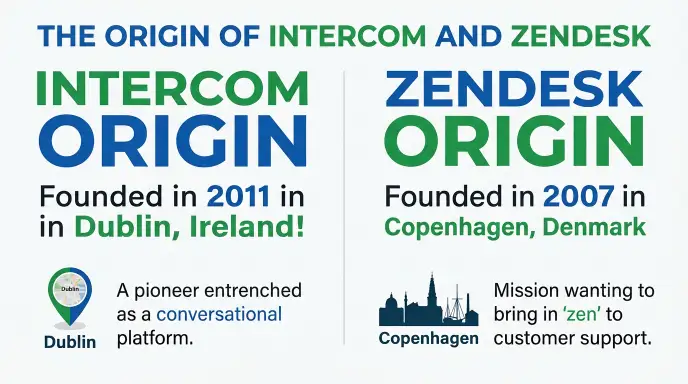
Intercom and Zendesk developed from different approaches to customer communication.
Intercom was created around direct communication between businesses and their customers. Over time, its platform expanded beyond messaging into a broader customer support system with Inbox, ticketing, automation, knowledge management, outbound communication, and AI.
Today, Intercom describes its product as a next generation help desk with omnichannel support, centralized ticketing, proactive support, workflows, and an integrated AI agent called Fin.
Zendesk developed as a customer service and help desk platform. Its strength has traditionally been organizing customer requests into structured support workflows.
Its modern platform has expanded significantly into AI. Zendesk AI now includes AI agents, agent assistance, intelligent triage, generative search, summaries, translations, and other service automation tools.
The difference is therefore not simply about age or popularity. It is about how a business wants customer support to operate.
Intercom vs Zendesk: Key Differences
| Feature | Intercom | Zendesk |
| Main strength | Conversational support | Structured customer service |
| Shared workspace | Inbox | Agent workspace |
| Live chat | Strong | Strong |
| Ticketing | Yes | Strong focus |
| AI support | Fin AI Agent and Copilot | Zendesk AI and AI agents |
| Proactive messaging | Strong | Available through platform capabilities |
| Knowledge base | Yes | Yes |
| Automation | Strong | Strong |
| Omnichannel support | Yes | Yes |
| Best suited to | Conversational, proactive support | Structured support operations |
| Customer engagement | Strong | Strong |
| Complex ticket workflows | Good | Particularly strong |
These are broad positioning differences rather than strict limitations. Both platforms have expanded their capabilities, and both can support sophisticated customer service teams.
Intercom vs Zendesk: AI Capabilities
AI is now one of the biggest reasons companies compare Intercom or Zendesk.
Intercom AI
Intercom’s Fin AI Agent is designed to interact directly with customers. It can answer questions using support content, handle conversations across channels, and escalate issues to human agents when required.
Intercom also provides Copilot for support agents. Copilot assists teammates inside the Inbox by surfacing information and helping them respond to customers.
Zendesk AI
Zendesk AI operates across the Zendesk service platform. Its capabilities include AI agents, intelligent triage, ticket summaries, suggested macros, generative search, writing assistance, and translation tools.
Zendesk AI agents can communicate with customers through messaging, email, web forms, and, in applicable programs, voice. They can also perform authorized actions to automate support processes.
Which Has Better AI?
There is no objective winner for every company.
Intercom may appeal more to businesses looking for an AI first conversational support experience.
Zendesk may appeal more to organizations that want AI deeply integrated into an established service and ticketing operation.
The better option depends on if your main problem is customer conversations or large scale service management.
British English vs American English
The phrase “Intercom or Zendesk” does not have a British versus American spelling difference. These are brand names, so they should normally be written exactly as the companies use them.
| British English | American English | Example |
| Intercom | Intercom | We use Intercom for customer conversations. |
| Zendesk | Zendesk | Zendesk manages our support tickets. |
| customer service | customer service | Both platforms support customer service teams. |
| help centre | help center | UK: help centre |
| help center | help center | US: help center |
The main regional difference you may notice is in ordinary English surrounding the product names.
For example:
- British English: “Our help centre is connected to Intercom.”
- American English: “Our help center is connected to Intercom.”
When writing for an international audience, use the spelling preferred by your target readers and keep the brand names unchanged.
Which Version Should You Use?
If you are asking which platform you should choose, consider your support model first.
United States
Both Intercom and Zendesk are widely relevant to US businesses.
Choose Intercom when conversational support, proactive engagement, and AI first customer interactions are central to your strategy.
Choose Zendesk when your team needs structured ticketing and mature support operations.
United Kingdom
Either platform can work well.
The deciding factors should be workflow, channels, integrations, reporting, AI requirements, and team size rather than the country itself.
Canada
Both are suitable options for Canadian businesses.
If multilingual communication is important, examine the exact language and translation capabilities available in your selected plan before purchasing.
Australia
The same general comparison applies.
Intercom can suit customer facing conversational support, while Zendesk can suit teams that prioritize structured service management.
International Writing
For international teams, compare:
- Supported channels
- Languages
- Automation
- AI capabilities
- Integrations
- Reporting
- Ticketing requirements
- Total operating cost
Academic Writing
If you are writing an academic comparison, avoid saying that one platform is simply “better.”
Instead, define the evaluation criteria first.
For example:
“Intercom and Zendesk can both support omnichannel customer service, but their product approaches differ in conversational engagement, ticket management, and AI assisted workflows.”
Business Writing
In business documents, be specific.
Instead of:
“Zendesk is better.”
Write:
“Zendesk is a stronger candidate for our team because we require structured ticket routing and complex support workflows.”
That makes the recommendation easier to defend.
Common Mistakes When Comparing Intercom or Zendesk
Mistake 1: Assuming One Platform Is Always Better
Incorrect:
“Intercom is better for every business.”
Correct:
“Intercom may be better for businesses that prioritize conversational and proactive support.”
Why: Different teams have different workflows.
Memory tip: Match the platform to the process.
Mistake 2: Treating Intercom as Only a Live Chat Tool
Incorrect:
“Intercom is just a live chat platform.”
Correct:
“Intercom provides a broader help desk with Inbox, ticketing, omnichannel support, automation, knowledge tools, outbound messaging, and AI.”
Intercom currently positions its platform as a full help desk rather than simply a chat widget.
Mistake 3: Treating Zendesk as Only a Ticketing Tool
Incorrect:
“Zendesk only handles tickets.”
Correct:
“Zendesk provides customer service capabilities that include ticketing, messaging, AI agents, knowledge tools, reporting, and agent assistance.”
Zendesk’s current AI offering extends well beyond basic ticket management.
Mistake 4: Comparing AI by Marketing Claims Alone
Incorrect:
“Platform A has better AI because its website says so.”
Correct:
“Compare AI based on resolution quality, escalation, channels, integrations, controls, reporting, and actual results for your use case.”
Memory tip: Test AI with your own customer questions.
Intercom or Zendesk: Everyday Business Examples
Customer Support Emails
A customer sends a support email.
Both platforms can help teams manage email based customer support, although the workflow and available features differ.
Business Support
A company wants every support request assigned to the correct team.
Zendesk may be attractive when structured routing and service workflows are central to the operation.
SaaS Support
A software company wants customers to contact support directly inside its product.
Intercom can be especially attractive when conversational support and proactive customer engagement are important.
News Headlines
A technology publication might write:
“Intercom and Zendesk compete for AI powered customer service teams.”
The headline should make the comparison clear without suggesting that one platform wins for every organization.
Blogs
A useful comparison should explain why a platform fits a particular business.
Avoid simply listing features.
Social Media
A short comparison might say:
“Intercom vs Zendesk? Think conversations and proactive engagement versus structured service operations.”
Academic Writing
Use neutral language and measurable criteria.
Compare:
- Ticket management
- Customer communication
- AI automation
- Reporting
- Integrations
- Scalability
- Usability
Daily Conversation
Someone might simply ask:
“Should we use Intercom or Zendesk?”
The best answer is:
“What kind of support workflow do you need?”
That question often matters more than the brand names themselves.
Google Trends & Modern Usage
People search for “Intercom or Zendesk”, “Intercom vs Zendesk”, and similar phrases because both platforms overlap in customer support, help desk, messaging, automation, and AI.
Modern comparisons are also changing because both companies are investing heavily in AI.
Intercom’s Fin AI Agent is designed to resolve customer questions across multiple channels and can hand conversations to human support when appropriate.
Zendesk is also expanding AI across customer service, including AI agents, agent assistance, intelligent triage, summaries, and generative search.
Exact search volume or regional Google Trends figures should not be assumed without checking current Google Trends data. General usage patterns show that people often search the comparison when they are evaluating customer service software, switching help desks, or looking for alternatives.
The most useful question is therefore not:
“Which brand is more popular?”
It is:
“Which platform fits the way our support team actually works?”
Quick Comparison Table
| Version | Meaning | Correct? | Region | Example |
| Intercom | Customer support and engagement platform | Yes | International | “We use Intercom for customer conversations.” |
| Zendesk | Customer service and support platform | Yes | International | “We use Zendesk to manage support.” |
| Intercom vs Zendesk | Comparison of the two platforms | Yes | International | “We are evaluating Intercom vs Zendesk.” |
| Intercom or Zendesk | Choice between the platforms | Yes | International | “Should we choose Intercom or Zendesk?” |
Key Takeaways
- Intercom and Zendesk are both legitimate customer service platforms.
- Intercom emphasizes conversational, proactive, and AI first customer support.
- Zendesk has strong foundations in structured service and ticket management.
- Both platforms now offer significant AI capabilities.
- Intercom can be attractive for SaaS and customer engagement focused teams.
- Zendesk can be attractive for organizations with complex support operations.
- Do not choose based on features alone.
- Test each platform against your actual support workflows before making a final decision.
FAQs
Is Intercom better than Zendesk?
Intercom is not universally better than Zendesk. It may be a better fit for teams that prioritize conversational support, proactive messaging, and AI first customer interactions. Zendesk may be a better fit for teams that need structured ticketing and mature service workflows. The best choice depends on support volume, team structure, channels, automation, integrations, and operational requirements.
Is Zendesk better than Intercom for customer support?
Zendesk can be a strong choice for customer support teams that depend on structured ticket management, routing, workflows, reporting, and service operations. However, Intercom can be more appealing when customer conversations, proactive engagement, and AI powered support are central. The right choice depends on how your team handles customer requests.
Which is easier to use, Intercom or Zendesk?
Ease of use depends on the team’s workflow and the features being configured. Intercom is often attractive to teams that prefer a conversational, modern Inbox experience. Zendesk can require more configuration for complex service operations, but that structure can be valuable for larger support teams. A trial with real workflows is the best way to judge usability.
Is Intercom a help desk?
Yes. Intercom currently describes itself as a help desk that combines Inbox, omnichannel support, ticketing, automation, knowledge tools, outbound messaging, and AI. Its platform is therefore much broader than a basic live chat widget.
Is Zendesk only for ticketing?
No. Zendesk offers much more than ticket management. Its current service platform includes AI agents, messaging, knowledge capabilities, reporting, agent assistance, intelligent triage, generative search, and other customer service tools.
Which is better for a SaaS company, Intercom or Zendesk?
Intercom can be a strong option for SaaS companies that want in product conversations, proactive engagement, and AI powered support. Zendesk can also work well for SaaS companies, especially when support operations require structured ticketing and detailed workflows. The decision should depend on how customers contact your team and how support requests are managed.
Which has better AI, Intercom or Zendesk?
Neither platform should be declared the universal AI winner. Intercom’s Fin AI Agent focuses heavily on customer facing conversations and automated resolution, while Zendesk AI combines customer facing AI agents with tools for agents and administrators.
Can Intercom and Zendesk both handle omnichannel support?
Yes. Both platforms support multiple customer communication channels, although the exact channels and capabilities depend on the product configuration and plan. Intercom’s current Inbox supports channels including email, chat, phone, WhatsApp, SMS, and social messaging. Zendesk also supports customer interactions through channels including messaging and email, with additional capabilities available across its service platform.
Should a startup choose Intercom or Zendesk?
A startup should choose based on its immediate support model and expected growth. Intercom may be appealing when the startup needs conversational support, proactive customer engagement, and AI. Zendesk may be preferable when the startup expects structured ticket management and more formal service operations. Both can be valid choices.
Can Intercom replace Zendesk?
For some businesses, yes. Intercom offers help desk, ticketing, omnichannel support, automation, knowledge management, and AI capabilities. However, if it can replace Zendesk depends on the organization’s existing workflows, integrations, reporting needs, service processes, and required features. A migration should be evaluated against real support cases rather than a feature checklist alone.
Conclusion
The choice between Intercom or Zendesk comes down to the type of customer support experience you want to build.
Intercom is a compelling option for teams that think of support as an ongoing conversation. Its Inbox, proactive messaging, omnichannel capabilities, and Fin AI Agent make it particularly relevant for businesses that want customers to receive fast, contextual help through conversations.
Zendesk is a strong option for teams that need a structured customer service operation. Its ticketing foundation, service workflows, AI tools, agent assistance, intelligent triage, and reporting capabilities can suit organizations with more formal support processes.
Neither platform is automatically the best choice.
If your priority is conversational, proactive, AI first support, start by evaluating Intercom.
If your priority is structured ticket management and mature service operations, start by evaluating Zendesk.
The smartest approach is to test both with your real customer questions, workflows, integrations, and support volume.
The best customer support platform is not the one with the longest feature list. It is the one that fits your team’s real workflow.
Discover More Articles!
Of or For: Which Preposition Is Correct
Bended or Bent: Which One Is Correct?
Feen vs Fiend: Which Word Should You Use?

Ethan Parker is an English-language writer known for his interest in words, language, and clear communication. His work focuses on making everyday English easier to understand through simple explanations and practical examples.