Choosing between of or for can be confusing because both are very common English prepositions, and sometimes they appear in similar sentence patterns. However, they usually express different relationships.
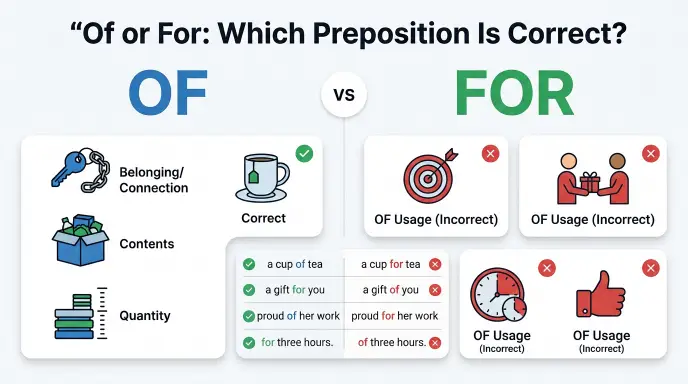
In simple terms, of often shows belonging, connection, composition, amount, or a relationship between two things.
For commonly shows purpose, intended use, benefit, duration, reason, or the person who receives something. For example, we say “the cover of the book,” but “a gift for my friend.”
The confusion usually comes from sentences where both words seem possible at first. English learners may also translate prepositions directly from their first language, which can lead to errors.
This guide explains the difference between of or for, shows practical examples, covers common mistakes, and gives you a simple way to choose the right preposition.
Of or For: The Quick Answer You Need
Of usually connects one thing with another by showing belonging, relationship, content, amount, or composition. For usually shows purpose, intended use, benefit, duration, reason, or a recipient.
Examples:
- The pages of the book are damaged.
- This gift is for Sarah.
- A glass of water is on the table.
- I waited for two hours.
- She is proud of her work.
- This tool is for cutting wood.
The key is to focus on the relationship between the words, not simply memorize one translation for each preposition. Oxford and Cambridge both list many distinct uses for these two words.
Of or For: Quick Answer
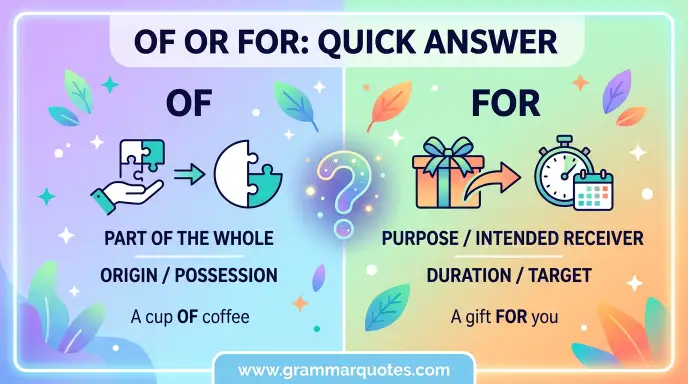
Here is the easiest way to remember the difference:
- Use of when you are connecting something to what it belongs to, contains, consists of, or relates to.
- Use for when you are showing who something is intended for, what it is used for, why something happens, or how long something lasts.
- Of often answers questions such as “whose?”, “what kind?”, or “what does it contain?”
- For often answers “for whom?”, “for what purpose?”, “why?”, or “how long?”
Compare:
| Sentence | Why? |
| The door of the house is open. | Shows a relationship. |
| I bought flowers for my mother. | Shows the intended recipient. |
| A cup of tea | Shows contents. |
| A machine for making coffee | Shows purpose. |
| She is afraid of spiders. | Fixed adjective + preposition combination. |
| We stayed there for three days. | Shows duration. |
These patterns reflect the standard dictionary uses of of and for.
What Does Of Mean?
Of is a preposition with many uses. It often connects a person, thing, quality, amount, or concept to another noun.
Oxford lists uses of of for relationships, belonging, contents, measurements, groups, position, and noun phrases formed from verbs.
1. Showing belonging or relationship
- The roof of the house
- The name of the student
- The manager of the company
- The capital of France
Here, of creates a relationship between two nouns.
2. Showing contents
- A glass of water
- A bowl of rice
- A cup of coffee
- A bottle of juice
The second noun tells you what is inside the first.
3. Showing amount or quantity
- A group of students
- A pair of shoes
- A lot of people
- Two kilos of apples
4. After certain adjectives and verbs
Some English expressions naturally require of.
- proud of
- afraid of
- tired of
- aware of
- think of
- take care of
For example:
She is proud of her son.
You cannot normally replace of with for in these fixed combinations.
What Does For Mean?
For is also a highly flexible preposition. It commonly expresses purpose, benefit, intended recipients, reason, duration, exchange, and support.
1. Showing the intended recipient
- This present is for you.
- I bought a book for my sister.
- There is a message for the manager.
The noun after for is the person or thing intended to receive something.
2. Showing purpose
- A knife for cutting bread
- A room for meetings
- Medicine for headaches
- A website for students
Oxford specifically identifies purpose or function as an important use of for.
3. Showing duration
- We stayed for three days.
- She worked there for five years.
- I waited for an hour.
Cambridge notes that for is used with a period of time to describe duration.
4. Showing a reason or cause
- He was punished for cheating.
- She thanked me for helping.
- The city is famous for its food.
5. Showing support
- I voted for the proposal.
- Are you for or against the plan?
- They are fighting for their rights.
So, for is strongly connected with ideas such as purpose, benefit, reason, duration, and support.
The Origin of For and Of
Both of and for are very old English words.
According to Oxford, of comes from Old English and has Germanic origins. It is related to forms found in Dutch and German and ultimately connects to an older Indo European root.
For also comes from Old English. Oxford describes it as probably developing from a Germanic preposition meaning “before” in place or time. It is related to German für and the English word fore.
Over centuries, their uses expanded and became part of many fixed English expressions. That is one reason modern learners cannot always choose a preposition by translating it word for word.
For example:
- proud of
- famous for
- afraid of
- suitable for
- tired of
- ready for
These combinations are best learned as natural English patterns.
British English vs American English
There is no major British versus American spelling difference between of and for. Both varieties use these prepositions in broadly the same ways.
The important differences are usually caused by context, fixed expressions, vocabulary, or sentence structure rather than regional spelling.
| British English | American English | Example |
| of | of | the color of the car |
| for | for | a gift for my friend |
| of | of | a cup of tea |
| for | for | a tool for cooking |
| of | of | proud of her work |
| for | for | famous for its beaches |
Both British and American English use of to express relationships, contents, and quantities. Both use for for purposes, recipients, duration, and many other meanings.
What about Canada and Australia?
Canadian and Australian English also generally follow the same core patterns.
For international writing, the safest approach is not to treat of and for as regional alternatives. Instead, learn the relationship that each preposition expresses.
Which Version Should You Use?
Unlike words such as color/colour or traveling/travelling, of and for do not normally have a US versus UK spelling choice.
Use them according to meaning.
United States
Use the standard English patterns:
- proud of
- famous for
- a piece of paper
- a present for John
United Kingdom
The same basic rules apply:
- afraid of
- responsible for
- a group of people
- a room for guests
Canada and Australia
Standard usage is also broadly the same.
International English
If you are writing for a global audience, focus on clear sentence structure rather than trying to choose based on nationality.
Academic writing
Academic writing often contains both prepositions:
- the effects of climate change
- evidence of a problem
- a method for measuring results
- a reason for the change
The correct choice depends on the relationship being expressed.
Business writing
Business English also uses both naturally:
- the cost of the service
- a plan for growth
- the results of the meeting
- a request for information
Common Mistakes with Of or For
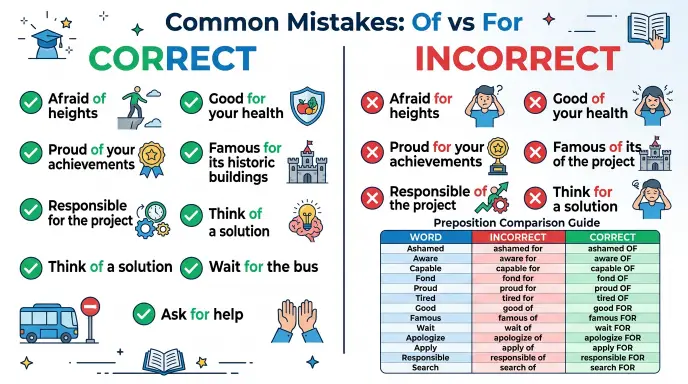
The biggest problem is treating of and for as interchangeable. They are not.
Mistake 1: Using “for” to show contents
Incorrect:
A glass for water.
This can mean a glass intended to be used for water, but it does not naturally mean that the glass currently contains water.
Correct:
A glass of water.
Why?
Of identifies the contents.
Memory tip:
of = what is inside
Mistake 2: Using “of” for a recipient
Incorrect:
I bought this gift of my sister.
Correct:
I bought this gift for my sister.
Why?
The sister is the intended recipient, so for is appropriate.
Memory tip:
for = intended for someone
Mistake 3: Confusing purpose with contents
Compare:
A bottle of water.
This tells us what the bottle contains.
A bottle for water.
This tells us what the bottle is intended to hold.
That small difference can change the meaning.
Mistake 4: Changing a fixed expression
Incorrect:
She is proud for her achievement.
Correct:
She is proud of her achievement.
The adjective proud normally takes of.
Other common combinations include:
- afraid of
- tired of
- aware of
- capable of
Mistake 5: Using “of” instead of “for” with duration
Incorrect:
I lived there of five years.
Correct:
I lived there for five years.
Use for with a period of time when you describe duration.
Of or For in Everyday Examples
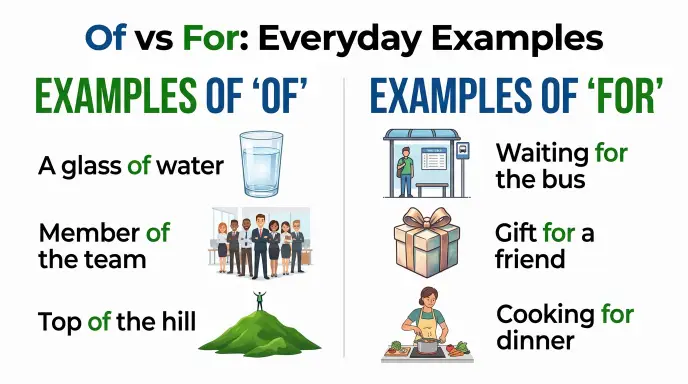
Seeing the words in real sentences makes the distinction easier.
Emails
Thank you for your email.
I have attached a copy of the report.
The first uses for to identify the reason for thanks. The second uses of to identify the thing being copied.
Business Writing
We are looking for a new supplier.
The cost of the service has increased.
This system is designed for small businesses.
News Headlines
The cause of the accident remains unknown.
New plans for the city announced.
Blogs
The benefits of regular exercise are widely discussed.
A simple guide for beginners can help.
Social Media
A photo of my new workspace.
A useful tool for students.
Academic Writing
The effects of social media require further study.
A framework for analyzing the results was developed.
Daily Conversation
Can I have a cup of coffee?
Is this seat for me?
What are you afraid of?
What did you buy that for?
These examples show why meaning matters more than trying to memorize one simple translation.
Google Trends & Modern Usage
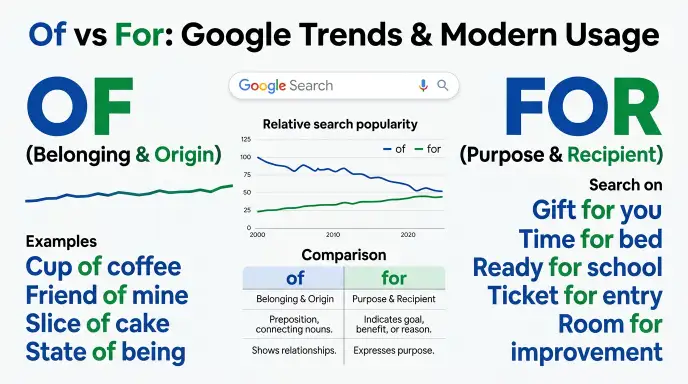
People frequently search of or for because English prepositions are difficult to translate directly. A learner may know the basic meaning of both words but still struggle when a particular verb, adjective, or noun requires one specific preposition.
Searches around this topic are especially likely to involve questions such as:
- Is it “proud of” or “proud for”?
- Is it “reason of” or “reason for”?
- Should I say “a picture of” or “a picture for”?
- Is “famous of” correct?
- What is the difference between “for” and “of”?
These questions are not mainly about British versus American English. They are usually about meaning, collocation, and sentence structure.
Modern dictionaries show that both words have many uses. Oxford lists numerous meanings for of and for, while Cambridge separately explains functions such as purpose, duration, recipients, reason, and exchange for for.
Exact search volume figures should not be assumed without current keyword data. However, the continued difficulty of these prepositions is understandable because both are among the most common words in English and appear in many different grammatical patterns.
Quick Comparison Table
| Version | Meaning | Correct? | Region | Example |
| of | Belonging or relationship | Yes | All major varieties | The name of the company |
| of | Contents | Yes | All major varieties | A cup of tea |
| of | Quantity or group | Yes | All major varieties | A group of students |
| of | Connection after certain adjectives | Yes | All major varieties | Proud of her work |
| for | Intended recipient | Yes | All major varieties | A gift for Ali |
| for | Purpose | Yes | All major varieties | A tool for cutting |
| for | Duration | Yes | All major varieties | For three hours |
| for | Reason or cause | Yes | All major varieties | Thank you for helping |
| for | Support | Yes | All major varieties | Vote for the proposal |
Key Takeaways
- Of and for are both prepositions, but they usually express different relationships.
- Use of for belonging, connection, contents, quantity, and many fixed expressions.
- Use for for purpose, recipients, duration, reason, benefit, and support.
- “A glass of water” describes contents.
- “A glass for water” describes intended use.
- “Proud of” is correct, while “proud for” is normally incorrect when expressing personal pride.
- British, American, Canadian, and Australian English generally use the same core rules.
- The best way to master these words is to learn common word combinations in context.
FAQs About Of or For
Q1: What is the main rule for using “of” vs “for”? Ans: Use “of” to show possession, relationships, or contents (e.g., a map of the city). Use “for” to show purpose, duration, or benefit (e.g., a map for the trip).
Q2: Is it “thanks of” or “thanks for”? Ans: The standard English expression is “thanks for” (e.g., thanks for your help). “For” correctly points to the reason or cause of your gratitude.
Q3: Should I say “afraid of” or “afraid for”? Ans: Both are correct but mean different things. Say “afraid of” when introducing a fear (afraid of spiders), and “afraid for” when caring about someone’s safety (afraid for his safety).
Q4: When do I use “for” instead of “since”? Ans: Use “for” to express total duration (for 5 hours). Use “since” to mark a specific starting point in time (since 5 PM).
Q5: What is the difference between “a photo of me” and “a photo for me”? Ans: “A photo of me” means you are the subject inside the picture. “A photo for me” means the photo was taken or given as a gift intended for you.
Q6: Is it “responsible of” or “responsible for”? Ans: Use “responsible for” when referring to duties or obligations (e.g., she is responsible for the project).
Q7: Can “of” be used to show purpose? Ans: No. “Of” connects origin, possession, or parts of a whole. Purpose, reason, or target destination are always expressed using “for.”
Q8: How do I choose between “of” and “for” in daily writing? Ans: Ask yourself if you are describing belonging/contents (use of) or intended outcome/benefit (use for). Memorizing standard adjective prepositions also speeds up accuracy.
Conclusion
The choice between of or for becomes much easier when you stop treating them as interchangeable words. Of usually creates a relationship between things. It can show belonging, contents, quantity, connection, or the object of certain adjectives and verbs. For, on the other hand, often points toward a purpose, recipient, benefit, reason, duration, or intended use.
For example, “a bottle of water” tells you what the bottle contains, while “a bottle for water” tells you what the bottle is designed to hold. Likewise, we say “proud of her work” but “thankful for her help.” These patterns are based on standard English usage documented by major dictionaries.
There is no major British versus American choice here. The same basic rules work across major varieties of English. When in doubt, look at the relationship you want to express and check the common word combination.
Remember: “of” connects, while “for” points toward purpose, benefit, or time.
Discover More Article!
Salem or Roofing: What Does It Mean?
Oases or Oasis: Meaning, Difference, and Correct Usage
GMT or UTC: What’s the Difference?

Ethan Parker is an English-language writer known for his interest in words, language, and clear communication. His work focuses on making everyday English easier to understand through simple explanations and practical examples.