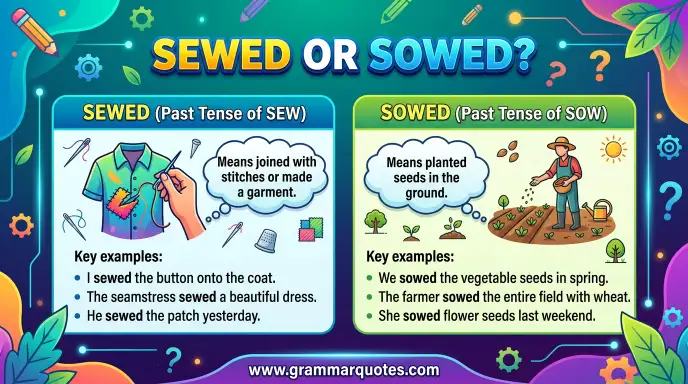
Sewed relates to stitching clothes, fabric, or other materials with a needle and thread. For example, “She sewed a button onto her shirt.”
Sowed relates mainly to planting seeds in the ground. It can also be used figuratively to describe causing or spreading something, such as an idea, feeling, or problem. For example, “The farmer sowed the seeds in the field.”
This guide explains sewed or sowed, their meanings, origins, grammar, pronunciation, common mistakes, everyday examples, and the easiest ways to remember which word to use.
Sewed or Sowed : Quick Answer
Both sewed and sowed are correct, but they are past tense forms of different verbs.
- Sewed → past tense of sew → stitched something
- Sowed → past tense of sow → planted seeds
Examples
She sewed a dress for her daughter.
The farmer sowed wheat seeds in the field.
So, if you are talking about needle and thread, use sewed.
If you are talking about planting seeds, use sowed.
Definition and Meaning
What Does Sewed Mean?
Sewed is the past tense of sew. It means to join or repair fabric, cloth, or other materials using a needle and thread.
Examples:
- She sewed a button onto my shirt.
- My grandmother sewed a beautiful dress.
- He sewed the torn fabric together.
What Does Sowed Mean?
Sowed is the past tense of sow. It means to put seeds into the ground so they can grow.
Examples:
- The farmer sowed the seeds in spring.
- They sowed wheat across the field.
- We sowed the vegetable seeds yesterday.
Sowed can also have a figurative meaning.
His actions sowed confusion among the students.
Here, sowed means caused or spread confusion.
The Origin of Sewed and Sowed
Sewed comes from the verb sew, an old English word related to stitching and joining materials with a needle and thread.
Sowed comes from sow, a much older word associated with planting seeds in the ground.
Although the words look and sound somewhat similar, they developed from different verbs. Their meanings have remained distinct for centuries.
This is why sewed and sowed should not be treated as spelling variations of the same word.
Sewed vs Sowed: The Main Difference
The easiest way to understand the difference is to remember the action involved.
| Word | Base verb | Meaning | Example |
| Sewed | Sew | Stitched with a needle and thread | She sewed the dress. |
| Sowed | Sow | Planted seeds | He sowed the seeds. |
Think of it this way:
Sewed = stitching
Sowed = planting
That simple connection can help you choose the correct word quickly.
Sewed: When Should You Use It?
Use sewed when someone stitched something using a needle and thread.
1. Sewing Clothes
She sewed a new shirt for her son.
2. Repairing Fabric
He sewed the hole in his jacket.
3. Making Something
My aunt sewed a beautiful curtain.
4. Adding a Button
She sewed a button onto the coat.
5. Sewing by Hand
The tailor sewed the fabric by hand.
Is “Sewed” the Past Tense of Sew?
Yes.
Sew → sewed
However, sewn is also commonly used as the past participle of sew, especially with auxiliary verbs such as have, has, and had.
Examples:
She sewed the dress yesterday.
She has sewn the dress already.
So, sewed is a normal simple past form, while sewn is often used as a past participle.
Sowed: When Should You Use It?
Use sowed when talking about planting seeds.
1. Planting Seeds
The farmer sowed the seeds before the rain.
2. Growing Crops
They sowed wheat in the field.
3. Gardening
We sowed tomato seeds in the garden.
4. Planting Flowers
She sowed flower seeds around the house.
5. Figurative Meaning
Sowed can also describe spreading or causing something.
The rumor sowed fear among the people.
In this sentence, no seeds are involved. The word is being used figuratively.
Is “Sowed” the Past Tense of Sow?
Yes.
Sow → sowed
The past participle can also be sown.
Examples:
The farmer sowed the seeds yesterday.
The seeds have been sown.
So the basic forms are:
Sow → sowed → sown
Sewed or Sowed in Everyday Examples
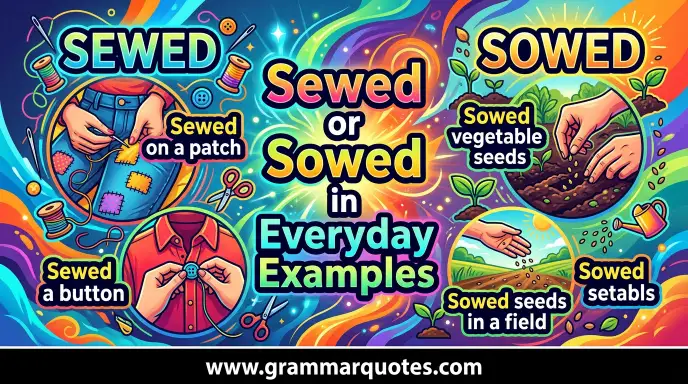
Here are some easy examples to understand the difference:
- She sewed a button onto her shirt.
- The farmer sowed wheat seeds.
- My grandmother sewed the torn cloth.
- They sowed seeds before the rainy season.
- He sewed a pocket onto the bag.
- The gardener sowed flower seeds.
- She sewed the fabric carefully.
- The farmer sowed the field with seeds.
- His speech sowed doubt among the audience.
- My mother sewed the broken seam.
Sewed or Sowed: Common Mistakes
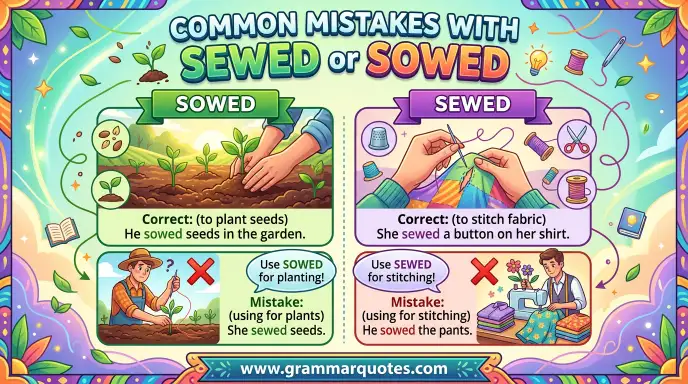
Mistake 1: Using Sowed for Sewing
❌ She sowed my shirt.
✅ She sewed my shirt.
The action involves stitching, so sewed is correct.
Mistake 2: Using Sewed for Planting
❌ The farmer sewed the seeds.
✅ The farmer sowed the seeds.
The action involves planting, so sowed is correct.
Mistake 3: Confusing Sow With Sew
❌ He will sew the seeds tomorrow.
✅ He will sow the seeds tomorrow.
Mistake 4: Confusing Sewed With Sown
These forms belong to different verbs:
- sewed → sew
- sown → sow
For example:
She sewed the fabric.
The seeds were sown in the field.
British English vs American English
There is no major British American spelling difference between sewed and sowed.
Both British English and American English use:
- sewed for the past tense of sew
- sowed for the past tense of sow
Examples:
British English:
She sewed the dress.
American English:
She sewed the dress.
Likewise:
British English:
The farmer sowed the seeds.
American English:
The farmer sowed the seeds.
The main challenge is not regional spelling. It is choosing the correct verb based on the meaning.
Sewed or Sowed: Which One Should You Use?
Ask yourself one simple question:
What action happened?
If someone used a needle and thread, choose sewed.
If someone planted seeds, choose sowed.
Quick Memory Trick
Sewed → Sewing
The two words are closely connected in spelling.
Sowed → Sow → Seeds
Think of sow when you think about planting.
Simple Rule
Clothes are sewed. Seeds are sowed.
This is not a rule for every figurative use, but it works well for remembering the basic difference.
Sewed or Sowed in Formal Writing
Both words are standard English and can be used in formal writing.
Sewed may appear in:
- clothing descriptions
- historical writing
- craft articles
- personal stories
- instructions
Sowed may appear in:
- farming articles
- gardening guides
- agricultural reports
- literature
- academic writing
The figurative form of sowed is also common in formal and literary writing:
The decision sowed uncertainty among investors.
Sewed vs Sowed Pronunciation
Although sewed and sowed are spelled differently, their pronunciation can vary by accent and word usage.
Sewed is commonly pronounced like “sohd.”
Sowed is also commonly pronounced like “sohd.”
This means they can be homophones or near homophones in common English pronunciation.
That is one reason people often confuse them when writing.
The best way to choose the correct spelling is to focus on the meaning, not just the sound.
Sewed or Sowed: Comparison Table
| Feature | Sewed | Sowed |
| Base verb | Sew | Sow |
| Meaning | Stitched material | Planted seeds |
| Past tense | Sewed | Sowed |
| Related noun/action | Sewing | Sowing |
| Common object | Cloth, clothes, fabric | Seeds, crops |
| Figurative use | Less common | Common |
| British English | Sewed | Sowed |
| American English | Sewed | Sowed |
| Example | She sewed the dress. | He sowed the seeds. |
Sewed or Sowed : Google Trends & Usage
People often search “sewed or sowed” because the two words have similar pronunciations but different meanings and spellings.
Search interest can increase when learners encounter sentences involving sewing, farming, gardening, or figurative expressions such as “sowed doubt.”
Sewed is closely associated with clothing, tailoring, crafts, and fabric repair.
Sowed is more closely associated with agriculture, gardening, farming, and expressions involving the spreading or creation of something.
Because the words serve different grammatical and semantic roles, understanding their meanings is more useful than memorizing them as simple spelling alternatives.
People Also Ask Questions About Sewed or Sowed
1. Is it sewed or sowed?
Both are correct words, but sewed means stitched, while sowed means planted seeds.
2. What is the past tense of sew?
The simple past tense of sew is sewed.
3. What is the past tense of sow?
The simple past tense of sow is sowed.
4. Is sowed the past tense of sew?
No. Sowed is the past tense of sow, not sew.
5. Is sewed the past tense of sow?
No. Sewed is the past tense of sew.
6. What does sewed mean?
Sewed means stitched something using a needle and thread.
7. What does sowed mean?
Sowed means planted seeds in the ground. It can also mean spread or caused something figuratively.
8. Are sewed and sowed homophones?
They are commonly pronounced alike or very similarly in many varieties of English.
9. What is the difference between sewed and sown?
Sewed comes from sew, while sown is a past participle of sow.
10. How can I remember sewed and sowed?
Remember: sewed = stitching, while sowed = seeds.
Frequently Asked Questions
Is “sewed” a correct word?
Yes. Sewed is the standard simple past tense of sew.
Is “sowed” a correct word?
Yes. Sowed is the standard simple past tense of sow.
Can I say “I sewed the seeds”?
No. If you mean planting seeds, use sowed.
I sowed the seeds.
Can I say “I sowed my shirt”?
No. If you mean stitching your shirt, use sewed.
I sewed my shirt.
What is the difference between sewed and sewn?
Sewed is the simple past tense of sew. Sewn is commonly used as the past participle.
She sewed the dress yesterday.
She has sewn the dress.
What is the difference between sowed and sown?
Sowed is the simple past tense of sow, while sown is commonly used as the past participle.
They sowed the seeds.
The seeds have been sown.
Are sewed and sowed pronounced the same?
In many accents, yes, they are pronounced the same or almost the same. This makes their meanings especially important when writing.
Final Comparison: Sewed or Sowed
Sewed and sowed are both correct English words, but they should never be used interchangeably.
Use sewed when talking about stitching fabric, clothing, or another material with a needle and thread.
She sewed a button onto her shirt.
Use sowed when talking about planting seeds.
The farmer sowed the seeds in the field.
The words are easy to confuse because they are pronounced the same or similarly in many accents. However, their base verbs are different: sewed comes from sew, while sowed comes from sow.
A useful memory trick is simple:
Sewed = sewing
Sowed = seeds
Also remember that sewn and sown are common past participles of sew and sow, respectively.
Once you connect each word with its action, the difference becomes much easier to remember.
Conclusion
The difference between sewed and sowed is mainly about meaning. Sewed is the simple past tense of sew and refers to stitching something with a needle and thread. Sowed is the simple past tense of sow and refers mainly to planting seeds.
For example, you sewed a shirt but sowed seeds in a garden. The two words can sound the same or very similar, which explains why they are often confused in writing.
Remember the easiest rule: sewed is connected with sewing, while sowed is connected with seeds.
It is also useful to remember their related past participles: sewn comes from sew, and sown comes from sow. Both British and American English use the same spellings.
When you focus on the action rather than the sound, choosing between sewed or sowed becomes simple and reliable.
Discover More Articles!
Recognisable or Recognizable: Which Is Correct?
Purple or Nectar Explained: Meaning, Uses, and Examples(2026)
Me vs I: What Is the Difference and When Should You Use Each?

Ethan Parker is an English-language writer known for his interest in words, language, and clear communication. His work focuses on making everyday English easier to understand through simple explanations and practical examples.