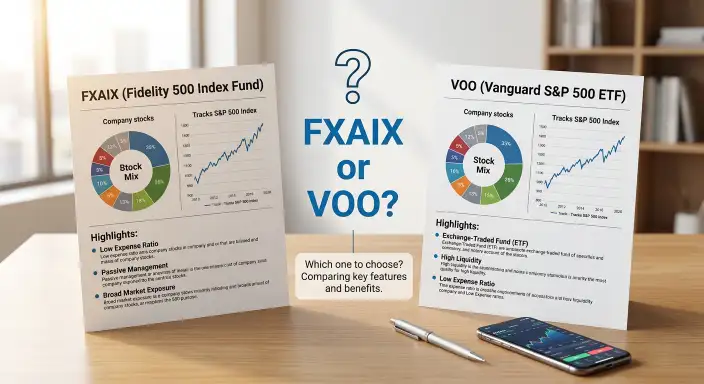
FXAIX and VOO are two popular index funds that aim to track the S&P 500, an index of large U.S. companies. Both give investors exposure to many well known businesses through a single fund. However, they differ in how they are structured, how investors buy and sell shares, and how their fees work.
FXAIX is the Fidelity 500 Index Fund, while VOO is the Vanguard S&P 500 ETF. Since both follow the same broad market index, their long term results are often similar, although small differences can occur.
The main difference is that FXAIX is a mutual fund, while VOO is an exchange traded fund (ETF). This affects how each fund trades, how transactions are processed, and how investors manage purchases.
In this guide, you will learn the meaning of FXAIX and VOO, compare their fees and features, explore their similarities and differences, and understand what factors matter when evaluating them. You will also find simple examples, common misconceptions, and answers to frequently asked questions.
FXAIX vs VOO: Quick Answer
VOO and FXAIX both seek to track the S&P 500, but they are offered by different investment companies and use different fund structures.
- FXAIX: A mutual fund managed by Fidelity.
- VOO: An exchange traded fund offered by Vanguard.
- Main similarity: Both provide exposure to large U.S. companies represented in the S&P 500.
- Main difference: FXAIX is a mutual fund, while VOO trades on a stock exchange like a share.
FXAIX has a reported expense ratio of 0.015%, while VOO has a reported expense ratio of 0.03% in the official fund information cited below. Fees can change, so check the latest documents before making a decision. <Cite refs={[“turn792322search4″,”turn792322search10”]}/>
Neither fund is guaranteed to make money. Both can lose value when the U.S. stock market declines.
Definition and Meaning
What Is FXAIX?
FXAIX is the ticker symbol for the Fidelity 500 Index Fund.
It is a mutual fund designed to track the performance of the S&P 500. This index represents many large publicly traded companies in the United States.
The fund allows investors to gain exposure to a broad group of companies without purchasing each stock separately. Its reported expense ratio is 0.015%, and Fidelity lists no minimum initial investment for the fund. <Cite refs={[“turn792322search0″,”turn792322search24”]}/>
Example: Instead of buying shares of many individual companies, an investor may use FXAIX to gain exposure to the S&P 500 through one fund.
What Is VOO?
VOO is the ticker symbol for the Vanguard S&P 500 ETF.
It also seeks to track the S&P 500, providing exposure to large U.S. companies through one investment fund.
Unlike FXAIX, VOO is an ETF. Its shares trade on a stock exchange during market hours, and its market price can change throughout the trading day. Vanguard reports an expense ratio of 0.03%. <Cite refs={[“turn792322search10″,”turn792322search11”]}/>
Example: An investor with a brokerage account can generally buy VOO in the same way they buy a publicly traded stock.
The Origin of FXAIX and VOO
The Background of FXAIX
FXAIX is offered by Fidelity Investments. The underlying Fidelity 500 Index Fund began in 1988 and aims to match the total return of U.S. stocks represented by the S&P 500. <Cite refs={[“turn792322search24”]}/>
Its mutual fund structure is often convenient for investors who want to make regular contributions through a platform that supports the fund.
The Background of VOO
VOO is offered by Vanguard. The Vanguard S&P 500 ETF began trading in 2010 and is designed to track a benchmark of large cap U.S. stocks. <Cite refs={[“turn792322search11”]}/>
Its ETF structure allows investors to buy and sell shares through a brokerage account during market hours.
FXAIX or VOO: Main Differences
1. Fund Structure
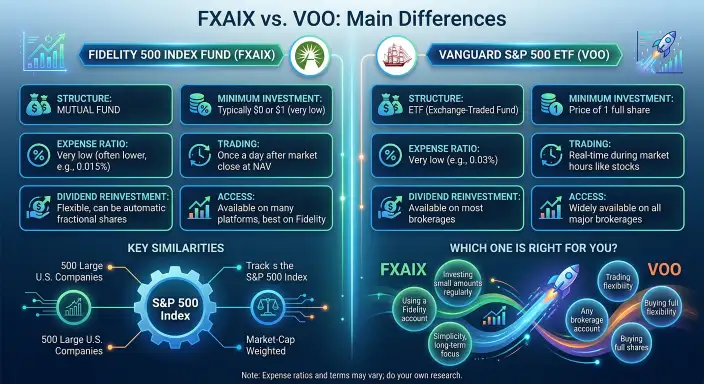
FXAIX is a mutual fund. Mutual fund orders are generally processed at the fund’s net asset value calculated after the market closes.
VOO is an ETF. Its shares trade on an exchange throughout the trading day, so the price may move as buyers and sellers trade.
This is one of the most important differences between the two funds.
2. Expense Ratio
An expense ratio is the annual operating cost of a fund expressed as a percentage of the money invested.
| Feature | FXAIX | VOO |
| Fund company | Fidelity | Vanguard |
| Fund type | Mutual fund | ETF |
| Reported expense ratio | 0.015% | 0.03% |
| Main index | S&P 500 | S&P 500 |
| Trading method | Mutual fund orders | Exchange trading |
The expense ratios shown here come from the cited fund information and may change over time. <Cite refs={[“turn792322search4″,”turn792322search10”]}/>
The difference is small. For example, on a hypothetical $10,000 balance, a 0.015% annual expense ratio equals about $1.50 per year, while 0.03% equals about $3 per year. These are estimates of fund operating expenses, not a promise of total costs.
3. Buying and Selling Shares
FXAIX transactions are generally processed once per business day after the market closes. Investors do not choose an intraday trading price.
VOO can be bought or sold during market hours through a brokerage account. Its market price may be slightly above or below its net asset value.
The best structure depends on how an investor prefers to manage transactions.
4. Minimum Investment and Fractional Shares
The minimum purchase depends on the brokerage platform and its rules.
Fidelity lists no minimum initial investment for FXAIX, although account requirements and transaction conditions may still apply. <Cite refs={[“turn792322search24”]}/>
VOO’s minimum purchase depends on its share price and if the brokerage offers fractional ETF shares. Some platforms allow investors to purchase a fraction of a share, while others require a full share.
5. Performance
Because FXAIX and VOO both track the S&P 500, their performance is usually close over the same period.
Small differences may come from fund expenses, tracking differences, trading prices, and the timing of distributions.
Past performance does not guarantee future results. It is important to compare returns over matching periods and use the same return method, including reinvested dividends when appropriate.
FXAIX vs VOO: Similarities
Both Track the S&P 500
Both funds aim to follow the performance of the S&P 500. This gives investors exposure to a range of large U.S. companies across different industries.
Both Provide Diversification
Owning either fund spreads an investment across many companies rather than relying on one company’s performance.
However, both funds concentrate on large U.S. stocks. They do not provide complete protection against market losses or the same diversification as a global stock and bond portfolio.
Both Have Low Fund Expenses
Both are known for low expense ratios compared with many actively managed funds. Even so, investors should consider other possible costs, including brokerage fees, taxes, and trading costs.
Which Is Better: FXAIX or VOO?
There is no single answer for every investor. The better fit depends on the brokerage account, trading preferences, and personal financial circumstances.
When FXAIX May Be a Suitable Fit
FXAIX may suit someone who:
- Uses Fidelity and wants an S&P 500 mutual fund.
- Prefers mutual fund transactions processed once daily.
- Wants to make regular contributions through a platform that supports the fund.
- Values its low reported expense ratio.
When VOO May Be a Suitable Fit
VOO may suit someone who:
- Prefers an ETF that trades during market hours.
- Wants to use a brokerage account that offers VOO.
- Values the flexibility to place exchange traded orders.
- Wants exposure to the S&P 500 through Vanguard’s ETF.
These are general features, not personalized investment recommendations. Availability, account rules, and tax treatment may differ by country and account type.
Common Mistakes When Comparing VOO and FXAIX

Thinking One Always Earns More
Neither fund is guaranteed to outperform the other. Since they track the same index, their results are usually similar, but small differences can occur.
Looking Only at the Expense Ratio
Fees matter, but they are not the only factor. Investors should also consider transaction costs, taxes, account availability, and trading preferences.
Assuming Diversification Removes All Risk
Both funds spread investments across many companies, but they are still exposed to the U.S. stock market. Their values can fall during market downturns.
Comparing Returns Over Different Periods
A one year return should not be compared directly with a five year annualized return. Use the same dates and measurement method for a fair comparison.
Simple Example: FXAIX vs VOO
Imagine two people each have a hypothetical $1,000 to invest and use funds that track the S&P 500.
- One chooses FXAIX through a platform that supports the mutual fund.
- The other chooses VOO through a brokerage account that supports ETF trading.
Both gain exposure to the same broad index. If the index rises, both funds will generally be expected to rise as well, before accounting for small differences. If the index falls, both may lose value.
This example explains how the funds work; it does not predict future returns or guarantee that either investment will be profitable.
Frequently Asked Questions
1. What is the difference between FXAIX and VOO?
FXAIX is Fidelity’s S&P 500 mutual fund, while VOO is Vanguard’s S&P 500 ETF. Both aim to track the same index, but their trading structures differ.
2. Is FXAIX cheaper than VOO?
Based on the cited official information, FXAIX has a 0.015% expense ratio and VOO has a 0.03% expense ratio. Check current fund documents because fees may change. <Cite refs={[“turn792322search4″,”turn792322search10”]}/>
3. Do FXAIX and VOO hold the same stocks?
Both aim to track the S&P 500, so their holdings are broadly similar. Exact holdings and weightings can vary slightly over time.
4. Which fund has better returns?
Neither fund always has better returns. Their performance is generally close because they track the same index, but results can differ slightly over particular periods.
5. Can FXAIX or VOO lose money?
Yes. Both are stock funds, and their values can fall when the market declines. Investors may lose some or all of the money they invest.
6. Is FXAIX a mutual fund or an ETF?
FXAIX is a mutual fund offered by Fidelity.
7. Is VOO a mutual fund or an ETF?
VOO is an exchange traded fund offered by Vanguard.
8. Can someone buy fractional shares of VOO?
Some brokerage platforms allow fractional ETF purchases, while others require whole shares. Check the rules of the specific platform.
9. Are FXAIX and VOO suitable for beginners?
Their broad exposure to large U.S. companies can make them easier to understand than picking individual stocks. However, they still carry market risk, and suitability depends on a person’s goals, time horizon, and financial situation.
10. Can an investor own both FXAIX and VOO?
It is possible where the relevant account and platform allow it. However, because both funds track the S&P 500, owning both usually creates substantial overlap rather than adding much diversification.
Conclusion
FXAIX and VOO are two low cost ways to gain exposure to the S&P 500. Both provide access to many large U.S. companies through a single fund, and their investment performance is generally similar because they follow the same index.
The main difference is their structure. FXAIX is a mutual fund from Fidelity, while VOO is an ETF from Vanguard. FXAIX’s reported expense ratio is slightly lower, while VOO offers the flexibility of exchange trading during market hours. The practical choice may depend more on the brokerage platform, transaction preferences, and account rules than on small differences in fees.
Remember that neither fund guarantees a profit. Both are exposed to stock market risk, and their prices can decline. Before making an investment decision, review current fund documents, understand the risks, and consider your financial goals and circumstances.
Discover More Articles!
Wasp or Bee: How to Tell the Difference
Awakened or Awoken: Which Word Is Correct?(2026)
Hydrate or Die: Meaning, Usage, and What It Really Means

Ethan Parker is an English-language writer known for his interest in words, language, and clear communication. His work focuses on making everyday English easier to understand through simple explanations and practical examples.