Awakened and awoken are both correct forms of the verb awake. They can describe waking up from sleep or becoming aware of something. However, they are not always used in exactly the same way. Understanding their grammar can help you choose the right word in everyday conversations and formal writing.
Imagine telling a friend about last night’s storm. You might say, “The loud thunder awakened me,” or “I had awoken before the alarm rang.” Both sentences are correct, but the words follow different grammatical patterns.
Many English learners find these words confusing because they have similar meanings and irregular verb forms. Some people also wonder if one is American English and the other is British English. In this guide, you will learn the meaning, pronunciation, history, and correct usage of both words. You will also find simple examples, common mistakes, comparison tables, and answers to frequently asked questions.
By the end, you will understand when to use awakened or awoken and how to make your English sound more natural.
Awakened or Awoken: Quick Answer
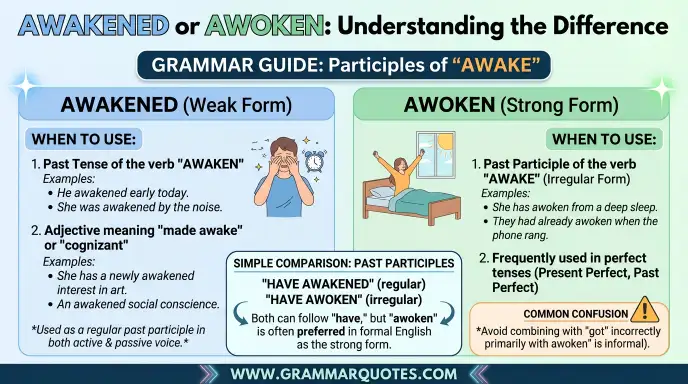
Both awakened and awoken are correct. They are forms of the verb awake, which means to wake up or become aware.
- Awakened: Commonly used as the simple past tense and past participle.
- Awoken: Commonly used as the past participle, especially with helping verbs such as have, has, and had.
Examples:
- The noise awakened the baby.
- I have awoken early every day this week.
- She had awoken before sunrise.
The word awakened is often more common in everyday writing, while awoken can sound more literary or expressive in some contexts. Both are standard English forms.
Definition and Meaning
What Does “Awakened” Mean?
Awakened (verb): The simple past tense or past participle of awaken, meaning to wake someone up or become awake or aware.
Examples:
- The alarm awakened me at six.
- The experience awakened her interest in science.
It can describe physical waking or a change in awareness.
What Does “Awoken” Mean?
Awoken (verb): A past participle of awake, meaning to have become awake or aware.
Examples:
- I have awoken before dawn several times.
- The event had awoken a strong sense of responsibility in him.
Awoken often appears with a helping verb, although its exact use depends on the sentence.
What Is the Difference Between Awake, Awaken, Awakened, and Awoken?
These words belong to related verb forms, but they do not all serve the same grammatical role.
| Word | Form or use | Example |
| Awake | Present form of the verb | I awake early each morning. |
| Awaken | Base form of a verb | Loud sounds can awaken a sleeping person. |
| Awakened | Simple past or past participle of awaken | The sound awakened me. |
| Awoken | Past participle of awake | I have awoken early today. |
Note that awake is also commonly used as an adjective, as in “I am awake.”
The Origin of Awakened and Awoken
Origin of “Awakened”
Awakened comes from the verb awaken, which developed from awake with the addition of the suffix en. The ending ed forms its regular past tense and past participle.
The word can refer to physical waking or to the beginning of awareness, understanding, or interest.
Origin of “Awoken”
Awoken comes from the irregular verb awake. English has kept several irregular verb patterns from older forms of the language.
The forms awake, awoke, and awoken follow an irregular pattern similar to speak, spoke, and spoken.
Historical Development
Old English (450–1100)
The ancestor of awake existed in Old English. Related forms described waking from sleep or being awake.
Middle English (1100–1500)
The verb continued to develop as English changed its spelling and grammar. Different verb forms gradually became established in use.
Modern English (1500–Present)
Both awakened and awoken remain in modern English. Awakened follows the regular ed pattern of awaken, while awoken is an irregular form of awake.
British English vs American English
Are Awakened and Awoken Different in British and American English?
Both forms are accepted in British and American English. The difference is mainly grammatical and stylistic, rather than a strict regional spelling rule.
| Feature | British English | American English |
| Awakened | Correct | Correct |
| Awoken | Correct | Correct |
| Main meaning | Woke up or became aware | Woke up or became aware |
| Past tense of awaken | Awakened | Awakened |
| Past participle of awake | Awoken is used | Awoken is used |
| Regional spelling difference | No major difference | No major difference |
Neither word belongs exclusively to one variety of English.
When Should You Use Awakened or Awoken?
Use “Awakened” for a Completed Past Action
Use awakened when describing an action that happened in the past.
Examples:
- The baby awakened when the door closed.
- Her teacher awakened her interest in literature.
- A loud noise awakened everyone in the house.
In these sentences, awakened tells the reader what happened.
Use “Awoken” with Helping Verbs
Awoken is often used as the past participle of awake. It commonly follows have, has, or had.
Examples:
- I have awoken earlier than usual this week.
- She has awoken to the importance of exercise.
- They had awoken before the storm began.
These examples use perfect tenses, which connect an action to another time or event.
Use “Awakened” as a Past Participle Too
Remember that awakened is also a correct past participle. You can use it with helping verbs.
Examples:
- I have awakened early all week.
- She had awakened before the alarm rang.
Therefore, it is incorrect to say that awoken is the only correct choice after have, has, or had.
Use “Awoken” for a Literary or Expressive Tone
In some sentences, awoken may sound more literary or expressive, particularly when describing emotions, memories, or awareness.
Examples:
- A forgotten memory had awoken.
- The speech had awoken hope in the community.
However, awakened also works in these contexts.
Common Mistakes with Awakened and Awoken
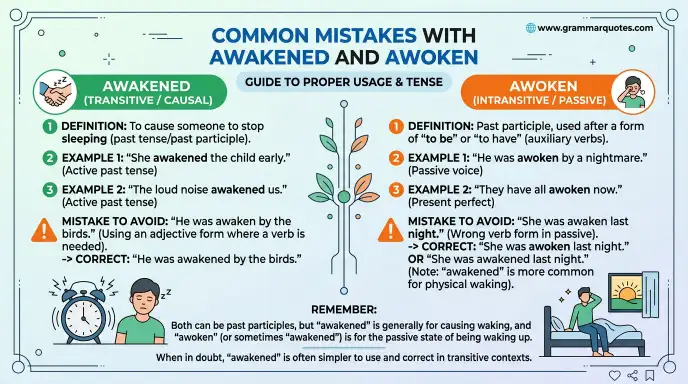
Mistake 1: Thinking Awoken Is Incorrect
Incorrect claim: “Awoken is not a real English word.”
Correct: “I have awoken early today.”
Why? Awoken is a recognized past participle of awake.
Mistake 2: Thinking Awakened Is Only an Adjective
Incorrect claim: “Awakened cannot be used as a verb.”
Correct: “The alarm awakened me.”
Why? Awakened is a correct past tense form of awaken.
Mistake 3: Using Awoken as the Simple Past of Awaken
Awkward in standard usage: “The noise awoken me yesterday.”
Better: “The noise awakened me yesterday.”
Why? Awakened is the usual simple past of awaken. Awoke is the simple past form of awake.
Mistake 4: Assuming Only One Form Works with “Have”
Incorrect claim: “I have awakened” is wrong.
Correct: “I have awakened early.”
Also correct: “I have awoken early.”
Why? Both awakened and awoken can be used as past participles, depending on the verb and sentence.
Mistake 5: Confusing Awoke with Awoken
- Awoke: The simple past of awake.
- Awoken: The past participle of awake.
Examples:
- I awoke at sunrise.
- I have awoken at sunrise all week.
Awakened and Awoken in Everyday Examples
In Daily Conversation
- Awakened: The phone ringing awakened me.
- Awoken: I have awoken early for the last three days.
In School Writing
- Awakened: The book awakened my interest in history.
- Awoken: She had awoken before her classmates arrived.
For Literature
- Awakened: The journey awakened a sense of wonder.
- Awoken: A long forgotten memory had awoken.
In News and Formal Writing
- Awakened: The incident awakened public concern.
- Awoken: The crisis had awoken new questions about safety.
In Figurative Language
Both words can describe becoming aware of a feeling, idea, or problem.
- The discussion awakened my curiosity.
- The experience has awoken a new sense of purpose.
Awakened vs Awoken: Comparison Table
| Feature | Awakened | Awoken |
| Base verb | Awaken | Awake |
| Verb type | Regular past form of awaken | Irregular past participle of awake |
| Simple past use | Yes | Not usually in standard modern usage |
| Past participle use | Yes | Yes |
| Common example | The sound awakened me. | I have awoken early. |
| Used with have | Yes | Yes |
| Used with had | Yes | Yes |
| Meaning | Woke up or became aware | Woke up or became aware |
| British English | Correct | Correct |
| American English | Correct | Correct |
A Simple Trick to Remember the Difference
Remember these verb patterns:
- Awaken → awakened → awakened
- Awake → awoke → awoken
Use awakened for the simple past of awaken.
Example: “The noise awakened me.”
Use awoken as the past participle of awake, commonly with a helping verb.
Example: “I have awoken early.”
You can also use awakened as a past participle, so both “I have awakened” and “I have awoken” can be correct.
Frequently Asked Questions
1. Is awakened or awoken correct?
Both are correct. Awakened is the regular past form of awaken, while awoken is the past participle of awake.
2. What is the difference between awakened and awoken?
They have similar meanings, but their verb patterns differ. Awakened is the past tense and past participle of awaken. Awoken is the past participle of awake.
3. Is awoken grammatically correct?
Yes. For example, “I have awoken early today” is grammatically correct.
4. Is awakened the past tense of awake?
The simple past of awake is usually awoke. Awakened is the simple past of the related verb awaken.
5. Can I say “I have awakened”?
Yes. Awakened is a valid past participle, so “I have awakened” is correct.
6. Can I say “I have awoken”?
Yes. Awoken is the past participle of awake, so this sentence is also correct.
7. Is awoken more British than American?
No strict rule separates them by region. Both forms are used in British and American English.
8. What is the simple past tense of awake?
The simple past tense is usually awoke. Example: “I awoke before sunrise.”
9. What is the past participle of awake?
The past participle is awoken. Example: “She has awoken early.” In modern English, awakened is also used as a past participle of awaken.
10. Which word should I use in formal writing?
Choose the word that matches your verb structure. Use awakened as the simple past of awaken and awoken as the past participle of awake. Both can be appropriate in formal writing.
Conclusion
Understanding awakened or awoken becomes easier when you learn the verbs behind them. Awakened is the simple past and past participle of awaken. Awoken is the past participle of awake, while awoke is its usual simple past form.
Both awakened and awoken can describe waking from sleep or becoming aware of something. The main difference is how they fit into a sentence, not if one is correct and the other is wrong. You can write “The noise awakened me,” “I have awakened early,” or “I have awoken early.” All three are correct.
For everyday writing, focus on the verb form and the tense you need. With regular practice, you will recognize these patterns more easily and make fewer grammar mistakes.
Discover More Articles!
Flea or Lice: Key Differences, Meaning, and How to Tell Them Apart
Orthopedics or Orthopaedics: Which Spelling Is Correct?(2026)
Bollard or Ballard: Which Spelling Is Correct?(2026)

Ethan Parker is an English-language writer known for his interest in words, language, and clear communication. His work focuses on making everyday English easier to understand through simple explanations and practical examples.