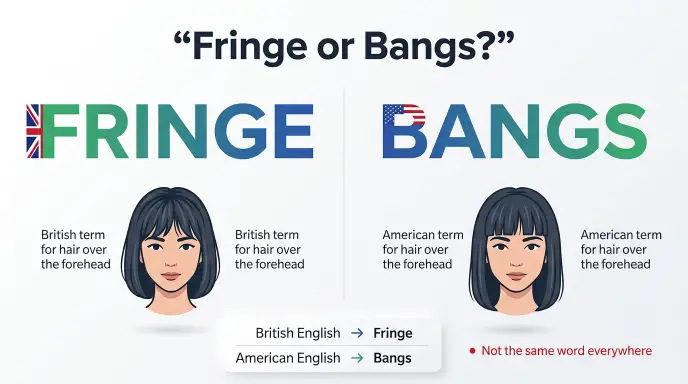
When talking about hair that falls across the forehead, fringe or bangs can both be correct. The difference is mainly regional: bangs is the usual American English term, while fringe is preferred in British English.
This simple vocabulary difference often confuses English learners because both words describe the same basic hairstyle.
You may see “bangs” in American fashion articles and “fringe” in British or Australian hair guides, even when the haircut itself is identical. The choice is not really about which hairstyle is correct. It is about which variety of English you are using.
In this guide, you will learn what fringe or bangs means, where each term comes from, how British and American English differ, and which word to use in different countries and types of writing. You will also see practical examples, common mistakes, comparison tables, and answers to frequently asked questions.
By the end, choosing between these two terms should be much easier.
Fringe or Bangs: Understanding the Difference in British and American English
The main difference between fringe or bangs is regional English. American speakers usually use bangs, while British speakers generally prefer fringe for the same front section of hair.
The difference also appears in hairstyle names. For example, Americans say curtain bangs and wispy bangs, while British English commonly uses curtain fringe and wispy fringe.
Fringe or Bangs: Quick Answer
The short answer is simple:
- Bangs = American English
- Fringe = British English
- Both refer to hair that hangs over the forehead.
- Neither word is inherently more correct than the other.
- Your choice should match your audience and variety of English.
For example:
American English:
She got her bangs cut yesterday.
British English:
She got her fringe cut yesterday.
American English:
I think curtain bangs would suit you.
British English:
I think a curtain fringe would suit you.
Dictionaries support this regional distinction. Cambridge lists bangs as the US term and gives fringe as the UK equivalent. Oxford likewise identifies fringe as British English and bangs as North American English.
So, if you are writing for an American audience, bangs is normally the natural choice. If you are writing for a British audience, fringe is usually better.
What Does Fringe or Bangs Mean?
Fringe and bangs describe the front section of the hair that is cut shorter than the rest and falls over the forehead.
Cambridge defines bangs as an area of hair hanging over the forehead that is cut shorter than the rest of the hair. Oxford gives essentially the same meaning for fringe.
The terms can cover many different styles, including:
- Straight bangs or fringe
- Curtain bangs or curtain fringe
- Side swept bangs
- Wispy bangs
- Blunt bangs
- Micro bangs
- Curly fringe
- Layered fringe
The important point is that fringe and bangs are usually vocabulary differences, not different hairstyles.
For example, a hairstylist in London may call a hairstyle a curtain fringe, while a stylist in New York may call the same look curtain bangs.
The word fringe also has other meanings in English. It can describe a decorative border made of hanging threads or something located at the outer edge of an area or group.
That is why context matters.
The Origin of Fringe or Bangs
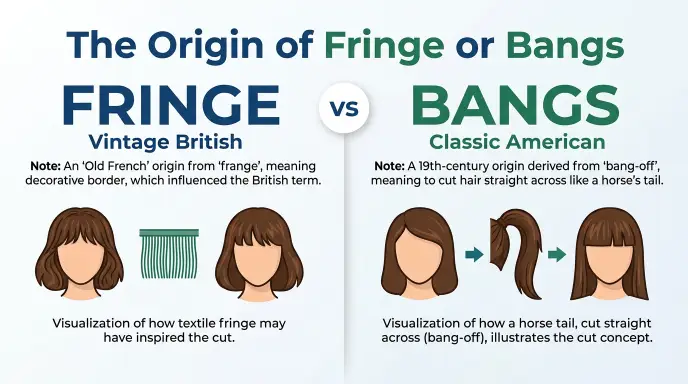
The two terms developed through different linguistic paths.
Where Does “Fringe” Come From?
The hair related use of fringe connects to the broader meaning of a border or edge. The word has roots going back through Middle English and Old French, ultimately connected with Latin fimbria, meaning a fringe, border, or fibers.
The hairstyle meaning makes intuitive sense. The front section of hair forms a kind of border around the forehead.
Today, fringe remains especially common in British English. Oxford lists it as the British term for the front part of someone’s hair that hangs over the forehead.
Where Does “Bangs” Come From?
The history of bangs is less straightforward, but dictionaries connect the hair sense with the idea of hair being cut abruptly or straight across. American Heritage records bangs as a plural noun for a fringe of hair and gives the related verb bang for cutting hair to form bangs.
The term became established in American English and is now strongly associated with the hairstyle.
One important detail is that bangs is normally plural when it means the hairstyle.
You would naturally say:
She has beautiful bangs.
Not:
She has a beautiful bang.
By contrast, fringe is normally singular when referring to the hairstyle:
She has a beautiful fringe.
British English vs American English
The main difference between fringe and bangs is regional vocabulary.
| British English | American English | Example |
| fringe | bangs | She cut her fringe/bangs. |
| curtain fringe | curtain bangs | Curtain fringe/bangs frame the face. |
| side fringe | side swept bangs | She prefers a side style. |
| blunt fringe | blunt bangs | The haircut is straight across. |
| wispy fringe | wispy bangs | The style looks soft and light. |
Cambridge and Oxford both identify bangs as the American/North American term and fringe as the British term.
Regional differences
United States:
Use bangs in normal American English.
United Kingdom:
Use fringe. This is the standard everyday term for the hairstyle.
Australia:
Fringe is generally the more traditional and natural term, although exposure to American media means bangs is also familiar.
New Zealand:
Fringe is commonly used, although bangs is widely understood.
Canada:
Both terms can be encountered. Canadian government terminology resources list bangs as correct and also recognize fringe in the relevant terminology record, while everyday North American usage commonly favors bangs.
Style guides and publishing
For professional writing, consistency matters more than choosing one term universally.
If your article is written in American English, use:
bangs
If it follows British English, use:
fringe
Do not switch randomly between the two unless you are specifically explaining the regional difference.
Which Version Should You Use?
Your best choice depends on your audience.
United States
Use bangs.
I want to get my bangs trimmed.
This is the most natural choice for American readers.
United Kingdom
Use fringe.
I need to have my fringe trimmed.
This sounds natural in British English.
Canada
Bangs is a safe choice for general North American usage, although fringe is also recognized and used in some contexts.
Australia
Use fringe for traditional Australian English. Bangs may still be understood, particularly through American media and online beauty content.
International writing
If you are writing for a global audience, you can introduce both terms:
Bangs, also called a fringe, are the front section of hair that falls over the forehead.
After that, choose one term and stay consistent.
Academic writing
In academic writing, clarity and consistency are more important than regional preference.
If your paper discusses English vocabulary, you can explicitly write:
The hairstyle is called “bangs” in American English and “fringe” in British English.
If the word is not the subject of your paper, use the variety of English required by your institution or publication.
Business writing
Use the terminology that matches your market.
For a US beauty website:
Best Bangs for Your Face Shape
For a UK beauty website:
Best Fringe Styles for Your Face Shape
This helps your content sound natural to the intended audience.
Common Mistakes
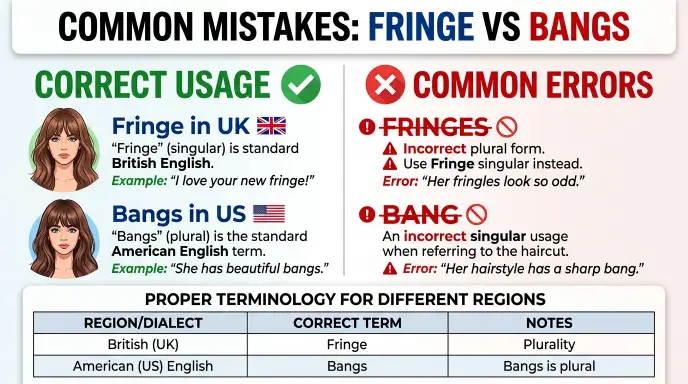
Mistake 1: Thinking One Word Is Wrong
Incorrect assumption:
“Fringe is wrong because Americans say bangs.”
Correct understanding:
Both are correct in the appropriate regional variety of English.
Explanation:
English has many regional vocabulary differences. Bangs/fringe works much like apartment/flat or elevator/lift.
Memory tip:
Think US = bangs, UK = fringe.
Mistake 2: Using “Bang” as a Singular Hair Noun
Incorrect:
She has a beautiful bang.
Correct:
She has beautiful bangs.
Explanation:
When referring to this hairstyle, bangs is normally used as a plural noun.
Memory tip:
Think of bangs as a group of hairs rather than one individual strand.
Mistake 3: Switching Terms in One Article
Less consistent:
The best bangs are easy to style. A fringe can also frame the face. Later, these bangs are popular.
Better:
The best bangs are easy to style. Bangs can also frame the face. These styles are popular.
Explanation:
If your article targets American readers, stay with bangs. If it targets British readers, use fringe.
Mistake 4: Assuming “Fringe” Means a Different Haircut
Incorrect assumption:
Fringe and bangs are two completely different hairstyles.
Correct:
Fringe and bangs are usually regional terms for the same basic hairstyle.
The exact cut can vary, but the vocabulary difference itself is mainly regional.
Fringe or Bangs in Everyday Examples
Emails
American English:
Hi Sarah, I love your new bangs. They really suit you.
British English:
Hi Sarah, I love your new fringe. It really suits you.
Business Writing
US:
Our guide explains how to choose the right bangs for your face shape.
UK:
Our guide explains how to choose the right fringe for your face shape.
News Headlines
American style headline:
Curtain Bangs Are Back in Style
British style headline:
Curtain Fringe Is Back in Style
The terminology changes, but the subject remains the same.
Blogs
US blog:
If you have fine hair, wispy bangs can create a soft look.
UK blog:
If you have fine hair, a wispy fringe can create a soft look.
Social Media
American users may write:
Should I get bangs?
British users may write:
Should I get a fringe?
Both are natural within their respective varieties.
Academic Writing
The terms bangs and fringe refer to the front section of hair but differ in regional usage.
This is a useful construction when discussing language variation.
Daily Conversation
US:
I think I’m going to get bangs.
UK:
I think I’m going to get a fringe.
These are natural everyday examples.
Google Trends & Modern Usage
People search for fringe or bangs because English language beauty content comes from many different countries. A person in the UK may encounter bangs while browsing American websites, while an American reader may encounter fringe in British or Australian content.
Search behavior is also influenced by social media, international fashion coverage, beauty blogs, and celebrity hairstyles. Modern beauty content frequently uses style specific phrases such as curtain bangs, curtain fringe, wispy bangs, and wispy fringe.
The important point is that search interest in one term does not make the other incorrect.
Exact regional popularity can change over time and depends on the search platform, country, and phrase being measured. Therefore, it is better not to treat a single search trend as proof that one term is universally preferred.
For , the smartest approach is to match the terminology to the audience.
For example:
- US audience: bangs
- UK audience: fringe
- Australian audience: fringe
- Global audience: fringe or bangs
- Language learning article: include both terms
This approach also captures related searches without forcing unnatural keyword repetition.
Quick Comparison Table
| Version | Meaning | Correct? | Region | Example |
| Bangs | Hair over the forehead | Yes | Mainly US/North America | She cut her bangs. |
| Fringe | Hair over the forehead | Yes | Mainly UK, Australia, NZ | She cut her fringe. |
| Curtain bangs | Center parted face framing style | Yes | US | She has curtain bangs. |
| Curtain fringe | Same style | Yes | UK/Australia | She has a curtain fringe. |
| Bang | Usually not used alone for the hairstyle | Generally no | American English | Avoid “a bang” for the hairstyle. |
Key Takeaways
- Fringe and bangs usually mean the same hairstyle.
- Bangs is the standard American English term.
- Fringe is the standard British English term.
- Australia and New Zealand commonly use fringe.
- Canada can use both, with bangs common in North American usage.
- Bangs is normally a plural noun.
- Use the term that matches your audience and regional variety.
- In global content, introduce both terms and then remain consistent.
FAQs
Is fringe or bangs correct?
Both fringe and bangs are correct. They are regional terms for hair cut or styled to fall over the forehead. Bangs is mainly associated with American English, while fringe is standard in British English. The correct choice depends on the variety of English you are using and the audience you are writing for.
Do Americans say fringe or bangs?
Americans normally say bangs when referring to the hair over the forehead. For example, an American speaker would naturally say, “I want to get bangs.” The word fringe still exists in American English, but it has several other meanings, including an outer edge or decorative border.
Do British people say bangs or fringe?
British English normally uses fringe for this hairstyle. A British speaker would usually say, “She has a new fringe” rather than “She has new bangs.” Dictionaries such as Oxford and Cambridge specifically identify fringe as the British equivalent of the American bangs.
Are bangs and fringe the same hairstyle?
Yes, in most contexts. Bangs and fringe refer to the front section of hair that hangs over the forehead. The terms can describe many styles, including blunt, wispy, side swept, curtain, and curly variations. The main difference between the words is regional English usage rather than the haircut itself.
Is “bangs” singular or plural?
Bangs is normally used as a plural noun when referring to this hairstyle. You would say, “She has beautiful bangs,” rather than “She has a beautiful bang.” This is an important grammar point for English learners because the word describes the hairstyle as a group or section of hair.
What do Australians call bangs?
Australians commonly use fringe for the hairstyle, although bangs is widely understood because of international and American media. If you are specifically writing in Australian English, fringe is generally the safer and more natural choice.
What do Canadians call bangs?
Both bangs and fringe can be found in Canadian English. North American usage makes bangs a common everyday choice, while official Canadian terminology resources also recognize both terms in relevant contexts. Therefore, either may be understood, but bangs is a practical choice for general Canadian facing content.
Why do Americans call it bangs?
The American term bangs developed separately from the British term fringe. Its history is associated with the idea of cutting hair abruptly or straight across. American Heritage records the hairstyle sense and a related verb meaning to cut hair to form bangs.
Should I use fringe or bangs for?
Use the term that matches your target audience. A US website should generally prioritize bangs, while a UK or Australian website should generally use fringe. If your website targets international English speakers, using the phrase fringe or bangs naturally can help explain the regional difference without keyword stuffing.
Can I use fringe and bangs interchangeably?
You can use them interchangeably when explaining the regional vocabulary difference because they usually refer to the same type of hair. However, consistent writing is better. Choose bangs for American English or fringe for British English unless you are deliberately comparing the two terms.
Conclusion
The choice between fringe or bangs is much simpler once you understand regional English. Both words describe hair that is cut or styled to fall over the forehead. The main difference is vocabulary, not the hairstyle itself.
Bangs is the usual American English term, while fringe is preferred in British English. Australia and New Zealand also commonly use fringe, while Canadian usage can include both terms, with bangs common in North American contexts.
For everyday communication, use the word your audience expects. If you are writing for Americans, choose bangs. For British readers, choose fringe. For international readers, introduce both terms and then use one consistently.
Remember that bangs normally takes a plural form, while fringe is commonly singular when referring to the hairstyle.
Memorable takeaway: Same hairstyle, different regional word: Americans say “bangs,” while British speakers say “fringe.”
Discover More Articles!
Bit or Byte: What’s the Difference and Which One Should You Use?
Rolex or Omega: Which Luxury Watch Brand Is Better for You?
Oases or Oasis: Meaning, Difference, and Correct Usage

Ethan Parker is an English-language writer known for his interest in words, language, and clear communication. His work focuses on making everyday English easier to understand through simple explanations and practical examples.