Bit or Byte: Which One Is Correct?
Confused between a bit and a byte? Learn the simple difference, how they are measured, and when to use each one.
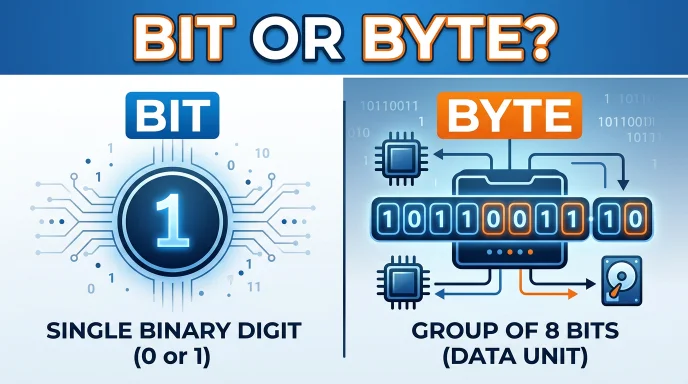
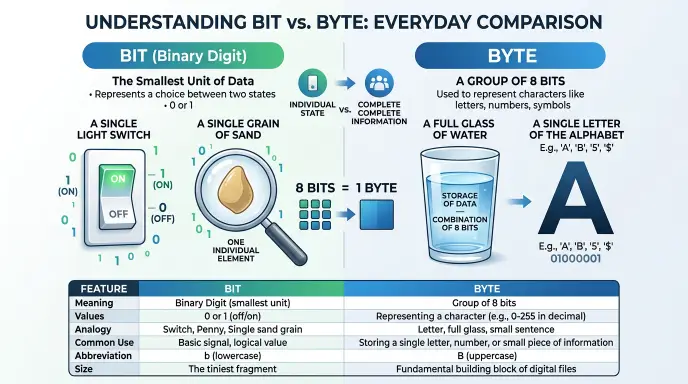
A bit is a single binary digit. It can be either 0 or 1. A byte is a group of eight bits. NIST defines a bit as a binary digit and a byte as a sequence of eight bits.
People often search for “bit or byte” because internet providers use terms such as Mbps, while computers and storage devices often show MB or GB. The lowercase b and uppercase B are important. Mixing them up can make an internet speed or file size look eight times larger or smaller than it really is.
This guide explains the difference in simple terms. You will learn where these words came from, how they are used, common mistakes, and when to use bit or byte.
Bit or Byte : Quick Answer
The simple answer is:
- Bit (b) = one binary digit, either 0 or 1.
- Byte (B) = 8 bits.
- Bits are commonly used for internet and network speeds.
- Bytes are commonly used for file sizes and storage capacity.
For example:
8 bits = 1 byte
So, a connection advertised as 100 Mbps means 100 megabits per second. It is not the same as 100 MB/s.
To convert bits to bytes, divide by 8:
100 Mbps ÷ 8 = 12.5 MB/s
The exact speed you see in real use can be lower because of network conditions, overhead, hardware, and other factors.
NIST confirms the relationship 1 byte = 8 bits.
The Origin of Bit or Byte
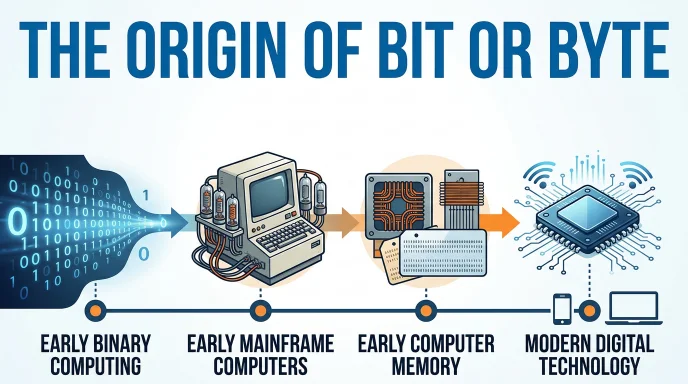
The word bit comes from the idea of a binary digit. A binary digit has only two possible values: 0 or 1. This makes the bit a basic building block of digital information.
The word byte has a different history. Merriam Webster records the first known use of “byte” in 1956 and gives its etymology as possibly an alteration of “bite.”
A byte became a common way to group bits for computer data. Today, a byte normally means eight bits. Historically, however, the size of a byte was not always fixed. NIST notes that the modern byte is generally treated as eight bits.
This history explains why the two terms are related but not interchangeable.
British English vs American English Spelling
Unlike many word pairs, bit and byte are not different British and American spellings.
Both forms are normally written the same way:
| Term | British English | American English | Meaning |
| bit | bit | bit | One binary digit |
| byte | byte | byte | Eight bits |
| bits per second | bps | bps | Data transfer rate |
| bytes per second | B/s | B/s | Data transfer rate |
| kilobit | kbit | kbit | 1,000 bits |
| kilobyte | kB | kB | 1,000 bytes |
So, there is no British vs American spelling problem with “bit or byte.” The real issue is understanding the technical difference and using the correct symbol.
Bit vs Byte Symbols
The symbols are especially important:
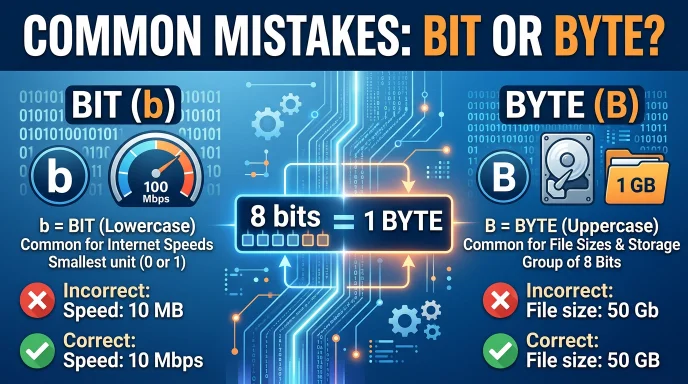
- b = bit
- B = byte
For example:
- Mbps = megabits per second
- MB/s = megabytes per second
- Gbps = gigabits per second
- GB = gigabytes
A capital B should not be treated as the same as a lowercase b.
Which Spelling Should You Use?
You do not need to choose between British and American spelling. Use bit and byte according to what you are describing.
For internet speed
Use bits.
Examples:
- 100 Mbps internet
- 1 Gbps fiber connection
- 500 Mbps download speed
Internet and network speeds are commonly expressed in bits per second.
For storage
Use bytes.
Examples:
- 256 GB SSD
- 1 TB hard drive
- 10 MB image
- 5 GB video
For a global audience
Use the standard symbols clearly. This avoids confusion no matter if your readers use British, American, or another form of English.
Common Mistakes with Bit or Byte
Many people make the same mistakes when reading computer specifications.
Mistake 1: Treating b and B as identical
Wrong: 100 Mbps = 100 MB/s
Correct: 100 Mbps = about 12.5 MB/s before accounting for real world losses.
Mistake 2: Saying a byte is one bit
Wrong: 1 byte = 1 bit
Correct: 1 byte = 8 bits.
Mistake 3: Confusing internet speed with storage
A 1 Gbps internet connection describes a transfer rate. A 1 GB file describes an amount of data.
They measure related things, but they are not the same measurement.
Mistake 4: Ignoring capitalization
Mb and MB are different.
- Mb = megabit
- MB = megabyte
Mistake 5: Assuming download speed will exactly match the advertised rate
An advertised network rate is not always the same as the speed shown during an actual download. Network traffic, Wi Fi, equipment, server limits, and protocol overhead can affect real performance.
Bit or Byte in Everyday Examples
Understanding the difference becomes easier when you see these terms in real life.
In emails
You might write:
“The attachment is 8 MB in size.”
Here, MB means megabytes because you are describing the amount of data in the file.
In news
A technology article might say:
“The company launched a 1 Gbps internet service.”
Here, Gbps describes the network’s data transfer rate.
On social media
You may see:
“This video is 250 MB.”
The number describes the video’s data size.
In formal writing
A technical report might say:
“The network supports data transfer rates up to 10 Gbps.”
A storage report might say:
“The device provides 2 TB of storage.”
In both cases, using the correct unit makes the information clear and professional.
Bit or Byte : Google Trends & Usage Data
Search interest for “bit or byte” is closely connected with technology questions. People often search the phrase when they are comparing internet speeds, file sizes, storage devices, computer memory, or data transfer rates.
The search intent also changes by context:
- Internet users often want to understand Mbps and Gbps.
- Computer users often compare MB, GB, and TB.
- Students may search for basic computer terminology.
- Developers and IT professionals use bits and bytes when discussing data structures, networking, and software.
- Consumers often encounter the terms when buying internet plans, SSDs, hard drives, or cloud storage.
Search popularity can change over time and by country, so fixed Google Trends numbers should not be treated as permanent facts. For content, the strongest approach is to cover the common questions behind the search: “What is a bit?” “What is a byte?” “How many bits are in a byte?” and “Why is Mbps different from MB/s?”
Bit or Byte Comparison Table
| Feature | Bit | Byte |
| Symbol | b | B |
| Basic meaning | Binary digit | Group of 8 bits |
| Values in one unit | 0 or 1 | 256 possible combinations |
| Common use | Network speed | Storage and file size |
| Example | 100 Mbps | 100 MB |
| Conversion | 8 bits = 1 byte | 1 byte = 8 bits |
| Common rate | Mbps, Gbps | MB/s, GB/s |
A byte contains eight bits and can represent 256 possible combinations, from 00000000 through 11111111.
FAQs
1. Is a bit bigger than a byte?
No. A byte is bigger. One byte contains eight bits.
2. How many bits are in one byte?
There are 8 bits in 1 byte.
3. Is Mbps the same as MBps?
No. Mbps means megabits per second, while MBps means megabytes per second. Since one byte contains eight bits, they represent different rates.
4. Why is internet speed measured in bits?
Network providers commonly describe connection speeds in bits per second, such as Mbps and Gbps.
5. Why are files measured in bytes?
Bytes are useful for describing the amount of digital data in files and storage systems. A file can therefore be shown as KB, MB, GB, or TB.
6. Is B a byte and b a bit?
Yes. In common computer terminology, lowercase b represents a bit and uppercase B represents a byte.
7. Which is correct: bit or byte?
Both are correct. The correct word depends on what you are measuring. Use bit for a single binary digit and commonly for network rates. Use byte for groups of eight bits and commonly for file sizes and storage.
Conclusion
The difference between bit and byte is simple once you remember one rule: 8 bits make 1 byte. A bit is a single binary digit with a value of 0 or 1. A byte is a group of eight bits. NIST uses these same basic definitions in its technical terminology.
The biggest source of confusion is capitalization. A lowercase b means bit, while an uppercase B means byte. This matters when reading internet plans, computer specifications, storage devices, and download speeds.
For internet and network speeds, you will often see Mbps or Gbps. For files and storage, you will often see MB, GB, or TB. Remembering this difference can help you compare technology products and internet plans more accurately.
So, when someone asks “bit or byte?”, the answer is not that one spelling is correct and the other is wrong. Both are correct technical terms, but they measure different amounts or rates of digital information.
Discover More Articles!
Rolex or Omega: Which Luxury Watch Brand Is Better for You?
Potatoe or Potato: Is “Potatoe” a Correct Word?
Salem or Roofing: What Does It Mean?

Hi,I am a Adrian walker. I’m passionate about making English grammar simple and easy to understand. I write clear comparisons that explain confusing words, spelling differences, and common grammar mistakes so readers can write with confidence. My goal is to provide accurate, practical, and easy-to-follow language guides for learners and writers worldwide.