Daddy’s vs Daddies: Confused about which form is correct? Learn the simple difference between daddy’s and daddies, including plural, possessive, and everyday usage.
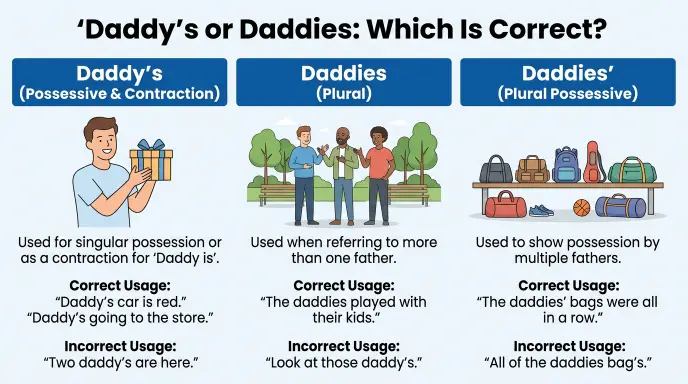
The correct choice depends on what you want to say. Daddy’s can show that something belongs to one daddy, or it can be a short form of “daddy is” or “daddy has.” Daddies is the plural form of daddy, meaning more than one father.
Cambridge and Oxford both list daddies as the standard plural form of daddy.
People search for daddy’s or daddies because the apostrophe makes the forms easy to confuse. Writers may also wonder if daddys is correct, how to form the plural possessive, or if the rules change in British and American English.
This guide explains every form in simple terms. You will learn when to use daddy’s, daddies, and daddies’, with clear examples for school, work, emails, social media, and everyday English.
Daddy’s or Daddies: Quick Answer
Daddy’s and daddies are both correct, but they have different jobs.
- Daddy’s = belongs to one daddy, or means “daddy is” / “daddy has”
- Daddies = more than one daddy
- Daddies’ = something belongs to more than one daddy
- Daddys = not the standard plural spelling
Examples
Possessive:
This is Daddy’s car.
The car belongs to one daddy.
Plural:
The daddies are waiting outside.
There is more than one daddy.
Plural possessive:
The daddies’ meeting starts at noon.
The meeting is connected to or belongs to several daddies.
Contraction:
Daddy’s coming home soon.
Here, daddy’s means daddy is.
So, the easiest rule is:
One daddy + ownership = daddy’s.
More than one daddy = daddies.
More than one daddy + ownership = daddies’.
What Does Daddy’s or Daddies Mean?
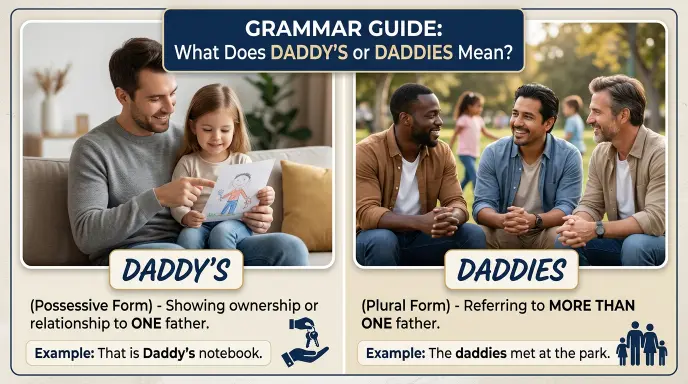
The word daddy is an informal word for father, especially one used by or with young children. Cambridge defines daddy as a child’s word for father, while Oxford gives the same basic meaning and lists daddies as its plural.
The three main forms are easy to separate once you understand their roles.
Daddy
Daddy is the singular noun.
My daddy is at work.
This means one father.
Daddy’s
Daddy’s has two common uses.
First, it can be possessive:
That is my daddy’s jacket.
The jacket belongs to one daddy.
Second, it can be a contraction:
Daddy’s tired.
This means:
Daddy is tired.
It can also represent daddy has:
Daddy’s gone to the store.
This can mean:
Daddy has gone to the store.
The apostrophe is important because ’s can show possession or form a contraction. Cambridge and Oxford both explain these two uses of apostrophe + s.
Daddies
Daddies is the plural form.
The children talked about their daddies.
It means more than one father.
The spelling changes from y to i before es because daddy ends in a consonant + y. Cambridge’s spelling guidance gives this general pattern for words such as hurry → hurries.
Daddies’
Daddies’ is the plural possessive form.
The daddies’ room is upstairs.
Here, several daddies are connected with the room.
This follows the normal possessive rule: a regular plural ending in s takes an apostrophe after the s.
The Origin of Daddy’s or Daddies
The key word behind all these forms is daddy.
Oxford traces daddy to the early 16th century and explains it as coming from dad + y. Merriam Webster gives a first known use of daddy in 1523.
The ending y helps create a familiar or affectionate form. Similar patterns appear in other English words used in informal or familiar contexts.
The word has remained strongly associated with family language and children, although it has developed additional informal meanings over time. Merriam Webster, for example, records several modern senses beyond the basic meaning of father.
The difference between daddy’s and daddies developed from normal English grammar.
For possession, English uses ’s after a singular noun:
Daddy’s phone
For the plural of a noun ending in consonant + y, English normally changes y to i and adds es:
daddy → daddies
So the two forms look different because they perform different grammatical jobs.
British English vs American English
There is no spelling difference between British and American English for daddy’s, daddies, or daddies’.
The grammar rules are the same in both varieties.
| Form | British English | American English | Example |
| Daddy | Daddy | Daddy | Daddy is home. |
| Daddy’s | Daddy’s | Daddy’s | Daddy’s phone is ringing. |
| Daddies | Daddies | Daddies | The daddies arrived early. |
| Daddies’ | Daddies’ | Daddies’ | The daddies’ meeting ended. |
British and American dictionaries both recognize daddies as the plural of daddy. Oxford also provides separate British and American dictionary entries with the same plural form.
The main difference is not regional. It is meaning.
A British writer and an American writer would normally use the same forms in the same grammatical situations.
Style and publishing
In formal writing, the basic rules stay the same.
However, daddy itself is informal. It is common in family speech, children’s writing, personal stories, dialogue, and informal content. In academic or professional writing, father or fathers may be more suitable when the informal family term is not needed.
Which Version Should You Use?
Use the form that matches your meaning, not your country.
United States
Use:
- daddy’s for singular possession or a contraction
- daddies for more than one daddy
- daddies’ for plural possession
United Kingdom
The same rules apply.
Daddy’s coat is wet.
The daddies are outside.
The daddies’ cars are parked here.
Canada
Canadian English follows the same basic distinction.
Use daddy’s for one daddy’s possession and daddies for multiple daddies.
Australia
Australian English also uses the same standard forms.
The choice depends on grammar, not Australian versus American spelling.
International English
For international readers, choose the clearest form.
If you mean several fathers, write daddies, not daddy’s.
If you mean something belongs to one father, write daddy’s.
Academic writing
Consider the level of formality.
The children described their fathers as supportive.
is usually more formal than:
The children described their daddies as supportive.
If daddy is part of a quotation, title, name, or specific context, keep it.
Business writing
Business writing normally uses father, parent, or another precise term unless daddy is part of a personal message or brand name.
Common Mistakes
Mistake 1: Using daddy’s as a plural
Incorrect:
There were three daddy’s at the event.
Correct:
There were three daddies at the event.
Why?
The sentence means there are several fathers. No apostrophe is needed.
Memory tip:
Apostrophes do not normally make nouns plural.
Mistake 2: Using daddies for possession
Incorrect:
This is my daddies car.
Correct:
This is my daddy’s car.
Why?
One daddy owns the car, so the singular possessive form is daddy’s.
Mistake 3: Writing daddys
Incorrect:
Two daddys came to the meeting.
Correct:
Two daddies came to the meeting.
Why?
A noun ending in consonant + y normally changes y to i before es when forming the plural.
Mistake 4: Confusing daddy’s with daddy is
Daddy’s happy.
Here, daddy’s means daddy is.
But:
Daddy’s jacket is blue.
Here, daddy’s shows possession.
Memory tip: Try replacing ’s with is or has. If the sentence still works, you probably have a contraction.
Mistake 5: Forgetting the plural possessive
Incorrect:
The daddies car was outside.
Correct:
The daddies’ car was outside.
If several daddies own or are connected with the car, the plural possessive is daddies’.
Everyday Examples
Knowing the rule is useful, but seeing these forms in real situations makes the difference easier to remember.
Emails
Daddy’s appointment is at 3 p.m.
Here, the appointment belongs to or concerns one daddy.
The daddies will receive an email tomorrow.
Here, the message is for several fathers.
Business Writing
The parents’ meeting will begin at 9 a.m.
In formal business or school writing, parents may sound more natural than daddies.
If the informal term is required by the context:
The daddies’ group will meet after lunch.
News Headlines
Local Daddies Join Community Event
This means several fathers joined the event.
A headline such as:
Daddy’s Car Found Near Station
uses daddy’s to show that the car belongs to one daddy.
Blogs
Why Daddy’s Advice Still Matters
Here, daddy’s means advice associated with one father.
Five Things Modern Daddies Do Differently
Here, daddies means several fathers.
Social Media
Happy birthday to the best daddy ever!
This refers to one father.
Sending love to all the amazing daddies out there!
This refers to multiple fathers.
Academic Writing
The study examined how fathers participate in early childhood care.
This is generally more formal than:
The study examined how daddies participate in early childhood care.
The second version may be suitable if the research specifically studies the word or uses it in participant language.
Daily Conversation
Daddy’s home!
This means:
Daddy is home!
But:
My daddy’s shoes are by the door.
means the shoes belong to daddy.
And:
The daddies are talking outside.
means several fathers are talking.
Google Trends & Modern Usage
Search interest in daddy’s or daddies usually reflects a grammar question rather than a regional spelling difference.
People may search for this phrase when they are:
- Learning English
- Checking an apostrophe
- Writing a school assignment
- Editing a sentence
- Writing a social media caption
- Unsure about the plural of daddy
- Confused by daddy’s, daddies, and daddies’
Exact Google Trends numbers can change by country, date range, and search term. Without a specific Trends dataset, it would be misleading to claim that one form has a particular percentage or search volume.
Modern usage also has more than one context. Daddy remains a familiar family word, while dictionaries record additional informal meanings. Merriam Webster notes that some slang uses have developed beyond the original family sense.
For grammar searches, however, the main distinction remains simple:
daddy’s = singular possessive or contraction
daddies = plural
Quick Comparison Table
| Version | Meaning | Correct? | Region | Example |
| Daddy | One father | Yes | US, UK, International | My daddy is home. |
| Daddy’s | Belongs to one daddy | Yes | US, UK, International | Daddy’s car is outside. |
| Daddy’s | Daddy is / Daddy has | Yes | US, UK, International | Daddy’s coming home. |
| Daddies | More than one daddy | Yes | US, UK, International | The daddies arrived. |
| Daddies’ | Belonging to several daddies | Yes | US, UK, International | The daddies’ meeting started. |
| Daddys | Intended plural of daddy | No | Standard English | Use daddies instead. |
Key Takeaways
- Daddy is the singular form.
- Daddy’s can show possession.
- Daddy’s can also mean daddy is or daddy has.
- Daddies is the standard plural of daddy.
- Daddies’ is the plural possessive form.
- Daddys is not the standard plural spelling.
- British and American English use the same forms.
- The apostrophe changes the grammatical meaning, so use it carefully.
FAQs
Is “daddy’s” plural?
No. Daddy’s is not normally the plural of daddy. It can show possession, as in “Daddy’s car,” or it can be a contraction of “daddy is” or “daddy has.” The standard plural form is daddies.
Is “daddies” the correct plural of “daddy”?
Yes. Daddies is the standard plural form of daddy. The spelling changes from y to i before es, following a common English spelling pattern for nouns ending in consonant + y.
What is the difference between “daddy’s” and “daddies”?
Daddy’s refers to one daddy’s possession or can mean “daddy is” or “daddy has.” Daddies means more than one daddy. For example, “Daddy’s hat” means one daddy owns the hat, while “the daddies” refers to several fathers.
Is “daddys” correct?
No, daddys is not the standard plural spelling. The correct plural is daddies. Because daddy ends in a consonant followed by y, the y changes to i before es.
What is the plural possessive of “daddy”?
The plural possessive is daddies’. It means something belongs to or is associated with several daddies. For example, “The daddies’ meeting” refers to a meeting involving or belonging to multiple fathers. Regular plural nouns ending in s normally take an apostrophe after the final s.
Is “Daddy’s” a contraction?
Yes. Daddy’s can be a contraction when it means daddy is or daddy has. For example, “Daddy’s tired” means “Daddy is tired,” while “Daddy’s gone” can mean “Daddy has gone.” Context tells you which meaning is intended.
Is “daddy’s” correct in British English?
Yes. British English uses daddy’s for singular possession and for the contractions “daddy is” and “daddy has.” It also uses daddies as the plural. These forms are not different in standard British and American English.
Should I write “Daddy’s girl” or “Daddies girl”?
If you mean a girl who is closely associated with one daddy, write “Daddy’s girl.” The apostrophe shows possession or relationship. “Daddies girl” is not correct for that meaning.
When should I use “daddies’”?
Use daddies’ when something belongs to or is connected with more than one daddy.
For example:
The daddies’ meeting was held at school.
The apostrophe comes after the s because daddies is already plural. This follows the standard plural possessive rule.
Conclusion
The difference between daddy’s or daddies becomes simple once you focus on meaning. Daddy’s is used for one daddy’s possession, such as “Daddy’s phone,” and it can also be a contraction meaning “daddy is” or “daddy has.” Daddies is the correct plural when you mean more than one father.
There is also a third form worth remembering: daddies’. This is the plural possessive form and shows that something belongs to or is connected with several daddies.
The same rules apply in British, American, Canadian, and Australian English. The difference is grammatical, not regional. Also remember that daddys is not the standard plural spelling.
When you are unsure, ask two simple questions: Am I talking about one daddy or several? Am I showing possession or making a contraction? Those questions will usually give you the answer immediately.
Remember: one daddy’s, many daddies, many daddies’ possessions. Use the form that matches your meaning, and your writing will stay clear and correct.
Discover More Articles!
Rolex or Omega: Which Luxury Watch Brand Is Better for You?
Buying or Renting: Which Is Better for You?
Keith or Kieth: Which Spelling Is Correct?

Hi,I am a Adrian walker. I’m passionate about making English grammar simple and easy to understand. I write clear comparisons that explain confusing words, spelling differences, and common grammar mistakes so readers can write with confidence. My goal is to provide accurate, practical, and easy-to-follow language guides for learners and writers worldwide.