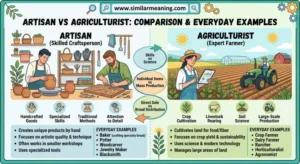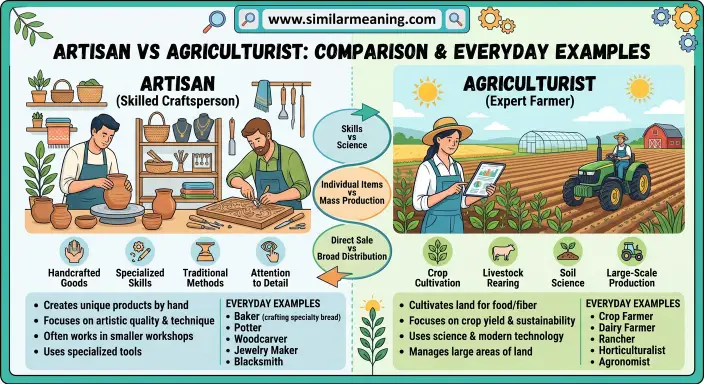
An artisan is a person who makes things by hand using specialized skills, while an agriculturist is a person who studies, practices, or works in agriculture.
Both people use knowledge and practical skills, but they usually work in different fields. An artisan may create pottery, jewelry, furniture, or handmade clothing, while an agriculturist may work with crops, soil, farming methods, or agricultural research.
For example, a person who makes beautiful clay pots is an artisan. A person who studies crop production and helps farmers improve their harvests may be an agriculturist.
Although these words describe people who use specialized knowledge, they are not interchangeable. Understanding the difference will help you choose the right word in everyday conversations, schoolwork, and professional writing.
In this guide, you will learn the definitions, origins, key differences, common mistakes, and practical examples of artisan and agriculturist. You will also discover related occupations and find answers to frequently asked questions.
Quick Answer: Artisan vs. Agriculturist
The main difference is that an artisan creates things using specialized craftsmanship, while an agriculturist works in the field of agriculture.
| Word | Meaning | Example |
| Artisan | A skilled craftsperson who makes things by hand | The artisan made a wooden chair. |
| Agriculturist | A person who studies or works in agriculture | The agriculturist advised farmers about soil management. |
Easy way to remember: An artisan makes or crafts things. An agriculturist works with farming, crops, soil, or agricultural systems.
What Does Artisan Mean?
An artisan is a skilled person who creates objects or products using practical knowledge and craftsmanship. Artisans may work with wood, metal, clay, fabric, leather, glass, or other materials.
Example: The artisan created handmade jewelry for the local market.
What Does Agriculturist Mean?
An agriculturist is someone who studies, practices, or works in agriculture. This field includes crop production, soil management, farming methods, and the development of agricultural systems.
Example: The agriculturist helped farmers choose suitable crops for the local climate.
Definition and Meaning of Artisan
The word artisan is a noun that refers to a skilled craftsperson who makes products by hand or uses specialized techniques to create or finish them.
Artisans often develop their skills through training, practice, and experience. Their work may combine creativity, technical knowledge, and attention to detail.
Examples of Artisans
- Potter: Creates bowls, pots, and other objects from clay.
- Carpenter: Makes or repairs wooden items and structures.
- Jeweler: Creates, repairs, or decorates jewelry.
- Weaver: Produces fabric or other materials by weaving threads.
- Blacksmith: Shapes metal using specialized tools and techniques.
- Leatherworker: Makes products from leather.
- Glassblower: Shapes glass into decorative or practical objects.
What Does an Artisan Do?
An artisan’s duties depend on the craft they practice. Common activities include:
- Designing and creating handmade products.
- Selecting suitable materials.
- Using specialized tools and techniques.
- Repairing or decorating objects.
- Checking the quality of finished products.
- Selling crafts to customers or businesses.
For example, a furniture artisan may design and build a table, while a textile artisan may weave fabric or create embroidered designs.
When Should You Use Artisan?
Use artisan when talking about someone who creates or works on products using specialized craftsmanship.
Common situations include:
- Handmade products: The artisan created a decorative bowl.
- Traditional crafts: Local artisans produce traditional pottery.
- Furniture: An artisan crafted the wooden cabinet.
- Jewelry: The artisan designed a silver necklace.
- Food production: An artisan baker makes bread using specialized methods.
The word can describe both traditional crafts and modern skilled creative work.
Definition and Meaning of Agriculturist
The word agriculturist is a noun that refers to a person who works in, studies, or has expertise in agriculture.
Agriculture involves growing crops, raising livestock, managing agricultural land, and producing food and other useful materials. Agriculturists may work directly on farms or in research, education, consulting, and agricultural management.
Examples of Agriculturists
- Crop specialist: Studies crops and helps improve their production.
- Soil specialist: Examines soil conditions and recommends suitable management practices.
- Agricultural researcher: Studies ways to improve farming methods.
- Farm consultant: Advises farmers about crops, resources, and production.
- Agricultural scientist: Conducts scientific research related to farming.
- Agricultural educator: Teaches people about agricultural practices.
These occupations can overlap, but not every agriculturist has the same training or responsibilities.
What Does an Agriculturist Do?
An agriculturist’s work depends on their role and area of expertise. Common responsibilities may include:
- Studying soil quality and crop conditions.
- Advising farmers about suitable crops.
- Evaluating irrigation and farming methods.
- Helping improve agricultural productivity.
- Researching pests, plant diseases, or crop varieties.
- Supporting sustainable land management.
- Examining agricultural production and resources.
For example, an agriculturist may help a farmer select crops suited to the region’s climate and soil conditions.
When Should You Use Agriculturist?
Use agriculturist when referring to someone involved in the study, practice, or professional development of agriculture.
Common situations include:
- Crop production: The agriculturist recommended a suitable wheat variety.
- Soil management: The agriculturist examined the soil.
- Farming research: The agriculturist studied methods to improve crop yields.
- Agricultural planning: The agriculturist advised the farming community.
- Sustainable farming: The agriculturist promoted responsible land use.
Origin of Artisan and Agriculturist
The words artisan and agriculturist have different linguistic origins that reflect their meanings.
Origin of Artisan
Artisan entered English through French and ultimately comes from Latin ars, meaning art, skill, or craft.
Its history is closely connected to skilled work and the creation of useful or decorative objects. Today, the term is commonly associated with craftsmanship, handmade products, and specialized creative skills.
Origin of Agriculturist
Agriculturist comes from agriculture combined with the suffix ist, which often refers to a person associated with a particular activity or field.
The word agriculture has Latin roots connected with fields and cultivation. The term agriculturist therefore describes a person involved in the cultivation of land or the broader field of agricultural knowledge and practice.
Artisan vs Agriculturist: Key Differences
Although both artisans and agriculturists use specialized skills, their work usually has different goals.
| Feature | Artisan | Agriculturist |
| Main field | Craftsmanship | Agriculture |
| Primary activity | Making or finishing products | Studying or working in agricultural production |
| Common materials | Wood, clay, metal, fabric, glass | Soil, crops, plants, agricultural resources |
| Main goal | Create useful or decorative products | Support or improve farming and agricultural systems |
| Typical workplace | Workshop, studio, craft market | Farm, laboratory, research center, agricultural office |
| Example | A person making handmade pottery | A specialist advising farmers on crop selection |
Are Artisan and Agriculturist Interchangeable?
No. These words describe different types of work.
- The artisan made a clay pot. This sentence focuses on craftsmanship.
- The agriculturist examined the soil. This sentence focuses on agriculture.
An artisan may use agricultural materials, and an agriculturist may make or repair equipment as part of a personal hobby. However, these possibilities do not make the words synonyms.
Artisan vs Agriculturist vs Farmer
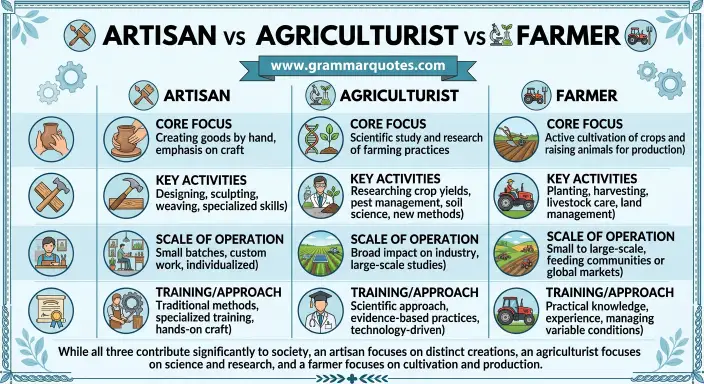
The word farmer is closely related to agriculturist, but the terms are not always identical.
| Word | Meaning | Example |
| Artisan | A skilled craftsperson | The artisan made a leather bag. |
| Agriculturist | A person who studies or works in agriculture | The agriculturist recommended a crop rotation plan. |
| Farmer | A person who manages or works on a farm | The farmer planted wheat. |
A farmer often focuses on the day to day operation of a farm. An agriculturist may work directly in farming or specialize in agricultural science, advice, or research.
An artisan, by contrast, generally focuses on making products through skilled craftsmanship.
How to Remember Artisan vs. Agriculturist
You can remember the difference by connecting each word with its main activity.
1. Artisan Means Craft
Think of an artisan creating a handmade object, such as a chair, necklace, or clay pot.
Example: The artisan made a decorative wooden box.
2. Agriculturist Means Agriculture
Think of crops, soil, irrigation, and farming methods.
Example: The agriculturist studied how different crops grow in local soil.
3. Ask Yourself One Question
Before using either word, ask:
Is this person making crafted products, or are they working in agriculture?
- If the person uses specialized craftsmanship to create products, use artisan.
- If the person studies or works in agriculture, use agriculturist.
This simple test will help you choose the right word in most situations.
Common Mistakes When Using Artisan and Agriculturist
These words are sometimes confused because both describe people with specialized knowledge or skills. Here are some mistakes to avoid.
Mistake 1: Calling Every Skilled Worker an Artisan
Incorrect assumption: Every person with a specialized job is an artisan.
Correct explanation: An artisan is specifically associated with craftsmanship and the making or finishing of products.
Example: A person who creates handmade wooden furniture is an artisan.
Mistake 2: Using Agriculturist as a Synonym for Artisan
Incorrect: The agriculturist made a handmade silver necklace.
Better: The artisan made a handmade silver necklace.
The sentence focuses on jewelry craftsmanship, not agriculture.
Mistake 3: Assuming Agriculturist Always Means Farmer
An agriculturist may be a farmer, but the term can also describe someone who researches crops, advises agricultural businesses, or studies soil and farming methods.
Example: The agriculturist conducted research on drought resistant crops.
Mistake 4: Confusing Agricultural Work with Craft Production
Incorrect: The artisan studied soil fertility to advise wheat farmers.
Better: The agriculturist studied soil fertility to advise wheat farmers.
Use agriculturist when the main activity involves agricultural expertise.
Mistake 5: Assuming an Artisan Only Makes Decorative Objects
Artisans can produce both decorative and practical items.
Examples:
- A potter makes cooking pots.
- A carpenter makes furniture.
- A leatherworker makes shoes or bags.
Artisan work is not limited to art displayed for decoration.
Everyday Examples of Artisan and Agriculturist
The following examples show how to use each word correctly in everyday English.
Artisan Examples
- The artisan created a beautiful clay vase.
- Local artisans sell handmade products at the market.
- The artisan repaired an old wooden chair.
- She learned traditional weaving from an experienced artisan.
- The artisan used metalworking skills to make a decorative gate.
- A skilled artisan designed the handmade jewelry.
- The village is known for its talented artisans.
- The artisan selected high quality leather for the bags.
- He visited a workshop to watch an artisan make pottery.
- The artisan added detailed patterns to the wooden box.
Agriculturist Examples
- The agriculturist advised farmers about crop rotation.
- An experienced agriculturist examined the soil.
- The agriculturist studied different methods of irrigation.
- Farmers asked the agriculturist for advice about crop diseases.
- The agriculturist researched drought resistant plants.
- The local agriculturist explained how to improve soil fertility.
- An agriculturist helped evaluate a new farming method.
- The agriculturist studied the effects of changing weather on crops.
- The agricultural organization hired an agriculturist as a consultant.
- The agriculturist recommended ways to reduce water waste.
Artisan or Agriculturist in Different Contexts
The situation in which a person works can help you choose the right word.
In Traditional Crafts
Use artisan for someone who creates products using specialized skills.
Example: The artisan made traditional pottery for the village market.
In Farming
Use agriculturist for someone who studies or works in agricultural production.
Example: The agriculturist recommended better methods of soil management.
In Business
An artisan may operate a craft business, while an agriculturist may manage or advise an agricultural business.
Example: The artisan sells handmade furniture, while the agriculturist advises farms on crop production.
In Education and Research
An artisan may teach a practical craft, while an agriculturist may research agricultural science or teach farming methods.
Example: The artisan taught students how to weave fabric, while the agriculturist taught them about crop management.
People Also Ask About Artisan and Agriculturist
1. What is the difference between an artisan and an agriculturist?
An artisan is a skilled craftsperson who makes products, while an agriculturist studies, practices, or works in agriculture.
2. Is an artisan a farmer?
Not necessarily. An artisan makes products using specialized craftsmanship. A farmer grows crops or raises livestock. One person could do both, but the words describe different roles.
3. What is an example of an artisan?
A potter who makes handmade clay pots is an artisan. Other examples include jewelers, weavers, and skilled furniture makers.
4. What is an example of an agriculturist?
A specialist who advises farmers on soil quality, crop selection, and agricultural methods is an agriculturist.
5. Is an agriculturist the same as an agricultural scientist?
The terms can overlap, but they are not always identical. An agricultural scientist generally emphasizes scientific research, while an agriculturist may work in research, farming, consulting, or other agricultural activities.
6. What is another word for artisan?
Depending on the context, related terms include craftsperson, craftworker, maker, and skilled worker. These words may have slightly different meanings.
7. What is another word for agriculturist?
Depending on the role, related terms include agricultural specialist, agricultural expert, and sometimes farmer. However, these terms are not always exact synonyms.
8. Can an agriculturist be a farmer?
Yes. Some agriculturists work directly as farmers, while others specialize in research, education, agricultural consulting, or related fields.
9. Does an artisan always make things by hand?
Artisans are associated with skilled craftsmanship, often involving handwork. Some may also use modern machinery or specialized tools as part of their work.
10. Which word should I use for someone who improves crop production?
Use agriculturist if the person works in agricultural science, advice, or production. Use farmer if you specifically mean someone who manages or works on a farm.
Conclusion
Artisan and agriculturist describe people with different skills and professional focuses. An artisan creates products through craftsmanship, while an agriculturist studies or works in agriculture.
An artisan may make pottery, furniture, jewelry, or handmade clothing. An agriculturist may study soil, advise farmers, research crops, or help improve agricultural production.
The easiest way to remember the difference is to associate artisan with crafts and agriculturist with agriculture. Although both roles require knowledge, practice, and specialized skills, they are not interchangeable.
Using the correct word will make your writing clearer and help readers understand exactly what kind of work a person does.
Discover More Articles!
By and By vs By the By: Meaning and Difference
Sleave vs Sleeve: Meaning, Difference, and Examples(2026)
Southpaw or Orthodox: What Is the Difference?(2026)

Ethan Parker is an English-language writer known for his interest in words, language, and clear communication. His work focuses on making everyday English easier to understand through simple explanations and practical examples.