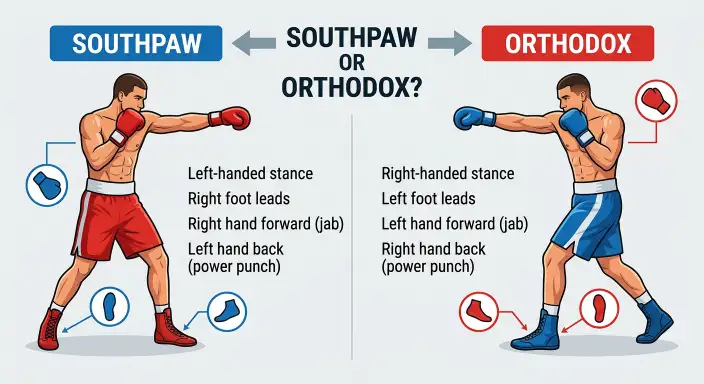
Southpaw and orthodox describe two different fighting stances in boxing. An orthodox boxer usually keeps the left foot forward and uses the left hand for the jab, while a southpaw boxer usually keeps the right foot forward and uses the right hand for the jab.
These terms are common in boxing and other combat sports. If you watch a boxing match, you may hear a commentator describe a fighter as a southpaw or an orthodox boxer. Understanding these words makes it easier to follow the action and understand how fighters position themselves.
The main difference is the stance and the positioning of the hands and feet. Orthodox is commonly used by right handed boxers, while southpaw is commonly used by left handed boxers. However, handedness does not always determine a person’s preferred stance.
In this guide, you will learn what southpaw and orthodox mean, how they differ, when each stance is used, and how to recognize them. You will also find everyday examples, a comparison table, and answers to common questions.
Southpaw or Orthodox: Quick Answer
Orthodox usually means the left foot is forward, while southpaw usually means the right foot is forward.
Here is a simple comparison:
- Orthodox: Left foot forward and left hand leading.
- Southpaw: Right foot forward and right hand leading.
- Common association: Orthodox is often used by right handed fighters, while southpaw is often used by left handed fighters.
- Important note: Fighters can choose a stance that feels natural, regardless of their dominant hand.
Both stances are valid in boxing. Neither is automatically better for every fighter.
Definition and Meaning
What Does Southpaw Mean?
In boxing, southpaw describes a stance in which the fighter usually places the right foot forward and the left hand farther back.
This position allows a left handed fighter to lead with the right hand and use the left hand as the rear hand. However, some fighters adopt a southpaw stance even if they are naturally right handed.
The term is also used in other combat sports, including mixed martial arts.
Example: “The boxer is a southpaw, so his stance looks different from that of most orthodox fighters.”
What Does Orthodox Mean?
In boxing, orthodox describes a stance in which the fighter usually places the left foot forward and the right hand farther back.
This stance is common among right handed boxers. The left hand is generally used for the jab, while the right hand is the rear hand.
Example: “The orthodox boxer keeps his left foot forward and uses his left hand to lead.”
Outside combat sports, orthodox can mean traditional or following established beliefs and practices. In boxing, however, it specifically refers to a fighting stance.
The Origin of Southpaw and Orthodox
Origin of Southpaw
The word southpaw is commonly associated with American baseball, where it traditionally referred to a left handed pitcher. Its use later became familiar in boxing to describe a left handed fighting stance.
The exact historical explanation for the word’s development is not completely settled. Today, its meaning in boxing is widely understood.
Origin of Orthodox
The word orthodox comes through Greek roots associated with correct belief or accepted opinion. In everyday English, it often describes something traditional or conventional.
In boxing, the term is used for the conventional stance with the left foot forward. It contrasts with the southpaw stance.
British English vs American English
The terms southpaw and orthodox have the same spelling and basic meaning in British and American boxing terminology.
| Feature | British English | American English |
| Southpaw | Left foot forward? No; right foot usually forward | Right foot usually forward |
| Orthodox | Left foot usually forward | Left foot usually forward |
| Spelling | Southpaw / Orthodox | Southpaw / Orthodox |
| Sport usage | Boxing and combat sports | Boxing and combat sports |
| Main difference | No major spelling difference | No major spelling difference |
Both terms are used internationally in boxing. Their meanings do not change between British and American English.
Main Differences Between Orthodox and Southpaw
1. Foot Position
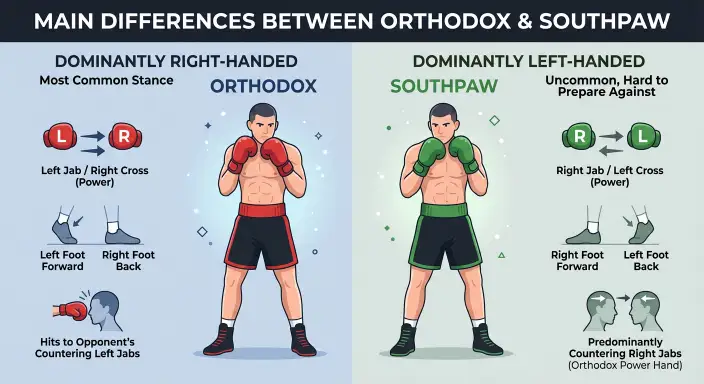
An orthodox boxer usually places the left foot forward and the right foot behind.
A southpaw boxer usually places the right foot forward and the left foot behind.
This change affects the fighter’s balance, movement, and positioning against an opponent.
2. Leading Hand
An orthodox boxer generally leads with the left hand.
A southpaw boxer generally leads with the right hand.
The leading hand is often used for the jab, while the rear hand is commonly used for stronger straight punches.
3. Dominant Hand
Orthodox is commonly associated with right handed fighters, while southpaw is commonly associated with left handed fighters.
However, this is a common pattern rather than a strict rule. Some fighters use a stance that does not match their dominant hand.
4. Facing an Opponent
When a southpaw faces an orthodox boxer, their lead feet and lead hands are positioned differently from those of two fighters using the same stance.
This can create different angles and tactical challenges. Fighters may need to adjust their footwork, distance, and defensive positioning.
5. Which Stance Is Better?
Neither stance is universally better. A fighter’s success depends on technique, experience, movement, timing, and how well the stance suits their skills.
A southpaw stance may feel natural to one person, while another may perform better using an orthodox stance.
When Should You Use Each Term?
When to Use Southpaw
Use southpaw when describing a fighter who usually keeps the right foot forward and leads with the right hand.
Examples:
- The southpaw boxer has a different stance from his opponent.
- She is a southpaw fighter.
- The commentator explained how the southpaw stance changes the match.
When to Use Orthodox
Use orthodox when describing a fighter who usually keeps the left foot forward and leads with the left hand.
Examples:
- The orthodox boxer uses a left hand jab.
- He prefers an orthodox stance.
- The southpaw faced an orthodox opponent.
When to Use Orthodox Outside Boxing
Outside sports, orthodox usually means traditional, conventional, or following established beliefs.
Examples:
- She prefers an orthodox approach to teaching.
- The group follows orthodox traditions.
- His ideas are different from the orthodox view.
In these sentences, orthodox has nothing to do with boxing stance.
Common Mistakes With Southpaw and Orthodox

Mistake 1: Thinking Southpaw Means Right Handed
In boxing, southpaw is commonly associated with left handed fighters, although a right handed person can also adopt the stance.
Mistake 2: Mixing Up the Feet
Remember that an orthodox fighter usually keeps the left foot forward, while a southpaw usually keeps the right foot forward.
Mistake 3: Assuming One Stance Always Wins
Neither stance guarantees victory. The outcome depends on the fighters’ skills, strategy, and performance.
Mistake 4: Thinking Orthodox Only Refers to Boxing
The word orthodox has several meanings in general English. It can describe traditional beliefs, practices, or methods.
Mistake 5: Assuming Every Left Handed Fighter Uses Southpaw
Many left handed boxers use southpaw, but some choose orthodox. A fighter’s stance is a choice influenced by training and personal preference.
Everyday Examples of Southpaw and Orthodox
In Boxing
- The southpaw fighter stands with the right foot forward.
- The orthodox boxer leads with the left hand.
- The coach explains the difference between the two stances.
In Sports Commentary
- The southpaw’s stance creates a different challenge for the opponent.
- The orthodox fighter changes his foot position during the match.
- The commentator identifies both fighters’ stances before the fight.
General English
- The athlete uses an unorthodox training method.
- The coach prefers a traditional approach.
- The word orthodox can describe a conventional idea or practice.
These examples show how the terms work in sports and how orthodox can also be used in everyday language.
Southpaw vs Orthodox: Comparison Table
| Feature | Southpaw | Orthodox |
| Usual front foot | Right | Left |
| Usual lead hand | Right | Left |
| Common association | Left handed fighters | Right handed fighters |
| Used in boxing | Yes | Yes |
| Used in other combat sports | Yes | Yes |
| Always linked to dominant hand? | No | No |
| Is it better? | Depends on the fighter | Depends on the fighter |
A Simple Trick to Remember the Difference
Use this easy rule:
- Southpaw = right foot forward.
- Orthodox = left foot forward.
Think of the front foot first. This is often the easiest way to identify a fighter’s stance.
Remember that these are the usual positions, not absolute rules for every fighter or every moment of a match.
FAQs About Southpaw or Orthodox
1. What is the difference between southpaw and orthodox?
A southpaw boxer usually keeps the right foot forward, while an orthodox boxer usually keeps the left foot forward. Their leading hands differ as well.
2. Is southpaw left handed?
Southpaw is commonly associated with left handed fighters. However, a right handed boxer can also choose to fight from a southpaw stance.
3. Is orthodox always right handed?
No. Orthodox is commonly associated with right handed fighters, but a left handed fighter can also use an orthodox stance.
4. Which stance is better, southpaw or orthodox?
Neither stance is always better. The right choice depends on the fighter’s comfort, training, skills, and strategy.
5. Why is southpaw called southpaw?
The word is commonly associated with American baseball, where it traditionally described a left handed pitcher. It later became a familiar term in boxing for a left handed stance.
6. What does orthodox mean in boxing?
In boxing, orthodox describes a stance with the left foot forward and the left hand leading, while the right hand is usually held farther back.
7. Can a boxer change from orthodox to southpaw?
Yes. Some trained fighters can switch between the two stances. This is often called switching stance, but it requires practice and control.
8. Is southpaw harder to fight against?
Some fighters find southpaw opponents unfamiliar because their positioning and angles differ from those of orthodox fighters. Difficulty depends on experience and preparation.
9. Is orthodox the normal boxing stance?
Orthodox is the conventional stance and is common among right handed boxers. Southpaw is also a recognized and effective stance.
10. Can these terms be used outside boxing?
Southpaw is also used in other sports and can describe left handed people in some contexts. Orthodox is a general English word meaning traditional or conventional, as well as a boxing stance.
Conclusion
Southpaw and orthodox describe two common fighting stances in boxing. A southpaw boxer usually keeps the right foot forward and leads with the right hand, while an orthodox boxer usually keeps the left foot forward and leads with the left hand.
These stances are often associated with left handed and right handed fighters, respectively, but handedness does not determine every fighter’s choice. Both stances can be effective when used with good technique, balance, and training.
The easiest way to remember the difference is to focus on the front foot: right foot forward usually means southpaw, and left foot forward usually means orthodox. The word orthodox can also mean traditional or conventional outside sports.
Understanding these terms helps you follow boxing commentary, recognize a fighter’s stance, and understand how different positions can affect a match.
Discover More Articles!
WordPress or Webflow: Which Platform Is Better?
Damned or Dammed: Meaning, Difference, and Examples(2026)
Your vs You’re: Meaning, Differences, and Examples(2026)

Ethan Parker is an English-language writer known for his interest in words, language, and clear communication. His work focuses on making everyday English easier to understand through simple explanations and practical examples.