Your vs you’re is a common English grammar question. Both words sound the same, but they have different meanings and uses. Your shows that something belongs to someone, while you’re is the short form of “you are.”
Imagine sending a message to your friend. You want to write, “Your phone is amazing,” but you accidentally write, “You’re phone is amazing.” The reader may understand your meaning, but the sentence contains a grammar mistake.
This confusion is common among students, English learners, bloggers, and even people who write in English every day. Learning the difference can improve your spelling, grammar, and writing skills. It can also help you avoid mistakes in school assignments, emails, social media posts, and professional documents.
In this guide, you will learn the meanings, origins, pronunciation, grammar rules, and everyday uses of both words. You will also find simple examples, a comparison table, common mistakes, and answers to frequently asked questions.
Your vs You’re: Quick Answer
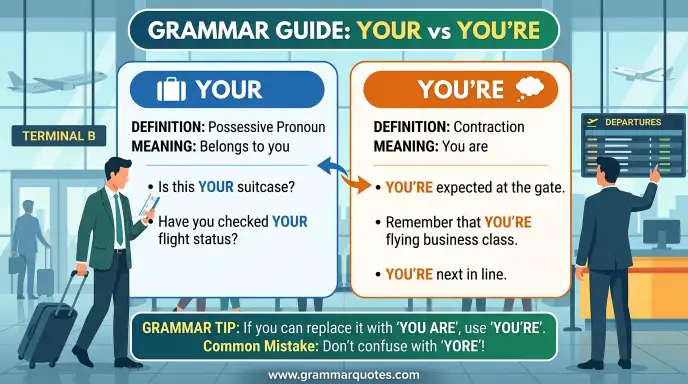
Your is a possessive word that shows ownership. You’re is a contraction of “you are.”
Compare these examples:
- Your: Your book is on the table.
- You’re: You’re very good at writing.
In the first sentence, “your” shows that the book belongs to the person being addressed. In the second sentence, “you’re” means “you are.”
An Easy Way to Remember
Replace you’re with you are in your sentence.
- If the sentence still makes sense, use you’re.
- If it does not make sense, you may need your.
For example:
- “You’re welcome.” → “You are welcome.” This works.
- “Your welcome.” → “You are welcome.” This changes the intended meaning and is incorrect when you mean the usual reply to “thank you.”
Definition and Meaning
What Does “Your” Mean?
Your (determiner): A word used before a noun to show that something belongs to, relates to, or is associated with the person or people being addressed.
Examples:
- Is this your bag?
- Your ideas are helpful.
- Please write your name here.
The word “your” does not always mean legal ownership. It can also show a relationship or connection.
For example, “your teacher” means the teacher connected with you.
What Does “You’re” Mean?
You’re (contraction): The shortened form of “you are.”
Examples:
- You’re my best teammate.
- You’re learning English quickly.
- I think you’re right.
The word combines “you” and “are.” The apostrophe replaces the omitted letter “a.”
Is “You’re” Possessive?
No. “You’re” does not show ownership. It means “you are.”
For ownership, use “your”:
- Correct: Your phone is new.
- Incorrect: You’re phone is new.
The Origin of Your and You’re
Origin of “Your”
The word “your” developed from older English forms related to “you” and its possessive forms. Over time, it became the standard way to show possession or association with the person being addressed.
Origin of “You’re”
“You’re” developed as a shortened form of “you are.” English commonly uses contractions to make speech and writing shorter and more natural.
The apostrophe marks the missing letter in “are.”
Historical Development
Old English (450–1100)
Old English used different forms of pronouns to show relationships and possession. The modern forms were not yet used exactly as they are today.
Middle English (1100–1500)
English pronouns and their forms changed over time. The forms that led to modern “your” became more established during this period.
Modern English (1500–Present)
“Your” became the standard possessive form, while contractions such as “you’re” became common in everyday writing and conversation.
British English vs American English
Are “Your” and “You’re” Different in British and American English?
No. Both British and American English use your to show possession and you’re as the contraction of “you are.”
| Feature | British English | American English |
| Possessive word | Your | Your |
| Contraction | You’re | You’re |
| Meaning of “your” | Belonging or related to you | Belonging or related to you |
| Meaning of “you’re” | You are | You are |
| Pronunciation | Usually the same in connected speech | Usually the same in connected speech |
| Spelling difference | None | None |
The distinction is grammatical, not regional.
When Should You Use Your or You’re?
Use “Your” to Show Possession
Use “your” before a noun when something belongs or relates to the person being addressed.
Examples:
- Your house looks beautiful.
- I like your writing style.
- Please bring your notebook.
A useful clue is that “your” is usually followed by a noun, although other words can appear between them.
Use “You’re” to Mean “You Are”
Use “you’re” when you mean “you are.”
Examples:
- You’re very kind.
- You’re doing a great job.
- I know you’re busy.
You can often expand the contraction to “you are” to check the sentence.
Use “Your” in Questions About Ownership
Examples:
- Is this your jacket?
- Where is your phone?
- What is your favorite subject?
Use “You’re” to Describe Someone
Examples:
- You’re helpful.
- You’re ready for the test.
- You’re becoming a better writer.
Common Mistakes with Your and You’re
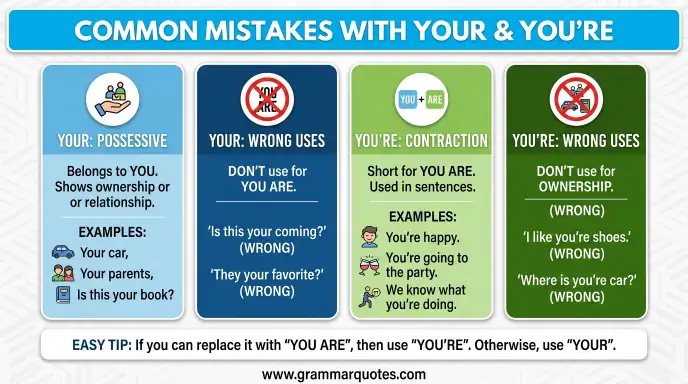
Mistake 1: Writing “Your Welcome”
Incorrect: Your welcome!
Correct: You’re welcome!
Why? The phrase means “you are welcome,” so the contraction “you’re” is needed.
Mistake 2: Writing “You’re Book”
Incorrect: You’re book is interesting.
Correct: Your book is interesting.
Why? The sentence refers to a book associated with someone. It needs the possessive word “your.”
Mistake 3: Writing “Your Going”
Incorrect: Your going to enjoy the movie.
Correct: You’re going to enjoy the movie.
Why? The sentence means “you are going,” so “you’re” is correct.
Mistake 4: Confusing Meaning with Sound
“Your” and “you’re” are often pronounced the same or very similarly in everyday speech. You cannot always identify the correct spelling by listening.
Instead, look at the meaning and grammar of the sentence.
Mistake 5: Forgetting the Apostrophe
Incorrect: Youre doing well.
Correct: You’re doing well.
Why? The apostrophe is part of the standard spelling of the contraction.
Your vs You’re in Everyday Examples
In Text Messages
- Your: Your message made me smile.
- You’re: You’re always helpful.
In Schoolwork
- Your: Your answer is correct.
- You’re: You’re ready for the exam.
For Emails
- Your: Your application has been received.
- You’re: You’re welcome to contact us with questions.
On Social Media
- Your: Your photos look great.
- You’re: You’re doing amazing!
In Professional Writing
- Your: Please check your details before submitting the form.
- You’re: You’re responsible for reviewing the final document.
Your vs You’re: Comparison Table
| Feature | Your | You’re |
| Word type | Possessive determiner | Contraction |
| Full form | No expanded form needed | You are |
| Main purpose | Shows possession or association | Describes a person or state |
| Apostrophe | No | Yes |
| Example | Your car is clean. | You’re very careful. |
| Before a noun | Commonly used | Not used to show possession |
| Can be expanded to “you are”? | No | Yes |
| Common error | Your welcome | You’re welcome is correct |
| British spelling | Your | You’re |
| American spelling | Your | You’re |
A Simple Trick to Remember the Difference
Remember these two rules:
- YOUR = belongs to you.
- YOU’RE = YOU ARE.
Try the replacement test whenever you are unsure.
Example 1: “_____ a great friend.”
Replace the blank with “you are”: “You are a great friend.” Therefore, write you’re.
Example 2: “I like _____ new shoes.”
“You are new shoes” does not make sense. Therefore, write your.
Frequently Asked Questions
1. What is the main difference between your and you’re?
“Your” shows possession or association. “You’re” means “you are.”
2. Is your or you’re correct?
Both are correct words, but they are used in different situations. Choose the one that matches your meaning.
3. Is “your welcome” grammatically correct?
Not when you are replying to “thank you.” The correct expression is “you’re welcome,” meaning “you are welcome.”
4. Is “you’re beautiful” correct?
Yes. It means “you are beautiful.”
5. Is “your beautiful” correct?
Usually not if you mean to describe someone as beautiful. Write “you’re beautiful.” However, “your beautiful smile” is correct because “your” describes the noun “smile.”
6. Why do people confuse your and you’re?
They often sound the same in everyday speech, so people may choose the wrong spelling when writing.
7. Can your and you’re be used interchangeably?
No. “Your” shows possession or association, while “you’re” means “you are.”
8. Does British English use your and you’re differently?
No. The meanings and standard spellings are the same in British and American English.
9. How can I check if to use your or you’re?
Replace “you’re” with “you are.” If the sentence still makes sense, “you’re” is likely correct. If you mean possession, use “your.”
10. Which is correct: “your right” or “you’re right”?
“You’re right” is correct when you mean “you are right.” “Your right” can be correct in a different context, such as “your right hand.”
Conclusion
Understanding your vs you’re is a simple but important step toward better English writing. Both words are correct, but they serve different purposes. Use “your” when talking about something that belongs or relates to the person you are addressing. Use “you’re” when you mean “you are.”
The easiest way to avoid mistakes is to check the meaning of your sentence. If you can replace the word with “you are,” use “you’re.” If you are showing possession, use “your.” Remember that the two words can sound alike, so pronunciation alone may not help you choose the correct spelling.
With regular practice, you can use both words correctly in messages, school assignments, emails, and professional content. Learning this small grammar rule will make your writing clearer and help you communicate with greater confidence.
Discover More Articles!
Flea or Lice: Key Differences, Meaning, and How to Tell Them Apart
Orthopedics or Orthopaedics: Which Spelling Is Correct?(2026)
Bollard or Ballard: Which Spelling Is Correct?(2026)

Ethan Parker is an English-language writer known for his interest in words, language, and clear communication. His work focuses on making everyday English easier to understand through simple explanations and practical examples.