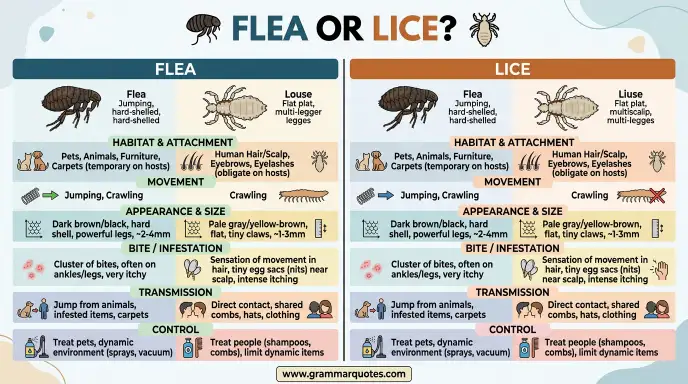
Fleas and lice are both small parasites, but they are different insects with different habits, hosts, and ways of moving. Fleas are known for jumping and are often found on pets, while lice usually live on a specific host and move through hair or clothing.
People often confuse these tiny pests because both can cause itching and discomfort. However, they are not the same. A flea can jump from place to place, while a louse cannot jump or fly. Lice usually stay close to their host, while fleas may move between animals, people, carpets, bedding, and other environments.
Understanding the difference is useful when identifying an infestation. It can also help you use the right words when writing about insects, pets, hygiene, or pest problems.
In this guide, we will explain the meanings, origins, appearance, behavior, life cycles, common mistakes, everyday examples, British and American usage, and key differences between these two words.
Flea or Lice : Quick Answer
A flea is a small, wingless insect that can jump and commonly feeds on the blood of mammals and birds. Lice are tiny parasitic insects that usually live on a specific host and feed on blood or other materials depending on the species.
The biggest difference is their lifestyle and movement.
- Flea: Can jump long distances compared with its body size.
- Louse: Cannot jump or fly.
- Fleas: Commonly affect pets such as cats and dogs.
- Lice: Different species affect humans, birds, and other animals.
- Fleas: May live in the surrounding environment as well as on an animal.
- Lice: Usually spend most of their lives on their host.
For example:
The dog may have fleas.
The child may have head lice.
These sentences describe different types of parasites.
Definition and Meaning
What is a flea?
A flea is a small, wingless insect belonging to the order Siphonaptera. It has a body adapted for moving through fur or feathers and powerful legs that allow it to jump.
Fleas commonly feed on blood. Some species are associated with domestic animals, while others affect wildlife.
The singular form is:
flea
The plural form is:
fleas
Example:
I found a flea on the dog.
The dog has fleas.
What are lice?
Lice is the plural form of louse. These are small parasitic insects that live on a host.
The singular form is:
louse
The plural form is:
lice
Example:
A louse was found on the animal.
The animal has lice.
This singular plural change is unusual in English, similar to other irregular pairs such as mouse → mice.
Flea vs Louse: The Main Difference
Although both are parasites, their biology is different.
| Feature | Flea | Louse |
| Type | Wingless insect | Parasitic insect |
| Movement | Jumps and crawls | Crawls |
| Can jump? | Yes | No |
| Can fly? | No | No |
| Common hosts | Mammals and birds | Humans and many animals |
| Lives on host | Sometimes | Usually |
| Plural | Fleas | Lice |
| Singular | Flea | Louse |
| Body shape | Laterally flattened | Usually flattened |
| Common association | Pets and animals | Hair, feathers, or fur |
The words describe different insects, so they should not be used as interchangeable terms.
How Do Fleas Move?
One of the most recognizable features of a flea is its ability to jump.
Its strong hind legs help it move quickly and escape danger. This allows it to travel between nearby hosts or locations.
Fleas can also crawl through fur, bedding, carpets, and other surfaces.
This means seeing a flea on a pet does not necessarily mean the insect is only on the animal. Flea life stages can also occur in the surrounding environment.
How Do Lice Move?
Lice are different.
They crawl rather than jump or fly. Their bodies and claws are adapted for holding onto hair, feathers, or fur.
Human head lice, for example, are adapted to living on human scalp hair.
This is one of the easiest ways to distinguish the two types of insects:
Fleas jump. Lice crawl.
That simple difference can help you remember which insect you are talking about.
Fleas and Pets
Fleas are strongly associated with household pets, especially dogs and cats.
An animal may pick them up from an environment where fleas are present. Once introduced into a home, the insects can also be found in places where pets rest.
Common places associated with flea activity include:
- Pet bedding
- Carpets
- Rugs
- Furniture
- Outdoor areas
- Animal sleeping areas
If you notice excessive scratching on a pet, a veterinarian can help determine if fleas or another problem may be responsible.
Lice and Humans
When people use the word lice in everyday conversation, they often mean head lice.
Head lice live on the human scalp and attach their eggs, commonly called nits, to hair shafts.
They spread mainly through close head to head contact. They do not jump or fly.
Other types of human lice exist, including body lice and pubic lice, each with different habitats and characteristics.
If someone suspects an infestation, a healthcare professional or pharmacist can provide appropriate guidance.
Flea Eggs or Lice Eggs
Both insects produce eggs, but the eggs are found in different places.
Flea eggs are commonly associated with an animal’s environment. They may fall from the host into bedding, carpets, or other areas.
Lice eggs, or nits, are typically attached to individual hairs close to the scalp or another suitable host surface, depending on the species.
This difference is useful when identifying the source of a problem.
Are flea eggs and nits the same?
No.
They belong to different insects and have different characteristics.
A nit is a louse egg or empty egg case attached to hair. Flea eggs are associated with the flea life cycle and are generally not attached to hair in the same way.
Flea or Lice: Which One Jumps?
Fleas jump. Lice do not.
This is one of the simplest identification clues.
If an insect appears to jump rapidly, a flea may be involved. If tiny insects are crawling through hair and holding onto the hair shafts, lice may be more likely.
However, visual identification can be difficult because these insects are very small. A professional should be consulted when accurate identification matters.
Can Fleas Live on Humans?
Fleas can bite humans, but humans are not the preferred long term host for many common flea species.
For example, the cat flea can feed on humans, dogs, and cats. However, its life cycle is closely associated with suitable animal hosts and their environments.
So, finding a flea bite does not necessarily mean a person has a permanent infestation on their body.
Can Lice Live on Animals?
Different lice species are adapted to different hosts.
Some lice affect humans, while others are adapted to dogs, cats, birds, livestock, and other animals.
A louse species that normally lives on one host may not be able to establish itself successfully on another species.
This is why identifying the host is important when discussing lice.
Common Mistakes
1. Treating both words as synonyms
They describe different insects.
❌ The dog has lice when you mean fleas.
✅ The dog has fleas.
2. Using “lice” for one insect
Lice is plural.
For one insect, use louse.
❌ I found one lice.
✅ I found one louse.
3. Using “flea” as the plural
The plural is fleas.
❌ There are several flea.
✅ There are several fleas.
4. Assuming lice can jump
They cannot jump or fly.
They move by crawling and holding onto their host.
5. Assuming every itchy bite comes from these insects
Itching can have many causes. A bite or rash alone does not identify the insect responsible.
Everyday Examples
Here are some natural examples:
- The puppy was scratching because it had fleas.
- We checked the pet’s bedding for signs of fleas.
- The veterinarian examined the dog.
- The school informed parents about a case of head lice.
- She checked her child’s hair carefully.
- Lice spread mainly through close contact.
- Fleas can move through carpets and pet bedding.
- The insect jumped away when disturbed.
- A louse is the singular form of lice.
- Fleas and lice are different types of parasites.
Flea vs Lice in Grammar
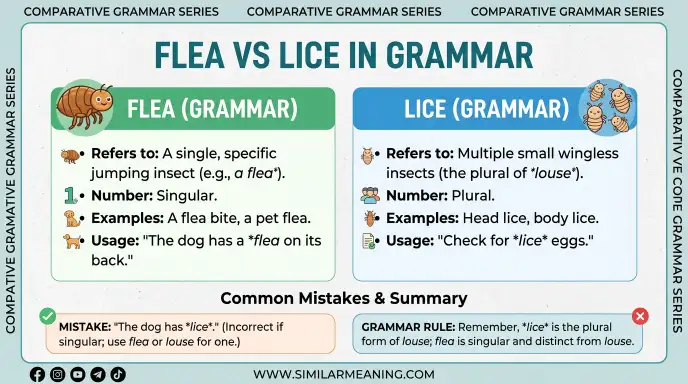
There is also an important grammar difference.
Flea
Flea is a regular countable noun.
- One flea
- Two fleas
- Several fleas
Louse
Louse is singular.
- One louse
Lice is plural.
- Two lice
- Several lice
Compare:
I found one louse.
I found several lice.
This irregular plural is one reason English learners sometimes search for the correct form.
British English vs American English
There is no major spelling difference between British and American English for these words.
Both varieties use:
- flea
- fleas
- louse
- lice
The pronunciation and vocabulary may vary slightly by region, but the standard spellings remain the same.
In both British and American English, lice refers to more than one louse.
Fleas vs Lice in Formal Writing
When writing about insects, pets, health, biology, or hygiene, use the specific term that matches the subject.
For example:
Fleas are external parasites commonly associated with mammals and birds.
Or:
Head lice are small parasitic insects that live on human scalp hair.
Avoid using one term as a general replacement for the other.
Scientific and educational writing benefits from precise terminology because different insects have different life cycles and behaviors.
How to Remember the Difference
Use this simple memory trick:
Flea = Jump
Think of the flea’s powerful legs.
Louse = Crawl
Think of the insect holding onto hair or fur.
You can also remember:
One louse, two or more lice.
And:
One flea, two or more fleas.
These two rules cover both the biology and the grammar.
Pronunciation
The two terms are short, but the plural form of louse changes significantly.
- Flea rhymes closely with words such as “sea” and “tea.”
- Lice has the same vowel sound found in “ice.”
- Louse has a different vowel sound and becomes lice in the plural.
Learning the singular and plural together can make the difference easier to remember.
Flea or Lice: Which Word Should You Use?
Choose the word based on the insect you mean.
Use flea when discussing the small jumping parasite commonly associated with pets and other animals.
Louse for one individual insect in the louse group.
Use lice when talking about more than one louse.
For example:
My cat has fleas.
The child has head lice.
The context tells you which term is appropriate.
Comparison at a Glance
| Question | Flea | Louse / Lice |
| Is it an insect? | Yes | Yes |
| Is it parasitic? | Yes | Yes |
| Does it jump? | Yes | No |
| Does it fly? | No | No |
| Does it crawl? | Yes | Yes |
| Common human association | Bites | Head lice |
| Common pet association | Dogs and cats | Various animal species |
| Singular | Flea | Louse |
| Plural | Fleas | Lice |
| Eggs | Flea eggs | Nits are louse eggs |
Google Trends & Usage
Searches for these terms often come from two different types of questions.
People searching for flea may be interested in pets, insects, bites, pest control, or animal care.
People searching for lice may be looking for information about hair, children, hygiene, or identifying an infestation.
Search interest can change by season, region, and current concerns. Rather than assuming one term is always more popular, it is better to look at the specific country and time period when analyzing search data.
For an English learning website, both terms can be useful because they teach vocabulary as well as an important singular plural distinction.
People Also Ask Questions
1. What is the difference between a flea and a louse?
A flea can jump, while a louse crawls and normally remains closely associated with its host.
2. Can fleas jump?
Yes. Jumping is one of their most recognizable characteristics.
3. Can lice jump?
No. Lice crawl and do not jump or fly.
4. Is lice singular or plural?
Lice is plural. The singular form is louse.
5. What is the plural of flea?
The plural is fleas.
6. Can fleas live on humans?
Fleas can bite humans, although many flea species are more closely associated with animal hosts.
7. Can humans get lice from pets?
The answer depends on the particular louse species. Lice are generally adapted to specific hosts.
8. Are nits lice?
Nits are the eggs or egg cases of lice.
9. Which insect crawls through hair?
Lice crawl through hair and use specialized structures to hold onto their host.
10. Are fleas and lice the same thing?
No. They are different groups of parasitic insects with different biology and behavior.
FAQs
Is a flea the same as a louse?
No. They are different insects. Fleas are especially known for jumping, while lice crawl and stay closely associated with their hosts.
What is one louse called?
One individual is called a louse. More than one is called lice.
What is one flea called?
One is a flea, and more than one is fleas.
Can lice fly?
No. Lice cannot fly.
Can fleas fly?
No. Fleas are wingless, but they can jump.
Why are fleas common on pets?
Many flea species are adapted to feeding on mammals and birds, including common household pets.
Why do people confuse fleas and lice?
Both are small parasitic insects and can cause itching or discomfort. Their different movement, habitats, and life cycles help distinguish them.
Final Comparison
| Feature | Flea | Louse / Lice |
| Main movement | Jumping and crawling | Crawling |
| Wings | None | None |
| Can jump? | Yes | No |
| Singular | Flea | Louse |
| Plural | Fleas | Lice |
| Common host examples | Cats, dogs, wildlife | Humans and various animals |
| Eggs | Flea eggs | Nits |
| Often associated with | Pets and environments | Hair, feathers, or fur |
| Same insect? | No | No |
Conclusion
Fleas and lice are both small parasitic insects, but they are not the same. The easiest difference to remember is movement: fleas can jump, while lice crawl.
The grammar is also important. One insect is a flea, while several are fleas. For the other group, one is a louse, while more than one is lice. This irregular plural is a common source of confusion for English learners.
The two terms should not be used interchangeably. Fleas are commonly associated with pets and their surroundings, while different louse species are adapted to specific hosts, including humans and various animals.
If you are writing about insects, pets, hygiene, or biology, choosing the precise word makes your sentence clearer. Remember the simple rule: flea means the jumping parasite, while louse and lice refer to a different group of crawling parasites.
Discover More Articles!
Since or Because: What Is the Difference?(2026)
Freckle or Cancer: Understanding the Difference Between Them
Conversing or Conversating: Which Word Is Correct?

Ethan Parker is an English-language writer known for his interest in words, language, and clear communication. His work focuses on making everyday English easier to understand through simple explanations and practical examples.