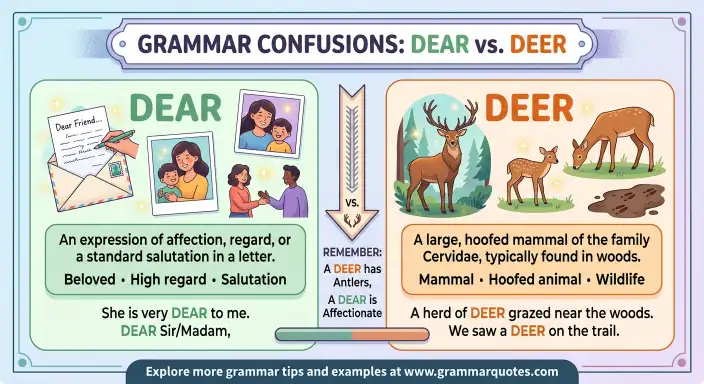
Have you ever wondered if to write dear or deer? Both words are correct, but they have completely different meanings. Dear is commonly used to address someone affectionately or politely, while deer refers to an animal often found in forests, grasslands, and parks.
For example, you might begin a letter with “Dear Sarah” when writing to a friend or colleague. However, “A deer crossed the road” describes an animal moving across the street.
These words are easy to confuse because they sound the same in many English accents. Such words are called homophones. They have the same pronunciation but different spellings and meanings.
Understanding the difference can help you avoid mistakes in emails, school assignments, stories, and everyday writing. In this guide, you will learn the meaning of dear and deer, discover when to use each word, and explore common spelling mistakes. You will also find practical examples, comparison tables, and answers to frequently asked questions.
Dear vs Deer: Quick Answer
Dear and deer are both correct English words, but they are used in different situations.
- Dear: An adjective used to express affection or importance. It is also used as a polite greeting in letters and emails.
- Deer: A noun that refers to a hoofed mammal, often recognized by its long legs and, in many species, antlers.
Examples of Dear
- Dear John, thank you for your help.
- She is a dear friend of mine.
- This old photograph is very dear to me.
Examples of Deer
- A deer was standing near the trees.
- We saw several deer in the forest.
- The deer ran across the field.
Easy rule: Use dear when talking about affection, value, or a greeting. Use deer when talking about the animal.
Definition and Meaning
What Does Dear Mean?
Dear is an adjective that describes someone or something loved, valued, or important. It can also be used as a polite way to address someone in a letter, email, or conversation.
Examples:
- My grandmother is very dear to me.
- Dear Mr. Ahmed, thank you for your message.
- This watch is dear to my heart.
The word can also describe something that costs a lot of money, although this use is less common in everyday conversation.
Example:
- Food has become dear in some places.
In this sentence, dear means expensive.
What Does Deer Mean?
Deer is a noun that refers to a group of hoofed mammals belonging to the family Cervidae. Many deer species have antlers, which are usually grown by males, although there are exceptions, such as reindeer.
Examples:
- A deer stood beside the road.
- The children watched the deer from a safe distance.
- We saw deer grazing in the meadow.
The word deer has the same form for both singular and plural in standard English.
- Singular: One deer.
- Plural: Three deer.
You do not normally add s to make deer plural.
The Origin of Dear and Deer
The Origin of Dear
The word dear comes from Old English dēore, which meant precious, valuable, or beloved. It has long been used to describe people and things that hold special importance.
Over time, it also became a common form of address in letters and personal messages.
Examples:
- My dear friend helped me during a difficult time.
- Dear teacher, I have a question.
Today, the word appears in greetings, affectionate expressions, and descriptions of things that matter to us.
The Origin of Deer
The word deer comes from Old English dēor. Historically, it could refer to an animal more generally. Over time, its meaning became more specific, referring to the animals now known as deer.
Examples:
- The deer moved quietly through the woods.
- A deer appeared near the edge of the village.
Although dear and deer have different meanings today, their historical forms help explain why the words look and sound similar.
British English vs American English
The spelling and basic meanings of dear and deer are the same in British and American English.
| Feature | British English | American English |
| Affectionate word | Dear | Dear |
| Animal | Deer | Deer |
| Pronunciation | Usually the same | Usually the same |
| Singular animal | One deer | One deer |
| Plural animals | Two deer | Two deer |
Is There Any Difference in Usage?
There is no major spelling difference between the two varieties. However, pronunciation may vary slightly depending on a speaker’s accent.
Examples:
- British English: Dear friend, thank you for your letter.
- American English: Dear friend, thank you for your letter.
- Both: We saw two deer near the woods.
The correct spelling depends on the meaning, not the country.
When to Use Dear
Use dear when expressing affection, describing something valuable, or addressing someone politely.
1. In Letters and Emails
Dear is commonly used at the beginning of letters and formal or informal emails.
Examples:
- Dear Mr. Khan, I am writing to ask a question.
- Dear Sara, thank you for your birthday wishes.
- Dear Admissions Team, I would like to know more about the application process.
It is a useful greeting in both personal and professional communication.
2. To Express Love or Affection
Use dear to describe someone who is loved or valued.
Examples:
- She is a dear friend.
- My family is very dear to me.
- He gave a gift to someone dear to him.
3. To Describe Something Important
The word can describe an object, memory, or idea that has special value.
Examples:
- This necklace is very dear to my heart.
- The old house holds dear memories.
- Education is dear to her.
4. To Mean Expensive
In some contexts, dear means costly or expensive. This use is more common in certain varieties of English, including British English.
Examples:
- The hotel was too dear for our budget.
- Fresh fruit can be dear during some seasons.
In everyday American English, expensive is often more common for this meaning.
When to Use Deer
Use deer when referring to the animal.
1. When Talking About Wildlife
Examples:
- A deer was drinking water near the lake.
- Deer live in many different habitats.
- We spotted a deer in the forest.
2. When Describing Nature
The word is common in stories, wildlife reports, and descriptions of outdoor scenes.
Examples:
- The deer moved through the quiet forest.
- Several deer were grazing in the field.
- A deer stood beneath the tall trees.
3. When Talking About More Than One Animal
Remember that the plural of deer is also deer.
Examples:
- One deer crossed the road.
- Five deer crossed the road.
- Many deer live in the park.
Avoid writing deers when you mean the ordinary plural of the animal.
Common Mistakes with Dear and Deer
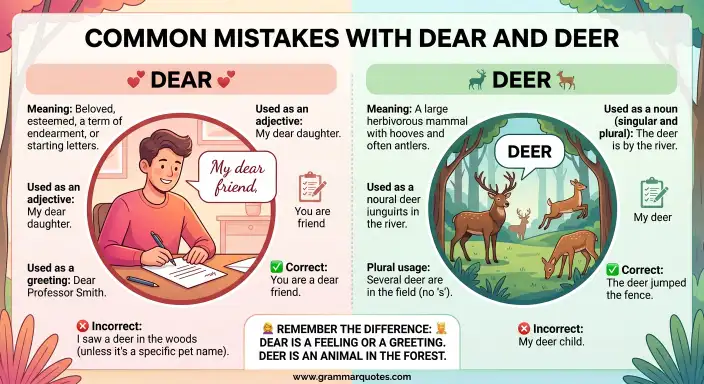
Mistake 1: Using Deer in a Greeting
Incorrect: Deer Mr. Ahmed, thank you for your email.
Correct: Dear Mr. Ahmed, thank you for your email.
Why? Dear is the conventional spelling for a polite greeting.
Mistake 2: Using Dear for the Animal
Incorrect: We saw a dear in the forest.
Correct: We saw a deer in the forest.
Why? Deer is the noun for the animal.
Mistake 3: Writing Deers as the Plural
Incorrect: We saw three deers near the river.
Correct: We saw three deer near the river.
Why? The usual plural form of deer is unchanged.
Mistake 4: Confusing Dear with Expensive
Dear can mean expensive in some contexts, but it does not always express affection.
Examples:
- My dear friend lives nearby. — Affection.
- The restaurant is too dear for me. — Expensive.
Always use the context to understand the intended meaning.
Everyday Examples of Dear vs. Deer
In Daily Conversation
- Dear friend, how have you been?
- A deer walked into the garden.
- My little sister is very dear to me.
- We saw two deer during our walk.
In School and Academic Writing
- Dear teacher, I need help with my assignment.
- The deer is a mammal.
- The students wrote a story about a deer in the woods.
- The book is dear to the main character.
Work and Professional Writing
- Dear Hiring Manager, I am applying for the position.
- The wildlife report described the deer population.
- Dear Customer, your order has been received.
- The park protects deer and other wild animals.
In Social Media and Personal Messages
- Happy birthday to my dear friend!
- Look at this beautiful deer.
- My family will always be dear to me.
- We were lucky to see a deer today.
Dear vs Deer: Side by Side Comparison
| Feature | Dear | Deer |
| Part of speech | Usually an adjective; also a form of address | Noun |
| Main meaning | Loved, valued, polite greeting, or expensive | A hoofed mammal |
| Used for people | Yes | No, not in its ordinary meaning |
| Used for animals | Not as the animal’s name | Yes |
| Singular form | Dear | Deer |
| Plural form | Dear friends | Deer |
| Example | Dear Sarah, thank you. | A deer crossed the road. |
Are Dear and Deer Homophones?
Yes. Dear and deer are homophones in many English accents. This means they sound alike but have different spellings and meanings.
For example:
- Dear friend, I miss you.
- A deer is standing near the tree.
The surrounding words help readers understand which meaning is intended.
Easy Tricks to Remember the Difference
Trick 1: Remember the Greeting
If you are starting a letter or email, use dear.
Example: Dear Sir or Madam, thank you for your time.
Trick 2: Think About the Animal
If your sentence describes wildlife, forests, antlers, or an animal crossing a road, use deer.
Example: A deer was grazing in the field.
Trick 3: Remember the Meaning
- Dear = loved, valued, or used in a greeting.
- Deer = an animal.
Trick 4: Check the Plural
If you are talking about several animals, write deer, not deers.
Example: We saw four deer near the lake.
Frequently Asked Questions
1. What Is the Difference Between Dear and Deer?
Dear expresses affection, value, or a polite greeting. Deer is the name of an animal.
2. Is Dear or Deer Correct?
Both are correct words. Use dear when addressing someone or describing something valued, and deer when talking about the animal.
3. Are Dear and Deer Pronounced the Same?
Yes. They sound the same in many English accents, so they are considered homophones.
4. Is It Dear Friend or Deer Friend?
The correct phrase is dear friend because it expresses affection. Deer friend would not have that meaning.
5. What Is the Plural of Deer?
The plural is deer. For example, “We saw three deer in the forest.”
6. Can Dear Mean Expensive?
Yes. In some varieties of English, especially British English, dear can mean expensive or costly.
7. How Do You Use Dear in an Email?
Use Dear followed by the person’s name, title, or the name of the team you are contacting.
Example: Dear Admissions Team, I am writing to ask about the application process.
8. Can Deer Be Used for More Than One Animal?
Yes. Deer can refer to one animal or several animals.
Examples: One deer, two deer, and ten deer.
9. Why Are Dear and Deer Confused?
They are often confused because they sound alike. Their different spellings reflect their different meanings.
10. How Can I Remember Dear vs. Deer?
Remember that dear is used in greetings and affectionate expressions, while deer names the animal you might see in a forest.
Conclusion
The difference between dear and deer is easy to understand once you learn what each word means. Use dear when addressing someone politely, expressing affection, or describing something valuable. For example, “Dear Sarah” is a common way to begin a letter, while “My grandmother is dear to me” expresses love and respect.
Use deer when referring to the animal. You might write, “A deer crossed the road” or “We saw three deer in the forest.” Remember that the plural of deer is also deer, so you do not usually add an s.
Both words sound alike in many English accents, but their meanings are different. This makes context especially important when reading or writing them.
A simple rule will help you remember: dear is for affection or greetings, and deer is the animal. With regular practice, you can use both words correctly in emails, schoolwork, stories, and everyday conversations.
Discover More Articles!
Offered vs Offerred: Which Spelling Is Correct and Why It Matters
Boat or Ship: What’s the Difference?(2026)
YAML vs YML: What’s the Difference?(2026)

Ethan Parker is an English-language writer known for his interest in words, language, and clear communication. His work focuses on making everyday English easier to understand through simple explanations and practical examples.