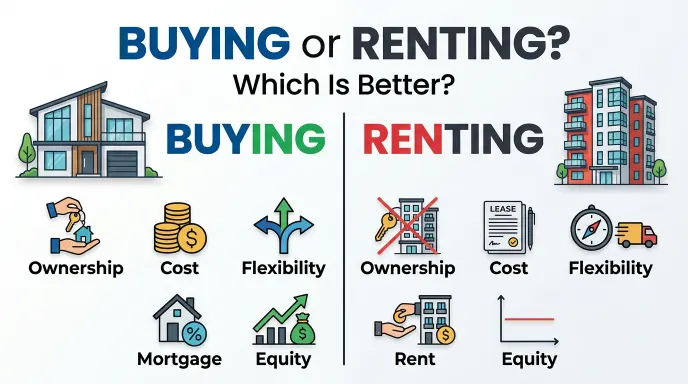
Buying or Renting means choosing between purchasing a home or property to own it, and paying rent to live in a property owned by someone else. It compares ownership, costs, flexibility, maintenance, and long term financial benefits.
People often search for “buying or renting” because they want to know which option makes more financial sense, if they should own a home, or if renting is the smarter choice for their current situation.
The answer depends on factors such as income, savings, housing costs, job stability, location, future plans, and how long you expect to stay in one place.
This guide explains buying or renting in simple terms. You will learn what each option means, how the costs compare, which choice may suit different situations, common mistakes to avoid, and practical examples you can use when making your decision.
Buying or Renting: Quick Answer
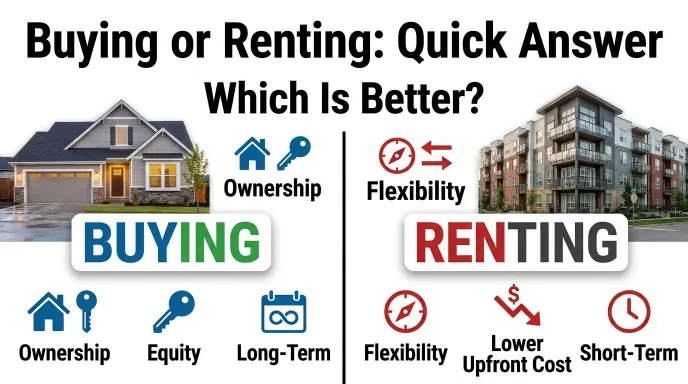
Buying means purchasing a property and becoming its owner. Renting means paying a landlord to live in a property without owning it.
As a simple rule:
- Buying may be better if you plan to stay for many years, have enough savings, and want to build home equity.
- Renting may be better if you need flexibility, have limited savings, or are unsure where you will live long term.
- The cheapest monthly payment is not always the cheapest overall option.
- The right choice depends on both your finances and your lifestyle.
What Does Buying or Renting Mean?
What does buying mean?
Buying a home means purchasing a property from an owner, developer, or seller. Once the transaction is completed, you own the property, subject to any mortgage or other legal obligations.
Homeowners may have costs such as:
- Down payment
- Mortgage payments
- Property taxes
- Home insurance
- Maintenance and repairs
- Utilities
- Closing costs
- Homeowners association fees, where applicable
The major benefit is that part of your housing payment may build equity, which is the portion of the property you own.
What does renting mean?
Renting means paying a landlord or property management company for the right to live in a property.
Renters commonly pay:
- Monthly rent
- Security deposit
- Utilities, depending on the agreement
- Renter’s insurance, where required or recommended
- Application or administrative fees in some markets
Renting does not normally give you ownership of the property. However, it can provide greater flexibility and fewer responsibilities for major repairs.
Buying vs renting in simple terms
Think of it this way:
Buying: You pay for a property with the goal of owning it.
Renting: You pay for the right to use a property for a specific period.
Both can be sensible choices. The better option depends on your circumstances.
The Origin of Buying or Renting
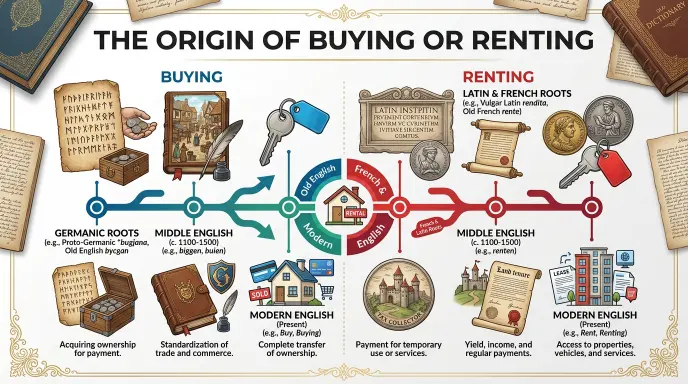
The words buying and renting come from two different English verbs.
Buy has Old English roots and has long referred to obtaining something in exchange for money. Rent comes through French from Latin roots associated with paying or receiving payment for the use of property.
In modern English, buying and renting are commonly used together when discussing housing choices. The phrase “buying or renting” is therefore not a question of which spelling is correct. It is a comparison between two different housing arrangements.
The wording appears frequently in personal finance, real estate, housing advice, and everyday conversations because people often need to compare the costs and benefits of owning a property with those of living in a rented home.
British English vs American English
The basic terms buying and renting are used in both British and American English. The main differences are often related to real estate vocabulary rather than the words buying and renting themselves.
| British English | American English | Example |
| Buying a house | Buying a house | We are thinking about buying a house. |
| Renting a flat | Renting an apartment | They are renting an apartment downtown. |
| Flat | Apartment | She rents a flat near work. |
| Estate agent | Real estate agent | We contacted a real estate agent. |
| Mortgage | Mortgage | They applied for a mortgage. |
| Landlord | Landlord | The landlord manages the property. |
| Tenant | Tenant | The tenant pays rent each month. |
The word flat is especially common in British English, while apartment is more common in American English. In Canada and Australia, usage can vary by context.
For international writing, both buying and renting are clear and widely understood.
Which Version Should You Use?
If you are deciding between the words themselves, there is no regional rule that makes buying correct and renting incorrect. Both are standard English.
If you are deciding which housing option to choose, however, your location and circumstances matter.
United States
Buying may make sense when you have stable income, sufficient savings, and expect to remain in the property for a long period. Renting may be attractive when you value mobility or do not want responsibility for property maintenance.
United Kingdom
The same basic principles apply. Compare the full cost of ownership with rent, not simply the mortgage payment versus monthly rent.
Canada
Housing prices and rental costs can vary significantly by city. Consider local property prices, mortgage costs, taxes, insurance, and expected length of stay.
Australia
Think beyond the advertised purchase price or rent. Include financing, maintenance, insurance, taxes, and other ownership costs.
International writing
Use buying or renting when you want a simple, widely understood phrase. You can add a home, a house, or property to make the meaning more specific.
Academic writing
Use precise language. Instead of saying, “Buying is better,” explain the factors behind the conclusion, such as long term costs, opportunity cost, mobility, and financial risk.
Business writing
Keep the comparison practical. Focus on cash flow, long term commitments, operating costs, and the reader’s specific objectives.
Common Mistakes
Mistake 1: Comparing rent only with the mortgage payment
Incorrect thinking:
“If rent is higher than the mortgage payment, buying must be cheaper.”
Better approach:
Compare rent with the total cost of owning.
Why?
Homeowners can have taxes, insurance, maintenance, repairs, fees, and financing costs.
Memory tip:
Mortgage is only one part of ownership.
Mistake 2: Assuming renting means wasting money
Incorrect thinking:
“Rent is wasted money.”
Correct understanding:
Rent pays for housing and flexibility. It does not normally create property ownership, but it can help you avoid certain ownership costs and responsibilities.
Memory tip:
Rent buys use and flexibility, while buying can create ownership and equity.
Mistake 3: Ignoring the upfront cost of buying
Incorrect thinking:
“I can afford the monthly mortgage, so I can afford the house.”
Better approach:
Consider the down payment, closing costs, moving costs, emergency savings, and other upfront expenses.
Mistake 4: Buying only because property prices may rise
Property values can increase, but they can also remain flat or decline. A home should not be treated as a guaranteed investment.
Mistake 5: Renting without checking the full agreement
Renters should understand the lease period, renewal terms, deposits, maintenance responsibilities, restrictions, and other fees before signing.
Everyday Examples
Emails
“We are comparing the costs of buying or renting before making a decision.”
Business writing
“The company is evaluating if buying or renting office space is more cost effective.”
News headlines
“Buying or Renting: What Makes Sense in Today’s Housing Market?”
Blogs
“Buying or renting can affect your finances in very different ways, especially if you plan to move soon.”
Social media
“Buying or renting? The right answer depends on your budget, plans, and local housing costs.”
Academic writing
“The decision between buying and renting involves financial, social, and lifestyle considerations.”
Daily conversation
“Are you thinking about buying or renting?”
“We are renting for now because we may move next year.”
Google Trends & Modern Usage
The phrase “buying or renting” is a natural search query because housing decisions involve both financial and lifestyle questions. People commonly use the phrase when comparing home ownership with renting.
Search interest can vary by country, city, economic conditions, property prices, mortgage rates, rental costs, and broader housing market conditions. The exact popularity of the query also changes over time.
It is important not to assume that one option is universally cheaper. A useful comparison should consider:
- Monthly housing costs
- Upfront costs
- Financing costs
- Maintenance
- Taxes and insurance
- Expected length of stay
- Property value changes
- Investment opportunities for unused savings
- Job and location flexibility
People also search related phrases such as “buying vs renting,” “should I buy or rent,” “is it better to buy or rent,” “renting vs buying a house,” and “buy or rent calculator.”
These searches show that the main intent is usually comparison and decision making, rather than simply learning the meaning of the phrase.
Quick Comparison Table
| Version | Meaning | Correct? | Region | Example |
| Buying | Purchasing and owning property | Yes | International | We are buying a house. |
| Renting | Paying to use property without owning it | Yes | International | We are renting a house. |
| Buying or renting | Comparing ownership with rental housing | Yes | International | We are deciding between buying or renting. |
| Buying vs renting | Direct comparison of the two options | Yes | International | Buying vs renting depends on your situation. |
Buying vs Renting: Practical Comparison
| Factor | Buying | Renting |
| Ownership | You own the property | Landlord owns the property |
| Upfront cost | Usually higher | Usually lower |
| Monthly payment | Mortgage and other costs | Rent and possible additional fees |
| Maintenance | Usually owner’s responsibility | Often landlord’s responsibility for major repairs |
| Flexibility | Lower | Usually higher |
| Equity | Can build equity | Does not normally build property equity |
| Long term commitment | Usually higher | Usually lower |
| Property value risk | Owner bears the risk | Landlord generally bears property value risk |
| Moving | Can be more complicated | Often easier after the lease ends |
| Customization | Usually greater | Often limited by the lease |
Key Takeaways
- Buying or renting is a comparison, not a spelling question.
- Buying gives you property ownership and may allow you to build equity.
- Renting usually provides more flexibility and fewer major maintenance responsibilities.
- Buying requires more attention to upfront and ongoing costs.
- Renting is not automatically cheaper, and buying is not automatically a better investment.
- Your expected length of stay is an important part of the decision.
- Local housing prices, financing costs, taxes, and rental rates can change the calculation.
- The best choice is the one that fits your finances, plans, and risk tolerance.
FAQs
1. Is buying or renting a home better?
There is no single answer because the better choice depends on your finances, plans, and lifestyle.
Buying can provide ownership and the potential to build equity, while renting can offer flexibility and lower upfront costs. Consider your savings, monthly budget, expected length of stay, and the total cost of each option.
2. What are the main advantages of buying a home?
Buying can provide long-term ownership, the potential to build equity, and more control over the property. Homeowners may also have greater freedom to renovate or customize their homes.
However, buying comes with responsibilities such as maintenance, repairs, insurance, taxes, and other ongoing expenses.
3. What are the main advantages of renting a home?
Renting can offer greater flexibility and usually requires less money upfront than buying. Depending on the rental agreement, major repairs may also be handled by the landlord.
Renting can be useful for people who expect to relocate, are saving for a future purchase, or are not ready for long term ownership.
4. Is buying always a better investment than renting?
No. Buying a home is not automatically a better investment. Property values can change, while homeowners also face financing costs, maintenance, taxes, insurance, and transaction expenses.
A fair comparison should consider the complete cost of ownership and what you could do with your money if you choose to rent.
5. How long should you live in a home before buying?
There is no fixed number of years that works for everyone. Buying may make more sense when you expect to stay long enough to spread out the costs of purchasing and eventually selling the property. If you may move soon, renting can offer more flexibility and fewer transaction concerns.
6. Why do people choose renting instead of buying?
People may choose renting because they want flexibility, have limited savings, expect to move, or prefer not to handle property maintenance.
Renting can also make it easier to live in an expensive area without purchasing a property. Your financial situation and future plans should guide the decision.
7. What costs should I consider when buying a house?
Consider more than the purchase price or mortgage payment. Buying can involve a down payment, closing costs, interest, property taxes, insurance, maintenance, repairs, utilities, and possible association fees. Looking at all these expenses gives you a more realistic picture of the cost of homeownership.
8. What costs should I consider when renting?
When renting, consider the monthly rent along with the security deposit, utilities, renter’s insurance, parking, application fees, and other possible charges.
You should also review the lease to understand rent increases, renewal terms, maintenance responsibilities, and other conditions before signing.
Conclusion
The choice between buying or renting is not simply about finding the lowest monthly payment.
Buying gives you ownership and may allow you to build equity, but it also brings upfront costs, maintenance, financing, and long term responsibility. Renting usually offers greater flexibility and can require less money upfront, but you generally do not build ownership in the property.
For someone planning to stay in one place for many years with stable finances and sufficient savings, buying may be worth considering.
For someone who expects to move, values flexibility, or is not ready for the financial responsibility of ownership, renting may be the more practical choice.
The best decision depends on your income, savings, location, housing costs, future plans, and comfort with financial risk.
Before deciding, compare the total cost of buying with the total cost of renting over the period you expect to live in the property.
Memorable takeaway: Choose the housing option that fits your life, not simply the one with the lower monthly payment.
Discover More Articles!
Oases or Oasis: Meaning, Difference, and Correct Usage
Obay or Obey: Which Spelling Is Correct?
Ques or Cues: Meaning, Usage, and Examples

Hi,I am a Adrian walker. I’m passionate about making English grammar simple and easy to understand. I write clear comparisons that explain confusing words, spelling differences, and common grammar mistakes so readers can write with confidence. My goal is to provide accurate, practical, and easy-to-follow language guides for learners and writers worldwide.