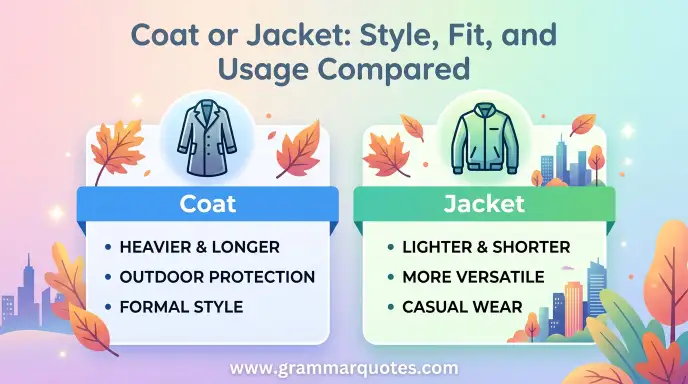
A coat is usually longer and warmer than a jacket, while a jacket is generally shorter and better for lighter or everyday wear.
Both are outerwear, but they differ in length, warmth, style, and use. This is why many people search for coat or jacket when choosing what to wear in cold or changing weather.
The difference is not always strict because clothing styles can overlap. Some jackets are very warm, while some coats are lightweight. The main clue is usually the garment’s length and intended purpose.
In this guide, we will explain coat or jacket in simple English. You will learn what each word means, where the terms come from, how coats and jackets differ, and when to use each one. We will also look at everyday examples, common mistakes, and questions people often ask about these two types of outerwear.
Coat or Jacket : Quick Answer
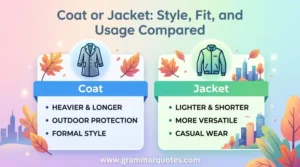
A coat is usually a longer outer garment designed to provide warmth and protection from cold weather. A jacket is generally shorter and is often used for everyday wear, mild weather, fashion, or specific activities.
Simple difference:
| Coat | Jacket |
| Usually longer | Usually shorter |
| Often warmer | Usually lighter |
| Common in cold weather | Common in mild or cool weather |
| May reach the knees | Usually ends around the waist or hips |
| Often worn over other clothing | Can be worn as a lighter outer layer |
For example:
- I wore a coat because it was freezing outside.
- She wore a jacket on her way to school.
So, if you need more warmth and coverage, a coat is often the better choice. If you want something shorter and more flexible, a jacket may be more suitable.
Coat and Jacket : Definition and Meaning
What Is a Coat?
A coat is an outer garment that is usually worn over other clothes. Coats are often designed to provide warmth and protection from cold, wind, or rain.
Examples include:
- Winter coat
- Overcoat
- Trench coat
- Wool coat
- Raincoat
- Peacoat
A coat can be formal or casual depending on its style.
What Is a Jacket?
A jacket is also an outer garment, but it is generally shorter than a coat. Jackets can be designed for warmth, fashion, work, sports, or protection.
Examples include:
- Denim jacket
- Leather jacket
- Bomber jacket
- Puffer jacket
- Blazer jacket
- Windbreaker
A jacket is often easier to wear for everyday activities because it is shorter and usually less bulky.
The Origin of Jacket and Coat
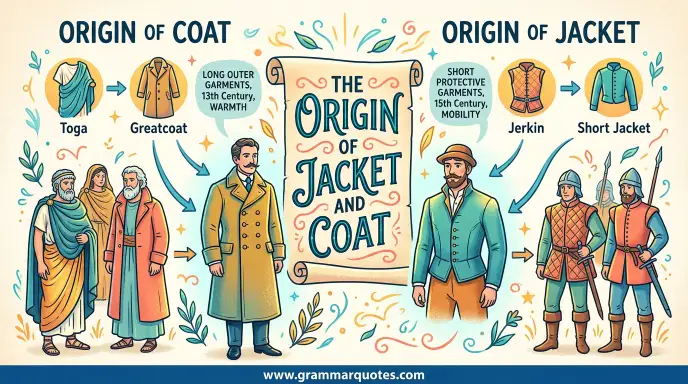
The word coat has a long history in English and has been used for different types of outer clothing for centuries. Over time, its meaning developed to describe garments worn over other clothes, especially for protection from weather.
The word jacket is related to the French word jaquette, which referred to a type of short coat or garment. The term later became common in English for shorter outerwear.
As clothing styles changed, the distinction between coats and jackets became more familiar. Today, designers use many different lengths, materials, and styles, so the line between the two can sometimes be unclear.
Coat vs Jacket: What Is the Main Difference?
The biggest difference is usually length and purpose.
A coat generally provides more coverage and is often associated with colder weather. A jacket usually provides less coverage and is commonly used for lighter weather or everyday activities.
However, length is not the only factor.
A thick puffer jacket can be warmer than a thin coat. Likewise, a lightweight trench coat may not be as warm as a heavy winter jacket.
This means you should consider weather, material, length, and design rather than relying on the name alone.
Coat vs Jacket Comparison Table
| Feature | Coat | Jacket |
| Length | Usually longer | Usually shorter |
| Warmth | Often warmer | Usually lighter, but varies |
| Coverage | More coverage | Less coverage |
| Weather | Cold weather | Mild to cool weather |
| Style | Formal or casual | Mostly casual, but can be formal |
| Mobility | Can feel heavier | Usually easier to move in |
| Examples | Overcoat, trench coat | Denim, bomber, leather jacket |
When Should You Wear a Coat?
A coat is a good choice when you need extra warmth or coverage.
You might wear a coat for:
- Very cold weather
- Winter travel
- Outdoor activities
- Formal events
- Rainy weather, depending on the material
- Long periods outside
For example:
“I need a warm coat for the winter.”
This sentence clearly suggests that the speaker needs a garment designed for colder conditions.
Is a coat warmer than a jacket?
Usually, coats are designed to provide more warmth and coverage than standard jackets. However, this is not always true.
A heavy insulated jacket can be warmer than a lightweight coat. The material, insulation, lining, and design all matter.
When Should You Wear a Jacket?
A jacket is useful when you want a shorter and more flexible outer layer.
You might wear a jacket for:
- Mild or cool weather
- Casual outings
- School or work
- Driving
- Walking
- Outdoor activities
- Fashion
For example:
“Take a jacket because it might get cold tonight.”
Here, the jacket is being used as a practical layer for changing weather.
Can a jacket be used in winter?
Yes. Some jackets are specifically designed for winter. Puffer jackets, insulated jackets, and heavy winter jackets can provide significant warmth.
The word jacket does not automatically mean that the garment is thin or unsuitable for winter.
Coat or Jacket for Formal Wear?
Both coats and jackets can be formal.
A formal coat may be worn over a suit, while a formal jacket can be part of a suit or another smart outfit.
For example:
- He wore an overcoat over his suit.
- She wore a formal jacket to the event.
The choice depends on the occasion, weather, and style of the clothing.
Common Mistakes with Jacket or Coat
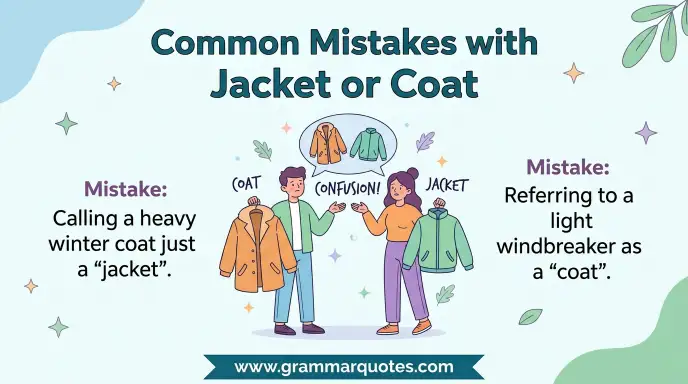
Mistake 1: Thinking Every Coat Is Long
Not every coat reaches the knees. Some modern coats are shorter.
Better idea: Think about the garment’s design and purpose, not only its length.
Mistake 2: Thinking Every Jacket Is Thin
Some jackets are heavily insulated and made for freezing weather.
Correct understanding: A jacket can be extremely warm.
Mistake 3: Using “Coat” and “Jacket” as Exact Synonyms
Although both are outerwear, they are not always interchangeable.
Coat: usually longer and offers more coverage.
Jacket: usually shorter and more flexible.
Mistake 4: Assuming One Word Is Always Correct
The right word depends on the specific garment.
For example:
- Leather jacket ✅
- Winter coat ✅
- Denim jacket ✅
- Long overcoat ✅
Coat or Jacket in Everyday Examples
Here are some natural examples:
Coat:
- I forgot my coat at home.
- This coat is perfect for winter.
- He bought a new wool coat.
- Take your coat; it is cold outside.
Jacket:
- I left my jacket in the car.
- She bought a new denim jacket.
- You should bring a jacket tonight.
- His leather jacket looks great.
Which is more common, coat or jacket?
Both words are very common, but their use depends on the type of clothing and the weather. Jacket is often used for shorter everyday outerwear, while coat commonly refers to longer or more protective garments.
Coat or Jacket : British English vs American English
The basic distinction is similar in both British and American English.
| Term | British English | American English |
| Coat | Common | Common |
| Jacket | Common | Common |
| Winter coat | Common | Common |
| Leather jacket | Common | Common |
| Raincoat | Common | Common |
| Overcoat | Common | Common |
There is no major spelling difference between coat and jacket in British and American English.
The main differences can come from regional clothing vocabulary and the specific type of garment being discussed.
Which One Should You Use: Coat or Jacket?
Use coat when you are talking about a longer outer garment, especially one designed for colder weather or greater coverage.
Use jacket when you are talking about a shorter outer garment, especially for casual wear, mild weather, or a specific style.
A simple rule is:
Longer and more protective → coat
Shorter and more flexible → jacket
But remember that this is a general rule, not an absolute definition.
Coat or Jacket : Google Trends and Usage Data
Search interest for coat and jacket can change depending on season, location, weather, and shopping trends.
People are more likely to search for terms such as winter coat, warm jacket, rain jacket, or leather jacket when they are looking for a specific type of clothing.
Seasonal searches can also increase during colder months. Fashion trends may influence searches for particular jacket or coat styles.
Because search interest changes over time and by country, it is better to compare specific terms and locations when using Google Trends rather than assuming one word is always more popular.
People Also Ask Questions About Coat or Jacket
1. Is a coat the same as a jacket?
No. Both are outerwear, but a coat is generally longer and offers more coverage than a jacket.
2. Which is warmer, a coat or a jacket?
A coat is often warmer, but not always. A heavily insulated jacket can be warmer than a lightweight coat.
3. Is a jacket considered a coat?
In a broad sense, a jacket can be considered outerwear like a coat. However, everyday English usually uses jacket for shorter garments and coat for longer ones.
4. Can I wear a jacket instead of a coat?
Yes. If the weather is not extremely cold, a jacket may provide enough warmth and flexibility.
5. Why are coats longer than jackets?
Longer coats provide more coverage and can help protect more of the body from cold, wind, or rain.
6. Is a winter jacket a coat?
A winter jacket is designed for cold weather, but it is usually still called a jacket because of its shorter design.
7. What is the difference between a coat and an overcoat?
An overcoat is a type of coat designed to be worn over other clothing. It is often longer and can be used with formal outfits.
8. Is a blazer a jacket or a coat?
A blazer is generally considered a type of jacket. It is usually smarter and more structured than a casual jacket.
9. Should I say “coat” or “jacket” for a leather garment?
Usually leather jacket is the natural phrase. A leather garment with a longer coat style design may be called a leather coat.
10. Is a puffer jacket a coat?
A puffer can be called a puffer jacket or puffer coat, depending on its length and design. Both terms are used.
Frequently Asked Questions
Is a coat better than a jacket?
Neither is always better. A coat may be better for colder weather and greater coverage, while a jacket can be better for everyday use and mild weather.
What is the simple difference between a coat and a jacket?
A coat is generally longer and provides more coverage. A jacket is generally shorter and more flexible.
Can a coat be short?
Yes. Clothing names do not always follow one strict length rule. Some coats are relatively short.
Can a jacket be long?
Yes. Some jackets have longer designs, so length alone cannot always determine the correct term.
Which is better for winter, a coat or jacket?
Both can work for winter. Choose based on insulation, material, weather protection, and how much coverage you need.
Is “coat or jacket” grammatically correct?
Yes. Coat or jacket is grammatically correct when you are asking someone to choose between the two types of clothing.
What should I wear in cold weather?
Choose clothing based on the actual temperature and conditions. A warm coat or insulated jacket can be useful in cold weather, especially when combined with suitable layers.
Coat or Jacket : Final Comparison
| Question | Coat | Jacket |
| Usually longer? | Yes | No |
| Usually warmer? | Often | Varies |
| Good for winter? | Yes | Yes, if insulated |
| Good for mild weather? | Sometimes | Yes |
| Formal option available? | Yes | Yes |
| Casual option available? | Yes | Yes |
| More coverage? | Usually | Usually less |
| Easy everyday wear? | Depends on style | Often |
Conclusion
The choice between coat or jacket mainly depends on the garment’s length, warmth, design, and purpose.
A coat is generally longer and provides more coverage, making it a common choice for cold weather and formal outerwear. A jacket is usually shorter and offers more flexibility for everyday wear, mild weather, fashion, and outdoor activities.
However, the difference is not absolute. A heavy winter jacket can be warmer than a lightweight coat, and some coats can be quite short. This is why the material and design are just as important as the name.
If you are talking about a long winter garment, coat is usually the natural word. If you mean a shorter outer layer such as a denim, leather, or bomber garment, jacket is usually correct.
In simple terms, remember: a coat is generally longer and more covering, while a jacket is generally shorter and more flexible.
Discover More Articles!
Dig or Die: Meaning, Usage & Examples(2026)
Absents or Absence: Meaning, Difference & Examples(2026)
Unbalanced or Imbalanced: Meaning, Differences & Examples

Ethan Parker is an English-language writer known for his interest in words, language, and clear communication. His work focuses on making everyday English easier to understand through simple explanations and practical examples.