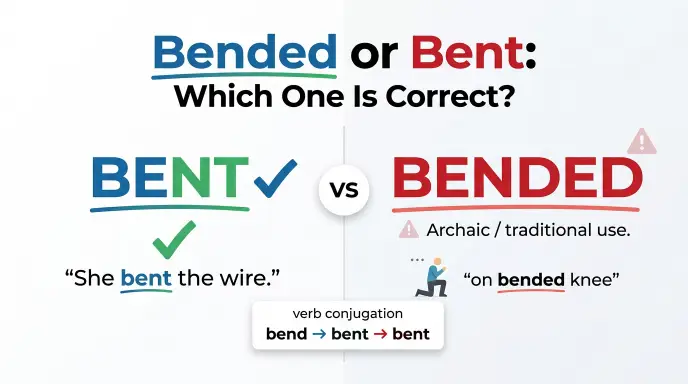
While both “bended” and “bent” originate from the verb bend, bent is the standard past tense and past participle used in modern English (e.g., “He bent the wire” or “a bent nail”).
Bended is an archaic form that is rarely used today, except in a few fixed historical expressions like “on bended knees.” For all everyday writing and spoken communication, bent is the correct and grammatically accepted choice.
Bended is not completely meaningless or impossible, but it is much less common. Modern dictionaries generally label it as archaic, while it survives in a few traditional expressions, most notably “on bended knee.”
This difference can be confusing because bended looks like the regular past tense form of bend. In fact, English has many irregular verbs, and bend follows the pattern bend → bent → bent.
In this guide, you will learn when to use bent, when bended may appear, how the two forms developed, and which version is best for everyday, academic, business, and professional writing.
Bended or Bent: The Quick Answer
Bent is the normal and preferred past tense and past participle of bend in modern English. Bended is an archaic or specialized form that mainly survives in fixed expressions such as “on bended knee.”
For example:
- Correct: She bent the metal bar.
- Correct: He bent down to pick up the keys.
- Correct: The tree was bent by the strong wind.
- Traditional expression: He asked for forgiveness on bended knee.
If you are writing normal modern English, choose “bent.”
Bended or Bent: Quick Answer
The simplest rule is:
Use “bent” for the past tense and past participle of “bend.” Use “bended” mainly in old fashioned or fixed expressions.
The verb bend means to curve, turn, or move something away from a straight position. Its standard forms are:
| Verb Form | Word | Example |
| Base form | bend | Please bend the wire. |
| Past tense | bent | She bent the wire. |
| Past participle | bent | The wire was bent. |
| Present participle | bending | He is bending the wire. |
Major dictionaries agree that bent is the standard past form. Cambridge gives the forms as bend, bent, bent, while Oxford likewise lists bent as both the past simple and past participle.
Examples with “bent”
- I bent my knees.
- She bent the paper in half.
- The branch was bent under the weight of the snow.
- He bent down to tie his shoe.
- The road bent sharply to the left.
What Does “Bended” or “Bent” Mean?
What does “bent” mean?
Bent is the past tense and past participle of bend. It can describe a physical change in shape, a movement of the body, or a change in direction.
For example:
- She bent her arm.
- The pipe was bent into a curve.
- He bent forward.
- The road bent around the hill.
Merriam Webster defines bend as changing something from a straight or even condition into a curved or angular form.
What does “bended” mean?
Bended is an older form of the past tense or past participle of bend. Merriam Webster specifically labels it as an archaic past tense of bend.
Today, it is rarely used as an ordinary past tense verb.
You may still encounter it in expressions such as:
- on bended knee
- on bended knees
- bended knees
For example:
He proposed on bended knee.
The phrase has a traditional or literary feel. In ordinary writing, however, you would normally say:
He bent down on one knee.
The Origin of “Bended” and “Bent”

The difference between these forms comes from the history of the English verb bend.
The verb bend is very old. Merriam Webster traces it to Middle English and Old English forms, with its first known use as a verb dating to before the 12th century.
Over time, English developed many irregular verb patterns. Instead of adding ed in the usual way, some verbs developed special past tense forms.
For example:
- bend → bent
- send → sent
- spend → spent
- lend → lent
Thus, bent became the normal modern form of bend.
The form bended continued in older English and eventually became restricted to particular uses. Modern dictionaries now describe it as archaic or associate it mainly with expressions such as “on bended knee.”
This is why bended may look grammatically logical but still sound unusual in modern English.
British English vs American English
There is no major British versus American spelling difference between bent and bended. Both varieties use bent as the normal past form.
| British English | American English | Example |
| bent | bent | She bent the wire. |
| bent | bent | He bent down. |
| bent | bent | The metal was bent. |
| bended, mainly traditional | bended, mainly traditional | on bended knee |
The key difference is not regional spelling. It is modern standard usage versus traditional usage.
Oxford lists bent as the past simple and past participle of bend. Collins also identifies bent as the past tense and past participle of bend, while treating bended as an archaic form in relevant dictionary entries.
What about “on bended knee”?
This is the main expression that can make bended seem more common than it really is.
The phrase “on bended knee” means being on one knee, often in a position of pleading, submission, or asking earnestly. Cambridge includes the expression in its entry for bend, and Merriam Webster also lists it under bended.
So you may see:
She begged him on bended knee.
But that does not mean bended is the normal past tense of bend.
Which Version Should You Use?
For almost all modern writing, use “bent.”
United States
Use bent in:
- School assignments
- Emails
- Business documents
- Websites
- News writing
- Reports
- Everyday conversation
Example:
The technician bent the cable during installation.
United Kingdom
The same basic rule applies in British English.
She bent down to pick up the book.
Use bended only when the traditional expression or a deliberately old fashioned style calls for it.
Canada
Canadian English also normally uses bent as the past form.
The frame was bent during transportation.
Australia
Australian English follows the same standard pattern:
He bent his knees before jumping.
International English
If you are writing for an international audience, bent is the safest choice.
It is immediately recognizable and follows the standard verb pattern found in major English dictionaries.
Academic Writing
Use bent.
Academic writing should normally favor modern, clear, standard English.
Instead of:
The researchers observed that the material bended under pressure.
Write:
The researchers observed that the material bent under pressure.
Business Writing
Use bent unless you are quoting a traditional phrase or historical source.
For example:
The metal support was bent during delivery.
This is clear and professional.
Common Mistakes With “Bended” and “Bent”
Mistake 1: Using “bended” as the normal past tense
Incorrect in standard modern usage:
She bended the wire yesterday.
Correct:
She bent the wire yesterday.
Why?
Bend is an irregular verb. Its past tense is bent, not normally bended.
Memory tip:
Think bend → bent → bent.
Mistake 2: Assuming every verb takes “ ed”
English verbs do not all form their past tense by simply adding ed.
Compare:
- walk → walked
- play → played
- bend → bent
- send → sent
- buy → bought
So the spelling pattern of bended may look natural, but the standard form is bent.
Mistake 3: Thinking “on bended knee” proves “bended” is always correct
The phrase “on bended knee” is a traditional expression.
That does not make bended the standard past tense.
Correct:
He bent down.
Also correct as a traditional expression:
He begged on bended knee.
The context matters.
Mistake 4: Using “bent” as if it always means physically curved
Bent has other meanings as an adjective.
For example:
She has a scientific bent.
Here, bent means a natural inclination, interest, or tendency. Merriam Webster lists this separate adjective sense alongside the physical meaning of bent.
Bended or Bent in Everyday Examples
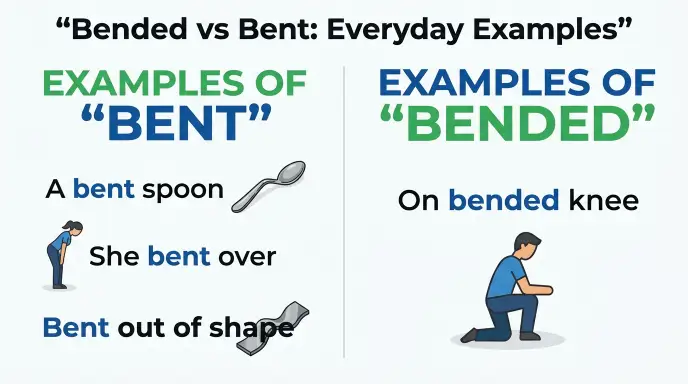
Seeing both forms in context makes the difference easier to remember.
Emails
I bent the document folder slightly, but the papers are still fine.
Business Writing
The inspection found that one of the metal panels was bent.
News Headlines
Strong Winds Bend Trees Along the Highway
For headlines, the base form can appear because headlines often use compressed grammar. If reporting a completed event in ordinary prose, bent is appropriate.
Blogs
I accidentally bent the frame while moving the furniture.
Social Media
I bent my phone stand and now it will not stay upright.
Academic Writing
The researchers found that the material bent when exposed to increased pressure.
Daily Conversation
I bent down to pick it up.
Traditional or Literary Writing
He pleaded on bended knee.
This last example has a more traditional tone than ordinary modern speech.
Google Trends & Modern Usage
Search interest around “bended or bent” is understandable because English learners often apply a regular ed pattern to irregular verbs.
The confusion is especially easy to understand when someone knows forms such as:
- fold → folded
- open → opened
- turn → turned
They may naturally assume:
bend → bended
But modern standard English uses:
bend → bent
Dictionary evidence supports this pattern. Oxford and Cambridge both list bent as the past tense and past participle of bend.
At the same time, people can encounter bended in books, songs, historical writing, religious language, or the expression “on bended knee.” That exposure can make the form appear more common than it actually is in everyday modern English.
There is no need to invent a regional rule here. Bended is not simply the British form while bent is the American form. Both British and American English normally use bent.
Quick Comparison Table
| Version | Meaning | Correct? | Region | Example |
| bent | Past tense of bend | Yes | Standard English | She bent the wire. |
| bent | Past participle of bend | Yes | Standard English | The wire was bent. |
| bended | Archaic past form | Limited | Historical/traditional | He knelt on bended knee. |
| bending | Present participle | Yes | Standard English | He is bending the pipe. |
| bend | Base form | Yes | Standard English | Please bend the wire. |
Key Takeaways
- Bent is the standard past tense of bend.
- Bent is also the standard past participle.
- Bended is an archaic or specialized form.
- Bended survives mainly in traditional expressions such as “on bended knee.”
- British and American English both normally use bent.
- Do not use bended simply because bend ends with a consonant and seems to take ed.
- For school, academic, business, and professional writing, choose bent.
- Remember the simple pattern: bend → bent → bent.
FAQs
Is “bended” a correct word?
Yes, bended is a real English word, but it is not the normal modern past tense of bend. Dictionaries describe it as archaic or associate it with traditional expressions such as “on bended knee.” For ordinary modern writing, use bent instead.
Is “bent” the past tense of “bend”?
Yes. Bent is both the past tense and past participle of bend. For example, you can say, “She bent the wire yesterday” and “The wire was bent during the process.” Oxford and Cambridge both list this verb pattern.
Is “bended” grammatically wrong?
Not always. Bended has a legitimate historical use and remains in certain fixed expressions. However, using it as the ordinary past tense of bend sounds incorrect or unnatural in modern standard English. In most situations, bent is the correct choice.
Why do people say “on bended knee”?
“On bended knee” is a traditional expression meaning to kneel while pleading, asking, or showing submission. The expression has preserved the older form bended, even though modern English normally uses bent as the past form of bend.
Is “bended” British English?
No. Bended is not simply a British alternative to American bent. British English normally uses bent as the past tense and past participle of bend, just as American English does. Bended is mainly archaic or traditional.
Should I write “I bended my knee” or “I bent my knee”?
Write “I bent my knee.” This follows the standard modern verb pattern bend → bent → bent. If you are using the traditional expression “on bended knee,” however, bended is retained as part of that established phrase.
Is “bended” ever used in modern English?
Yes, but it is uncommon as an ordinary verb form. It can appear in traditional, literary, historical, or poetic language and in expressions such as “on bended knee.” Modern writers should normally choose bent unless they have a specific reason to preserve the older style.
What is the past participle of “bend”?
The standard past participle is bent. For example: “The metal has bent under the pressure.” More commonly, when describing the resulting state, you may see: “The metal has been bent.”
What is the easiest way to remember “bend” and “bent”?
Remember the three main forms as a simple sequence:
bend → bent → bent
The first word is the base form. The second is the past tense. The third is the past participle. This pattern is similar to other irregular verbs such as send → sent → sent.
Conclusion
When choosing between bended or bent, the answer is usually simple: use bent. It is the standard modern past tense and past participle of bend. You can say, “She bent the wire,” “He bent down,” or “The frame was bent.” Major English dictionaries consistently support this usage.
Bended has not disappeared completely. It remains familiar in traditional language, especially in the expression “on bended knee.” It can also appear in older or deliberately literary writing. Merriam Webster labels bended as an archaic past tense, which explains why it can look correct while sounding unusual in everyday English.
For students, ESL learners, writers, and professionals, the safest rule is straightforward: bend → bent → bent.
Remember: “Bent” is the modern standard; “bended” is mainly traditional.
If you are unsure about a sentence, choose bent unless you are using a recognized expression such as “on bended knee.”
Discover More Articles!
Salem or Roofing: What Does It Mean?
GMT or UTC: What’s the Difference?
Of or For: Which Preposition Is Correct?

Ethan Parker is an English-language writer known for his interest in words, language, and clear communication. His work focuses on making everyday English easier to understand through simple explanations and practical examples.