Choosing between graduate or undergraduate can be confusing, especially if you are filling out a university application, writing a résumé, or trying to describe your education correctly. The two terms refer to different stages of higher education, so they are not interchangeable.
An undergraduate is usually a student working toward a first university degree, such as a bachelor’s degree.
A graduate can mean someone who has completed a degree, but in the US, “graduate student” often means a person studying beyond a bachelor’s degree, such as for a master’s or doctoral degree. Context matters.
This distinction becomes even more important because British and American English do not always use these terms in exactly the same way.
A university form may also ask if you are an undergraduate or graduate student, which can affect the application process, tuition category, or program type.
In this guide, you will learn the exact difference between graduate or undergraduate, how each term is used, common mistakes, regional differences, and which word to choose in everyday, academic, and professional writing.
Graduate or Undergraduate: The Quick Answer for Searchers
Undergraduate usually refers to a student studying for a first degree, such as a bachelor’s degree. Graduate can refer to someone who has completed a degree, while graduate student usually means someone pursuing an advanced degree after a bachelor’s degree. The exact meaning depends on context and region.
Graduate or Undergraduate: Quick Answer
The simplest distinction is based on educational level:
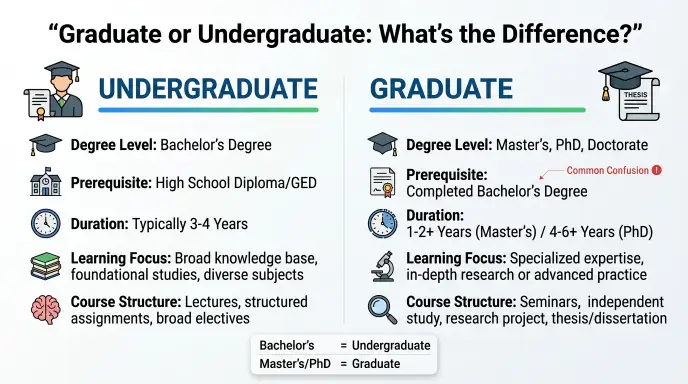
- Undergraduate student: Usually studying for a bachelor’s or first university degree.
- Graduate student: Usually studying for a master’s, doctoral, or other advanced degree.
- Graduate: A person who has completed and received a degree or diploma.
- Undergraduate degree: A degree earned before graduate level study.
- Graduate degree: An advanced degree earned after an undergraduate degree.
Examples
Sarah is an undergraduate studying biology.
James is a graduate student pursuing a master’s degree.
Maria is a graduate of the university.
A key point is that graduate has more than one meaning. It can describe a person who has completed a course of study, or it can describe advanced university study when used in phrases such as graduate school or graduate student.
What Does Graduate or Undergraduate Mean?
What Is an Undergraduate?
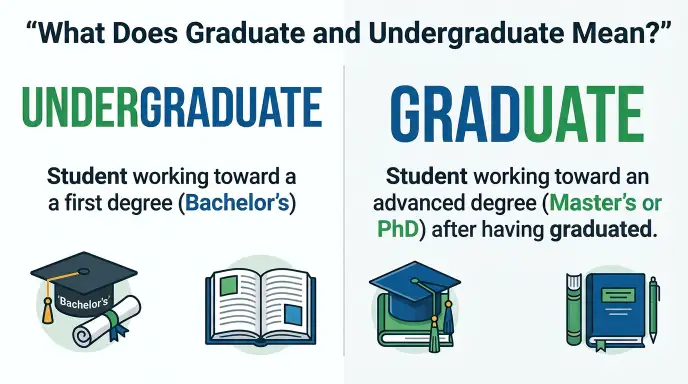
An undergraduate is generally a student who has not yet completed their first university level degree.
In the United States, undergraduate study commonly includes:
- Associate degrees
- Bachelor’s degrees
- Other first degree programs
For example:
David is an undergraduate student at a university.
This tells us that David is studying at the undergraduate level.
The word can also be used as a noun:
She is an undergraduate.
Or as an adjective:
She is taking an undergraduate course.
What Is a Graduate?
The word graduate is more complicated because it has two common meanings.
First, a graduate can be someone who has completed a degree or course:
Ahmed is a graduate of Harvard University.
Second, in American academic language, graduate can describe education that comes after undergraduate study:
Ahmed is enrolled in graduate school.
This is why graduate and undergraduate are not simple opposites in every sentence.
The more precise comparison is often:
undergraduate student vs graduate student
rather than simply:
undergraduate vs graduate
Graduate Student vs Graduate
These terms should not be confused.
| Term | Typical meaning |
| Undergraduate student | Student working toward a first university degree |
| Graduate student | Student pursuing an advanced degree |
| Graduate | Person who has completed a degree or program |
| Graduate school | Institution or division offering advanced degrees |
This distinction can prevent many common errors.
The Origin of Graduate or Undergraduate
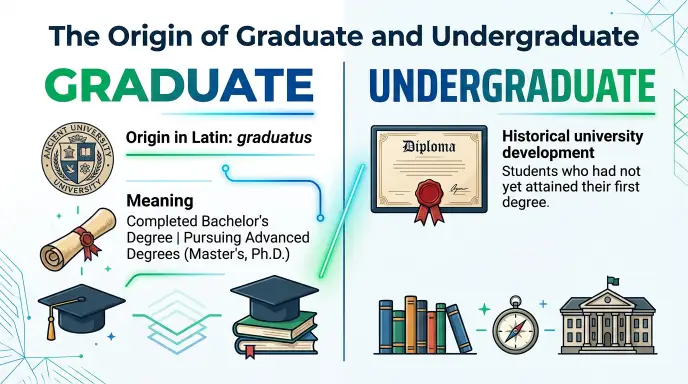
The word graduate comes from the Latin gradus, meaning “step” or “degree.” It developed into words connected with academic degrees and levels of education.
The word undergraduate combines under with graduate. Historically, it came to describe a student who had not yet reached the status of a graduate.
Over time, universities developed more specific terms for different stages of education. Today, undergraduate generally identifies first degree study, while graduate education usually refers to advanced study after a bachelor’s degree, especially in American English.
The meaning of graduate can therefore change depending on if it is being used as a noun, verb, or adjective.
For example:
- Noun: She is a graduate.
- Verb: She will graduate next year.
- Adjective: He is applying to graduate school.
Understanding the grammatical role helps you identify the intended meaning.
British English vs American English
The terms are broadly understood in both British and American English, but universities may use them differently.
| British English | American English | Example |
| Undergraduate | Undergraduate | She is an undergraduate student. |
| Postgraduate | Graduate | He is studying for a master’s degree. |
| Postgraduate student | Graduate student | She is a graduate student. |
| Graduate | Graduate | He is a university graduate. |
| Postgraduate degree | Graduate degree | She has a master’s degree. |
In British English, postgraduate is very common for study after a bachelor’s degree.
In American English, graduate is commonly used for advanced university study.
For example:
UK:
She is a postgraduate student.
US:
She is a graduate student.
Both can refer to someone studying for a master’s degree.
There are also differences in how universities name programs. British universities may use terms such as postgraduate taught and postgraduate research, while American institutions commonly use graduate programs.
Which Version Should You Use?
The best choice depends on your audience and what you actually mean.
United States
Use undergraduate for first degree study.
Use graduate student for someone pursuing a master’s or doctoral degree.
I am an undergraduate at UCLA.
I am a graduate student studying chemistry.
United Kingdom
Use undergraduate for first degree university study.
Use postgraduate for study after an undergraduate degree.
She is an undergraduate student.
He is a postgraduate student.
Canada
Canadian universities commonly use both undergraduate and graduate terminology.
For advanced university study, graduate student is widely understood.
Australia
Australian institutions commonly distinguish between undergraduate and postgraduate study.
If you are writing for an Australian university, check that institution’s preferred terminology.
International Writing
For a global audience, be precise.
Instead of writing:
I am a graduate student.
You can write:
I am studying for a master’s degree.
This removes regional ambiguity.
Academic Writing
Use the terminology preferred by your university or publication.
If the context is international, define the level clearly.
Business Writing
When discussing someone’s education, focus on the completed qualification when possible:
She holds a bachelor’s degree in economics.
This is often clearer than simply saying:
She is an undergraduate.
Common Mistakes with Graduate or Undergraduate
Mistake 1: Calling a master’s student an undergraduate
Incorrect:
James is an undergraduate student in a master’s program.
Correct:
James is a graduate student in a master’s program.
Why? A master’s program is normally graduate level study.
Memory tip:
Bachelor’s = undergraduate. Master’s/PhD = graduate or postgraduate.
Mistake 2: Assuming “graduate” always means current student
Incorrect assumption:
A graduate is always someone currently studying for a master’s degree.
Better understanding:
A graduate can be someone who has already completed a degree.
Context determines the meaning.
Mistake 3: Treating graduate and undergraduate as exact opposites
The terms are related, but graduate can describe either a completed degree or advanced study.
A clearer comparison is:
undergraduate student vs graduate student
Mistake 4: Using “postgraduate” in every English speaking country
Postgraduate is especially common in British, Australian, and related educational contexts.
American universities generally prefer graduate for advanced study.
Mistake 5: Saying “I am a graduate” when you mean “I am graduating”
Compare:
I am a graduate.
This normally means you have already completed your studies.
I am graduating this year.
This means you expect to complete your studies this year.
Graduate or Undergraduate in Everyday Examples
The right term changes with the situation.
Emails
Dear Professor,
I am an undergraduate student enrolled in your economics course.
For advanced study:
I am a graduate student working on my master’s thesis.
Business Writing
Our company is recruiting undergraduate students for summer internships.
Or:
The program is designed for recent university graduates.
News Headlines
University launches new undergraduate program.
Graduate students receive research funding.
Blogs
Choosing the right undergraduate major can affect your future career options.
Social Media
Excited to start my final year as an undergraduate!
Proud to begin my graduate studies this fall!
Academic Writing
The study surveyed undergraduate students from three universities.
The researchers interviewed graduate students about their research experiences.
Daily Conversation
Are you an undergraduate or a graduate student?
A more specific version is:
Are you studying for a bachelor’s, master’s, or doctoral degree?
That question avoids ambiguity.
Google Trends & Modern Usage
Searches for graduate or undergraduate are usually driven by practical questions about education terminology. People may encounter the terms on university websites, scholarship applications, job applications, admissions forms, or academic documents.
The confusion often comes from the multiple meanings of graduate.
Someone may search the phrase because they want to know:
- if a bachelor’s student is an undergraduate
- if a master’s student is a graduate student
- What “graduate” means on an application
- if “postgraduate” and “graduate” mean the same thing
- Which term to use in a résumé
- if the terminology changes between the UK and US
Modern usage also varies by institution. For this reason, when completing an official application, the safest approach is to follow the terminology used by that university.
Quick Comparison Table
| Version | Meaning | Correct? | Region | Example |
| Undergraduate | Student pursuing a first degree | Yes | International | She is an undergraduate. |
| Graduate student | Student pursuing advanced study | Yes | Mainly US/Canada | He is a graduate student. |
| Postgraduate student | Student pursuing advanced study | Yes | Mainly UK/Australia | She is a postgraduate student. |
| Graduate | Person who completed a degree | Yes | International | He is a university graduate. |
| Undergraduate degree | First university level degree | Yes | International | She earned an undergraduate degree. |
| Graduate degree | Advanced degree | Yes | Mainly US/Canada | He earned a graduate degree. |
Key Takeaways
- Undergraduate usually means a student working toward a first university degree.
- A graduate student usually studies beyond the bachelor’s level.
- Graduate can also mean someone who has already completed a degree.
- Postgraduate is especially common in British and Australian English.
- American universities commonly use graduate student for master’s and doctoral students.
- Undergraduate and graduate are not always exact opposites.
- For maximum clarity, name the actual degree when the context allows it.
FAQs
1). What is the difference between undergraduate, graduate, and postgraduate degrees?
An undergraduate degree (like a Bachelor’s) is your first college-level qualification earned after high school. A graduate degree (like a Master’s or PhD) requires an completed undergraduate degree as a prerequisite for advanced study. Postgraduate is often used interchangeably with graduate studies, though in some academic systems it specifically refers to degrees or certificates pursued after completing a Master’s or doctorate.
2). Undergraduate vs graduate vs postgraduate: Which academic level comes first?
The educational sequence starts with undergraduate studies (Associate or Bachelor’s degrees). After graduating, students can move on to graduate programs (Master’s or professional degrees). Finally, postgraduate work encompasses advanced research degrees like PhDs, post-doctoral fellowships, or specialized graduate certificates.
3). What is the literal meaning of an undergraduate degree?
The term undergraduate refers to a university student who has not yet earned a first university degree. An undergraduate program provides foundational knowledge, core curriculum requirements, and professional preparation in a chosen major field.
4). Is an MBBS considered a graduate or undergraduate degree?
In most international education systems (including the UK, India, and Pakistan), an MBBS is an undergraduate medical degree entered directly after secondary school. However, in the US and Canada, equivalent medical degrees (MDs) are completed at the graduate level after earning a foundational Bachelor’s degree.
5). Graduate or undergraduate: Which is better for career growth?
Neither is inherently better; they serve different career stages. An undergraduate degree builds foundational knowledge and opens entry-level professional career paths. A graduate degree provides specialized expertise, leading to higher earning potential, leadership roles, or specialized research positions.
6). How do admission requirements differ between undergraduate and graduate programs?
Undergraduate admissions rely on high school transcripts, standardized tests (like the SAT/ACT), and general extracurriculars. Graduate programs require a completed Bachelor’s degree, competitive GPA, professional recommendations, research proposals, or specialized exam scores (such as the GRE, GMAT, or MCAT).
7). What is the difference between “under graduate” and “undergraduate”?
“Undergraduate” is written as a single word when referring to college students or Bachelor’s programs. Writing it as two words (“under graduate”) is simply a common spelling variation or typo; both refer to the same level of post-secondary education.
8). How long does it take to complete undergraduate, graduate, and postgraduate degrees?
An undergraduate Bachelor’s degree typically takes 3 to 4 years of full-time study. A graduate Master’s degree takes 1 to 2 years, while a postgraduate doctoral program (PhD) generally requires 3 to 6 years of advanced research and coursework.
Conclusion
The difference between graduate or undergraduate becomes simple once you focus on the student’s level of education. An undergraduate is generally studying for a first university degree, most often a bachelor’s degree. A graduate student is usually studying beyond that level, such as for a master’s or doctoral degree.
The word graduate, however, has another important meaning. It can describe someone who has already completed a degree. This is why “graduate” should not automatically be treated as the direct opposite of “undergraduate.”
Regional usage matters too. American English commonly uses graduate student, while British and Australian English often use postgraduate student. When writing for an international audience, naming the actual degree, such as “master’s student” or “bachelor’s student,” can make your meaning crystal clear.
The best rule is simple: bachelor’s level study is undergraduate; advanced study is graduate or postgraduate. When in doubt, describe the exact degree level.
Discover More Articles!
WAV or FLAC: Which Audio Format Is Better for Music Production?
Understanding the Difference Between Lynx and Linx(2026)
Daddy’s vs Daddies: Meaning, Plural, and Usage

Ethan Parker is an English-language writer known for his interest in words, language, and clear communication. His work focuses on making everyday English easier to understand through simple explanations and practical examples.