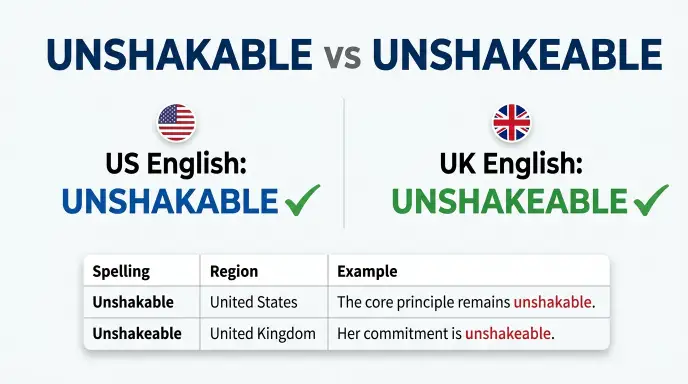
Unshakable or Unshakeable: Which spelling is correct? Both forms are accepted in English, but their usage can vary between American and British English. Learn the meaning, regional difference, and which spelling is best for your writing.
Both words are adjectives meaning something that cannot be weakened, changed, or destroyed, especially a belief, feeling, confidence, or attitude. Oxford also recognizes unshakeable as an alternative form of unshakable.
This small spelling difference can cause confusion because American English often prefers shorter forms ending in able, while British English sometimes keeps the extra e. If you are writing for a specific country, matching its usual spelling is the safest choice. Let’s look at the difference in detail.
Unshakable or Unshakeable: The Quick Answer
Unshakable and unshakeable are both correct spellings of the same adjective. Unshakable is mainly the American English spelling, while unshakeable is mainly the British English spelling.
Examples:
- US: She has unshakable confidence in her abilities.
- UK: She has unshakeable confidence in her abilities.
- Both: Their unshakable/unshakeable belief never changed.
There is no difference in meaning or pronunciation. The choice is mostly a matter of regional spelling and editorial style. Cambridge gives the same definition for both forms.
Unshakable or Unshakeable: Quick Answer
If you need one simple rule:
- Unshakable = preferred in American English.
- Unshakeable = preferred in British English.
- Both = correct English.
- Meaning = firm, unwavering, or impossible to weaken or change.
- Pronunciation = essentially the same.
For an American audience, use unshakable. For a British audience, unshakeable is usually the better choice. For international writing, either is acceptable, but consistency matters.
What Does Unshakable or Unshakeable Mean?
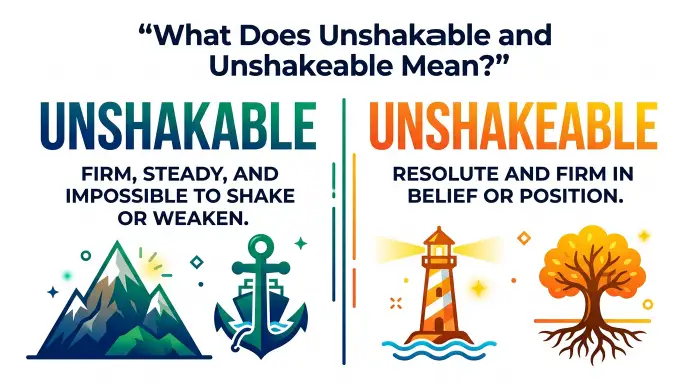
Unshakable and unshakeable describe something that is extremely firm and cannot easily be changed, weakened, or destroyed.
The word is commonly used for things such as:
- beliefs
- confidence
- trust
- loyalty
- faith
- determination
- commitment
- convictions
- opinions
For example:
She has an unshakable belief in herself.
This means her belief is so strong that other people or difficult situations are unlikely to make her lose it.
Cambridge defines the word in terms of a trust or belief that is firm and cannot be made weaker or destroyed. Oxford similarly describes it as a feeling or attitude that cannot be changed or destroyed.
Unshakable vs. Unshaken
Do not confuse unshakable with unshaken.
Unshakable means something cannot easily be shaken or changed:
He has unshakable confidence.
Unshaken describes someone or something that has remained unaffected after an event:
She remained unshaken by the criticism.
The first describes a quality. The second describes a state or condition.
The Origin of Unshakable or Unshakeable
The word is formed from the verb shake with the prefix un and the adjective forming ending able.
The basic structure is:
un + shake + able = unshakable
The prefix un gives the word a negative sense, while able expresses possibility or capability. So, in a literal sense, unshakable means something that cannot be shaken.
The spelling unshakeable keeps an additional e before able:
un + shake + able = unshakeable
English spelling does not always apply one simple rule to words ending in able. Different spelling traditions developed over time, and British and American English sometimes settled on different forms.
Modern dictionaries recognize both forms. Oxford lists unshakable as the main entry and identifies unshakeable as an alternative.
So, there is no need to treat one spelling as a misspelling simply because it looks unfamiliar.
British English vs American English
The clearest distinction is regional.
| Feature | British English | American English | Example |
| Common spelling | unshakeable | unshakable | unshakeable/unshakable belief |
| Meaning | Same | Same | A firm belief |
| Pronunciation | Same | Same | /ʌnˈʃeɪkəbəl/ |
| Status | Correct | Correct | Both are standard |
| Best for local audiences | UK spelling | US spelling | Match your audience |
Cambridge identifies unshakeable as mainly UK and unshakable as mainly US.
Oxford is slightly broader in its treatment. It lists unshakable and notes unshakeable as an alternative, showing that both forms are established in English.
What About Canada and Australia?
English speaking countries outside the US and UK can use either spelling, depending on local publishing conventions, the organization, and the style guide being followed.
For Canadian or Australian writing, the safest approach is to check the publication’s established spelling preferences. If you are editing a document, do not switch between unshakable and unshakeable without a reason.
Consistency is more important than trying to force one spelling across every English speaking country.
Which Version Should You Use?
United States
Use unshakable.
She showed unshakable confidence during the interview.
This matches the spelling identified by Cambridge as the usual US form.
United Kingdom
Use unshakeable in most British English contexts.
He has an unshakeable belief in the team’s ability to succeed.
Cambridge identifies unshakeable as mainly UK.
Canada
Either form may appear, so follow the style guide or publication standard you are using. If no house style exists, choose one spelling and use it consistently.
Australia
As with other varieties of English, local editorial preferences matter. If you are writing for an Australian publication, check its preferred dictionary or style guide.
International Writing
For a global audience, unshakable may be easier for readers familiar with American English, but unshakeable is also completely understandable and correct.
The most important point is consistency.
Academic Writing
Follow the style guide required by your school, university, journal, or publisher.
Do not change spelling simply because one version looks more familiar. If your paper uses British English, use unshakeable. If it uses American English, use unshakable.
Business Writing
Match the variety of English used by your company and audience.
For a US company:
Our commitment to quality remains unshakable.
For a UK company:
Our commitment to quality remains unshakeable.
Common Mistakes
Mistake 1: Assuming One Spelling Is Wrong
Incorrect assumption:
“Unshakeable is misspelled because unshakable is the correct version.”
Correct:
Both are standard spellings.
Why?
They represent regional spelling preferences.
Memory tip:
US = unshakable; UK = unshakeable.
Mistake 2: Mixing Both Forms in One Document
You might write:
Our unshakable commitment is matched by our unshakeable confidence.
This is not grammatically wrong, but it can look inconsistent if both words are being used with the same spelling convention.
Better:
Our unshakable commitment is matched by our unshakable confidence.
Or, in British English:
Our unshakeable commitment is matched by our unshakeable confidence.
Mistake 3: Using It to Mean Physically Indestructible
Unshakable usually describes firmness of belief, attitude, confidence, or commitment.
She has unshakable confidence.
If you mean that an object cannot physically break, unbreakable is usually the appropriate word.
The container is unbreakable.
Cambridge defines unbreakable as something that is impossible to break.
Mistake 4: Confusing It With “Unshaken”
His confidence was unshakable.
This means his confidence could not easily be weakened.
His confidence remained unshaken.
This means his confidence was not affected by what happened.
Unshakable or Unshakeable in Everyday Examples
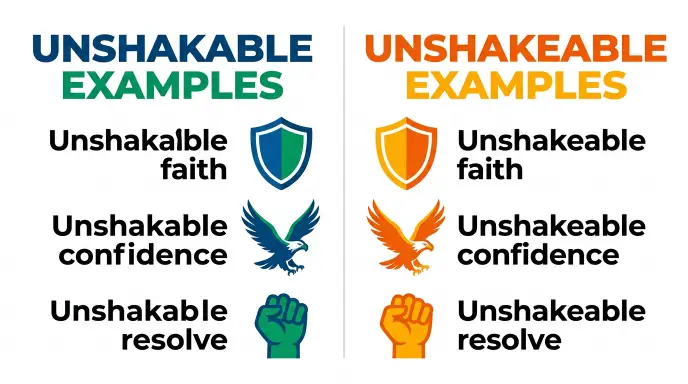
The word is common in formal and everyday English.
Emails
Thank you for your unshakable support during this project.
Business Writing
The company remains unshakable in its commitment to customer service.
News Headlines
Coach Shows Unshakable Confidence Ahead of Final
Headlines may favor the shorter unshakable form, especially in American publications, but usage depends on the publication.
Blogs
Building unshakable confidence takes time and practice.
Social Media
Stay focused. Keep your unshakable confidence.
Academic Writing
The study examines the author’s unshakable belief in social reform.
Daily Conversation
She has an unshakable belief that everything will work out.
More Natural Collocations
Some common combinations include:
- unshakable confidence
- unshakable belief
- unshakable faith
- unshakable loyalty
- unshakable commitment
- unshakable conviction
- unshakable determination
Oxford specifically gives examples involving loyalty, confidence, belief, and conviction.
Google Trends & Modern Usage
People often search “unshakable or unshakeable” because the two spellings look almost identical. Unlike many spelling questions, this one does not have a simple right versus wrong answer.
Modern dictionary evidence shows a clear regional pattern. Cambridge labels unshakable as mainly US and unshakeable as mainly UK.
Oxford also recognizes both forms, listing unshakeable as an alternative to unshakable.
That means a writer may encounter either spelling online, in books, or in professional publications.
Search interest is also likely driven by the fact that the extra e is easy to overlook. Writers may see unshakable in American content and unshakeable in British content and wonder if one is an error.
The practical answer is simple: check your audience, follow the appropriate style, and remain consistent.
Quick Comparison Table
| Version | Meaning | Correct? | Region | Example |
| Unshakable | Firm and not easily changed | Yes | Mainly US | Unshakable confidence |
| Unshakeable | Firm and not easily changed | Yes | Mainly UK | Unshakeable confidence |
| Unshaken | Not affected or disturbed | Yes | International | Her confidence remained unshaken |
| Unbreakable | Impossible to break | Yes | International | An unbreakable bond |
The first two forms have the same core meaning. Unshaken and unbreakable are related but are not interchangeable in every sentence.
Key Takeaways
- Unshakable and unshakeable are both correct.
- Unshakable is the usual American English spelling.
- Unshakeable is the usual British English spelling.
- Both forms have the same meaning.
- The pronunciation is essentially the same.
- Use unshakable for a US audience.
- Use unshakeable for a British audience.
- Follow the required style guide in academic and professional writing.
- Do not confuse unshakable with unshaken or unbreakable.
- Most importantly, stay consistent throughout your writing.
FAQs
1. Unshakable or unshakeable meaning: What is the difference and definition?
Both spellings are correct. Unshakable (American English) and unshakeable (British English) share the exact same meaning: strongly felt or believed, and impossible to weaken or destroy. It is commonly used to describe firm faith, trust, or determination.
2. What is the Unshakable or unshakeable Oxford Dictionary definition?
According to the Oxford Dictionary, unshakable (or unshakeable) is defined as an adjective meaning “not able to be shaken, weakened, or destroyed.” It usually refers to deep-seated beliefs, confidence, or positions.
3. What are the best synonyms for Unshakable or unshakeable?
The most accurate synonyms include:
- Steadfast
- Unwavering
- Firm
- Resolute
- Unyielding
4. What does an Unshakable person mean?
An unshakable person is someone who remains calm, confident, and determined even during difficult situations, stress, or criticism. They stay true to their values and do not easily lose composure or confidence.
5. How do you pronounce Unshakable?
The correct pronunciation is /ʌnˈʃeɪ.kə.bəl/ (phonetically written as uh-SHAY-kuh-buhl).
6. What does an Unshakable vibe mean?
In modern slang, an unshakable vibe refers to an aura or attitude of deep self-assurance and composure. Someone with an unshakable vibe stays relaxed, unaffected by outside judgment or chaos around them.
7. How do you say Unshakable in French?
In French, unshakable translates to “inébranlable”. For example, “an unshakable faith” is written as “une foi inébranlable”.
Conclusion
So, unshakable or unshakeable? The answer is that both are correct. The difference is mainly regional rather than grammatical or semantic. American English generally uses unshakable, while British English generally uses unshakeable. Cambridge and Oxford both support this distinction.
Both forms describe something firm that cannot easily be changed, weakened, or destroyed. They are especially common with words such as confidence, belief, faith, loyalty, commitment, and conviction.
If you are writing for readers in the United States, unshakable is the natural choice. If your audience is in the United Kingdom, unshakeable will usually fit better. For Canadian, Australian, or international writing, follow the relevant house style or dictionary preference.
The most important rule is simple: choose the spelling that matches your audience and use it consistently.
Remember: unshakable and unshakeable mean the same thing, but your audience can determine which spelling looks right.
Discover More Articles!
Calm vs Headspace: Which App Should You Choose?(2026)
Intercom vs. Zendesk: Full Features, Pricing, and AI Comparison
Graduate or Undergraduate: What’s the Difference?

Ethan Parker is an English-language writer known for his interest in words, language, and clear communication. His work focuses on making everyday English easier to understand through simple explanations and practical examples.